Utah Issues
Utah 4th Congressional District 2026 General Election Debate
Special | 56m 15sVideo has Closed Captions
Candidates for Utah's 4th Congressional District in the 2026 General Election debate the issues.
The candidates running to represent Utah's 4th Congressional District in the 2026 General Election answer questions about the issues facing Utah and the country. Candidates include Republican Mike Kennedy and Democrat Jonny Larsen. The debate is moderated by Doug Wilks, Executive Editor of the Deseret News.
Problems playing video? | Closed Captioning Feedback
Problems playing video? | Closed Captioning Feedback
Utah Issues is a local public television program presented by PBS Utah
Utah Issues
Utah 4th Congressional District 2026 General Election Debate
Special | 56m 15sVideo has Closed Captions
The candidates running to represent Utah's 4th Congressional District in the 2026 General Election answer questions about the issues facing Utah and the country. Candidates include Republican Mike Kennedy and Democrat Jonny Larsen. The debate is moderated by Doug Wilks, Executive Editor of the Deseret News.
Problems playing video? | Closed Captioning Feedback
Where to Watch Utah Issues
Utah Issues is available to stream on pbs.org and the PBS app.
More from This Collection
Candidates debate in the races for Utah's four congressional districts. Presented by PBS Utah in partnership with the Utah Debate Commission.
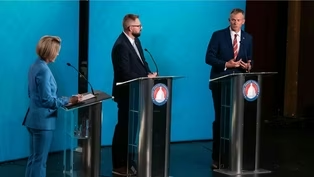
Utah 2nd Congressional District 2026 General Election Debate
Video has Closed Captions
Candidates for Utah's 2nd Congressional District in the 2026 General Election debate the issues. (56m 21s)
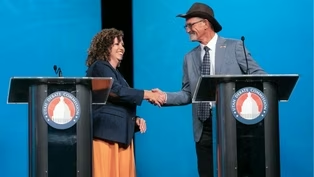
Utah 3rd Congressional District 2026 General Election Debate
Video has Closed Captions
Candidates for Utah's 3rd Congressional District in the 2026 General Election debate the issues. (56m 15s)
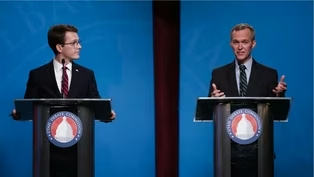
Utah 1st Congressional District 2026 General Election Debate
Video has Closed Captions
Candidates for Utah's 1st Congressional District in the 2026 General Election debate the issues. (56m 14s)
Providing Support for PBS.org
Learn Moreabout PBS online sponsorship- [Announcer] From the campus of Snow College in Ephraim, the Utah Debate Commission welcomes you to the general election debate for Utah's fourth congressional district.
(gentle music) - Welcome, my name is Doug Wilks, and I'm the moderator tonight for this important debate with the debate commission.
We thank you for joining us.
(audience applauds) Today, we'll hear from two candidates who qualified for this debate in the race to represent Utah's fourth congressional district.
The candidates are Republican Mike Kennedy and Democrat Jonny Larsen.
We look forward to an engaging and civil discussion with the goal of helping Utah voters make informed decisions.
Candidates will each receive one minute to answer questions with up to a 30-second rebuttal if needed at my discretion.
A coin toss was held prior to the debate that determined the order in which opening statements and closing statements would be done.
Candidate Larsen will get the initial opening statement and then we will alternate turns on questions following Mr.
Kennedy's opening statement.
Now, let us begin with the opening statement for Mr.
Larsen.
- Good evening, and first I'd like to express my gratitude to the debate commission, my amazing volunteer team, and to the ASL interpreter.
My name is Jonny Larsen.
I'm a Blue Dog Democrat and United States Marine Combat veteran.
I was in DC and witnessed the attack on the Pentagon, was an honor guard for 9/11 at the ground zero.
I did two tours to Iraq.
My battalion tore down Saddam's statue, and I went back again and fought in the Battle of Husaybah, which was during the first Fallujah battle, but I'm also from Utah, and I say mountain just like everyone else.
I grew up in a trailer park.
We ripped out food stamps to pay for groceries.
I even went through Utah's foster care system, and my grandma rescued me.
And she was afforded this opportunity because of her social security and her union pension from the Teamsters.
I am here today to help represent the people of Utah.
Thank you very much for having me.
- [Doug] Thank you, Mr.
Kennedy.
- Thank you for having me tonight.
Good evening, my name is Mike Kennedy.
I've served as a family doctor, I've served as an attorney, I've served as a state legislator, and now as your Congressman.
It's my privilege to be here tonight at Snow College, and thank you President McIff and Snow College for hosting us tonight.
I not only applaud you for your outstanding educational quality that you do here at Snow College, but also for the fact that you have the lowest tuition here in this state.
I recognize that our country faces serious problems, but I believe that every generation has a responsibility to leave this country stronger than we found it.
As a physician, I learned to diagnose the problem, tell the truth and works to fix it.
As an attorney, I learned to advocate for those that I represent.
As a small business owner, I learned that decisions have consequences and that you can't spend more than you take in.
I bring those lessons with me to Washington DC where I'm seeking to reign in bureaucracy, reduce costs, and bring home real results for the state of Utah.
I don't just think about you when you vote.
I think about you when I vote, and I'm just getting started making Washington smaller and Utah stronger.
Thank you.
- Thank you both.
Let us get to our first question, and we'll start with you, Mr.
Kennedy.
We're gonna talk about a few issues related to the economy and the cost of living.
People in Utah have told us that they are hurting.
Gas prices are high, other cost of living expenses are increasing, and Utah continues to experience rapid population growth, which is both a very strong positive, but also faces challenges.
Let's talk first about gas prices.
What would you do to help bring down gas prices, if anything?
Can the federal government do anything, Mr.
Kennedy?
- I'm proud of the work that we've done in the Republican conference as well as with President Trump to work on our economy.
And I know that our families are challenged by the current economic conditions.
And I, along with many others, fill up the tank just like you and recognize how difficult it is.
I recognize also the fact that we have an Iranian regime that chants "death to America" on a regular basis, that this regime, this despotic regime, if they were to get access to nuclear weapons, and now we've learned since this attack on Iran that they have ballistic missiles that can reach 2,500 miles, that if this despotic regime were to get nuclear weapons, that it would not only be a threat to the United States of America, but to the whole world.
And so I support President Trump as he seeks to bring safety, not only to the American people, but also to the world, but what are we working on to help those gas prices go down?
I definitely am working on that.
The License to Drill Act has passed the House that I sponsored, the Senate, as well as it's on the president's desk to be signed.
This is going to reduce costs for gas, and I'm proud of the fact that I was able to pass that through the House of Representatives and also the Senate and get it to the president's desk.
- [Doug] Mr.
Larsen, gas prices?
- The immediate thing that we can do right now is end this illegal war.
My opponent over here voted against the War Powers Resolution Act six times.
He had an interview back in April with KSVC where he actually stated that he didn't want forever wars, yet his vote does not represent that.
As a veteran myself who did two tours in combat, I understand that cost and that price that we pay with American blood.
We were told last year the Iranian regime did not have nuclear weapons because we had destroyed the building to do so.
And yet here we are, yet again, in a forever war, well beyond the 60 days and the 30 days that the current war powers provides.
We absolutely need to end this illegal war to bring order back so that the price of barrel comes down.
- Mr.
Kennedy, you have 30-second rebuttal to that?
- To tie the president's hands in the middle of a national security crisis is not the right thing for us to do, which is why I support President Trump and continuing to move forward.
I believe this war will be resolved in a quick fashion after this election.
Right now, Iran is playing with our politics and they actually want people like my opponent to win this race so that they can actually be empowered to continue to threaten America as well as the world.
I wanna see this war end as fast as possible and I along with my team are working to see that termination of the war, and you can bet that we pass that message on to the president as well as his administration, but in the meantime, in the middle of a conflict like this, for us to walk away is not a smart move.
- Okay, Mr.
Larsen, let's follow up on that.
The follow-up question is about the war in Iraq, so you can respond specifically, or Iran, excuse me.
What role should Congress play at this point?
- Congress's duty, Article 1, Section 8, gives us the power to declare war.
The president currently has the power to declare war under an emergency for 60 days to bring our troops home within 30.
My opponent gave that constitutional duty up.
Our young, brave, young men and women sending the sons and daughters of families that he will never meet when he himself wouldn't go, he wouldn't send his children or his grandchildren to fight in this war.
It's reprehensible.
And every time these families go to fill up at the pump, they pay for it.
They are reminded every time they pay that high gas.
They have no idea if their son or daughter are gonna make it home alive, and we have lost 19 of our American, brave young men and women, and it's absolute shame.
- [Doug] Mr.
Kennedy, the war has been going on for the period of time it has.
What should Congress do now?
- The religious zealotry of this regime in Iran that chants death to America on a regular basis and for decades has threatened the United States of America and the world needed to be dealt with.
As a doctor, I recognize how devastating cancer can be.
And when I find cancer in my medical practice, I wanna cut it out.
I wanna chemotherapy and radiate it as fast as possible.
I want it out of a person's body and I want it out of the body politic.
The Iranian people are good people, but they are ruled in a despotic fashion, ruining not only them, but also the whole world.
They have to be dealt with, and I recognize that there's pain in the short run, but there will be significant gain in the long run.
In the meantime, the patience of the American people is something that we all hope that we can continue to see the support of, because this is something that should have been dealt with decades ago, but at this point, President Trump is trying to move forward and help not only the United States of America, but also the whole world.
- Let's move on to another economic issue.
We're pleased tonight to have Will Cheshire, a freshman at Snow College here.
Will, you have a question for the candidates?
- Yes, thank you.
As a college student in Utah, myself and others are worried that by the time we graduate and start our careers, that owning a home will feel out of reach.
So what is a specific federal policy that you would support to help make home ownership more attainable for young Utahans, and how would this policy lower the cost of housing rather than only helping people afford today's high price of homes?
- [Doug] Mr.
Kennedy.
- We passed off the House floor and off the Senate floor the 21st Century Road to Housing Act.
And in that act, that forbade institutional investors like BlackRock from buying up large tracts of single occupant, single owner, single owned homes, which is a massive step in the right direction.
In addition, last year we passed the Working Families Tax Code Act, which no tax on tips, no tax on overtime, no tax on social security for our senior citizens.
This is empowering 97% of American citizens to receive more money in their pocket, which is exactly where it should be, so that they can go build their business and buy the homes that they want to buy.
We are working hard to get the federal bureaucracy out of the way and allow people the opportunity to live the lives in America that our constitutional framers found that was the best way to approach this.
And I'm gonna continue to work to make Washington smaller and Utah stronger.
- [Doug] Mr.
Larsen, housing.
- To make our homes more affordable, we need to stop these egregious tariffs that we have placed on every other country.
They do not help the situation at all.
And the other thing that we can actually do is work with our unions and our labor members, get with them, find out what things that we can cut.
We need to move forward and work together so that we can actually make these homes more affordable.
We can work with our neighbors when it comes to logging, we can bring that in, and when we work at a local level and we do the right thing without just stripping out our forests so that we can make the lumber that we need to build homes, we bring jobs to America and we make homes more affordable again.
- Okay, Mr.
Kennedy, do you have any response?
- As a state legislator for 10 years, I was proud to work with the governor as well as state senate president, as well as the speaker of the house to work on this compelling issue.
This is a primarily state-based issue, and I'm proud of the work that the state has done to open tracts of land and also to expand the housing opportunities for individuals such as our student that just asked this question.
I have eight children and I want them to live in Utah if they wanna live in Utah.
It is extremely expensive and it's a problem that we confront because so many people wanna live here.
They are fleeing some of the blue states that my opponent represents, California, Illinois, and New York, to come to places like Utah where we have sensible policies, and we're definitely confronted by that good problem where these people are fleeing the nonsense policies of the Democrats.
Welcome to our state and we are working on a state and federal level to make sure you have access to cost-effective housing.
- Let's keep an eye on time.
Will, did you hear your answer?
- Yes, thank you.
- Great, you ready to buy a house?
You ready to buy a house?
- Yes.
- All right.
See Will if you need a loan.
Thank you, Will.
Another important point, and it's one dear to both of you, is the cost of healthcare.
You both obviously have a strong interest in healthcare and in childcare, Mr.
Kennedy, certainly as a doctor, Mr.
Larsen, part of your campaign, part of your work, and certainly as a cancer survivor, as you spoke.
What federal changes would you support to reduce healthcare costs while maintaining access to care in rural Utah?
And I believe it's to you, Mr.
Larsen.
- Healthcare is extremely important to every American.
I am very lucky to be afforded the opportunity to have the VA healthcare system where they treated my cancer.
I had an $80,000 surgery that I didn't have to pay for.
And the VA healthcare system may not be perfect, but I'll tell you what, it's better than what most everyone else has right now.
And while I may have been a guinea pig for that system, I know it's something that we can bring to every American to make sure that they have the same kind of healthcare at a lower cost.
Something that happened at the beginning of this year, actually slightly before that, they were trying to pass the ACA healthcare subsidies, and that would have lowered your costs of healthcare and kept it somewhere between 300 and $500 a month.
Yet right now, most people are paying 1,000s of dollars a month and one in eight in Millard and San Pete can't even afford their healthcare.
- [Doug] Mr.
Kennedy.
- In 2010, when Obamacare passed, we saw some of the worst mistruths quoted and foisted on American society that I may have ever seen in my adult life.
We were told when Obamacare passed 16 years ago, "If you like your doctor, keep your doctor and every family's gonna save 1,000s of dollars."
The party that my opponent represents was the one that foisted this nonsense on society, a bill that was written by insurance companies for insurance companies.
And what have we seen in the past 16 years?
We've seen nothing but cost increase.
We've seen the consolidation of healthcare.
We've seen private physician practices like the one that I am a current partner with, we've seen them consumed by large institutional investors.
This is the reason why costs are going up, is because Washington DC got even more involved than they've ever been.
I believe in telehealth.
I believe that there are ways to allow our economy to deal with this in the form of transparency.
I believe that doctor's offices as well as hospitals should post their prices.
I'm a big fan of HSAs as well.
Bring the consumer back into the healthcare debate and you will find the costs will go down.
- Thank you, Mr.
Larsen, you have 30-second response?
- Yes, so Representative Kennedy, we are still waiting for the Republican healthcare plan that they said that they were gonna provide within two weeks decades ago.
Costs are going up because the Republican Party and Congress, they've just continued to attack the Affordable Care Act.
This has led to the increase in your cost for healthcare.
This is an absolute disgusting shame and they should be ashamed of theirselves.
- Mr.
Kennedy, because of the response, I can give you a 30-second response and then we'll move on.
- Primary care is the answer.
I'm a big fan of preventative care.
I've been doing it for 25 years, and primary care in the form of cheap and easy access to mammograms as well as colon cancer screening tests, these are the ways that we can reduce costs as well.
We've worked to unfetter doctor's offices so that they're not on the phone for hours every day with insurance companies fighting for prior authorization for medicines that I and my colleagues are prescribing, fighting to get tests covered like MRIs and CAT scans.
What is going on right now in healthcare is a problem that was created by Washington DC.
And less Washington DC in healthcare, you will find costs are gonna go down and frankly, quality will go up.
- It's time.
Okay, as we've started this, we've talked about gas prices and talked a little bit about war and some of those causes.
We talked about housing.
The Kem C. Gardner Institute reports that 250,000 units are gonna be needed by 2035, and now we've talked about healthcare for a time.
So my question to you both, is the American dream actually out of reach for some Utahans?
And that goes to Mr.
Kennedy.
- The American Dream is not out of reach for Utahans or for the United States of America.
I'm proud in this case to pull out a photo that my, it's part of my family heritage.
This is a photo of my immigrant father who was naturalized by Ronald Reagan, who my father sent Ronald Reagan a thank you naturalization ceremony letter and Ronald Reagan sent back to my father this picture that was signed by Ronald Reagan in the 80s.
My dad is an immigrant and he's a naturalized citizen and I'm proud of that fact.
I'm a first generation American.
I started off in a difficult circumstance.
I was a free school lunch child.
I was a subject of divorce.
My parents divorced when I was young, and as a result, we had significant financial challenges, but through hard work and determination, I went to college, I went to medical school, I went to law school, and I was able to, with the amazing support of my wife for 34 years, Katrina, we have built a family and a life.
The United States of America still has the American dream alive and well, and I've lived it.
- Mr.
Larsen.
- I also agree that the American dream is still alive and well.
We just need representatives in Congress to make sure that we keep that.
Right now, it is out of reach for many.
Many of our youth, even people my age, cannot afford a home.
The average price of homes in Utah County is $650,000, and yet their wages are over $90,000 a year short to be able to afford that home.
I applaud my opponent here and the hard times that he went through.
Many just read about the struggles that we go through instead of having a lived experience that can speak to many.
And having that lived experience speaks volumes when you are representing people of your state.
I was born here, I own my home, and I know all of my neighbors.
And those community values, knowing your neighbors, being able to know what they go through is exactly what Utah understands.
- You have a 30-second response.
- I love the way Utah approaches things.
We are a family-friendly and also a community-friendly state.
We recognize that there are disagreements, but we are willing to work together to try to help each other.
And frankly, that's another aspect of this conversation, is whose job is what.
Is it the federal government's job to come in and feed everybody, to house everybody, to charity and welfare everybody?
When the federal government gets involved, everybody else backs out, and often it comes, any sort of federal blanishments come with hooks and crooks that create all sorts of problems for the states and the communities that receive them.
I'm supportive of Utah's approach to things, and I want Washington smaller and Utah stronger.
- Okay, thank you both.
Let's talk about water.
Or did you have a quick response?
- [Jonny] I do.
- I'll give you 30 seconds.
- Oh, there's a saying that I've seen.
Elected Democrats, they would rather feed 100 people instead to let one go without food, but elected Republicans would allow 100 people to go hungry to just make sure one person who they think doesn't earn those rights or that food or that benefit.
And I think that's a shame.
I think that's a disservice when we are the richest nation and we can absolutely take care of everyone.
- Mr.
Moderator, I must interject.
The idea that any Republican, let alone myself, wants people to go hungry is nonsense.
This is a nightmare that this opponent of mine is trying to create.
I love serving people and have served people on multiple levels on a regular basis.
I donate money to help people that are hungry, but I also believe the federal government has a responsibility to be careful with tax dollars, which is why when we pass SNAP benefit adjustments, you need to prove that you need those.
And if you're able-bodied working age adult, you should go out and get a job before you get food stamp benefits.
- Okay, let's move on.
Can I ask you each just to give me a 30-second response to the following?
Okay, Mr.
Larsen, is Utah paying the price for its success?
And then Mr.
Kennedy, the same.
Please, just a 30-second response to put a period on this topic.
- I do, I think so.
We are actually one of the few red states that's a donor state, and I applaud us for being able to do that.
That takes a lot of our officials to make sure that something like that happens, and a lot of the community resources that come from other methods, they make sure that everyone is truly taken care of.
And so yes, I do think that that is the case.
- Mr.
Kennedy, are we paying the price of our success?
- Number one state in the union once again this year, and we have been recognized over and over again for the power that this state brings, not only to serving each other, but the academic institutions like the mighty Snow College where we are tonight.
The fact that our people are healthy, they help each other, and every year, shockingly, but not mysteriously, every year, our state government balances its budget.
I believe that the way that we need to approach things is more state and less Washington, DC.
Utah does it well.
People come here from other nonsense states because of how terrible their policies are, and I'm proud of the work that I did as a state legislator working with my college to promote this state and help it to be functional.
- Thank you, let's move to water.
The 1922 Colorado River Compact remains in place, but the multi-state management agreements officially ended a week ago on October 1st after Utah and the other six basin states failed to reach a management plan.
As a result, the Department of the Interior and the Bureau of Reclamation is managing with California, Arizona, and Nevada facing mandatory reductions, and Colorado, Utah, Wyoming, and New Mexico spared those reductions.
Nevada, however, is currently suing over this.
So what is the path forward for these seven Western states, which includes Utah?
Mr.
Kennedy.
- The Colorado River Compact is old, and it's really important that it continue forward.
It was an agreement made many years ago, and I'm proud of the work that was done, but to foist this on the federal government or to hope that our judges are gonna come to some kind of conclusion makes me really sorry to hear that there are states that are disputing the outcomes associated with these negotiations.
I believe the states have the answer and that they should continue to work together on this because the Colorado River Compact needs to survive so that we can thrive.
I'm also proud when we're talking about water to mention the Great Salt Lake.
I'm a big fan of the Great Salt Lake.
I'm one of the few people that had the wherewithal to actually go swimming in the Great Salt Lake a few summers ago, and it was one of the most interesting and pleasant experiences of my life.
President Trump and the Republicans are working to get a billion dollars into this state to help the Great Salt Lake survive.
We estimate 30% of our snowfall every year comes out of the Great Salt Lake, and we want that Great Salt Lake to survive.
So think what you want about the current administration and the Republicans.
I want that billion dollars coming to this state to help that amazing lake to thrive and survive.
- Mr.
Larsen, the seven states, what's the path forward?
- Yes, the Colorado River, that accord was made during one of the wettest years that we had.
So we definitely need to revisit that so that those allocations to the upper basin and lower basin are made appropriate for the amount of flow that are coming through that.
The other thing that is, our rural counties, all of their water for the most part is actually coming from underground.
And if we move to mine or drill on our public lands, we risk to contaminate that drinking water that every resident relies on.
And that is something that I am completely against.
We must protect that water.
We must ensure that it is there.
And the effects from the Great Salt Lake shrinking, it is my number one priority.
We absolutely need to make sure that we bring the levels up so that the toxic dust does not affect the two million people that are already suffering from their health problems from it.
- Mr.
Larsen, let's continue there on that then with the Great Salt Lake.
If it's your number one priority, what are you going to do to fill the lake?
- Yes, so I wanna say first that I just support our agricultural, our farmers, and our ranchers.
And I think the federal government can come in and help them create a upgraded irrigation system that creates a more efficient watering method for them so that they can do the same things that they still do now.
Our farmers and ranchers are a backbone of our country and they deserve our full support, 100%.
And we can take the conserved water and help move it to the Great Salt Lake so that we can refill that.
This is just but one of things, because when that lake is more full, our snow pack will increase.
And hopefully, when I was growing up in the '80s and the '90s, I remember 8 foot, 10 foot mounds, and we just don't have that anymore.
And we absolutely need that so that we can have the drinking water and the supply so that we can build the more homes that we need to, 'cause that's our number one issue, is why we can't build more homes.
- Mr.
Kennedy, you mentioned the $1 billion that President Trump said he would give to this Great Salt Lake.
How do we get the money?
How do you enforce that pledge?
How do we make sure it gets here?
- First, I'll say, the state legislature working with Governor Cox has worked really hard on this over the past decade at least, and I'm proud of the work that they've done.
A lot of the work that they've done is seeding the ground or priming the pump, as we may wanna say, to actually help facilitate the survival of the Great Salt Lake.
So kudos to them and keep up the good work.
When it comes to President Trump and the billion dollars, that needs to work through appropriations, and I can guarantee that my Congressional colleagues, Celeste Maloy, as well as myself, Blake Moore, and working with the administration, we're gonna work diligently to make sure that that money comes here so we can lease water rights from farmers.
Water rights are preeminent in this state.
It's a fundamental issue, and guess who owns most of them?
Our good farmers and ranchers.
We lease water rights from those individuals.
Instead of planting crops, they let the water go into the Great Salt Lake that they would otherwise have used.
We need to get rid of some of these invasive species of phragmites, and we need to do the research to support that Great Lake, and I'm dedicated to making sure we can do everything we can to help that money come to make that Great Salt Lake great again.
- So can I ask each of you to respond to this then?
How do you specifically balance the interest of agriculture in Utah and the interest of a growing population that needs water from the tap?
Mr.
Larsen and Mr.
Kennedy.
- That's simple, we stop blacktopping all of our farmland.
This is an absolute sinister thing that we can do to our farmers and ranchers.
We can pass things like the right to repair.
We can do more for them.
We can absolutely support them more than we are, make sure that they can conserve water through other means by helping them upgrade their current methods so that we can actually conserve that water to build more homes.
That is the number one problem.
When I've talked to people out, talked to voters, they are absolutely worried that their wells are going to run dry.
Millard, when the year started, they immediately restricted everyone to a 50% supply.
We need to do better, and we can do better.
Again, we are the richest nation in the world, and we can take care of our own.
- So with more housing needed in Utah and that growth, and agriculture is still a staple of Utah, Mr.
Kennedy, what's the balance from your perspective?
- Our farmers and ranchers are a gem for this state, and I wanna support them in every way that I can.
As a federal legislator, my responsibility is less there, except for stay out of their way.
When it comes to water, Mr.
Moderator, the water rights are a state-based privilege, not a federal privilege.
And I wanna make sure Washington's not invading that important space for us, but a farmer is not incentivized to upgrade their equipment and be more water sensitive or conscious, unless there's ways that we can help that to be financially feasible.
So that's where the state legislature comes in and they've dedicated 100s of millions of dollars over the past decade to facilitate that transfer from water less useful, water less intensive, more intensive to water, less intensive resource management opportunities.
And I'm proud of that work that the state legislature has done.
And I'm committed as a federal legislator, if there's any ways that I can facilitate that, as mentioned through this billion dollars that President Trump talks about, absolutely I will because we need to support our farmers and there's ways for us to drink water and also grow alfalfa as well.
- Okay, thank you both, for that discussion.
We've now reached the halfway point of the debate featuring candidates in the race to represent Utah's fourth congressional district.
If you're just joining us, I'm Doug Wilks, moderator for this presentation of the Utah Debate Commission.
We're coming to you from the Eccles Performing Arts Center here at Snow College in Ephraim, Utah.
Now, let's get back to the questions.
Let's talk about land and land use, land control.
The federal government controls about 64% of Utah's total land area, second only to Nevada.
A few interesting stats as we have this conversation.
The Bureau of Land Management controls 65%, US Forest Service 23%, National Park Service 6%, Department of Defense 5, private owners, property owners 21, state lands 10, and tribal nations 4.5%.
So do each of you believe that Utah should control more of the land within its borders?
And then we'll have some follow-ups.
Mr.
Kennedy, to you.
- For a decade as a state legislator, this was a constant refrain in our conversation points, is how do we work with this amazing state that we have when almost two thirds of it is locked up in federal control?
And the mother, may I experience that every time we had an idea or a way to potentially use land, we had to go to the federal government and through the cumbersome and often decades long process, we had to try to get the federal government's permission to use that land.
I think it's nonsense.
The best people to manage the land are the ones that are closest to it.
That includes tribal interests as well as local communities.
And I have worked diligently to try to get the land as close to the people as possible instead of having distant individuals control it, which is why I support the Forest Service coming to the state of Utah.
I believe those that are gonna manage our land and tell us how to manage it, and they're bureaucrats from Washington DC, come out here and live with us and watch this land and let's make sure that we're working together so that we can use this land in the most productive as well as the most responsible fashion.
I'm an Eagle Scout, I love our lands and our environments.
I've been doing that since I was 12 years old.
And I'm a big fan of supporting our land.
- Mr.
Larsen.
- I think public lands must remain in public hands.
My opponent has actually said earlier this year that our public lands are being treated like a museum.
And I think that this is the wrong way to be looking at our public lands.
There is a wildlife and an ecosystem that we have to protect.
And in fact, our public lands serve many purposes.
Tourism, it allows cheaper grazing rights for our ranchers, but even more importantly, PILT, payment in lieu of taxes.
This is a federal fund given to our rural counties that they absolutely rely on.
Several millions of dollars a year go to them to help cover their schools, their police, their sheriffs, their county buildings and their roads.
These counties are already struggling.
And unfortunately, Sanpete lives in the highest poverty level in our district and they absolutely need that PILT money and those lands can never be sold.
- Okay, Mr.
Kennedy, a 30-second response.
- In the state legislature, I learned that PILT, P-I-L-T, stands for pennies in lieu of trillions.
The reality is, is the federal government will never give a sufficient amount of money to these counties.
Particularly I think about San Juan County and the fact that 90% of San Juan County is controlled and constrained by the federal government.
The idea that the federal government is ever gonna give any equivalent for what that county value has associated with their land is nonsense.
So I'm a big supporter of these good Utahans as well as working with the Native Americans managing the lands.
I trust them and I know that they can do better than the federal government any day.
- Let me do a specific follow-up to this, and this is to you first, Mr.
Larsen.
Are there any circumstances under which federal public lands in Utah should be sold or transferred?
- No, I don't think so at all.
Like I said before, our public lands must remain in public hands.
It's not just a museum.
We leave them alone for many reasons.
Our ecosystem requires that.
Much of the water that it's in the rural counties, like I said, is underground.
And if we go through, if we unprotect them, if we allow them to be mined and drilled upon, the water underground will eventually get contaminated.
In fact, we have a problem like that in South Jordan, Riverton and Herriman, and it's not even on public land.
And this happened decades ago and they're still trying to clean that mess up.
So let's not ruin our public lands, let's not ruin the water supply that we are so desperately in need of right now and protect our public lands for our indigenous people and tribes who absolutely deserve that.
- Mr.
Kennedy, are there circumstances where Utah should sell or transfer lands?
- I love our public lands.
I've walked those trails and I've climbed those mountains and have been inspired by my participation in God's country, which is present here in Utah.
The answer is, absolutely yes.
There is an opportunity for us to use those lands in a responsible fashion.
One of the policies marching around Washington DC that still has yet to pass because the East Coast doesn't understand why we talk about this in the West, is called the Houses Act.
This act would allow a local community that has small tracts of land that are federally controlled outside of the contiguous community to be able to use that land to develop housing.
We've talked about the housing affordability crisis.
One of the problems is that we have two-thirds of our land locked up in the federal government.
We can't do anything with it.
That naturally raises the costs associated with housing.
If we were able to pass the Houses Act, which would allow contiguous close by tracts of land, small pieces in a community area to build houses, we'd find housing costs go down and the land would still be appropriately used.
- Mr.
Larsen, do you have a response to the Houses Act specifically?
- Yes, so 80% of Utahans, more than that, actually said they wanted to keep the Bears Ears and Grand Staircase protected, and yet every single one of our congressional delegation voted in opposition of that.
They own protected that land, that land to protect our indigenous people and tribes, as well as all of the bone fossils that have been found there.
We cannot mine and drill on that.
And after that was done, that's exactly what happened.
And President Trump went to go make a deal with the Saudis about enriched uranium, and that's exactly why they have done this.
- Let's talk about that, Mr.
Kennedy.
To you, Bears Ears, Escalante, it's gone back and forth depending on which administration is there, largely thanks to the Antiquities Act and the power of either administration, to grow it or shrink it.
So what can be done in the future?
Are you in favor of getting rid of the Antiquities Act or is there some other solution to Bears Ears and Escalante and protecting public lands?
- The Antiquities Act has been abused for generations and I'm ashamed of the fact that it's been used for political power plays and it's especially abusive to the state of Utah.
If you have a look at the origination of the Antiquities Act, just a few years later, a great place that I visited called Hovenweep was designated to protect ancient American artifacts and a really beautiful place.
If you've never been to Hovenweep, I ask you please to go at some point in your life.
If you have been, you know exactly what I'm talking about.
It's only a few 100 acres that was designated that close to the Antiquities Act because the Antiquities Act is intended to be small enough to protect the necessary structures.
In this case, Bears Ears is 1.3 million acres large.
There's been no money designated to support that designation.
There's been only one resource officer allocated to those millions of acres.
This is nonsense that only could be foisted upon us by the federal government via the president, and I support Congress and the local communities making these decisions, not the president.
Yes, the Antiquities Act needs to be reformed, and particularly Utah needs to stop being abused in this fashion.
- Mr.
Larsen, the Antiquities Act, again, it was designed so that quick action could be taken to protect antiquities in a small area.
Do you think it's been abused, and why the back and forth from administrations?
What's the future of that act for you?
- Yes, I do think it's been abused, but in a way that's opposite to my opponent's views.
I think it has been used for political gain, but in the opposite fashion.
Our congressional delegation said that they think that the presidential power to do so should be removed, but yet my opponent continued to vote six times against the War Powers Resolution Act that Congress tried to push forward.
So why are they trying to remove presidential power for the Antiquities Act, but not when we go to war, especially when it's beyond the 90 days allotted that the presidential power has afforded to them?
I believe, again, public hands must remain in public hands, and our public lands are meant to be protected for more reasons than one, and it's against drilling and mining and to ensure that our indigenous peoples, their grave sites are protected.
- [Doug] It's time, Mr.
Larsen.
Thank you, Excuse me.
Mr.
Kennedy, any response to Antiquities?
- Washington smaller and Utah stronger.
The answer is less federal government and more Utah-based local control.
- Thank you both.
Let's move on to energy.
The development of energy resources such as mining, oil and gas, nuclear and renewables are crucial to the economy of this new fourth district.
How would you balance the development of energy resources with concerns about the protection of water, wildlife, and recreation areas?
Mr.
Larsen, you're first.
- Earlier in the debate, I forgot what I was trying to say, and that was about permits, working with our unions to ensure that the proper permits are actually reduced to make sure that the jobs that they can be afforded are still safe, but they can also be made proper.
I lost my train of thought, I'm sorry.
- [Doug] It's okay, should we move on?
Mr.
Kennedy?
- [Mike] We can land a man on the moon.
We can make sure that we use but not abuse our land.
There's no question that energy is fundamental.
And when my constituents are suffering from gas prices from the Middle East actions that are being taken at this point, that's nonsense.
We are an energy rich society, but we act like we're energy poor because of permits.
It takes years, even decades for any sort of development of energy projects because of NEPA and the fact that NEPA needs to be reformed.
In fact, even my Democrat colleagues currently in Congress recognize NEPA reforms because I'm a big fan of geothermal, solar, wind, coal, oil, natural gas, and nuclear.
I want all of 'em on the table and believe that we can use all of them responsibly, but when it comes to solar and wind, the Democrats can't get their permits any easier than oil and gas permits to be allocated.
- That's time, Mr.
Kennedy.
Okay, Mr.
Larsen, you have a response?
- Yep, I'm sorry for having a brain fart there.
And Representative Kennedy, I appreciate you for actually reminding me what I wanted to talk about.
I have solar panels myself.
I think solar is exactly what we should be focusing on.
This year in May, that's how we produce the most energy that we did make this year.
Coupled with geothermal, as well as even new bladeless wind turbine technology, we can do this with renewable energies, as well as looking into fusion.
It is on the brink of actually becoming a commercial product.
- Okay, Mr.
Kennedy, a quick response.
- Permit reform, I have a Co-Location Energy Act, which is going to allow if a permit has already been allocated from the federal government for oil or natural gas, that a wind turbine or a solar farm could be also applied.
That is the kind of sensible reform that I think Utahans would expect their representative to move forward.
And I am all hands on deck, all energy supply, and my bills is reflective of that.
Utah is energy rich and we can do these things in a responsible fashion.
- Let me move on to something that's been both a national issue and a Utah issue, a land issue, an energy issue, a future issue, and that is data centers.
Both nationally and here in Utah, the establishment of data centers has come under fire.
So quite simply, do data centers belong in Utah?
Mr.
Kennedy.
- The better question is who should allocate the resource associated with that?
And I once again believe that my local communities are best suited to make those determinations.
I was just with South Jordan Mayor, Dawn Ramsey, just a few days ago and we were talking about this issue and I asked her in general, what did she think about this?
And she believes, just like I do, that South Jordan can say yes or no to these things.
We don't need the federal government to tell one way or the other.
I believe in my local communities that they will work with mayors, city council, county commissions.
They'll work with their citizens.
And if they don't, we've seen the consequences of these things earlier this year.
If people feel like they're being blindsided by this, there will be a political price to pay.
I love my Utah citizens, even the ones that disagree with me.
I know that they can make sensible decisions.
When we work together, we can find the answers to these things.
When it comes to data centers, I have communities right now that I know want them, other communities don't want them.
And that's where these decisions should be made.
- Data centers, Mr.
Larsen?
- Data centers has been a huge topic here in Utah.
First starting with Stratos, but then also down in Delta with Joule Capital, with a potential planned 12 gigawatt data center.
And then again, in Mona, and many other data centers are popping up.
One thing, the voters, the constituents of this district are upset and they're not being listened to.
They don't want them and they want a moratorium on these data centers until we can actually come up with solutions to make them work better for everyone.
I am definitely not against innovation.
I actually come from an IT background.
I went to the U for a math and physics degree.
I understand these things very much, but when we waste our water to cool them, when we create temperatures that are around them and then blacktop the land around it that do not do anyone a service with creating loud noises from turbines for the neighbors across them, that does not create a situation good for the residents that have to live with that.
- Okay, any quick comment, Mr.
Kennedy?
Are you good?
- I'm good, thank you, sir.
- Okay, we're running short on time.
I want to make sure we hit immigration.
So let me ask it this way.
We often hear descriptions of the US immigration system as broken with different stakeholders arguing we should prioritize border security, humanity or workforce needs.
Perhaps that's a false choice, but would you agree it's broken and if it's broken, how would you fix it?
And that question is for Mr.
Larsen.
- It's often thought that Democrats don't care about our borders, and I'm here to tell you that's false.
I care very much about the security of our borders, and I don't want people who want to come in here commit crimes or sell drugs or anything horrible like that.
I'm very aware of some of the problems that do come from it, but I'm also reminded of what's on the Statue of Liberty.
Give me your poor, your hungry, and your tired.
We offer the land of opportunity and liberty and freedom.
Representative Kennedy, his father came over here at a time to take advantage of that, and that's absolutely amazing.
Our immigrants, for the most part, while they're here, they are paying taxes into the system.
They don't get the benefits from that, though, until they become naturalized.
We need to improve the process, make it less bureaucratic, bring it back to an easy time where you don't have to pay 1,000s of dollars and a lawyer to actually become an American.
- Mr.
Kennedy, do you believe it's broken?
And if so, how would you fix it?
- I believe there's a lot of work to be done for sure in that area, but I'll hold up once again this photo that's a family heirloom signed by President Ronald Reagan.
And as a child, I went to Detroit, Michigan where my father was naturalized, and I didn't understand at the time what was happening, but I was so proud of that.
I just felt a sense of pride that something important was happening to me and my family.
I've been able, as I mentioned earlier, to live the American dream as a first generation American on my father's side.
And the answer to this is Biden and the four years of nonsense and reprehensible behavior where they opened our borders to more than 10 million people.
Flooding across our borders is a terrible policy.
I'm proud of President Trump and the current administration for securing our borders such that the criminals, the gangsters are not coming across our borders.
Our citizens are safer.
The second thing is we need to make legal immigration easier, and I'm dedicated to that.
This is not just theoretical to me, this is personal.
And finally, we need to deal with the more than 20 million people that are in this country illegally, and I'm working on it.
It's gonna take a while.
- We have time for one more question, so it'll come to this, and I want to follow on immigration, and then we'll go to closing statements.
ICE is arresting about 1,600 people a day, and reports of a directive this week from Washington suggests that they want to increase to Trump administration's goal of about 3,000 daily arrests.
Do each of you support this effort with ICE, which specifically is following a specific set of laws?
And given where we are, do you support that or would you do something differently?
Mr.
Kennedy's first, and then it comes back to Mr.
Larsen.
- ICE should focus on criminals, people that are gangsters, drug dealers, rapists.
That should be the first focus.
Tom Holman, who's working on this area, I've heard him personally talk about this in the form of we have tens of thousands of known criminals in this country that were let through by opponent's party intentionally to flood into our state, our state and our federal other states.
And this has been a terrible policy that results in the death of good people like Laken Riley, a Georgia nursing student who was killed.
- [Doug] That's time, I have to hold you short.
Mr.
Larsen.
- I believe what ICE is doing is very sinister.
Recently, within this own county, there was a turkey farm that was raided.
Families were separated.
How can we do that and still say we have family values?
This is reprehensible.
Everyone a part of that should be ashamed that they are allowing this to happen.
I do not support it.
They should be on the border.
And during the Biden administration, they deported more allele immigrants than this current administration did.
- We need to have time for your closing statements.
We have reached the end of the debate.
Each candidate will now receive one minute to share a closing statement.
A random drawing was actually a coin toss held early determined that Mr.
Larsen will go first and then we will end with Mr.
Kennedy.
So Mr.
Larsen, your final thoughts.
- First, I would like to address all the Republicans.
If you've been listening and you feel like, "Wow, I kind of actually agree with that Democrat," I'm pleading with you to put down your party identity politics.
I swore an oath to the Constitution and that never expired.
I want you to be a part of a country coming together instead of coming apart.
You deserve a government that works for everyone and works together.
We should be working on the 90% of issues that we all agree on instead of fighting over the 10% that we don't.
So I'd like to ask you, would you like a blue dog or a lapdog to this administration?
My name is Jonny Larsen, United States Marine, and this election, I am asking for your vote so that we can make the change we need in Congress today so you can be represented.
- Thank you, Mr.
Larsen.
Mr.
Kennedy, final thoughts.
- This year we celebrate 250 years in America, and I think it's worth asking, how will our generation be remembered?
Here in Utah, we believe the future is something that can be built.
Our pioneers cross plains and mountains with faith, courage, and determination to build something better.
They planted crops and raised their families.
They built communities and sacrificed for generations that they would never meet.
We can do these things together.
We have the opportunity to work together to build a brighter future here in this state.
And I'm dedicated as your representative, if you're willing to support me through this, to make sure you always know that I'll always remember you when I vote, not just when you vote.
It's about time with our pioneers that we recognize that they did their part, now it's time for us to do our part.
I'm Mike Kennedy, and I'd be honored to earn your vote.
- Thank you, thank you both, Mr.
Larsen and Mr.
Kennedy, for participating today, and thank you to our audience for engaging with us either online or through TV and radio.
Election day is Tuesday, November 3rd, and ballots begin arriving in mailboxes on October 13th.
So please contact your county clerk if you have any questions about making your vote count in this election.
We very much appreciate Snow College and the staff at the Eccles Performing Arts Center for hosting us, as well as the security personnel working tonight's event.
And we also want to acknowledge the Debate Commission Advisory Board representing media organizations and colleges and universities throughout the state.
I'm Doug Wilks.
Thank you, again, for joining us.
And have a wonderful day and night.
(gentle music) (audience applauds)
 New Episode
- News and Public Affairs

Top journalists deliver compelling original analysis of the hour's headlines.
 New Episode
- News and Public Affairs

Today's top journalists discuss Washington's current political events and public affairs.
 New Episode

 New Episode
 New Episode
 New Episode
 New Episode

 New Episode
 New Episode

 New Episode

Support for PBS provided by:
Utah Issues is a local public television program presented by PBS Utah