Utah Issues
2026 Utah 3rd Congressional District Republican Primary Election Debate
Special | 56m 16sVideo has Audio Description
Candidates in Utah's 2026 3rd Congressional District Republican Primary Election debate questions.
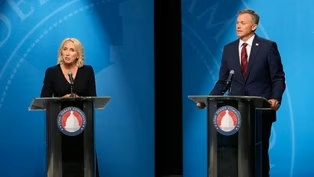
The candidates vying for the Utah Republican Party's 2026 nomination for the 3rd Congressional District answer questions about the issues facing Utah and the country. Candidates include Phil Lyman and Celeste Maloy. The debate is moderated by Utah political expert and entrepreneur Thomas Wright.
See all videos with Audio DescriptionADProblems playing video? | Closed Captioning Feedback
Problems playing video? | Closed Captioning Feedback
Utah Issues is a local public television program presented by PBS Utah
Utah Issues
2026 Utah 3rd Congressional District Republican Primary Election Debate
Special | 56m 16sVideo has Audio Description
The candidates vying for the Utah Republican Party's 2026 nomination for the 3rd Congressional District answer questions about the issues facing Utah and the country. Candidates include Phil Lyman and Celeste Maloy. The debate is moderated by Utah political expert and entrepreneur Thomas Wright.
See all videos with Audio DescriptionADProblems playing video? | Closed Captioning Feedback
Where to Watch Utah Issues
Utah Issues is available to stream on pbs.org and the PBS app.
More from This Collection
Candidates face off in primary election debates in Utah's 1st, 2nd, and 3rd congressional districts.
2026 Utah 2nd Congressional District Republican Primary Election Debate
Video has Closed Captions
Candidates in Utah's 2026 2nd Congressional District Republican Primary Election debate questions. (56m 16s)

2026 Utah 1st Congressional District Democratic Primary Election Debate
Video has Closed Captions
Candidates in Utah's 2026 1st Congressional District Democratic Primary Election debate questions. (56m 20s)
Providing Support for PBS.org
Learn Moreabout PBS online sponsorship- [Narrator] From the PBS Utah Studios on the campus of the University of Utah in Salt Lake City, the Utah Debate Commission welcomes you to the Republican primary candidate debate for Utah's 3rd Congressional District.
(bright orchestral music) (audience applauding) - Welcome, I'm Thomas Wright, moderator for this exchange, and on behalf of the Utah Debate Commission, thank you for joining us.
Today, we'll hear from the two candidates running for the Utah Republican Party's nomination for Utah's 3rd Congressional District.
These candidates both qualified for the primary ballot through the support of delegates at the state nominating convention.
The candidates are Celeste Maloy and Phil Lyman.
We look forward to an engaging and civil discussion with the goal of helping Utah voters make informed decisions.
Candidates will each receive one minute to answer questions, with up to 30 seconds for rebuttals if needed at my discretion.
A random drawing held earlier determined that candidate Maloy will get the initial response to the first question, and we will then alternate turns on the remaining questions.
Now, let's begin.
In recent months, Utah has seen proposals for major data center projects in both Box Elder and Iron Counties.
Supporters point to jobs, tax revenue, technological leadership and national security benefits, opponents raise concerns about water consumption, power demands and long-term impacts on local communities.
Based on what you know today, do you support the proposed Box Elder County project, and what specific criteria should every future data center project in Utah have to meet before receiving support?
- So on paper, Utah is a perfect place to build data centers, unfortunately, data centers aren't built on paper and states are made up of people, and the people in Utah have questions and they want those questions answered.
I think we have a unique opportunity in Utah to lead on AI policy and development, that's going to require data centers, but in order to build data centers in Utah, we've gotta make sure that we're siting them where people want them and we're building the type that match our resources.
So there are basically two types of data centers, one type is water-cooled, and that takes a lot of water, and Utah's not a great place for that kind of data center, then there are air-cooled ones, and they take a lot of power, we can produce power in Utah, but we don't have any more water, so we should be making thoughtful decisions about building data centers in Utah that match Utah's needs, Utah's resources and what the people of Utah are asking for, and we have to make sure we bring the public along and answer their questions along the way.
- [Thomas] Thank you, candidate Lyman.
- Yeah, thank you, you know, I was in a meeting last week in Box Elder County, went up to a protest there and... A lot of people there that have very different political views than I have, and I said, "The one thing I think we have in common is we don't like being treated poorly," and the people were treated poorly in this instance, they weren't consulted, they weren't told what was going on, we get the message coming down, "We did this in five months, this is gonna be great for you, don't ask any questions," and when the leaders who should be most compassionate to the needs of the people were asked the questions, the response was a reprimand, a put-down, a condescension towards those people, and that type of government is what creates more of the questions than were maybe there in the first place.
As far as whether I agree with the data center, I don't agree with the process, I don't agree that Utah is the best place for data centers, they are water-intensive and they are a drain on resources, and those things can all be measured if we have transparency on the front end of it, if we don't have transparency, then it's a no-go for me.
- So just a quick follow-up, 15-second follow-up, based on what you know today, do you support the Box Elder County data center?
Candidate Maloy, and then, candidate Lyman.
- I propose... Or I support building data centers in Utah when the people of Utah support them, and right now, I don't know that we have that in Box Elder County, so if the people who wanna build the data center can answer the questions and bring the public along, then yes.
- [Thomas] Candidate Lyman.
- First of all, I'm a fan of Kevin O'Leary, I'm a fan of data, I'm a fan of computers, I'm a fan of technology, I believe in that, but as far as the one in Box Elder County, until they're transparent about it, I'm opposed to it.
- So proponents of data centers... I'm gonna ask a follow-up question, candidate Lyman, we'll go first to you, proponents of data centers say that we need to compete with China, and then, there's those that think that there's a surveillance state and it's not in the best interest of our citizens.
Which side of that equation do you fall on?
- There's something about the way this data center was rolled out that gives me the feeling it is about surveillance, and that's a disconcerting feeling, I mean, it's next to the military base, there's a lot of issues... The way it's been pushed through so quickly kind of behind closed doors, and then, the attitude afterwards, I believe that this is about surveillance more than it is about data.
- [Thomas] Candidate Maloy.
- Utah's been leading the nation on AI policy in a lot of ways, and I wanna see Utah continue to lead the nation and the United States continue to lead the world when it comes to AI, and if we want to do that, we have to be able to store data here.
For storing our data overseas though, we don't really have control over it, so I wanna see us get to a place where the people of Utah welcome data centers.
- Great, we'll get to AI later, but let's shift to water policy.
Candidate Lyman, you'll go first.
Southern Utah continues to be one of the fastest-growing regions in the country, Washington County in particular has built a strong economy and attracted thousands of new residents, but much of that growth depends on water supplies and the constraint on them, especially with the long-term pressure from droughts, population growth and competing demands throughout the Colorado River system, so the question is, what's one specific action Congress can take during the next two to four years to improve long-term water security for Southern Utah?
- Well, it's interesting, if you take the upper Colorado River Basin and you overlay it over Utah, it matches almost identical to CD3, and that's where our issues are, whether we're talking about the lake levels at Flaming Gorge, the lake levels at Lake Powell, the water that's running in the Colorado River, the Colorado River Compact that's being renegotiated right now, Utah has been behind the curve on that, Colorado's way out in front of us with their attorneys and with their policies to try to take the water that is coming through the Colorado River, and we've made guarantees to provide wet water to these communities when we don't have it, we don't produce water, the Colorado River is a river, and when it's low, we can't produce water, but what we can do is develop more infrastructure to fill that river, to create more canals and more reservoirs, more pipelines to the people that depend on 'em, I'm a big supporter of infrastructure for especially the southern half of Utah, and we're way behind on developing that, and it's time in Congress that we fund some of those projects.
- [Thomas] Candidate Maloy.
- Yeah, I agree that what we need is the federal government to support the state and the state's goals when it comes to water.
It's also important that the federal government doesn't step on the state's toes, water law is state law for the most part and when it comes to something like the Colorado River that's interstate, there is a federal role to play, but the state of Utah is... We're unique, we do things differently here and we have... You know, our state song says, "People working together," we actually do that, so right now, we have the federal government, the state, the local water conservancy district, the counties, everybody working together to try to make sure that we have water stability for the next, you know, 20, 30... I would like to see Congress helping the states make plans for water stability for the next 100 years, and I think that's going to require infrastructure and some thinking outside of the box, and looking at large solutions that we just haven't considered yet.
- Thank you, I'm gonna ask a follow-up though, because the question was what's one specific action item Congress can take in the next two to four years to improve long-term water security?
So as a follow-up, 15-seconds, candidate Lyman, you first, what's one specific thing Congress can do?
- Well, I will say what I see happening is a leveraging of the water resources by large developers to control what happens in Utah, if you control the water, you control everything in this state.
What's the one thing that Congress could do?
They could let us manage our forests better, they could let us manage our water resources ourselves, and the state legislature has jurisdiction over those things.
- [Thomas] Candidate Maloy.
- Well, I'm gonna give you two things, even though you only ask for one, one specific thing Congress can do is write a century water stability plan for the West that includes infrastructure, and the other thing that we'll hopefully be doing very soon is ratifying the agreement that the Colorado River Basin states are negotiating.
- All right, let's shift to public lands, a big issue in Utah and especially in Utah's 3rd Congressional District.
As you know, Utah's 3rd Congressional District contains some of the most federally-controlled land in the country, in Grand County, for example, approximately 95% of the land is owned and managed by the federal government, similar challenges exist throughout San Juan, Garfield, Kane, Emery and Carbon Counties, so the question is, who should have the greatest influence over the management of public lands in Utah?
Local communities, the state of Utah or the federal government?
Please choose one, and then, explain why, and tell us under what authority you would transfer it to that level of government.
Candidate Maloy.
- Oh, sorry.
Well, I think local communities should have the greatest input, and that doesn't necessarily mean that authority has to be transferred, it's already there, this is public land, the public should have input, that's one of the reasons that I have introduced a Congressional Review Act on the resource management plan for the Grand Staircase-Escalante National Monument, because local voices were not considered the way they should have been when the plan was written, and so, I want them to go back to the previous plan that had more input from the locals.
Sometimes when we talk about public lands, we forget that a lot of the authorities are already there to manage these lands in a way that is beneficial to the people who live closest to them, but what we have had in past administrations is an unwillingness to accept that input, to listen to the locals, to manage accordingly, right now, we have an administration that is willing to listen, is willing to try things that haven't been tried before, and I'm working closely with my partners in the Senate and in the administration to make sure that we're addressing that.
- [Thomas] Candidate Lyman.
- So when I got in the legislature, one of the legislators approached me and said, "Are you gonna be with us on transfer of public lands?"
And I said, "Oh, that already happened, that was 1896 when Utah became a state, prior to that, we were a territory, and we were governed as a territory and managed as a territory by the people in Washington D.C.," that jurisdiction that we had, when you look at the map, and you can see Utah on the map, this funny shape, you know, on the map, that's Utah, that means we have a geopolitical, geographic territory over which we have jurisdiction, the legislature has to step forward and exercise the jurisdiction that they've been given, when we talk about how could we possibly manage all the public land, all the federal land in Utah, well, we have these nifty little things called counties, and that's exactly what they were designed to do, is to manage those resources, and if you put people in the counties in charge of those lands and those resources, who knows better what's going on there than the people that are living in those places day to day, and we've gotta protect their interests.
- Just a quick follow-up, 30 seconds on this, I'll go to Candidate Maloy first, can you give us a specific example of land you would support transferring or land you would not support transferring?
- Yeah, I would support transferring land that's... Orphan parcels is what we call them, they're inside of cities or they're surrounded by private land, and the land management agencies have a hard time managing them anyway, also land that's adjacent to cities, I had a proposal last year to transfer some land that local governments need for infrastructure.
The thing that always comes up if we talk about transfer is the national parks, and I would oppose transferring the national parks, I think everybody opposes that, but we can do a better job of managing them for the locals.
- [Thomas] Candidate Lyman.
- So I appreciated Mike Lee's bill a few years ago that created basically a homestead type provision, I do not support transferring ownership of federal land to the state, because if the state has jurisdiction and ownership, I've seen what they will do with their state land, and I've watched the cronyism, and the pay-to-play, and the picking winners and losers, and I do not trust the state of Utah in this situation to be in charge of divvying up the public land if they were to receive that from the federal government.
- Thank you, let's shift to artificial intelligence.
As you know, artificial intelligence is expected to impact national security, employment, education, healthcare, and really nearly every sector of the economy.
Some experts believe it may be the most important technological development in our lifetime.
What role should Congress play in the development of artificial intelligence?
And specifically, should Congress primarily be facilitating innovation, regulating risk, or maybe some combination of both?
Candidate Lyman, one minute.
- Well, I appreciate the question, and first of all, I believe in artificial intelligence, I believe in AI, I've seen it, I've seen it at work, I think it is gonna have a very important role to play in our future, I don't fear it, but it is powerful, similar to nuclear energy, it could be used to destroy things, it could be used to really make positive changes for our society, the fear that I have with this is... From the federal government is that they will try to regulate it to where people are not able to transact business, to have commerce on an open and free basis, and we see that when we talk about digital currencies, and Bitcoin, and blockchain technologies, those things, Congress has to stay out of the way, those things belong to the people and I think this is gonna be... You know, as we move forward, I believe that AI has the potential to make our society much better, I think it has the potential to make government much more transparent, give us greater access to the actual facts that are going on inside of the government and to be able to give people the tools and the power to really monitor the government itself.
- [Thomas] Candidate Maloy.
- Yeah, I've been impressed to see Utah stepping up to meet this moment, AI is happening, it's changing the way we do business, I talked to a small business owner just this weekend who's excited about having the ability to use AI in his business so that he doesn't have to hire people to do some of the menial tasks, and he can hire people who are specialized and let AI do some of the busywork and make his small business leaner and more efficient, and Utah's been leading the way on AI regulation as well, the model in Utah is that we shouldn't regulate the development of AI, we need to be making sure we're keeping up on that, but maybe we should regulate the deployment to make sure that AI isn't violating American civil liberties, it isn't harming children, make sure that the way AI is being deployed doesn't harm people, and I think the federal government should learn from that example and not interfere with the state's ability to be innovative and be pioneering on this.
- So I'm gonna ask you a quick follow-up, 30 seconds, first to you, candidate Lyman, what concerns you more, America moving too slowly and losing China...?
Losing ground to China or America moving too quickly without sufficient safeguards?
- You know, in a free market, the market dictates what people will do, and in a country that is based on consent, people are able to produce and to innovate the way that they should, now, if government gets involved, I fear that we have people in our own government who put China before America, who put those policies first, so this is a perfect time when government needs to, you know, practice laissez-faire, let the market do what it will do and let our innovators innovate in the United States.
- [Thomas] So to you, America moving too slowly and losing ground to China is what you're most concerned about?
- I believe that government does a better job of restricting growth in advance than in promoting it in America, we need to just stay out of the way and let this innovation take its course.
- Thank you, candidate Maloy, same question.
- Yeah, I fear moving too slowly more than I fear moving too quickly, we can figure this out as we go, we've always done that, when trains came around, they were a new technology, we figured out how to do it, when cars came around, we didn't have a lot of roads, we figured out how to build them, but what we need to do right now is make sure we're innovating and we're not falling behind our neighbors who don't have our best interests at heart and making Americans vulnerable to technologies that are being deployed elsewhere in the world.
- All right, well, let's shift gears and let's go to foreign policy.
Many voters supported President Trump because they believed he would pursue an American-first policy agenda and avoid unnecessary foreign conflicts, yet there's events overseas that continue to affect us, energy prices, inflation and the cost of living for families in Utah's 3rd Congressional District.
Where do you draw the line between strategic restraint and military intervention?
Candidate Maloy.
- So I ascribe to Ronald Reagan's vision of peace through strength, and I support President Trump's opposition to unnecessary intervention around the world, there are some places that it is necessary, in the past, we've had administrations that didn't show strength in certain parts of the country and embolden some of our enemies, and this administration was willing to take bold action and address some of those problems, Iran's been the world's largest sponsor of terrorism since before I was born, and I'm getting wrinkles and my hair's starting to go gray, that's a long time, we stepped forward, we met the moment, but through the entire process, the administration's been focused on getting us to peace, there are peace talks happening right now, we had clearly-defined goals, I was just in Korea last week commemorating the Utah National Guard's role in the Korean War and they have a big sign that says, "Freedom isn't free," and it's true, it's never been free, we always have to pay a price for peace, but the end goal is peace.
- Candidate Lyman.
- Well, we talk about policy on one hand, and then, we gotta talk about people on the other hand, I trust President Trump, I trust the direction that he wants to take, I trust the power in his hands that I would not trust that same power in the hands of a Gavin Newsom or a Kamala Harris, so the people in charge make a huge difference and I do trust President Trump, when we're talking about global economic interests, it is really the commerce, world... Global commerce that has driven more of the peace talks and more of the motivation for countries to come together, and we see this right now over in the Strait of Hormuz and in the Middle East, the economics of this are playing such a huge factor, Iran is behind the times, and they are a threat, and they're, you know, chanting death to America and threatening to wipe Israel off the face of the earth, we have to protect ourself against those types of threats, but at the end of the day, it's commerce and the ability for people to transact globally that is going to resolve more problems than going to war and shooting.
- So just to be really clear, yes-or-no answer, we'll go to you first, candidate Maloy, do you support President Trump's actions regarding Iran and support the conflict as it stands right now?
- Yes.
- [Thomas] Candidate Lyman.
- I do, but there is a Constitutional question about the War Powers Act and the justification needs to come, I think Congress needs to either authorize additional hostilities in that area or they need to weigh in on it... (indistinct) - I agree that Congress needs to take action.
- All right, let's shift gears, not really, from foreign policy, but to the state of Israel.
Do you view Israel as one of America's strongest and most important allies?
And if so, please identify one specific thing the United States has done for Israel and one specific thing Israel has done for the United States that justifies that relationship, candidate Maloy.
- I do support the alliance between Israel and the United States, when I talk about peace through strength, we're talking about military strength, and Israel has been a strategic ally in the Middle East where we've needed to show strength, they're sitting in a very vulnerable position, and one specific thing we've done for them is the Iron Dome and one specific thing they've done for us is eliminating the ayatollah, so when I talk about the world's number-one sponsor of terrorism since before I was born, it was driven by an individual, and Israel had the intelligence to know how to take that individual out, and they worked with us, took action and eliminated a threat that we have talked about drawing red lines in the sand for and we haven't always shown the strength we should have shown, and having a strategic ally allows us to have the military strength and the respect around the world that we have to have to have peace.
- [Thomas] Candidate Lyman.
- Yeah, so in the Middle East, you've got Israel there with a population of about nine million people surrounded by about, you know, 200 million hostile... Potentially hostile forces, and they do feel that is an existential threat, so what have...?
What has America done for Israel?
We've given our military strength, we've stood behind them with our military strength, and that's an important thing and it's important to the United States, we have to have an ally in the Middle East because it is such a crucial part of the global economy and the oil that moves to that area, just the people that live there, what have we done for Israel besides the military?
The strikes on Iran, I think were a direct response to the threats that were... That Israel were facing, and what has Israel done for us?
They are... They're an ally, they are a presence in the Middle East that is vital to the United States' interest there, and they've been a friend to the United States.
- Okay, this next question on the economy, we'll go to you, candidate Lyman, the 2024 election cycle centered heavily on affordability and cost of living.
While unemployment remains relatively low, many families are still feeling the pinch.
I just read recently Walmart reported that the average fuel purchase at its gas stations fell below 10 gallons per purchase for the first time in several years, which made me think it's a sign of growing financial stress amongst your consumers and constituents.
What is the clearest sign that the economy's not working as well as it should be for families in Utah's 3rd Congressional District, and what is the first federal policy you would change to address it?
- Well, it's interesting to me that certain government officials will come out and talk about all the good things that they're doing for America, "We're giving you the biggest tax cuts in industry, we're giving you all this money," while we see the cost of everything going up, inflation is a very real thing, we've got a national debt that's pushing 40 trillion dollars right now, the only way that they're going to address that is by printing more money, quantitative easing, that's a huge tax on everybody and we see that tax in our mortgages, you know, you've got a fixed-rate mortgage, but your mortgage payment goes up because your insurance has gone up and your property taxes are going up, people feel it, they feel it in the fees that they pay, you know, things... Services that used to be free at the utah.gov are now 35 dollars a year, and then, a payment for each additional thing, and that's the same thing at the federal government, the attempt to pacify people and to convince them that they're doing better is astonishing to me when families are truly struggling, and I see it in my own CPA for my... (indistinct) Families who are truly struggling to pay even their basic necessities.
- [Thomas] Candidate Maloy.
- We have to make sure that Utah families are keeping more of their dollars in their own pockets, in their family budget, so we have eliminated some of the direct costs of government by making the tax cuts permanent, doubling the child tax credit, there's no state that benefits from that as much as Utah does, I hear from parents how much they appreciate that, and we have to keep going, we passed 12 individual appropriations bills last year, that's where we cut the discretionary spending, we also cut mandatory spending last year through the reconciliation package, through the rescissions, we pulled back money that had already been appropriated that hadn't been spent, and at the same time, we're working on eliminating some of these hidden costs to families where government regulation makes things cost more and that makes your dollars not go as far, we're working on both at the same time and we have to keep going, we didn't get here overnight, we've had administrations and Congresses in the past that just wanted to print more money and wanted to go into more debt, and now, we're finally heading in the right direction.
- [Phil] Can I have a rebuttal to that?
- Go ahead, candidate Lyman.
- In 2017, Congress passed the Tax Cuts and Jobs Act and it was a great tax cut, it doubled the child tax credit, that was set to expire here this year, Congress made a bill that it would not expire, so they kept the 2,000 dollars, they raised it by 200 dollars, that's not doubling the child tax credit, and all the other things that were going to expire with that 2017 bill are not a huge tax cut, in fact, the... At the same time that the child tax credit was doubled, they took away the dependency exemption, which was a huge cut to people who have in live in Utah, especially if they're above the 25% tax bracket because they get a 4,150-dollar tax deduction per child, and now, they get a 1,000-dollar tax credit, we have not seen major cuts on taxes in regards to that 2017 bill or especially to the 2020 vote.
- [Thomas] Candidate Maloy.
- So we reduced the tax on tips, the tax on overtime, the tax on Social Security, we doubled the death tax cap so that when a family's passing down a farm or a small business, they keep more of that money and less of it goes to the federal government, this Congress has been very busy working to make sure that Americans can invest their own money and not have it go to the federal government.
- I'm gonna have to follow up 'cause this 3rd Congressional District is really an interesting district, you have some of the fastest-growing communities in America, and then, you have rural communities like Price and Castle Dale, Blanding, Panguitch, Kanab that maybe aren't experiencing that same economic growth, so what would you say to residents and voters in that district, in those communities?
How did we get where we are with these tough economic conditions?
Why are they putting eight gallons of gas in their car at a time and what can be done to fix it for them?
Candidate Lyman first, and then, Maloy.
- So I feel very blessed to live in a town that looks very much like it did when I was a kid, and my children that are moving back want that same experience for their children, so growth for the sake of growth is not necessarily a good thing, I don't think these communities are feeling left out from a growth standpoint, what they are feeling is treated poorly by those people who are making decisions, that are divvying out the money, we talk about things like water development, water development for whom?
Well, it's going to the Wasatch Front, it's not going to the rural areas, they're the ones that are paying the price, even when we talk about things like cloud seeding and stuff like that, it's not cloud seeding in the rural areas, it's cloud seeding for the ski resorts and we see it, those people in those communities, they're not dumb and they can see where the money is going, they're appreciative of the benefits, they're appreciative of government, but it's not right when families are picking up the tab for the Olympics, or for stadiums, or for things like that that they're not gonna be the beneficiaries of, and they feel that it's not right and somebody's gotta step in and advocate and protect those families.
- [Thomas] Great, candidate Maloy.
- We have to make sure that the rural towns, rural counties are not being left out of the economic growth that's happening in Utah, and to that end, I have worked with the elected officials in those areas to make sure that we are investing in water infrastructure, in road infrastructure, making sure that these rural communities that don't have the tax base, largely because they're surrounded by federal land, have the ability to keep up with the infrastructure needs that make it so that people can live there, to make it so people can move there, can invest there, start their small business there so the rural counties aren't being left out of the economic boom, you know, I grew up in a small town, we love to say that the biggest export from our rural areas is our kids, and I wanna make sure that the kids who want to stay in rural areas can stay, that they have the ability to build a house, start a business, start a family, and make sure that those rural communities keep thriving and that they keep being the charming places that we love where people want to settle down, where they wanna raise their kids.
- Thank you for those answers, let's shift gears and go to housing.
We have some students here from Utah Valley University, two bright Utah students, one of which has a question related to housing, it's better than my question, so I'll save mine for the follow-up, but student question comes from Alexa Herrera, Alexa.
- Thank you, Tom, candidates, my question to you is obviously this topic of housing, I wanna hone in on students in your district who are being priced out of their housing near their schools.
What specific federal regulations are policies...?
Excuse me, or policy are making that worse, and if elected, what would you do to lower the cost of living for college students specifically?
- [Thomas] Candidate Maloy.
- Well, I'll tell you one thing that I've done just recently, we just passed out of the House the 21st Century Road to Housing Act, and it's designed to address some of the inputs to housing that make them more expensive on the backend, and in a well-intentioned move, it originally had a clause in there that didn't allow corporations to invest in housing and own it, and then, somebody realized that that would harm renters, there are a lot of corporations that build housing specifically for renters, and if they had to divest that housing, it would harm college students and people who are just starting out in their professional careers, so we adjusted it and passed it again to make sure that people who want to invest in temporary housing for college students, or for young couples who are starting out, or for small families are not knocked out of the market, that they can help supply that need and that we didn't have an unintended consequence while we're addressing the real issues that prevent people from being able to build housing.
- [Thomas] Candidate Lyman.
- Yeah, well, thank you, Alexa, for the question, and what I see happening is huge incentives for high-density housing, government subsidies for low-income housing, and who gets left out of that?
It's the single families, it's the students, it's those people that are just trying to pay rent, at the same time, you've got a massive push by business-people to buy up all the houses and turn them into vacation rentals, I see that in these small communities, and the college students are suffering from that, I've said before many times, bad policy hurts people and you can trace... Most of the housing crisis you can trace back to bad policy, whether it's immigration and having an overabundance of illegal immigrants who are buying up the houses, or corporations who have incentives to build only high-density homes, or if you've got corporations that are coming in and buying up the houses with the blessing and the lifting of the regulations by the state themselves because they're spending so much money, so we're favoring... We're picking winners and losers in the housing market, and unfortunately, the students tend to be at the bottom of that scale.
- One quick follow-up, 30 seconds on this, Washington County communities like St.
George, Washington, Hurricane are struggling with affordability as the growth continues at a rapid pace, meanwhile, communities like Monticello, Escalante, Beaver, Hanksville, they face a different challenge, right?
There's not enough investment, there's not enough economic activity to make new housing projects financially viable, how as a member of Congress will you balance those two interests?
Congresswoman Maloy.
- So I'm gonna refer to my earlier answer, we have to make sure that the rural counties don't miss out on the economic benefits, when new businesses are coming into Beaver County, which they are, then the county has the tax base to invest in infrastructure that encourages new housing, so I think we can address a lot of the problems in the smaller communities by making sure that we're investing in getting businesses to locate there and create jobs.
- [Thomas] Candidate Lyman.
- Again, housing is one of those areas where entrepreneuring-minded people look and say, you know, "I have an advantage here because I know how to build houses, I would have an even greater advantage if I could own all of the water rights that allowed me to build," or, "If I could make the..." "Get the legislature to pass legislation that would favor my projects in these counties, if I could get PIDs, and tiffs, and all of these incentives to help subsidize those programs," the net effect is housing that goes through the roof and becomes unaffordable to everybody else.
- Thank you.
We've now reached the halfway point of the debate featuring the primary election candidates for the Utah Republican Party's nomination for Utah's 3rd Congressional District.
If you're just joining us, I'm Thomas Wright, moderator for this presentation of the Utah Debate Commission.
We're coming to you from the PBS Utah Studios on the campus of the University of Utah in Salt Lake City.
Let's get back now to the questions, we have a candidate... We have a student question from another great student at UVU, this question deals with federalism and it's gonna be asked by Rebecca White.
- Utah consistently leads out on many federalism initiatives, as a member of Congress, how will you help balance the role of the state's versus the role of the federal government?
- [Thomas] Candidate Lyman.
- Well, thank you for that question, I know UVU has got their federalism department down there, they've been doing some great things, they've been doing some research, federalism is the balance of government, it's the three branches, it's the state versus the federal, those things that keep government in check, and I've always said government, if it will stay in its lane, does a service, when it gets out of its lane, it does not do a service, the federal government will expand, and overreach, and encroach upon the rights of Utah every time we let them, and who is it that's supposed to be there to hold the line?
It's the state legislature, and if the state legislature won't hold that line on federalism, then we're gonna see an overreach and a dysfunction in that function of government, by the same token, you've got the legislative, the judicial and the executive branches, and we've gotta have a point in our government where the legislative branch is willing to stand up to the executive if that's what it comes to, or stand up to the judicial, and we've seen that here in Utah over and over and over, whether it's the judicial branch drawing the districts for congressional boundaries or whether it's the legislature yielding to the federal government on public lands jurisdiction.
- [Thomas] Candidate Maloy.
- I love that question, federalism is part of the genius of what makes our system of government work, and we're celebrating America's 250th birthday in about a month, having our big semi-quincentennial, and I think part of the reason we're still here 250 years later is that we have that natural tension between the states and the federal government, between the branches, and so, one of the things I do personally as a member of Congress is I decline to support a lot of bills that sound like a good idea except that they should be handled by the states, the way federalism is designed to work and the way it has to work is that we have to stay in our lane in the federal government and the state needs to be legislating on most issues, so the state should be jealous, should be guarding its authority, the legislative branch should be jealously guarding our authority, the judicial branch should be exercising checks and balances, that's what makes it so that the people can control the government and no part of the government can get strong enough to violate people's rights.
- On the federal budget, the federal government hasn't run a balanced budget for 25-plus years, and since then, Republicans and Democrats have each controlled the White House and the Congress at same times and similar times, yet the national debt has continued to grow and skyrocket, where now it exceeds, what, 39 trillion dollars.
Why has Washington failed to balance the budget for more than 25 years, and what can you do in office to correct that?
Candidate Maloy.
- Well, I'll answer the second part of the question first, the reason it's so difficult for Washington, D.C., to balance a budget is because people want things from the federal government and people who are in elected office want to give people things in order to stay in office, but what we're doing right now is course-correcting and making sure that we're doing our job, I'm on the appropriations committee, that's where the spending decisions are made, we're passing our appropriations bills, 12 individual bills the way we're supposed to, negotiated by subcommittee chairs who understand the issue areas, and we're cutting spending, at the same time that we're investing in our national defense and making sure we have a strong military, we're cutting other things out of the budget and making sure that we're spending less money year-over-year, not just slowing down the growth, but spending less money year-over-year, and at the same time, through the reconciliation process, we're also making changes to mandatory spending because if we wanna get back to a balanced budget, what we have to do is stop spending on some of the things we've been spending on.
- [Thomas] Candidate Lyman.
- Well, it's interesting to see Congress continue to spend and spend and spend, and what we see sometimes is an inclination to bend their knee to the government interests such as government shutdowns, "Oh, we can't have a government shutdown, that's gonna affect too many people," when that's probably exactly what needs to happen if they're doing the wrong things, so they hold us hostage, they hold Congress hostage, they hold us hostage with these government shutdowns, you know, government... We cannot be making excuses for the government at the expense of the people of Utah, and we've gotta recognize that the family's budget is more important than the budget of the states or the county, that those families that are struggling to pay their bills is more important.
The sad reality of the deficit that we've got is that it will take more quantitative easing and that is gonna lead to greater inflation, you'll still get your Social Security check, it just won't buy what it used to buy or what it should be able to buy, and that's a serious problem moving forward, the biggest tax we have in this country is not our income tax, it is the inflation, and as we see those things go up, it's gonna get worse and worse and worse unless we will really pull back on this... On the spending.
- So let's dig into the budget a little bit here, I have a couple follow-ups, and we'll go first to you, candidate Maloy, continuing resolutions have become the order of the day, meaning the government hasn't passed a budget, so we operate on a continuing resolution, why hasn't the government been able to pass a budget in over 25 years?
- So this is what we're actually doing right now, we were doing continuing resolutions, Speaker Johnson made it a goal of his not to do a continuing resolution last year, we had to do a temporary one to get our bills done but we got 12 appropriations bills done, we're well into the appropriations process, this year, we're on track to get all 12 appropriations bills done this year, this is what the American public has been asking for, people talk a lot about regular order, "We have to get back to regular order," that's what it means, it means the committees are doing their jobs, we're going through the appropriations bills line-by-line and deciding what should be in what should be out, we're having committee hearings, committee markups, we're voting on the floor, we're passing these, that's how we keep the government accountable because then I'm voting on what we're spending in the government, I'm not just kicking the can down the road, and we're making decisions every year about what goes in and what comes out so that we're modern, we're up-to-date, we're meeting the needs of today instead of just doing a continuing resolution so we don't have to do something that's hard.
- [Thomas] Thank you.
Candidate Lyman.
- Well, you know, the American people, they watch this happen, and that's why there's such low trust in government is because they see the things that are happening, we read just this last week about a David Rush who had 303 gold bars and two million dollars' worth of foreign currency in his possession, the FBI raided his house and arrested him, well, this wasn't a gangster from Chicago, this was former top leader of the CIA who's pilfering this money, so we're we're talking about these efforts to save money, when DOGE came about it, it wasn't that government woke up and said, "Oh, wow, we didn't realize we were overspending so much money," it's because it was revealed to the people of America, and they said, "We cannot continue to spend this kinda money," and so, we saw programs that evaporated overnight, and I think that that... Without the transparency in this system, we are not going to see the results that we hope to because they continue to pilfer, we're literally being run by pirates at the government level, and it's no surprise.
- So 30-second follow-up just to conclude our debate on the federal budget, we all agree that two-trillion-dollar deficit every year isn't sustainable, that's why we're 39 trillion dollars in debt and counting, what's one program, federal cut in the budget you would make to get our spending under control?
30 seconds to you, candidate Maloy.
- Well, other than the appropriations process which I just described, which I'm part of, we also have to root out all the waste, fraud and abuse, it's true that we do have a low-trust environment right now because there have been things that have been happening that didn't get addressed, we're addressing them now, the president has assigned the vice president to be in charge of rooting out waste, fraud and abuse, we have committees in Congress rooting out waste, fraud and abuse, that's a drag on the whole system and it's one of those hidden costs we talked about earlier, and it is the easiest, least controversial way to cut the budget.
- [Thomas] Candidate Lyman.
- You know, do we have this deficit because America doesn't have resources, or innovation, or the ability to produce?
No, we have this because of the lack of transparency and the absolute plundering that's taking place in this government.
I'm a CPA, we audit things, we go in and we look at things, if we wanted to audit the Pentagon, and I think they did that and it came up by missing a trillion dollars, so what programs would I cut?
I would cut the U.S.
Department of Education, I know we're in the process of doing that, and there's... And across the board with all the entitlement programs, what you find is those people that are benefiting from the entitlement programs are not the ones who are targeted as the ones that should be benefiting.
- Thank you, let's talk about Social Security.
For years, Americans have been warned that Social Security faces long-term financial challenges, yet Congress has repeatedly postponed major reforms and many younger workers question whether the system will be there for them when they retire.
Do you believe Social Security can be preserved without reducing benefits, increasing taxes or raising their retirement age?
Why or why not?
Candidate Lyman.
- Well, as I said before, I mean, you've got people who live in their homes, have lived in their homes for 70 years who are now being taxed out of their homes, the value of that house has gone from the 8,000 dollars that they paid for it to over a million dollars, I know some families up in Midway that this is exactly the case, and this is inflation, you know, we went off the gold standard back in 1971, we've seen this massive inflation, this is... Again, this is policy that is hurting people, it's destroying the lives of people, so do I think that the Social Security checks will stop?
No, I think that they will continue to go to those people, but they won't buy what they were intended to buy or what they used to be able to buy, it's... They're not holding up their end of the bargain, and it has been a pyramid scheme where the ones at the bottom are paying more in to support the ones at the top, the government, in true form, has been plundering and pilfering the Social Security fund as they are inclined to do, and who is protecting, who is standing in the way of that?
Because Congress certainly has not been standing in the way of that.
- [Thomas] Candidate Maloy.
- I'm one of those younger people who doesn't expect Social Security to be solvent by the time I'm eligible, and I think we have to do two things with Social Security, we have to keep the promise we made to people who are dependent on Social Security or about to retire and we have to put all options on the table long-term to see what we can do to keep it solvent for future generations, for people who are just entering the workforce, people like me who are mid-career, so that we can plan ahead and make sure that we have a retirement plan that will actually work for us and not keep pretending that Social Security is going to be okay, and I saw just recently that this is the first time in history that people who are of retirement age agree with that and people on both sides of the aisle agree with that, I think 20 years ago, if you heard that Social Security might not be solvent in 30 years, you could feel like that wasn't going to be your problem maybe, and that's not the case anymore, so I think we have the political will to actually look at innovative solutions finally.
- So I wanna ask a follow-up question, I'll come to you first, candidate Lyman, if changes are necessary, how do you prioritize these...?
The following things, you're welcome to add to them, and which one would you attack first to create a more solvent system?
Would you go for raising the retirement age, adjusting benefits for higher-income retirees, increasing payroll taxes or any other combination?
What would you do to solve this problem?
- Well, again, the problem with Social Security is that it has been plundered.
The savings of the people that put into Social Security has been used for other purposes, it's been taken and used for other purposes, and what are those other purposes?
And we're starting to see what some of those are through the DOGE effort, we saw what a lot of those purposes are, it's pure... It's wrong, it's wrong what we've done to the... Social Security, so what do we do to address that issue?
Again, I believe that there's gonna be an aggressive continued pattern of quantitative easing and it's gonna continue to push inflation up for all of us, in the meantime, there's alternatives to this which are the hard assets, people that saw this long ago are buying real estate, buying gold, buying silver, what I don't wanna see happen is that the federal government come in and regulate those abilities, the ability to create transactions or to perform transactions based on... With those hard assets.
When we get into the digital currency, that's a way for people to divorce themselves from the... From a collapsing dollar that we're watching happen right now, and that's something that we've gotta allow on a global scale, we've gotta allow our citizens to participate in those transactions.
- [Thomas] Candidate Maloy.
- Yeah, I already said that I think we should put all options on the table for addressing Social Security, if I had to choose one first, I'd probably go with adjusting the retirement age, but I think it needs to be paired with other adjustments and it needs to be graduated so that people who are close to retirement can make their plans, and people who have a lot of working years left like I do can also plan for what their retirement will look like, but the one thing I'm sure of is we have to make sure that Americans have a system we can count on, what we can't do is continue to go down this road where people are paying into a system that we know won't remain solvent and they won't be able to draw out of it, and so, all options are on the table, it's time to get creative, it's time to think big and it's time to make sure that we keep the promise to people who are retired or eligible for retirement, but we extend that promise to people who are younger than that.
- Thank you, let's shift gears, go to immigration.
Immigration remains one of the most debated issues in our country.
Most Americans agree that the border should be secure, but there is far less agreement on what should happen after that.
What should be the top immigration priority for Congress over the next four years, securing the border, increasing deportations, reforming legal immigration processes, addressing workforce shortages or something else?
Please tell us about your immigration stance and why, candidate Maloy.
- Well, luckily, the number-one issue a year ago was border security and we've done a great job of that, the Trump administration was willing to go enforce the laws that were already on the books and we're doing much better at the border, and now, we have to decide what to do with our immigration system, we've always been a country that welcomes people who want to come here, be Americans, contribute, but what we've had for the last five years, for the four years before this administration came back were people crossing the border illegally and not becoming part of our culture, not contributing to our tax rolls, and the quickest way to go bankrupt is to have a welfare state and have people coming in who are not part of contributing, so we've got the border under control, now, we need to do two things at the same time and we can do two things at the same time, we have to make sure we're deporting the people who need to be deported and fixing the legal immigration system so the people who want to come here, live the American dream and become Americans have a way to do that that makes sense.
- [Thomas] Candidate Lyman.
(Phil clearing throat) - Well, I think what you find in Congress are certain members of Congress who hate America, and they're pushing for the same policies that are destroying this country, and immigration is one of those, I think Congress needs to wake up and recognize that China has an agenda when it comes to immigration, Cuba had an agenda back with Jimmy Carter to send their worst, their most vile, their drug dealers, their human trafficking people to destabilize and undermine this country, China has a wolf diplomacy policy of taking over countries through their Belt and Road Initiative, and it's happening all over the world and we're watching it, and then, we go along in the United States as if somehow, our virtue doesn't allow us to address those issues, Gad Saad calls it suicidal empathy and it is suicidal when we're unwilling to look at visa programs that we're designed to provide temporary workers being abused and turned into conduits for human trafficking and fentanyl trafficking, a Congress that can't distinguish between those two is doomed to have some serious problems in immigration, and that's what we've got right now.
- 30-second follow up, there's been discussion about locating a large-scale immigration detention center in Utah, do you support that proposal?
Candidate Maloy.
- I support having more beds for federal detainees in Utah, this is something I've been working on for years, actually, we don't have enough beds for detainees that the marshals pick up or ICE, what I would like to see is the administration work with Utah and treat us like we are a state that supports them, and find a place and do it in a way that makes sense for the state and not have a heavy hand the way a Democrat administration would be expected to act in Utah.
- Candidate Lyman.
- No.
I don't think that Utah should build a giant facility to house illegal immigrants, I think those immigrants should be shipped back to their countries, and the only crime worthy of deportation should be that you entered the country illegally.
Now, when we wanna implement that, it might be that we go after criminals, you know, that are known first, but anybody that's in this country illegally should be deported, and no, I do not support building a facility out there, Utah has kind of a prison mentality already and I'm afraid that if we build a big facility like that, the emphasis would be more to keep it full than to get it emptied.
- Let's go rapid-fire, you guys wanna do some rapid-fire questions?
We'll start with you, candidate Lyman, we'll go 15 seconds each, I got some good rapid-fire for you, before the broadcast, I asked you what your favorite Tom Petty song was, so I already know that about you guys, but let's start with this one, do you support term limits for members of Congress?
- Yes, I do.
- [Thomas] Candidate Maloy.
- I'm kind of indifferent on term limits, if I have to vote on it, I'll probably vote in favor.
- Thank you.
Candidate Maloy, this comes to you, tell us about a time you changed your mind on a significant issue.
- Ooh, that is a good question.
I probably have changed my mind on how much I think the federal government should be involved in water infrastructure.
I want the federal government to spend less, but I think water infrastructure is an investment, not a cost.
- [Thomas] Great.
Candidate Lyman.
- When I was a county commissioner and they brought up the proposition of mail-in ballots, I looked at the benefit that that would be to San Juan County thinking, you know, "This could work," and I had had an idea from a CPA standpoint how that might work, in retrospect, we should never have implemented mail-in ballots in the first place.
- Okay, candidate Lyman, this went to you, should members of Congress be required to publicly disclose every stock and company investment they own?
- Yes, I think they are required to do that, but yes, they should be, and... - [Thomas] Go ahead.
- I was gonna say, and not only that, it's interesting that they're the only group of people... Senators and Congressmen are the only people who are exempt from insider trading, I don't know why that's the case, but yes, they should at least have to disclose it.
- [Thomas] I think that was the nature of the question, the insider trading, but thank you, candidate Maloy.
- So, yes, I think we should be required, we are required and we're not actually exempt from insider trading, but we need to make sure that it's being enforced, and I've supported bills that ban stock trading by members of Congress.
- Great, thank you both.
We've reached the end of our debate.
Each candidate will now receive one minute to share a closing statement.
A random drawing held earlier determined that candidate Maloy will go first.
- Thank you.
I'm here running for reelection and I already talked about America's 250th birthday, I want to close on a similar and hopeful note, 250 years ago, our founding fathers had this idea that ordinary people could govern themselves, that you didn't have to have a certain bloodline or a calling from God, and I'm standing here, an ordinary person, I'm a middle child from a middle-class family who grew up in the middle of nowhere and I've managed to get involved in policy, and then, politics, and now, I have the profound honor of representing my fellow Utahans on the national stage, I get to go vote on behalf of the people in the current 2nd District, I'm running to represent the people in the new 3rd District because representation matters and I want to make sure that everybody in this state has a voice on the federal stage that reflects who they are, and I'm so grateful to be here and I would love to have your vote and represent you again.
- [Thomas] Candidate Lyman.
- So about 20 years ago, my wife and I moved into a house that we built, and we built the house not so we'd have a place to live, but so that we could teach our boys responsibility, how to be providers, how to stand up and provide for the family.
We just graduated our third one from medical school, our third son from medical school a couple of weeks ago.
I defined... I've described my politics as aspirational, what I mean by that is I believe that we can do better, I believe that there is a way for America to be the America that our founding fathers envisioned it to be.
The Constitution is not just a document, a historical document, it's a pattern, it's a business model that works for us, and I believe that if our children understand the ability and the importance of taking accountability for their lives, they're going to live better lives.
For me, getting involved in politics has never been in the abstract, everything that I do is dealing directly with issues that I've faced, whether it's the public lands issues, the weaponization of the IRS or the Bureau of Land Management, all of those things have been first-hand experiences for me.
- Thank you to the candidates for participating, and thank you, our audience, for engaging us online or through TV and radio.
Election day is Tuesday, June 23rd and ballots begin arriving in mailboxes on June 2nd.
Contact your county clerk if you have any questions about making your vote count this election cycle.
We appreciate PBS Utah and the University of Utah for hosting us, and I also want to acknowledge the members of the Utah Debate Commission Advisory Board, representing media organizations and colleges and universities throughout our state.
My name is Thomas Wright, thank you again for joining us.
(bright orchestral music) (bright orchestral music continues) (bright orchestral music continues) (bright orchestral music continues) (bright orchestral music continues) (bright orchestral music continues) (bright orchestral music continues)
 New Episode
- News and Public Affairs

Top journalists deliver compelling original analysis of the hour's headlines.

- News and Public Affairs

FRONTLINE is investigative journalism that questions, explains and changes our world.
 New Episode
 New Episode
 New Episode
 New Episode
 New Episode
 New Episode
 New Episode
 New Episode
 New Episode
Support for PBS provided by:
Utah Issues is a local public television program presented by PBS Utah