Utah Issues
2026 Utah 2nd Congressional District Republican Primary Election Debate
Special | 56m 16sVideo has Closed Captions
Candidates in Utah's 2026 2nd Congressional District Republican Primary Election debate questions.
The candidates vying for the Utah Republican Party's 2026 nomination for the 2nd Congressional District answer questions about the issues facing Utah and the country. Candidates include Karianne Lisonbee and Blake Moore. The debate is moderated by former political reporter Glen Mills.
Problems playing video? | Closed Captioning Feedback
Problems playing video? | Closed Captioning Feedback
Utah Issues is a local public television program presented by PBS Utah
Utah Issues
2026 Utah 2nd Congressional District Republican Primary Election Debate
Special | 56m 16sVideo has Closed Captions
The candidates vying for the Utah Republican Party's 2026 nomination for the 2nd Congressional District answer questions about the issues facing Utah and the country. Candidates include Karianne Lisonbee and Blake Moore. The debate is moderated by former political reporter Glen Mills.
Problems playing video? | Closed Captioning Feedback
Where to Watch Utah Issues
Utah Issues is available to stream on pbs.org and the PBS app.
More from This Collection
Candidates face off in primary election debates in Utah's 1st, 2nd, and 3rd congressional districts.
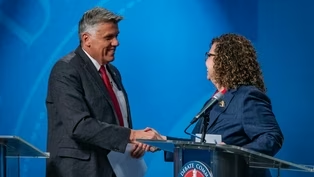
2026 Utah 3rd Congressional District Republican Primary Election Debate
Video has Audio Description
Candidates in Utah's 2026 3rd Congressional District Republican Primary Election debate questions. (56m 16s)

2026 Utah 1st Congressional District Democratic Primary Election Debate
Video has Closed Captions
Candidates in Utah's 2026 1st Congressional District Democratic Primary Election debate questions. (56m 20s)
Providing Support for PBS.org
Learn Moreabout PBS online sponsorship- [Presenter] From the PBS Utah Studios on the campus of the University of Utah in Salt Lake City, the Utah Debate Commission welcomes you to the Republican Primary Candidate Debate for Utah's 2nd Congressional District.
(stately music) (audience applauds) - Welcome, I'm Glenn Mills moderator for this exchange.
And on behalf of the Utah Debate Commission, I want to thank you for joining us.
Today we will hear from two candidates running for the Utah Republican Party's nomination in Utah's 2nd Congressional District.
These candidates qualified for the primary ballot either through the support of delegates at the state nominating convention, or by gathering signatures from registered Utah voters.
The candidates are Karianne Lisonbee and Blake Moore.
We look forward to an engaging and civil discussion tonight with the goal of helping you the voter, make informed decisions.
Candidates will each receive one minute to answer questions with up to 30 seconds for rebuttal time if needed at my discretion.
A random drawing held earlier, determining that candidate Lisonbee, will get the initial response to the first question.
We'll then alternate turns on the remaining questions.
Now let's begin and in lieu of a traditional opening statement, we will begin with a more broad introductory question tonight, and that is to introduce yourself to the voters of Utah's 2nd Congressional District and make the pitch to them why you are most well suited to represent them.
Candidate Lisonbee we begin with you.
- Thank you.
I'm Karianne Lisonbee.
I live in the district, it's my home.
Seth and I raised our family here.
I represented part of this district in the legislature where I was a champion of conservative priorities.
Just like you, the prices of gas, energy, and groceries impact my life.
I'm not going to DC to climb a ladder or enrich myself.
I'm going to DC to make life better for you.
You deserve a strong conservative advocate and I am unwavering in the principles that make this country great.
I'm 100% pro-life and pro-Second Amendment.
I have cut taxes and balanced budgets.
I pledge to cut federal spending and worked to rid the federal government of waste and corruption.
My loyalty is to the Constitution and to the good people of northern Utah.
- Thank you, Candidate Moore, introduce yourself to the voters of the 2nd Congressional District and talk about why you believe you are the most qualified candidate for the job.
- Thank you Glenn.
And thank you to the Debate commission and to representative Lisonbee.
Look forward to an opportunity, as I've had before in this setting actually, and be able to have a productive conversation and dialogue about what's important and what are the issues that are facing Utah in our nation.
As I look at it, this has been the honor of a lifetime to be able to in my third term represent northern Utah in the congressional world.
And it's a uniquely challenging environment, but it's been a fascinating opportunity to be able to put forth initiatives and results that matter.
When I first ran, it's very seldom that you get to actually be able to say, you know, promises made, promises kept But it was very, very important that we didn't only extend the Trump tax cuts, we made them permanent and I worked heavily to be able to get on the right committee to be able to go and do that.
To be able to find deficit reductions this year and support Hill Air Force base.
Those things have been an incredibly awesome opportunity in which we've had an enormous amount of success and I look forward to being able to share more context on that, thank you.
- We will delve into a lot of big issues that are surrounding this race, but we're going to start with one that seemingly out of nowhere has become a huge focus.
And that would be large data centers blowing up really over the proposal of the Stratos data center in the very district the two of you are vying to represent.
Those who support it, say it can bring economic opportunity, while those who oppose it question the strain it will have on precious resources here in our state.
So we are going to tackle this on three different levels, starting with security.
And the first response goes to you Candidate Moore, do you agree or disagree that we need more data centers to assist with national security?
Expound upon that and then also talk about what you believe Utah's role in that is.
- Absolutely and I appreciate the way you frame that because it's in actuality, both are right, both competing issues are right, they are very important and we have incredibly important and natural resources that cannot be disrupted and in particularly, but at the front of it'll be the debate about the Great Salt Lake.
I assume that'll be one of the three things that we talk about.
But we cannot lose this race to China because we will do it more responsibly.
We will do it with better efficacy and we will be able to, you know, maintain our supreme position in the world stage by embracing and doing it ethically with regards to everything on this AI sort of arms race if you will.
And so I revert back to my statement that I made a few weeks ago.
Box Elder County has been absolutely on the world stage on big events.
We joined the Continental Railroad, we've put men and women into space from Box Elder County and this is an opportunity that if we do this right, we can actually continue to be a world leader.
- Thank you, Candidate Lisonbee.
Let's talk security.
Do you believe that data centers play a key role in assisting national security and what role should Utah play in that?
- Thank you.
So Utah is playing a role.
Utah has many data centers and as the legislature has been grappling with this, we passed a bill this year, HB507, to ensure that these large load data centers that we are not giving out of control tax incentives to billionaires while we're taxing mechanics on Main Street.
So we have to be mindful of those impacts on everyday voters in Utah.
And I think based on the signaling from House and Senate leadership and from the governor over the last few days signaling a reduction in the size of the data center, we are seeing that there is listening happening.
I was the first Republican elected official to say publicly that we needed more transparency around this, more public hearings and a better process.
So I look forward to continuing to talk about this important issue.
- Okay.
Let's dig now into public support.
A recent poll from both the Hinkley Institute and the "Deseret News," finding that nearly 70% of Utahans think the cost outweigh the benefit of a major data center like this one.
What is your response to this level of concern from voters?
Candidate Lisonbee we start with you.
- Thank you, so from the very beginning I posted my concerns on social media, like I said, and I have had a huge response from people texting, calling, wanting to talk more about this.
The process matters.
And when the public is seeing a rushed process and there's many unanswered questions about the impacts on environment and water and there's no impact studies, there's been no input from the public, that is when elected officials run into problems.
And so I've been very proactive at voicing my concerns and was proactive when it was signaled by our state auditor that our code was being abused in ways by these development tools that were being utilized out in the communities.
And so that's why we worked really hard to push and then pass HB507 in the House and Senate this year, - Candidate Moore, your response to the public support and 70% of Utahans saying the risk outweigh the benefits here.
- Absolutely, so there was obviously a dearth of information going out to the public.
You know, in my role I'm not a decision maker on MIDAR or anything like that, but people were not brought onto on the stage I was with the Box Elder County commissioners when we were at an energy round table they were doing and they were just getting wind of it and it was something that is very important for them to be able to have an opportunity to weigh in because they're gonna be the best to be able to communicate with their constituents.
And the Box Elder county residents didn't get brought in.
I'm glad that that is happening now.
It's very important, right?
And so I think that people have heard that, but it needs to have been a better process from years before to make sure that this stuff gets out there to the public and they have a chance to weigh in on it.
And so I'm all about having a positive outlook on things and so this is a good opportunity to be able to say, hey, there's problems within this process and the public has had a chance to weigh in.
They've weighed in heavily and I think that there's a response to that now.
- Alright, the third level here, and you alluded to this already, but we will give you some more opportunity to talk in greater detail.
Let's talk incentives when it comes to large data centers.
Do you support state and federal government incentives and subsidies to help support these data centers?
Coming to our state here in Utah.
Candidate Moore, you'll begin this one.
- Right, part of our tax reform.
That we actually had to fix something that took place in 2017, very supportive of the tax reform, the ProGo tax reform that took place.
But we had to fix something in last year's, one big beautiful bill.
With respect to research and development, expensing.
We need to be able to have companies have investment opportunity, but they cannot be just corporate giveaways, right?
And they need to be broad based and they need to not just particular set up for one industry or company for success.
So incentives, we need pro-growth tax policy that exists.
You can go through the entire list of the working families tax cuts to be able to identify lots of ways that we've done that.
A data center like this, if the public and the local officials decide to move forward with something like this, they can't be just micro-focused on this type of work.
It has to be something that multiple different companies can take advantage of.
- Candidate Lisonbee, incentives, do you support state and federal government incentives and subsidies for the creation of large data centers in our state.
- Thank you, so as a member of Syracuse City Council and as a member of the state legislature for 10 years, I voted for incentives and I voted against incentives.
I've tried to be very strategic.
And every year we have looked at the tax incentives that we give.
I firmly believe government should not be in the position of choosing winners and losers in the market, but get out of the way and let the market work.
And I think sometimes when we see these incentives, they act to paper over bad decisions in the marketplace instead of letting the market filter out those bad decisions.
So it's really important that we're very surgical and strategic about that.
- Alright, let's do a quick follow up.
We'll go 15 seconds each on this one really fast.
In the end the dust settles.
Trying to draw a distinction between the two of you on this very issue.
Do you support the proposal as it is?
Should it be scaled back or should there be no data center in Boxelder County, Candidate Lisonbee?
- Well, frankly, there's too many unanswered questions to answer that definitively.
So I think I would just need more answers to the questions that I've asked many, many people.
And those surround water impacts and other real impacts to everyday taxpayers, those impacts don't go away just because we give tax incentives.
And so I am not supportive at this point until questions are answered and that's why I've called for more public hearings and more transparency.
- Okay.
We went about 10 seconds over on that, so you'll have 25 seconds to answer this one.
- Well, I can be brief, water is paramount.
We need to make sure that we're being very protective of that resource.
There's opportunities to do things in a more bite-sized approach where you don't have to bite off so much.
I mean that the land scale of this was enormous and I think that was what gave people a lot of pause.
And so there is smart ways to be able to address this and my opportunity will be is to make sure key stakeholders are talking to each other and if they do decide this, we help usher this in the right way.
- [Glen] 25 seconds goes by really fast.
- Sure does.
- So there you go.
Okay, part of tonight's exchange includes questions from students here in the state of Utah.
First one comes from Chase Smith.
Chase is a sophomore at Weber State, majoring in political science, Chase.
- Yeah, so I have a question about the projected strain on Utah's energy grid.
We are looking at population growth, electrification, energy intensive industries, and the retirement of reliable baseload resources as the greatest factors in our future.
So my question is, what is your plan to ensure that Utah leads the country in energy innovation?
- Candidate Moore, you will have the first minute.
- Great.
Thanks Chase.
Great question.
And I think one of the most important things to deal with, you see Governor Cox putting together many different round tables about this.
This is the hot topic that needs to be addressed.
The Speed Act in Congress has brought bipartisan support.
There's a lot of work that's been done to get it to that point.
Making sure who... Bruce Westerman is the chairman of the National Resources Committee.
And he's been very good about ushering this to a point where it can actually pass.
'Cause people are so frustrated with just seeing, you know, constant gridlock on issue that we actually all can wrap our heads around and agree with.
So there's particular legislation that will be directly related to this.
And we wanna make sure that that gets ushered through.
There's a lot of good work, again, it's called the Speed Act and there's the type of work that we did in the Ways and Means Committee, with respect to nuclear energy and that's one of the best ways to bring on new base load power and other opportunities to ensure that they have that capability to grow fast, so.
- [Chase] Thank you.
- [Glenn] Candidate Lisonbee, your plan to ensure Utah is leading the country in energy innovation.
- So frankly, Utah already is leading the country in energy innovation and as I've traveled around the United States meeting with legislators from other states, they are copying what Utah's doing.
In fact, I even met with a delegation from Germany who was asking us, how are you doing this in Utah?
We've taken an all of the above approach and so we have already let out, we've already submitted for permitting.
What we need from the federal government is streamlining the permitting process.
That is so important to be able to bring the power sources that we have ready to go online and providing power to the grid in reliable dispatchable ways.
- Thank you.
Turning now to the Great Salt Lake.
Another opportunity to get more into that.
We all know the vital role it plays to our lives here in the State of Utah.
President Trump's 2027 fiscal budget includes $1 billion to help with funding efforts for the Great Salt Lake.
How will you work with both the president and Congress to make sure that that money is indeed delivered here to the state of Utah, Candidate Moore?
- Thank you, this is an immediate issue right now that we're taking up.
So most importantly to your question, I just had a private meeting with the budget director Russ Vought on this exact issue.
He actually brought it up to me because I talked to him about it in a committee hearing.
And he wanted to know a little bit more about how Utah was thinking about it in the sense.
Celeste Maloy is on the subcommittee.
So our teams are working together to make sure that that subcommittee that will usher in some of the funding is, it's clearly articulated, it talks about how the impact will be and it makes sure Utah has the opportunity to use it the best way possible.
So we just had a summit about this last week and I'll just reiterate what I talked about there.
In my first term, I was in the minority as a freshman and was able to still pass the legislation regarding the Great Salt Lake, it's called the Sailing Lakes Ecosystems Act.
And what it does is it engaged the US Geological Survey to be able to start monitoring and evaluating it and you can see a throughput from getting the federal government in a way that they can actually get involved to now that there's an actual funding request.
And so we've got a track record that we can see some success here.
- Okay, thank you.
Candidate Lisonbee talk about how you would ensure that that funding request makes it to the state of Utah to be put to use?
- So water in Utah is a limited resource and I have some questions around where does the billion dollars come from?
Is that more deficit spending that is going to drive up prices for everyday Utahans for the things that they need?
And look, I'm not saying I'm not grateful for any resources that can go to the Great Salt Lake, but also, you know, we have to talk about what program did we cut to get a 100 billion dollars or a billion dollars dedicated to the Great Salt Lake.
So as a state legislator, we have led out on the water issue.
We dedicated money to the trust to be able to make sure that we are prioritizing shares when we can to the Great Salt Lake.
But we're in a prolonged and intense drought cycle right now.
And I was one out of only four Republicans to vote against a bill that removed oversight by the state water engineer to consider broad impacts of a water right application.
And it also restricted protests and significantly raised the legal burden for appeals.
So that was a vote to protect good process Now that bill passed.
And so we have a different process now, but- - We are over time.
- Oh I apologize.
- By about 15 seconds or so.
I'm gonna move to the next question though and you may be able to get some more when it comes to the Great Salt Lake out of that because we are sticking to that subject at this time.
Former house speaker Brad Wilson, he used to talk about the Great Salt Lake in the way that it was one of his constituents because so much of it landed within the district that he represented.
You could say the same thing about the second district here in the State of Utah.
So let's get specific into policies that you think are most crucial when it comes to saving the lake, Candidate Lisonbee we begin with you.
- So it's going to take collaboration at the local, state and federal level to really solve our water issues here in this state.
We've done all that we can on conservation publicly.
There's ag conservation happening and with the prolonged drought cycle we are looking at serious restrictions on water over the coming water cycle.
And we have the governor calling for a fast.
So specifically what we need to do is I am proud to have the support of 42 of my colleagues in the legislature and many local leaders across the district.
And we will work hand in hand as a federal partner to ensure that we are getting water into our district.
But also we have to make sure that with the Colorado River compact negotiations that we are getting that prioritized for Utah as well.
- Candidate Moore, name off some specific policies that you think are most crucial to saving the lake?
- I'm glad you mentioned former speaker Brad Wilson.
This was a legacy item for him.
He was able to communicate it in a way that was so urgent but thoughtful, Tim Hawkes as well in the state legislature.
It was an honor to be able to work with them to get some actual legislation done that kind of started this focus on how important it is to study and analyze what was needed, right?
Money can go to helping remove some of the Phragmites population that sucks up so much acreage that, you know, you kinda think, okay, what can you actually do?
We obviously need more snow, we need more snow pack.
That's crucial for the potential of this playing out in the right way.
But there's real ways we can go and make sure that we conserve as much as possible, reduce as much possible evaporation.
But you've got our, you know, our folks talking to lower Colorado Bay, Colorado River Compact, about what desalination efforts they can do and there's a whole bunch of innovative ideas that a little bit of resource can actually produce a really big result here.
- Okay, let's move now to redistricting.
We are seeing some interesting developments on both the national level and here in the state of Utah, but let's start locally.
Prop Four is a focal point of this particular race.
Talk about your earlier thoughts on Prop four and do you stand by those today, Candidate Moore?
- Absolutely right.
No, I love being able to address this head on.
Because there was a lot of discussion about this.
The things that are very important to clarify Glen, is I believe I come from a very credible voice on this and like have been very clear that I do not agree with the judge's decision.
If she ultimately deemed that the legislature didn't adhere to statutes or whatever, she should have given that back to the state legislature over and over again because the constitutional authority to draw the maps is on by the state legislature.
And I'm looking forward to an opportunity if it happens this time or not, the constitutional amendment that actually ensures that the state legislature has that ultimately that supreme control over it.
But I mean you're seeing what's going on in our nation right now.
And the funny thing is, is it's kind of irony if, if I would've been involved in this same initiative saying the same exact thing, but I was in like California or Illinois or New York, folks would've called me a conservative hero.
So this is just an issue that kind of cuts both ways.
Can't sit there and celebrate what happened in Virginia.
Not say that there's also stuff that red states can do.
Republicans can win on candidates and policy.
We don't need to manipulate too much to do it.
- Candidate Lisonbee, this is something I've heard you refer to in your campaign.
Talk about your thoughts on Prop Four both early on and today.
- Well I didn't support Prop Four at the beginning and look, gerrymandering is bad whether Democrats or Republicans do it.
But Utah's constitution does give the legislature an elected and accountable body, the authority to draw maps.
And Blake co-sponsored prop Four that enacted an unelected and unaccountable commission in code.
And he knew at that time in 2018 that it would result in a lawsuit.
He talked about that in 2018 and he's tried to claim just weeks ago that his is the principled stance.
I truly can't tell whether he's naive or gaslighting the public truly to suggest that because Blake gifted a blue seat to the Democrats in... Or a congressional seat to the Democrats in Utah, that Gavin Newsom will now magically decide to give a seat to the Republicans in California or pick your blue state.
It's just not good policy.
- We're outta time on that one.
And I am going to award 30 seconds of rebuttal time on that.
- Right when my involvement was this, I had no idea how anything was gonna play out.
But what's important to remember back in 2018, most of the states in the US actually were moving to some type of redistricting reform.
Like there was this kind of movement that was taking place that was happening and that was in red states, blue states, purple states.
But that's what we have to decide going forward, right from 2030 and on, like how are states gonna address this?
Is this going to be like we said, you know, is this going to be sort of a race to the bottom or are we gonna rise above this?
And I don't know how that plays out, but I've maintained my very specific positions on the state legislature having the authority.
- Thank you.
Let's stick with redistricting because there's a really important issue to get to on the national stage as well.
We have seen over a dozen states redistrict this past year breaking from the norm of only redistricting on the 10 year census.
Additionally, we expect to see more follow suit in the coming years.
So when we talk about redistricting and breaking from the norm, are you worried about possible consequences of frequent redistricting or do you think this should become the new norm and we will begin with Candidate Lisonbee on this.
- No, I think redistricting should happen on the normal schedule and that it should be a deliberative process.
In Utah, the legislature, we have public hearings, we have open meetings, anybody can come.
And I believe that the last round of redistricting that we engaged in as a legislature, that we produced some very fair and good maps and just the fact that my opponents, like we had, no in 2018 you predicted that this would go to the courts and the courts very clearly chose to give a blue seat to a Democrat in Utah.
And I think what we're seeing is, you know, we may very well lose the majority over this nationally and that is so important.
We have to stick to the principles of the constitution.
Sure if this was a national movement it was out of state money that came into Utah that tried to fund and pass and was successful a very liberal idea.
- Candidate Moore, your thoughts on redistricting and what we're seeing on the national level.
Do you think this should become the new norm or should we?
- Right, I even said this right after Texas had gone through a mid cycle for redistricting effort and I think this should be on an every 10 year cycle.
I think it should be every 10 years, a red, blue, purple states, whatever that there is.
And I've been very clear about that, but I've been, you know, willing to talk about that.
What's missing from this conversation is as I saw what Texas was going to do, yes I knew then California and Virginia were gonna try to do it and that would greatly hurt our chances to be able to win the majority.
If Virginia's scheme had been able to go through a few weeks ago, we would've lost four Republicans, right?
And so we need to be able to do this on a 10 year basis.
And I hope that that norm can get reestablished back from 2030 on.
- Alright, we're gonna move to the national debt.
It's a figure that most people can't even comprehend when they hear it.
And we recently hit an astounding benchmark here in our country with our national debt of $31 trillion surpassing the size of our economy for the first time since World War II.
As a member of Congress, what specific actions would you take to work on that debt and get it down for future generations, Candidate Moore?
- There are two things we can do to substantively address this major issue.
I'm leading one of them with Americans for Prosperity approaching our office, seeing the committees that I'm on.
And my focus on this particular issue, it's called the Comprehensive Congressional Budget Act.
Glenn, we vote on 22% of our entire budget, our entire expenditure, the top is over 7 trillion.
We only vote on 22% of it.
The vast majority of is mandatory spending.
The comprehensive Congressional Budget Act will force Congress to be able to vote on the entirety of the expenditure every year.
Now it's gonna be tough, but I welcome those tough opportunities.
'Cause if you don't vote on it, you can't reform the program.
The reform that needs to take place on these massive programs that exist need to take place on a more consistent basis, not from when Reagan and O'Neill did it back in the '80's.
We need to be able to do that on a consistent basis.
The other is the Fiscal Commission Act, and I'm a member of the budget committee and we ushered this through.
This is actually a bipartisan bill, strongly supported on the Republican side.
If we can do one or those two things, we can actually create a stimulus to make Congress act on this.
- Candidate Lisonbee, talk about actions you would take to decrease the national debt.
- Thank you.
So currently, just to set the stage, we are now adding a trillion dollars to our federal deficit every 100 days.
It used to be decades, now it's a 100 days.
When does it become weeks?
This is unsustainable.
And even Scott Bessent said, we cannot grow the economy out of this.
We have to cut.
So what programs shouldn't we cut?
The federal government makes hundreds of billions in improper payments annually.
And this is all under the leadership of our current congressmen.
So whether it's daycare fraud in Minnesota, or Medicaid fraud in California, waste, fraud and abuse at all levels of government must stop.
The American people deserve better.
We can reign in the debt by returning the government to its proper size and scope.
Congress controls the purse strings, but they don't have a very firm grasp and they need to start pulling.
- Candidate Moore, 30 seconds for rebuttal.
- Yeah, I clearly don't have any responsibility for what took place in Minneapolis, but here's what we just had done in my task force.
I'm on the Healthcare Task Force.
We had Kim Brandt come in from CMS and be able to articulate to us what they're doing.
There's over 1,500 hospice companies in Los Angeles County.
400 licenses just got expired or they just canceled 400 licenses, only 12 reached out about it.
There's an enormous amount of fraud.
We just put together in ways and means a bill that will help them be able to root that out and cut that expenditure.
So there's a lot that's really good work that's going on on the front, you don't ever hear about it, but it's really amazing and it's actually cutting a lot of those types of fraudulent programs.
- All right, we have now reached the halfway point of this debate, featuring the primary election candidates for the Utah Republicans party's nomination for Utah's Second Congressional district.
If you're just joining us, my name is Glenn Mills, I'm the moderator for this presentation of the Utah Debate Commission.
We are coming to you from the PBS Utah Studios on the campus of the University of Utah in Salt Lake City.
Now let's get back to the questions.
We are going to turn now to shut down.
It's something we have seen over the last decade where we have seen the longest government shutdowns in our nation's history.
This is not only impacting the thousands of federal employees who live within the boundaries of Utah's second congressional district, but also the restaurants and stores and other businesses that rely on them to spend money.
Should the federal government do more to support local businesses impacted by government shutdowns?
And if so, what programs would you support?
Candidate Lisonbee, you go first.
- Okay, well thank you.
No, I don't think the federal government belongs in our local economies.
What I think the federal government should do is its job.
It would depend on the circumstances whether I would vote for a shutdown or not.
But all of the go along to get along compromising and backroom dealing have resulted in $39 trillion in debt in America.
And it's unsustainable.
It's time for leaders to stand up and say no more.
And I might add, if the government is shut down, members of Congress shouldn't receive a paycheck.
- Okay, Candidate Moore, your thoughts on whether or not the government should do more to support local businesses who also suffer from a government shutdown?
- Could not agree more.
It's actually one of the most ridiculous things I've seen.
You have to go and submit a letter requesting your pay to be withheld during that shutdown.
I did it and I was like just amazed that the people that were most responsible for the shutdowns, things just go on as normal, so that has to end.
It's not just thousands.
We have the top 5% in northern Utah, top 5% of federal workforce.
So this does dramatically impact us.
Our constituent service team out of Ogden worked like crazy, particularly during the October and November shutdown.
But that was all based off of Obamacare subsidies.
And we had to stand our ground.
We actually as Republicans stood together, led by Speaker Johnson and our leadership team to be able to say, look, we're not gonna do $0 premiums anymore.
They've enacted an enormous amount of fraud that takes place within the healthcare system and a waste of taxpayer dollars that are just directly subsidized.
We had to stand firm on that.
It was horrible though.
And the Democrats was the most disingenuous thing I've seen in my time to be able to shut the government down based on some principle that had nothing to do with the actual bill that we were negotiating.
The appropriations bills.
We get them into a good spot.
We actually cut funding from year over year on those approps bills, and all of a sudden we're stuck in this debate with the Democrats, it was ridiculous.
- All right, you went over on that one.
So Candidate Lisonbee, I'm going to give you a little more, we're gonna stay on this topic.
I'm gonna give you a little more time to answer the next question.
When I was a political reporter here in the market at the time what was the longest shutdown in US history, one of the workers from the IRS in Ogden, had a phone call with Senator Mike Lee.
I was actually able to be in the room and listen to that and report on it.
I would like each of you to take a minute and put yourself in the position as the congress representative of this district and what you would say to that IRS worker who is not receiving a paycheck and is struggling and making very difficult decisions on a daily basis.
Candidate Moore, we'll start with you.
- Yeah, we had many of those conversations just last fall.
And then Department of Homeland Security folks, I would go through the airport line and I would commiserate with them.
There was food drives that we were helping, you know, communicate out.
Th this community is amazing though, right?
All that type of stuff that goes on.
Hill Air Force Base was a big focus point.
They show up every day and they don't a paycheck.
So we work in a way that helps them understand, you know, why it's going on.
It's so frustrating to them to see, hey, why is this even happening?
Has nothing to do with their individual workload, but it's happening to them.
So we communicate why that is and what we're doing to try to get to overcome it.
And we held town halls during this timeframe and a lot of outward communication.
My district director Lisa did just amazing work to be able to go with the IRS, talk to them about it, predict what this is gonna play out and help them do it.
It helped that my team and I were not taking any pay during this time as well and working to try to get this resolved.
But the Democrat demands were so unreasonable in last fall.
- That's our time, sorry about that.
Candidate Lisonbee, I'm gonna give you an extra 10 to 15 seconds on this one.
You're on a phone call with employee of the IRS who's not receiving a paycheck, struggling to make ends meet, having to make difficult decisions.
What is your message to that individual?
- Thank you, Glenn.
So over the 10 years I've served in the legislature and on the city council, I've had many such calls where people are impacted by what government does and I've been able to listen, to respond and to work with local businesses.
I've served as an honorary commander on Hill Air Force Base twice.
During a shutdown I was able to help work with local businesses, connect with local food banks, and really help to connect resources with people as they're trying to navigate these shutdowns.
So again, the government needs to get out of the way and the government needs to do its job.
And I think if it was required that Congress didn't get paid unless they passed a budget, then we would see a budget passed really quick.
So I am hoping that we have some major reforms in Congress moving forward to have an actual working budget process here in Utah.
I was able to help reform our process and now we have zero-based budgeting every four years for every appropriation committee on rotation.
Thus, such an important process change to have to justify the expenditures of government to the people.
And that's something that Congress is not doing.
- Thank you, time now to turn to our second question from a student here in the state of Utah.
Berkeley Sharman is a senior at Weber State, majoring in history, take it away.
- Thank you.
The big beautiful bill cut Medicaid by an estimated $900 billion and impacted health access to rural areas, including here in Utah.
Congress allocated a one-time funding of $50 million to help assist and help that loss of the cut.
Do you think this allocation is enough to offset the cut?
If so, why?
If not, what else should be done?
- Candidate Lisonbee, you have one minute to answer that question.
- Sure, look, I'm so happy that we have so many Weber State students here asking questions.
This is awesome.
And I would say we need major entitlement reforms because as the federal government keeps shifting the burden to the states, our portion that we are paying in Medicaid benefits is burgeoning.
And as a state with a limited budgetary outlook, that is concerning.
We have seen that portion of our budget grow substantially.
And I know that other states are seeing similar impacts from federal action in that space.
So either the federal government needs to decide that they're actually going to just block grant money to the states and let the states handle the program.
Or I mean there's all of the above potential solutions to really get at.
We have a safety net.
The safety net is being delivered and we know that government closest to the people actually delivers better than the government farther away.
- [Glenn] Candidate Moore?
- Absolutely.
Berkeley thanks for the question.
I think it's again, one of a very important one.
And that's a big number about a potential cut to a program.
The reality is it's what we did to be able to enact that type of number to be recorded, right?
The way the budget scoring goes Congress with this congressional budget office, it's a bit of a convoluted issue, but what we did, I stand firmly behind.
We don't know how the ultimate impacts of it'll be on fiscal matters, but it was the largest... We enacted the largest man mandatory spending cut in our nation's history last year, which is something that has to happen.
'Cause as I mentioned, that's the vast majority of where our debt is coming from.
But now this Medicaid piece, this is a very important program that we have reenacted and we haven't seen this for several decades, but it's called a work requirement.
The work requirement is key.
It's important to be able to run Medicaid the responsibly the way that it is.
We make exceptions for folks that have, you know, certain ailments.
We make opportunities for people that, you know, that have dependents, but folks that are on Medicaid and they're from working age, they need to be working and we're gonna work with them to make sure that they're doing this properly and it's gonna make Medicaid a better program.
- Okay, I'm going to give each of you another shot at that one.
Candidate Lisonbee, you had something come up there that you wanted to discuss.
- I just wanted a rebuttal.
My opponent has had two, I wanted one.
- [Glenn] The stage is yours.
- I have something to say.
Thank you, alright, so look, as a person who served at local and state government levels, I'm very aware of when congress makes decisions that impact you, every one of your lives, but also state government and local government.
And this is one of those cases.
So we had requirements in place that then a changing administration said, well, you can't actually have those requirements for Medicaid.
This is my point.
Is Medicaid best administered at the federal level or is this a state issue?
So I think it's a state issue and we need to have federal block grants or something like that where the states can really make the determinations.
- Okay, you got more than 30 seconds on that rebuttal, so we will take it from there.
- I can just be very brief I completely agree, right?
We saw the Biden administration just enact wide sweeping changes that made it one of the most irresponsible programs.
And what we had to do, and it's tough politically.
and we're gonna have tough races in securing this majority.
But we had to do the responsible thing with Medicaid because I have seen Utah do a really good job at addressing this issue, but other states don't.
And we had to at the federal level make sure, so we're in agreement on this and it's gonna make this a better program for the people that it's actually designed for.
- I really think it's fair to give Candidate Lisonbee the last word on this one.
Anything else you want to add?
- I think I've said my piece.
Thank you.
- Okay, let's move on to the economy and specifically Hill Air Force Base, which is an important part of the economy in this district.
A two part question here.
What committee assignments would you pursue and what's your plan to expand and revitalize Hill's Mission?
Candidate Moore, we start with you on this.
- Thank you.
I had a long track record this, I'm thrilled to be able to share some results on Hill Air Force Base.
It is one of the strongest economic engines for Northern Utah workforce.
Davis Weber Box Elder counties are... It's the best workforce in the country.
That's why Hill Air Force Base is a shining light within the Air Force.
The two programs that we have F-35 and the Sentinel Program are key.
We have secured $28 million for the infrastructure.
That was a couple years ago.
It was record infrastructure investment.
Now we've just got six point five million dollars investment into the F-35 canopy.
I started out in my time on Armed Services committee and I am the co-chair of the Depo Caucus and the Air Force caucus as well as Ways and Means is an area where we actually address a lot of the issues that are surrounding Hill Air Force Base.
Mayor Shepherd came to me with an idea that his biggest concern is housing for Hill Air Force Base and we're running an idea that a local mayor brought to us with regards to affordable housing.
And so we've had a great track record and it's in a great spot.
- Time is up, Candidate Lisonbee your thoughts on committee assignments you would pursue and what's your plan to expand and revitalize Hill's Mission?
- So Hill Air Force Base is 20% of Utah's economy when you include the surrounding aerospace industry and is even more concentrated for Northern Utah.
It's a vastly important economic driver for Northern Utah.
And I've served with base leadership with the boots on the ground, had a lot of interaction and been able to interface with congressional leaders and with the base leaders to make sure that their priorities are being addressed and right now there's still some outstanding priorities that they would like to see addressed.
So look, I've talked with many former congressmen in Utah who are very concerned that we do not have somebody on Armed Services committee and that there was a commitment to be on Armed Services Committee prior to running or to winning six years ago by Congressman Blake Moore.
And so I plan to try to get back on Armed Services Committee.
That's where the nuts and bolts of the budget are made.
And I appreciate that Ways and Means is a tax committee, but it really does nothing for Utah.
- Okay, so when you mention the candidate specifically by name, I have to by the rules of the debate, give him a rebuttal.
So Congressman Moore, you have 30 seconds to respond to that.
- Yeah, it's very simple.
I made a very strong commitment to support Hill Air Force Base in my time in Congress and I have actually brought record funding in even after being off the committee.
When I was from the Armed Services Committee to the Ways and Means Committee, I brought along all the local leaders that are most concerned about Hill Air Force Base and they all thought it was a great idea.
I'm a member of leadership the first time in Utah's history.
There's this sphere of influence that I can be able to go and make sure the base is protected.
Orrin Hatch Hatch was able to do this too and you know the committees that he served on.
The key part is key part is- - [Glenn] Real quick.
- Yep, I'm good, I'm good.
I able to speak that.
- Alright, Candidate Lisonbee, we're gonna go to you and we're gonna move to housing.
From Davis to Cache Counties.
The district has seen some dramatic population coupled with housing that is really becoming increasingly unaffordable for many Utahans especially those trying to start off.
What specific policies would you promote to address affordable housing?
- Thank you, so, like many of you, I want my children and grandchildren to be able to live and work close to me and I have two that live out of state with their families.
So I feel it personally.
It's no coincidence that the cost of housing these past five years surged at the same time that Utah experienced a huge surge in migration.
And that demand was compounded by out of control federal spending, fueling increased prices with inflationary pressures.
So as a city council member, as a state legislator, I've always supported local control.
There's nothing in the constitution of the United States that says the federal government should be involved in housing policy.
And I believe the greatest way to solve most of our problems is to get the federal government out of the way.
- Candidate Moore, your thoughts on specific policies that would promote to address affordable housing in our state?
- Absolutely, the vast majority, the impact on this is all done at local zoning laws, making sure infrastructure networks are overlaid, we can help support some infrastructure projects that are here locally.
But something very unique just happened a few weeks ago.
In our last session, we were able to pass a bill with over 400 votes, which means it's incredibly bipartisan.
The Senate was doing something parallel at their time.
House doesn't always win these battles with the Senate, but this one we did, we dug our hills in and we knew that we had a specific scope that we could get involved with.
It's called the 21st century to realize this is an area that the federal government can get involved because it deals with permitting, it deals with streamlining HUD and it deals with some banking regulation that will allow more capital to be able to give to lower income Americans so they can go and start their homes.
So there's a lot of really unique pieces that just got... But like to a congress that gets blamed of being very gridlock and not getting anything done.
This was a significantly positive achievement.
The Trump's administration's very supportive of it and we should be able to get this done soon.
- Thank you.
Social media and our artificial intelligence becoming huge parts of our lives.
Specifically on the latter.
We currently have a patchwork approach for states regulating social media, but we've seen a call on the federal level to start to address and regulate AI.
Do these different sectors require these different approaches or should it be states leading out on both?
Candidate Moore we begin with you.
- Well, the inverse was starting to happen a little while ago and we needed to make sure that states had a voice and the administration and a lot of congressional leaders were like, hey, we need to make, you know, we need to give more authority to the federal government to do this.
And there was a bit of an uprising to make sure that states and Utah did a great job communicating with us.
I just forgot the gentleman's name, I apologize.
He came to us.
He had a whole group of people.
Paul Cutler was a part of this group and they wanted to make sure what they were doing, what they were working on.
There's been a lot of great work that's been going on here we are layering in to make sure that children aren't harmed in this.
So AI chatbots in children's toys, making sure there's the proper disclosures if there is any type of mimicking an actual personal relationship that the companies are held accountable.
To make sure that that type of stuff just doesn't happen.
Those things go through the FTC and it's very important, but what I've seen is to make sure that the states still have an ability to do something, even if a heavy handed federal tries to come in and do it.
- Representative Lisonbee your thoughts on the state versus federal and when we're taking on social media and artificial intelligence.
- Thank you, so in the last decade we have seen the devastating effects of social media on our youth and tech companies have known exactly what they are doing, putting profit over young people.
So Utah has truly led the way in holding these companies accountable.
And we've been copied by many other states now.
I voted personally to restrict harmful advertising to minors, regulate addictive algorithms and restore parental rights.
Other states are following suit, but the federal government has failed to act.
COPPA hasn't been updated in 25 years.
And productive bills have stalled in the house.
I will fight for our youth just as I did in the legislature in Congress.
I will fight for our youth and for parental rights.
- Let's talk foreign policy.
When we hear President Trump talk about the war in Iran, his main argument is first and foremost, we must keep a nuclear weapon out of the hands of Iran.
Do you support the actions that President Trump has taken and talk to us more about why you have that position.
Candidate Lisonbee, we start with you.
- Thank you, I'm incredibly grateful for our armed forces and I hate sending them into war, but we must also put America first.
I appreciate a president who is decisive, strategic, and goes into conflict with a clear plan and exit strategy.
By destabilizing Iran's power, the US has strengthened its position globally in the energy market and against China.
I hope to see swift resolution to the conflict in Iran and relief for Americans at the pump.
The US must continue to lead on the world stage, but we also need to be more strategic and surgical in how we advance American interests abroad.
- Candidate Moore?
- Yeah.
Operation Midnight Hammer was a huge success.
Maduro operation, we have a Medal of Honor recipients from this particular operation.
It was done to perfection.
Iran is an entirely different beast as we all know, but we have to come to a resolution on this.
Is the energy prices that are going up are really hamstringing American families on a daily basis.
We worked to get a group of like 60 plus people out of Dubai.
One of the things that I'll remember most in my time, one of the most impactful things is getting Utahans home from this issue.
We weren't prepared for some of their drone capabilities that's been minor on the larger scales.
Our military has done an exceptional job.
I was very supportive of making sure that we went into ceasefire and that was the right decision.
And I believe we're in a strong position for President Trump to make a final ability to make a deal.
I don't know if a deal is gonna solve all the problems, but we can continue to monitor and we do have supremacy over them and good intelligence we need to keep moving forward on this.
- And we're starting to approach the end of our debate here.
So we are going to go into a rapid fire session.
Please try to keep your answers to 10 to 15 seconds.
The first question would be, do you support term limits for members of Congress and how long would you serve if elected and we begin with Candidate Moore.
- Right, I've signed a pledge to do term limits.
It has to be across the entire... Self term limits would only hurt Utah, but I support term limits.
as far as the number goes.
I don't really have a specific, what's great about the Utah, about Republicans, we actually term limit ourselves outta leadership.
So we do this a little bit naturally.
- [Glenn] We gotta go to Candidate Lisonbee on that.
- Thank you, so I've signed the term limits pledge when I served in the legislature, I term limited myself at 10 years and I signed the term limit pledge for Congress.
And I think it's really important to point out that we have to also term limit bureaucracies.
We can't just term limit elected officials.
- Okay.
The next one.
Taking a look at the divisiveness and the unrest in our country right now, what is something that gives you hope in our country?
Candidate Lisonbee?
- So yeah, the political climate is rough and the number one issue on people's minds today as I've been talking with them is corruption.
The American people are paying $5 a gallon for gas while members of Congress are going to DC to get filthy rich.
Congressional approval levels are in the tank and the American people have lost trust with their institutions.
But what has given me hope on the campaign trail has been, oh, I forgot we only have 10 seconds, I apologize.
- [Glenn] Yeah, you need to wrap this up really fast.
- All the good people of Northern Utah and their hope for a new leader in Congress - [Glenn] Candidate Moore?
- Yeah, very simple.
The notable de deficit reduction we've been able to accomplish year over year.
'24 to '25 gives us hope, it gives us momentum and it's something that we can continue on with.
I've met with the budget director about this in particular.
The amount of interest that we have to pay on the debt from the last 25 years is a major problem.
But that's what gives me hope.
And then the ability to see actual fraud being removed from the current system.
These agencies that are working within the Trump administration are doing a really good job and you don't even actually hear about it.
- Alright, thank you to you both for those answers.
We have now reached the end of the debate.
Each candidate will now receive one minute to share a closing statement, a random drawing held earlier.
Determining that Candidate Lisonbee will go first.
Candidate Lisonbee.
- Glenn, thank you.
Thank you to the U of U and to Glen and to PBS for hosting.
And thank you for watching.
Northern Utahans have a clear choice this election, one of us represents status quo, go along to get along politics that have given us $39 trillion in debt.
I represent bold, conservative leadership that will get our country back on track.
One of us votes to eliminate the debt ceiling and fund programs.
I vote for balanced budgets.
One of us handed a Utah congressional seat to Democrats.
I will always fight for conservative principles and outcomes.
I pledge to never trade individual stocks in Congress.
I pledge to root out corruption in DC.
Vote for me and I promise to get to work for you each and every day.
- Candidate Moore, you have one minute.
- Thank you again Glenn, and to the debate commission for hosting this, my challenger.
This has been a very productive dialogue and I always appreciate that.
I wanted to use this last few seconds just to be able to talk about something I'm very proud of that I was able to lead and it's called Trump Accounts.
We've put out a lot of communication about this.
They just went live a few days ago, could not be more grateful for my family, for my wife, and my four boys.
And it just means so much to me that they're gonna be able to go and have something where they're constantly learning about how to save for their future.
So this initiative, the Trump administration is putting a ton of weight behind this.
There's philanthropic dollars that are coming in for this like we've never seen before, and I got to be the house lead on this.
It's one of the things that I'm most proud of to be able to show.
Children are gonna be able to fundamentally change how they think and understand, even if it's just a little bit when they're young, but they're gonna be able to see this grow over time.
We have really big concerns with our retirement systems and the potential failing of those systems in the coming decade.
This is a way to be able to hedge.
Go, make sure to sign up your kids and your grandkids for Trump Accounts by July 4th.
- On that note, we are out of time.
Thank you to the candidates for participating, and thank you to our audience for engaging with us online, on TV and on radio.
Remember, election day is Tuesday, June 23rd.
And ballots begin arriving in mailboxes this week, starting Tuesday, June 2nd.
Contact your county clerk if you have any questions about making your vote count this election cycle.
We appreciate PBS Utah and the University of Utah for hosting us and also want to acknowledge the members of the Utah Debate Commission Advisory Board.
Representing media organizations and colleges and universities all throughout the great State of Utah.
I am Glenn Mills.
It has been my honor to be the moderator for tonight's discussion.
Thank you so much for joining us and we will see you next time.
(stately music)
 New Episode
- News and Public Affairs

Top journalists deliver compelling original analysis of the hour's headlines.

- News and Public Affairs

FRONTLINE is investigative journalism that questions, explains and changes our world.
 New Episode
 New Episode
 New Episode
 New Episode
 New Episode
 New Episode
 New Episode
 New Episode
 New Episode
Support for PBS provided by:
Utah Issues is a local public television program presented by PBS Utah