
Year in Review 2022
Season 7 Episode 16 | 26m 44sVideo has Closed Captions
Our panel examines how the big stories of 2022 will impact politics in the upcoming year.
From efforts to save the Great Salt Lake, to Utah’s historic midterm election, to the Supreme Court overturning Roe v. Wade – 2022 has been a banner year for politics. Our panel examines how the big stories of this year will impact the narrative in 2023. Journalists Glen Mills, Lindsay Aerts, and Max Roth join host Jason Perry on this episode of The Hinckley Report.
Problems playing video? | Closed Captioning Feedback
Problems playing video? | Closed Captioning Feedback
The Hinckley Report is a local public television program presented by PBS Utah
Funding for The Hinckley Report is made possible in part by Cleone Peterson Eccles Endowment Fund, AARP Utah, and Merit Medical.
Year in Review 2022
Season 7 Episode 16 | 26m 44sVideo has Closed Captions
From efforts to save the Great Salt Lake, to Utah’s historic midterm election, to the Supreme Court overturning Roe v. Wade – 2022 has been a banner year for politics. Our panel examines how the big stories of this year will impact the narrative in 2023. Journalists Glen Mills, Lindsay Aerts, and Max Roth join host Jason Perry on this episode of The Hinckley Report.
Problems playing video? | Closed Captioning Feedback
How to Watch The Hinckley Report
The Hinckley Report is available to stream on pbs.org and the free PBS App, available on iPhone, Apple TV, Android TV, Android smartphones, Amazon Fire TV, Amazon Fire Tablet, Roku, Samsung Smart TV, and Vizio.
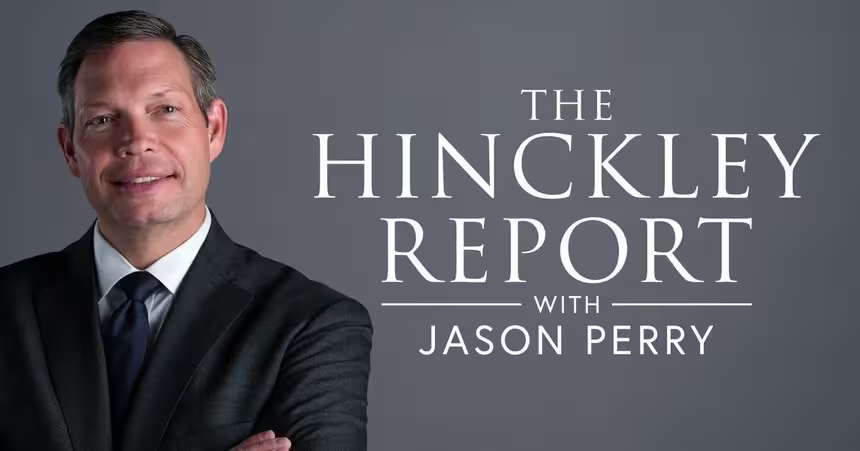
The Hinckley Report
Hosted by Jason Perry, each week’s guests feature Utah’s top journalists, lawmakers and policy experts.Providing Support for PBS.org
Learn Moreabout PBS online sponsorship(ethereal chime music) - [Announcer] Funding for "The Hinckley Report" is made possible in part by the Cleone Peterson Eccles Endowment Fund.
- [Announcer] Tonight on "The Hinckley report."
As another turbulent year in politics comes to a close, our panelists break down the major headlines.
Who are the winners and losers of the midterm elections?
Which stories had the biggest influence on our state?
And what does 2023 have in store?
(adventurous music) Good evening and welcome to "The Hinckley Report".
I'm Jason Perry, director of the Hinckley Institute of Politics.
Covering the year we have Glen Mills, anchor with ABC4 News, Lindsay Aerts, reporter with KSL NewsRadio, and Max Roth, Anchor with Fox 13 News.
This is a great episode this evening, when we get to talk about what's happened this past year.
It's always so interesting you all are helping with the news in the state of Utah, and every time we have a show like this, you start talking about these topics, you say, "Was that this year?"
- I know, I can't even believe we're sitting here again in A Year in Review show.
- And you look back at these topics and you're like, "Wait, was that January?"
- Right.
- Yeah.
- "When did that happen?"
- Yes, indeed it was, and you're gonna help us remember some of these big stories 'cause you all covered them, you helped us know.
And so I'd like to kind of go through and just hear from you what you think some of the big stories were.
Max, let's start with you, give us a big story.
- It was so important, I think, this year that Utah's political consensus or political leaders came to a consensus in caring about the Great Salt Lake, that I remember when I was a kid, my cousin was in a punk rock band and they had a concert with a bunch of bands, and it was called The City by a Dead Lake Concert, and that's how we all thought about the Great Salt Lake at one time or another, that it's just this dead lake, it's smelly, you can't drink the water, there are a lot of bugs.
It is so important, it's so important.
It's an ecological wonder for birds and other kinds of life, but it's also important for us because it fuels our snow, it protects us from all of the toxic stuff that's on the lake bed, and so the fact that both political parties came together to care about it and to put money into saving it is key.
- Yeah, and I think some of the money is there.
This is some of the start of fixing it, and I think what Max is saying is correct, that everyone is kind of on the same page that, "Okay, we need to do something about it," but the solutions are what we're not agreeing on and what are the solutions are kinda the bigger question, and I know we're gonna talk about themes in 2023 coming up, but that is a consensus that's gonna have to, they're gonna have to get on the same page about what that fix is.
Right now we've seen some money in a trust for saving the Great Salt Lake, we've seen, a big one this year was the water rights, the way we revamped water rights, and that they can be sold now, so it's not use-it-or-lose-it kind of mentality, so those are big shifts, but we still haven't gotten to the point where we're addressing the property taxes, and I know that was a bill that they started to talk about in the interim and it died there in a committee before it even got out of an interim.
So clearly this isn't the year that we're gonna revamp the whole structure, but we may need to get to the point where we are taking more systematic changes and we haven't seen those happen yet.
- And advocates all along have been saying, "We've been telling you this for years."
- Yeah.
- "We need to get ahead of this.
Let's start investing in this, let's start addressing this."
You know, you go back decades even- - Yeah.
- When people were starting to sound the warning.
So we're finally to the point where we're paying attention to it, I think a big part of that is the environmental impact because that's something we all feel directly.
We started to see, you know, more dust come up and more storms, and we really saw firsthand how that impacted us even on a personal health issue, and that kind of brings into play that out of sight, out of mind thing.
When it's right in front of your face, you start to pay attention to it a lot more.
- Yeah.
Max, what's interesting about this is, not only is it crossed all political boundaries, but there are reasons why people in Washington County should care about what's happening here in the Great Salt Lake.
- Yeah, you know, it's, first of all, there's no place in the country and few places in the world where you have this big a population.
The Wasatch Front is a mega city, it is, you know, we're talking about more than two thirds of the state's population.
When you take in the whole Wasatch Front that will be affected by that dust, that will be affected by that lack of snow, and to have that big a population right next to this inland sea and to be affected by that, and to have that sea go away, if it does, it would be an environmental catastrophe.
- Maybe we should be thanking the New York Times though, 'cause they're the one who wrote this story that really kicked off this firestorm in the last few months of the year, I would say, where they called it the environmental nuclear bomb, isn't that what- - Hm-hmm.
They did.
- They called it, right?
And then everyone sort of jumped, not that there wasn't prep before that, but there was certainly a push after that article came out.
- I do wanna say though, not to just toot our horn, but we're part of the Great Salt Lake collaborative, KSL is as well, and the Desert News and Salt Lake Tribune, and before that story came out, we had already formed that group to focus attention across these different commercial enterprises that compete with each other, sharing video, sharing stories, sharing photographers to get the word out about this lake, and I wanna, think that's important.
- And there was some lamenting over that, you know, like, the New York, that article that you referred to definitely brought it to the forefront, but local journalists were sitting here saying, "Hey, hello, we've been covering this-" - Yeah.
- For a while as well."
- Yeah.
Before we leave this entirely, Glenn, so the legislature put about 500 million, close to that, last year, into this, we're gonna see that again this next legislative session, some amount of funding?
- I think so, that's still a top priority when you talk to the legislators up on the hill.
You've even seen them come out with priority statements, which include addressing this again, But one thing we haven't mentioned also is it's not only local, at the state level, that are starting to address this, We saw a bill pass in mid-December- - Yeah.
- Through Senator Romney.
We've seen Blake Moore, Representative Moore, and other representatives working on this as well.
So it's also being addressed at the national level.
- Yeah, even just this week, 'cause things are happening in the federal government dealing with the Great Salt Lake, that's another good one.
For our viewers, there's a special episode next week about this very topic.
The whole show is about the Great Salt Lake.
Okay, Lindsay, just give us a story you've been following that was impactful.
- Well, you can't get out of 2022 without talking about how the Supreme Court overturned Roe v. Wade.
- Oh yes.
- Obviously that is a massive story that impacted every single person in the United States of America, but then not only did you have this national storyline about what it was doing, it trickled down into your state level where now the rules, the laws, the guidelines that your state put forward became your local laws, and so we saw Utah's trigger law take effect.
We're now seeing it being held up in courts, and again, I'll push towards 2023, this legislative session upcoming, are we gonna see them make more changes to this law to kinda just, you know, solidify things.
We saw a letter come out from Representative Karriane Lisonbee and Representative Kera Birkenland, that was sort of putting doctors on notice that they're paying attention to whether or not abortions are happening in Utah, that was really an unprecedented move, and they cited some legal analysis, their interpretation of the law that other lawyers, at least our lawyer at KSL, was like, "There is no interpretation of this law that we see this as valid," but at the same time, you know, they are telling doctors, "Okay, we may tighten this up," more or less.
- Mm-hmm, mm-hmm.
Glen, talk about what's happening here, 'cause it's an interesting decision here where this issue is left to the states.
- Yeah.
- And you know, across the country, and Utah has a very specific sort of approach to this and we'll probably will see some, talk about how that's being received by policy makers and then by the people you're interviewing.
- So we had that trigger law passed in 2020, I believe, and it was to go into effect once the Supreme Court, if it were to overturn Roe v. Wade, and that's another point in this discussion is pro-life advocates have really been laying the groundwork and the foundation- - Oh yeah.
- For this- - Yeah.
- For a long time.
Really, you could go back to the original Roe ruling when they started laying the groundwork, and once they got their makeup that they knew they could potentially push this, that six to three majority, they took advantage of that, they pushed it and they got the result that they wanted.
So we had this trigger law in effect that essentially banned all abortion, there are a few minor exceptions.
So that the state at that point, I believe it was the night the Supreme Court overturned Roe v Wade, said, "Okay, we have this rule in effect and it is now going into effect immediately," the very day that happened.
So of course all the opponents then, which they threatened to take this to the court from the very beginning, immediately did that, the court intervenes and puts a stay on that.
So then the state comes back to this other law that was passed back in 2019 that bans abortion essentially after 18 weeks, and they say, "Okay, this is the law of the land at this time while this all works out," but Lindsay makes a very good point, we may see some additional changes in the upcoming session.
- Go ahead, Max.
- Oh, you know, I was just going to say this had a political impact, I believe, maybe not so much in Utah, in terms of the outcome of elections, but you could argue that the Supreme Court is democratic majority now, probably because of some momentum from backlash to this decision, and so what we're gonna have to see play out is where the country falls as this moves forward.
If the courts allow these bans to stay in effect, if a political consensus starts to shift towards pro-life or pro-choice, because right now most polling says that America's majority pro-choice.
- Let's break that out for a second, Max, 'cause you talk about the makeup of the Supreme Court, which is so important, which, you know, has more of them were conservative judges appointed by Republican presidents, but why don't you go back to 2016?
- Yeah.
- Because when we, you know, this is through the Hinckley Institute, as we polled people in the state of Utah, we said, "What is important for you and who you'll be voting for for President of the United States?"
And this was a key issue for Utah voters, even back to that point, since you talked about setting the stage.
- Yeah.
Yeah, and I think another thing that comes to mind, because I think politics suddenly becomes the realm where this is really important.
Not that it's not personally important, that's the most important thing, is how it impacts human beings, but in terms of policy, the court's not gonna change anytime soon, there are a bunch of young conservative judges there, so it's gonna be a political question.
- Yeah.
- And if Democrats wind up in the majority in both houses of Congress, then it could, a ban could be overturned.
- Just, before I leave this one a little quickly, Glen.
This does impact, this kinda issue impacts voter turnout in a significant way.
- You bet.
- This connects even to our midterm elections.
- Yeah.
- Maybe talk about that for a moment.
- Well, there is no doubt that fired up a certain base of the electorate.
You take a look at all the conditions that went into this midterm election.
One, historically, when one party controls the White House and both chambers of Congress, voters want to see that change, it happened a little bit, but not anywhere near what we thought it was going to.
We had a President in office that had low approval ratings, historically, we had an economic situation where people were really feeling the crunch, everything was lining up for a red wave in the midterm election, and it simply didn't happen, and you have to say that that was one of the factors that played into that.
- And you know what I'd like to just point out before we leave this topic is that I find myself in a strange place because I'm a guy, I'm a man, and I don't know how many women I know have gone through something like this, it's not something that they're going to tell me, and clearly I have not gone through it, and so, but it's a decision that a whole lot of men make, you know, in terms of the policy.
- And that was one of the debate faux pas, if you will, from Representative John Curtis.
Remember when he said, "As a man, I don't wanna have to make this decision," and everyone was like, "You know you don't have to, right?"
So that was kind of his vehicle.
But yeah, I mean, that happens, I think, first time it doesn't matter, whoever's in the powers, position is who's gonna be making these decisions unfortunately.
- And we saw protests play out across the country, including here in Utah on that very note, people sending that exact same message.
- Uh-huh, it's very interesting since this comes down to state control, those local elections become even more important for us to pay attention to, which is interesting.
Okay, Glen, just give a story.
- All right, let's get into the great independent experiment, we saw- - It's like the Charlie Brown experiment.
- Yes.
- Right?
- All right.
- Good title.
- Yeah.
And in a lot of ways this was a beta test.
I have sources that tell me high ranking people, including Senator Romney, were invested in this, watching it to see how this was gonna play out for potential future runs.
- Okay- - So what we- - We're talking about the Senate race- - The Senate race, yes.
- Evan McMullin, Senator Mike Lee.
- So Senator Mike Lee going for his third term, independent candidate Evan McMullin, who left the Republican Party several years before that, we know him from a presidential run back in 2016, he comes up and runs as an independent.
Now, there was a very important key that played out in this race, and that was that they went to the Utah Democratic Party and said, "Look, can we get you to bypass your own Senate candidate for this race and throw your support behind us as an independent?"
As a result we saw the closest Senate race that we have seen probably since 1970 here in the state of Utah, but it still fell short by double digits.
So there are really some important lessons there.
Yes, it was a very close race, but Senator Lee still won reelection by 10- - About 11 or so- - Yeah, 10, 11 points, depending on how you wanna round that up.
So my network mostly looks at this and says, "Yes, it provided a very close race, and we saw tons of money come in for this race, advertising was out the roof on this race, and it was closer than we have seen for Utah standards," but they draw the conclusion that it probably was not enough for those people that were watching to say, "Yes, there is a clear path for an independent candidate to be successful in the state of Utah."
- I wonder if that is indeed the takeaway because, while, yes, Evan McMullin was running as an independent, he really was a Republican, but yet not conservative enough for some people, right?
So I still wonder if there is a path for an independent who is an independent.
This, you know, if Romney, for example, were to run as an independent, would he fare as well?
Probably not, right?
And that's kind of the same lines as what you're saying, there isn't a path for that type of independent, but is there a path for someone who is more moderate but not a democrat?
And I think McMullin's fatal flaw was that he was not a democrat, that he ran with Democrat's backing but he was not a Democrat, and so perhaps a Democrat statewide could do better, but maybe this Republican trying to be an independent, there isn't a path for that.
- My one thought on that is this, what I had mentioned about the Democrats bypassing on a candidate, that was a very big key in Evan McMullin getting the type of numbers he did.
So once you have this true independent in the mix and you have a democratic candidate, that's where I think that potentially falls apart.
- Yeah, and I think it's important also to say, I think this, and and you were both suggesting this as well, or Glen, you were, that this just shows that Utah is a deeply red state, it's that, someone can come in with that kind of funding and in the political environment that we've been in, and still do better than anyone else and lose that big, we're a red state, even though there are pockets of blue, it's gonna be a long time before someone wins statewide- - So Max, talk about this, using this experiment analogy a little bit too, because we've seen some high-profile people in Congress.
Let's take Senator Kirsten Sinema from Arizona, announcing last week that she is going to file as a independent in the Senate, still going to caucus with the Democrats, that looks like, but does that give us any more picture about what might be coming in the future?
Whether or not this was a test case, we might see it down the road?
- Well, I think when you have an established, an elected official, who changes their label, that can be a different thing.
I mean, you look at Bernie Sanders from Vermont, he officially isn't in the Democratic party either, but he runs on the Democratic ticket.
- [Lindsay] He's one the most progressive democrats.
- Yeah, yeah.
- Yeah.
And a Mitt Romney, I could see being a different case in Utah if he were to run and the Republicans didn't feel the candidate- - Yeah.
- But he said he was independent.
- Yeah.
So if you look at the future races in Utah, at least right now, the lesson learned is you probably still need to be, one of your parties, probably need to be a Republican.
- Yeah.
- It seems to me that it's pretty clear that the Senate seats in the state of Utah still run through the Republican party at this point, and just one point with the Arizona dynamic you bring up, we've seen the electorate in Arizona shift a little bit over the last couple cycles to where they are more potentially independent minded than what we have seen here in the state of Utah.
- I was thinking too that one thing that could happen, we've seen it happen once, is that Utahns, Utah conservatives are also people who really care about people, and so you remember when Bill Orton and Karl Snow were running?
- Oh, yeah.
- And Karl Snow's campaign director put an ad in the local paper that showed him and his family, his big family, and Karl Snow and his family right next to a headshot of Bill Orton, Bill Orton and his family.
- [Jason] Yeah.
- And it backfired, and Bill Orton won in what might have been the reddest district in the country, as a Democrat, because those conservative Utah County largely voters, looked at that and said, "That's not right," and so something like that could happen.
But barring that, I don't see it.
- Okay.
Any other big stories?
I got a couple in mind too.
Lindsay, did you have something, Glen?
Go ahead.
- Well, we can't get out of 2022 as well without talking about inflation.
- Yeah.
- Because that is on everyone's minds, it's infecting everybody's pocketbooks.
Obviously inflation has gotta come down some way, we're seeing the feds start to do that to try to raise interest rates to cool off the housing market, cool off other markets, slow things down a little bit.
How that's controlled on a local level, I don't really know.
I mean, other than us not going out and panic buying, right?
So we can kinda curb our own spending individually, I guess that could help things a little bit, but I also see inflation impacting charities, especially around the holiday.
I did a story in the last couple of weeks about the Utah Food Bank who says they're seeing monetary donations roll in still, but they're smaller and they also say they can see it in food donations.
They used to get donations that are like, you know, that make up a meal, right?
The yams, and the beans, and the, you know, all the fixings, the stuffing, and now they're getting the hamburger helpers, and the assorted beans, right?
Suggesting that people may be digging into their pantries to give what they can, but not necessarily going out and buying new, so it's impacting everything.
- Go on.
- I think another big story that we should mention when we talk about 2022, redistricting, which happened the year before, but we saw the impacts of it this year, we saw it go to court this year, but you take a look at the four congressional districts here in the state of Utah, one of the big complaints about it is that Salt Lake County was divvied up into those four.
In fact, there's a point in Salt Lake County you could call the Four Corners Area.
- Yeah.
- Where it comes right to the point of all the districts.
We saw in the election results, we used to have at least one competitive district in the state of Utah where a Democrat could be competitive, a Democrat could win it, that was the fourth district.
The fourth wasn't even the closest race this year, it was the second, and it was still a 26-point difference between representative Chris Stewart and his democratic opponent.
So we have now four clearly red, safe congressional districts in the state of Utah.
- And I wonder how Democrats react to that.
I mean, what do they do?
How do they overcome that?
I mean, this happens, you know, on the democratic side as well, so it's not just a Republican gerrymandering thing that's a problem, obviously Democrats gerrymander in ways too, but I just wonder if you're the Democratic party statewide, you're just thinking, "How do I, I'm just like running up a hill that I'm never gonna get to the top of."
- Okay, I wanna get into some prognostications for this next year.
I noticed none of you mentioned University of Utah back-to-back Pac-12 championships.
- Yeah- - Well, they- - Or- - Didn't win last year.
- Yeah.
Well, Pac-12.
- Well- - Well- - So the Rose Bowl- - Sorry, sorry.
- Yes, there you go- - You stole my thunder because I was gonna say it's gonna be a triple, you know, they're gonna do the hat trick.
- Oh- - Excellent.
- The three- - Max Roth has called it here first.
Let's talk about what's we're gonna see, stories for the coming year.
What do you see coming, Glen?
- Okay, well, one big one will be what does Senator Mitt Romney do?
- Yeah.
- And- - Yeah.
- And we should expect to see him soon perhaps start to put together fundraising teams, possibly make an announcement by mid-summer, is he going to run again?
And how is he going to run again?
Which we have alluded to earlier in the show.
- And who will his challengers be?
We know Attorney General Sean Reyes has signaled that he is likely to get into that race or perhaps getting into that race, he hasn't said as much, but he's kind of started the ball rolling there.
We know some other names behind the scenes that are also gonna throw their hat in the ring.
So I think this is Romney's race to decide how to control the field here, right?
If he runs, the race looks different, if he doesn't run, the race looks different.
- There's one word that is how he'll control the field, and that's primary.
He has to thank his lucky stars that the convention isn't everything because he would not win in the Republican convention.
So if that were it, then I don't think he'd run, but because he can go to a primary, he has that opportunity.
- Yeah.
That's a good point.
And when he ran the first time, he didn't win at convention, and he won the primary with 75% of the vote, that has changed likely from the last time, but another name to watch for the Senate race is former Congressman Jason Chaffetz.
If he potentially gets in, and then there are other people, who are eyeing that as well if Senator Romney decides he doesn't want to run.
- So that's, there's a different slate of people- - Right.
- Who are willing to run against him regardless- - Right.
- Than if not.
Okay.
- And I think the two we mentioned are on the regardless side.
- Okay, excellent.
Lindsay?
- The other things I think I'm looking at for 2023, just whether or not Utah might do something with the abortion trigger law, either in code or constitutionally, depending on what happens with the lawsuit.
Could Utah lawmakers make a proposal to amend Utah's constitution to protect the unborn?
That's a, there's been a bill file open in the past and so we'll watch to see if that happens.
We're also watching, you know, could there be a school choice bill?
We haven't really talked about education, but could there be a school choice also known as a voucher bill that may be tied to this increase in teacher salary that the governor wants to do.
- Yeah.
- So we'll watch for that.
Water conservation, obviously gonna be how those come down, and then obviously our lawmakers are signaling they want more tax cuts, but how the taxes are cut is kind of- - Yeah.
- Depends on where you fall.
- A lot to negotiate there, huh?
Max, in your mind, you take any of those as well, but you get the final minute here.
- Water and air, water and air.
We're really good on snowpack right now, but right now doesn't matter so much.
We were even better off last year later in the season and we had a terrible water year.
And so if we have another bad water year, it's gonna be bad for us.
I mean, you need water, it's just one of those rules of life, and you need clean air and wildfires, are we going to have more catastrophic wildfires coming out of California, Oregon, Idaho, and filling up our skies?
Pollution used to be our winter problem, it's now our summer problem far more.
- Mm-hmm.
Any potential legislation you see coming on those issues?
This is our last 30 seconds.
- Well, a big one that wasn't mentioned relate to transgender community.
- Oh yes.
- We're going to see bills come out to try to prevent minors from transitioning, and sources tell me we could see that right off the bat when the legislative session starts.
- Yeah, it's always interesting, some of these bills, you know, there's a strategy from legislators, we'll probably see some of those bills pretty early on.
Thank you so much for your year in review and we'll have a chance to see how you've done on the forecasting for what's to come.
- Happy New Year, Jason.
- To you as well.
And thank you for watching "The Hinckley Report."
This show is also available as a podcast on pbsutah.org/hinkleyreport, or wherever you get your podcasts.
Thank you for being with us and we will see you in the new year.
(adventurous bright music)

- News and Public Affairs

Top journalists deliver compelling original analysis of the hour's headlines.

- News and Public Affairs

FRONTLINE is investigative journalism that questions, explains and changes our world.











Support for PBS provided by:
The Hinckley Report is a local public television program presented by PBS Utah
Funding for The Hinckley Report is made possible in part by Cleone Peterson Eccles Endowment Fund, AARP Utah, and Merit Medical.