Roots, Race & Culture
Utah’s Latino Life and Legacy
Season 8 Episode 4 | 26m 15sVideo has Closed Captions
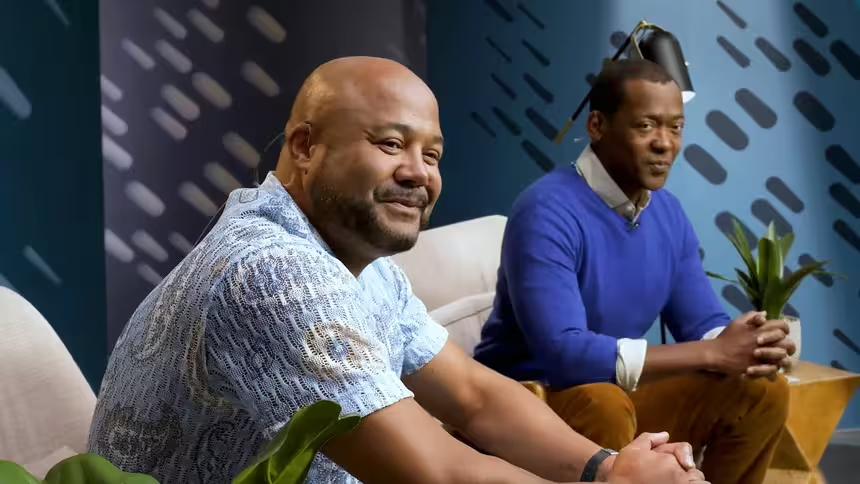
How does Latino culture shape Utah’s past, present, and future?
From railroad laborers and miners in the early 1900s to thriving entrepreneurs, educators, artists and political leaders today, Latinos are rewriting Utah’s cultural and economic landscape. Explore the challenges and successes that define the Hispanic community in Utah. How has Latino culture shaped the state, and how will it shape the future?
Problems playing video? | Closed Captioning Feedback
Problems playing video? | Closed Captioning Feedback
Roots, Race & Culture is a local public television program presented by PBS Utah
Roots, Race & Culture
Utah’s Latino Life and Legacy
Season 8 Episode 4 | 26m 15sVideo has Closed Captions
From railroad laborers and miners in the early 1900s to thriving entrepreneurs, educators, artists and political leaders today, Latinos are rewriting Utah’s cultural and economic landscape. Explore the challenges and successes that define the Hispanic community in Utah. How has Latino culture shaped the state, and how will it shape the future?
Problems playing video? | Closed Captioning Feedback
How to Watch Roots, Race & Culture
Roots, Race & Culture is available to stream on pbs.org and the free PBS App, available on iPhone, Apple TV, Android TV, Android smartphones, Amazon Fire TV, Amazon Fire Tablet, Roku, Samsung Smart TV, and Vizio.
Welcome to Season 7
Bold and honest conversations tackled with humor, insight, and empathy.Providing Support for PBS.org
Learn Moreabout PBS online sponsorship- [Narrator] Funding for "Roots, Race & Culture" is provided in part by the Norman C. and Barbara L. Tanner Charitable Support Trust, and by donations to PBS Utah from viewers like you.
Thank you.
(upbeat music) - Hey, everyone, and welcome to "Roots, Race & Culture" where we bring you into candid conversations about shared cultural experiences.
I'm Lonzo Liggins.
- And I'm Danor Gerald.
Thanks for joining us.
Today, we're diving into the story of Latinos in Utah.
From railroad laborers and miners in the early 1900s to thriving entrepreneurs, educators, artists, and political leaders, Latinos are rewriting Utah's cultural and economic landscape.
- So where did their story begin?
What challenges and successes define the Hispanic community in Utah, and how does their culture shape Utah's past, present, and future?
Joining us, we have two guests to help us understand this group's contributions to our state.
Welcome.
- Thank you so much for having me.
Lorena Riffo-Jenson, and I'm the Director of Economic Development for Salt Lake City, and I'm so passionate about our city.
- [Lonzo] We're excited to hear about it.
- Thank you.
- Professor, tell us about yourself.
- My name is Armando Solorzano, and I have been at the University of Utah for 37 years in the Department of Ethnic Studies.
And since I came here, I start looking deeply into the history of Mexican, Hispanics, Latinos in the state of Utah, which also brought me to study the history of the African-Americans in the state.
At the same time, I look at the Indigenous population, the Navajo, the Utes, the Goshutes, and put the whole thing together in a way that makes sense for all of us to understand that we belong here.
- I have a quote from Professor Solorzano's book, and I want you to comment on that, okay?
Now, it says, "Erasure is a form of violence.
Recognition is its healing.
Remembering is an act of justice."
Can you break that down for us and tell us what that means for you?
- Yeah.
Well, my first encounter when I came to Utah and this general tendency to deny the history of Mexican, Hispanic, Latinos in the state, which, again, it contrast with much understanding and learning of history in Mexico, since at the age of five years old, I learned that Utah was part of the Mexican territory.
- Yeah, - This was Mexico before it was Utah.
- So it was this psychology called cognitive dissonance, meaning that what you know in your inside and who you are doesn't match with the outside.
So again, being in Utah and continuously hearing, "Oh, you just arrive, you just came," it did not match my experience.
And because we do have a key history, I want to clarify that.
What we need is people who write the history, but since we haven't been written in it for different reasons, so people don't know it, so they deny it.
When in fact, and by denying the history, they deny ourselves.
So again, writing the book, it was more like a moral responsibility to my people, to my community, and to myself, because if I'm in this position as a scholar, as a PhD, it owes to the community.
- Yeah.
Yeah.
- I can never make it to the university by myself- - Right.
- Given the situation.
So I felt this responsibility to the community, not to make the history, because they already made the history, but just have the energy, the inspiration, the challenge to write it, in which you write it, again, remember, everybody, that we are not immigrants.
- Right.
- That we never came here.
America came to us.
- Yes, and there's a history, a long history of, basically, Hispanics in Utah.
It didn't just start, I mean, not only was it their country, but there's a part of Hispanics building Utah.
Can you tell us just a little bit about that?
- Yeah, we are the putting together of the Indigenous people and the European people who came to this land, right?
In the case of the Spaniards, they mix.
That's where the word mixture come from.
So, and again, in that mixture, I need to take and attend to my Indigenous roots.
In our mythologies, this is the Aztlán, this is the land of the sacred people.
This is the land that the goddess gave to the people.
So again, our sense of identity comes through the land.
You take the land from us, you take our identity, and that is something that, historically, we are not allowed, right?
And we are not claiming that we own the land.
In our mythologies, the lands belong to the great spirit.
We are here to take care of it and share it.
We just ask to respect our dignity, and again, our sincerity when we talk to you.
- Yeah, and I want to delve so much deeper into the history of it.
Lorena, you grew up in Chile but you moved here- - [Lorena] I did.
I did.
- How old were you when you moved here?
- I was almost 14.
My parents came to Utah, and it was a very different place.
It was a wonderful place, but it was a very hard place.
At the time, even though I lived in a country where doctors, engineers were part of the government, the Latino experience was one where I was actually placed in resources because I didn't speak English, although I grew up speaking Spanish and French, and there was just the limitations that they were being put upon me.
I think the one thing that I was very fortunate is my experience to have lived in Chile, where I could see professionals that looked like me.
I remember being in high school and some of my counselors, I kept telling them, "I'm going to be a lawyer."
And they kept saying.
They looked at me, like you talked about, cognitive dissonance with that look, and school is always something very important to me.
I grew up, education was something I didn't learn here, but rather in Chile.
And of course, I went to law school, got my master's in public health at the University of Utah, my graduate at the University of Utah and BYU, and so my experience has been very different.
It's very hard to leave your place, your home, and go to a new place, but what was interesting for me from the onset, it was kind of, we talked about recognizing our Indigenous tribes that were here, recognizing that Mormon pioneers were being persecuted, and they found a place of peace in Mexico.
And I have always said this makes Utah a very special place, and we shouldn't forget our history because as a young woman, as a political asylee to this country, naturalized citizen, I feel that that is the magic of Utah, is accepting that, at one point or another, our history brings us together because we were running from persecution, some of us, not all of us.
- Let's talk about Utah being the example for the country.
Right now, a very big topic that's going on is immigration.
- [Lorena] Yes.
- And how is immigration impacting your community today?
- Hmm, well, I would say Salt Lake City is very diverse, and not all of us are immigrants.
I mean, my friends who are Mexican-Americans have always been here, as they tell me, but we all have family members that may be permanent residents, and when you hear some of the things happening out there, and having gone through a process of waiting eight years to have my political asylum, waiting five more years to become a citizen, it takes time, so it affects all of us.
It affects our community.
And as our country becomes, as we come together, we marry and we have children, many of our children are multiracial, and I think the United States of America will continue to become that.
So I don't think it's just affecting the Latino community.
I think it's affecting everyone.
- People are afraid, and that has a strong repercussion because our state already is one of the less educated in the nation, and if we continue with this trend, what kind of state, what kind of nation are we building?
What has distinguished us?
- [Danor] It definitely weakens the nation.
- How has it impacted your job with teaching?
- Oh, it's absolutely, like right now, again, the enrollment of minority students, you wanna call them, at the U diminish, so you don't find that rich environment in the classroom.
You start our meeting with your question that, we start at the very onset.
You start omitting, denying our participation, how our students, our people are enriching the whole cultural, and even the religious life of the whole state.
- [Danor] Of the whole community.
Yeah.
- The whole community, and when you raised the question about immigration, the first thing to came to my mind was this very famous citation from one of the greatest historian in the United States, Hanley, who said, "When I started writing the history of the United States, I didn't realize that I was writing the history of immigration," because we tend to forget that this is the land, the nation of the immigrants.
The United States is an experiment.
- Yes.
- Yeah.
- The only one in the world, and we better work together, or we're going to disappear together.
- That's a really powerful and significant point.
I mean, you are talking about stuff at the level that's fundamental to the existence of the country, and one thing that I find that's kind of interesting, and we're gonna talk about kind of, I'm gonna answer your question, how does it affect our job?
We can tell you this, many topics that we cover are about people of color and all sorts of communities and genders and all sorts of things, and recently, I have found that it has been more difficult to get people to come on the show, but not just Latino or anything like that, just across the board, out of what you just mentioned, out of fear.
People are afraid of letting their face be seen, letting their voice be heard, and- - Authenticity together.
- And it's really disheartening.
It's troubling that people don't feel like it's safe to be visible.
- When talk about economic impact, how much of an economic impact does the Hispanic community have in the state of Utah?
- The numbers that I've looked is, across the state, is about $3 billion in buying and buying power.
- Wow.
- We have an incredible partnership with the Suazo Business Center.
They support our—all businesse but of course, because of Suazo, a lot of Latino-owned businesses obtain their technical support there.
The goal of that organization is to create wealth in our Latino communities so we can grow and be part of this beautiful American dream, if we can all share that dream.
- What are some myths that people have about the Latino community that are just myths?
- The presence of Latinos or Mexicans in the state happens in 1990.
Absolutely wrong.
- Yeah, that's a good one.
- We were here 2,000 years before the pioneers, and that has been proved in our relationship with other Indigenous group, especially with the Utes.
We spoke what is called the Ute Aztec language with words.
Another misconception about us, that all Latinos in Utah are LDS.
It's the opposite.
85% of Latinos in Utah are Catholics.
- [Lonzo] Oh, yeah.
- And that precisely opened a new study by Georgetown University here in Utah, how in a state who in its majorities is represented by people of the LDS faith is integrating this new wave of Catholic immigrants.
It's a beautiful, beautiful study.
Latinos, Mexicans, Hispanic of the LDS faith and the Catholic faith, they always been working together.
- Yes.
- Religion is respected, right?
- [Danor] Yes.
- We come from different roots.
That's what make our community so beautiful.
- I just wanted to clarify, present day, what are some of the barriers that some entrepreneurs, Hispanic entrepreneurs might face when it comes to starting businesses?
- I would say access to capital.
That's why Salt Lake City has an economic development loan fund, where if you're a local business, we will work with you to ensure that at the point of entrance, we create access, and we create it in a way that it doesn't matter from where, you can go to one place and find the information how to do business in Salt Lake City.
- That's awesome.
- And you can find examples in our community, I'm gonna mention the Rico family.
- Absolutely.
- The one that produced the salsa, and that economic success, again, was based on the community.
They started selling tamales, and for us, again, it goes beyond the business because it has community implications.
We just witnessed the closing of Mestizo Cafe, which was a very important cultural center for us, but in the case, like for instance, of the Rico family, right, look at one of their sons.
Now, he's a doctor.
He's the most brilliant person I have seen studying medicine here.
He was recruited then, I believe, in Boston, and now, he's in doctor at Stanford University.
- Wow.
- So again, the implication of businesses, again, it expand to the whole community, and that is the beauty of the Latino.
- You bring up a really good point because, within our community, within the Black community, there's so many contributions that we bring to America that people overlook.
They think about some of the stereotypes, but they don't think about the beauty they bring with music, we bring with language, they bring through the clothing- - [Danor] Medical.
- Just all of the different things that we bring and all different aspects.
With your cultures, tell us more about that, the beautiful and wonderful contributions that the Hispanic culture actually brings to Utah.
But Lorena, tell us about some of that stuff.
- Oh, wow, I think culturally, it's seeing the world and its beauty and honoring our Mother Earth with an incredible respect.
And I would say just the vibrancy of design, color, music.
I grew up listening to jazz and knowing Billie Holiday before I moved to this country, and Louis Armstrong and Nina Simone and the opera, just almost touching and searching all the time for the beauty.
Whether it is Bachata, Cumbia, whether it's something you would hear in a Cuban cafe, the guitar, I mean the Charanga for the Andes or the people of the Andes.
There's just so much beauty, and I would say it's the beauty and the words.
I mean, I think about all the poets, Pablo Neruda, Gabriela Mistral, you talk about the science that the Aztecs brought, the Incas, I mean, we have so much.
- [Lonzo] The art.
- And one of the writers, a Mexican-American writer, said that even if all the Hispanic, we jump up to the middle class or the upper class, still the big differences in the United States within Latinos and the rest is gonna be cultural.
It's a culture embedded in joy, not happiness, and that's a big distinction.
- Yes.
- The Constitution talk about happiness, that the right to be happiness, but happiness is very frugal, very fast, enjoyable.
Joy is internal predisposition of who we are, to enjoy even suffering, and I'm not saying we are masochist, I'm saying we know and we go through suffering because it's part of life, right?
But we transform into joy, we transform into flowers, into dancing, into the cycle of life, into, again, loving the land, Mama Pacha.
- [Lorena] Yeah, Mama Pacha.
- And we suffer in Utah right now because what is going on with the Great Salt Lake?
- Thank you for mentioning that.
One thing that concerns me immensely now just looking at the economics of the Great Salt Lake, we will not have the ability to do much economic development if our lake dries up.
The University of Utah Law School had an article, the Law Review article that talked about the millions of dollars just from securities, public companies, that will have to disclose what's happening.
So that's something that our leaders who are in a position of power, they really need to be strong about their solutions because this is a beautiful place.
It's a place that is, for me, is my second home and my home because I have a daughter and I will stay here, so it does affect our economic development, but it also affects the spirit of our people.
And that means- - I love that.
- When I say people, I mean all of us in our state.
- What words of wisdom would you have for the young Latino generation that's coming up?
What advice would you like to say to them?
- Love who you are, cherish what comes through your family lines, your values, the knowledge, but remember that we're all coming together.
And I tell my daughter, she is the bridge.
Her father's side of the family happens to be Danish, and I'm Chilean, so I tell her she's the north and the south.
So if we can find a way for our young people to do better than we have done, I think it would be very powerful.
- I love that.
- Oh, wow.
- How about you, Professor?
- In academia, we teach our students, our Latino students, that we always live in between.
It's a very difficult place to live, but probably is the most meaningful one, okay?
Like Lorena said, we are not only Europeans, we are Africans.
Do not forget that when the time on the Underground Railroad, a lot of African went to live in the south part of Mexico, okay?
And they are with us.
They are Mexican, they're African-Mexicans, but to us, again, that is the beauty of growing up in Mexico that we are the cosmic race.
And we ask our children, you are everything.
You are everybody.
You are the conglomeration of our race.
That, at the end of the day, all of us are just one.
- [Lonzo] I love that.
I love that.
- And we carry, again, and I'm sorry to bring religion here, but when Pope Francis visit Mexico, one of the reporters in the airplane asked, "Why do you think the Mexican people suffer so much?"
And said, "Because they are the only one who continuously are saying yes to life, just to include everybody."
They are reminding them, we all are just one.
That, again, probably that's what the history is calling us to do, being this conglomeration of all races, and then all races come just one.
People call it the human race, but they say it so fast that they don't know what they're talking about, without knowing that it's a process of life to bring us to that level of consciousness, and together, we can achieve it.
- I just have to say, this has been one of the most beautiful and sacred shows that we have done.
You have both brought wisdom, beauty, knowledge, understanding that is hard to find in this world at this time, and so I just wanna thank you both so very much.
- Authentic and showing us the beauty of your cultures and the importance of it, and the importance of how we humanize people in our society.
We see them as not just statistics, or not just people who are immigrants or this or that, but they're human beings who contribute massively to the beauty of not only our nation, but to our state and to our city, so thank you so much for coming on.
- From all of us at PBS Utah, thank you for joining this exciting and fascinating conversation.
As always, other episodes can be found on our website, PBSUtah.org/roots or on the PBS Utah YouTube channel.
- And if you have feedback or ideas for other episodes, be sure to give us a shout out on social media.
Until next time, for "Roots, Race & and Culture," y'all, we are out (upbeat music) - [Narrator] Funding for "Roots, Race & and Culture" is provided in part by the Norman C. and Barbara L. Tanner Charitable Support Trust, and by donations to PBS Utah from viewers like you.
Thank you.
(upbeat music)

Preview: S8 Ep4 | 30s | How does Latino culture shape Utah’s past, present, and future? (30s)
Providing Support for PBS.org
Learn Moreabout PBS online sponsorship












Support for PBS provided by:
Roots, Race & Culture is a local public television program presented by PBS Utah