
The Growing Influence of Southern Utah
Season 10 Episode 28 | 28mVideo has Closed Captions
How does southern Utah manage growth? And what does that growth mean for political influence?
On this special episode of The Hinckley Report, we're on location in St. George. As the population of southern Utah continues growing, how do local leaders manage the needed infrastructure and natural resources for an expanding population? And with more people comes more political power. We examine the growing influence of Washington and Iron Counties on both the state and federal governments.
Problems playing video? | Closed Captioning Feedback
Problems playing video? | Closed Captioning Feedback
The Hinckley Report is a local public television program presented by PBS Utah
Funding for The Hinckley Report is made possible in part by Cleone Peterson Eccles Endowment Fund, AARP Utah, and Merit Medical.
The Growing Influence of Southern Utah
Season 10 Episode 28 | 28mVideo has Closed Captions
On this special episode of The Hinckley Report, we're on location in St. George. As the population of southern Utah continues growing, how do local leaders manage the needed infrastructure and natural resources for an expanding population? And with more people comes more political power. We examine the growing influence of Washington and Iron Counties on both the state and federal governments.
Problems playing video? | Closed Captioning Feedback
How to Watch The Hinckley Report
The Hinckley Report is available to stream on pbs.org and the free PBS App, available on iPhone, Apple TV, Android TV, Android smartphones, Amazon Fire TV, Amazon Fire Tablet, Roku, Samsung Smart TV, and Vizio.
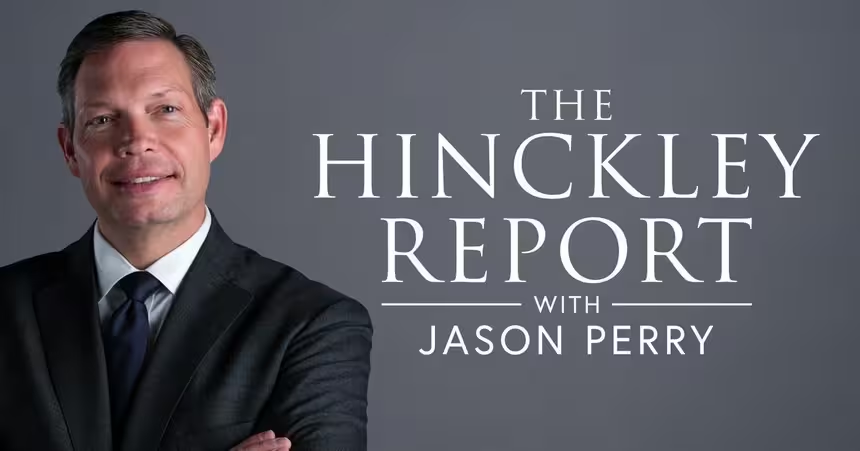
The Hinckley Report
Hosted by Jason Perry, each week’s guests feature Utah’s top journalists, lawmakers and policy experts.Providing Support for PBS.org
Learn Moreabout PBS online sponsorshipJason Perry: On this episode of "The Hinckley Report."
Our expert panelists discuss the major issues impacting Southern Utah.
As the region grows in size, how has the economy been impacted?
How are leaders handling constraints and concerns over resources?
And how is this growing region making an impact on the rest of the state?
announcer: Funding for "The Hinckley Report" is made possible in part by the Cleone Peterson Eccles Endowment Fund, and by donations to "PBS Utah" from viewers like you.
Thank you.
♪♪♪ ♪♪♪ Jason Perry: Hello, and welcome to "The Hinckley Report."
I'm Jason Perry, Director of the Hinckley Institute of Politics.
We are today filming a very special episode of "The Hinckley Report," live from the campus of Utah Tech University here in Southern Utah.
We love this campus.
We're so glad to have our guests with us here today.
Joining me for our discussion is Christa Hinton, member of the Santa Clara City Council, and Zach Renstrom, General Manager of the Washington County Water Conservancy District.
Thank you so much for being with us on this special episode.
So many things happening here in Southern Utah.
I look at this backdrop.
It's beautiful, such an amazing part of the state, and there's a reason why so many people want to be here.
And you are the two people really guiding the growth of what's happening here in Southern Utah.
I want to start with you for just a moment, Christa, if you don't mind, particularly through the lens of someone on the city council.
A lot has changed over the last ten years.
Washington County alone, 30% growth in the last 10 years.
Through your lens, how are you managing that, and what are some of the implications on this great part of the state?
Christa Hinton: One of the things we're managing with city council is kind of that balance between what our residents want to see happen and what's actually happening.
So we have a lot of residents that sometimes don't want to see a lot of growth in our areas, but with a lot of growth comes a lot of opportunities as well.
And so it's our job to be really careful about that growth.
Make sure we have the water that we need, the infrastructure that we need, and that the growth is in a manner that is positive for our residents.
Jason Perry: How do they reach out to you about this?
How do you kind of gauge that?
Because so many people want to be here.
That's a lot of growth.
How do you sort of manage that balance of what the people here would like to have in terms of the growth, the smart growth that they're looking for, and you match that with the demand?
Christa Hinton: We hear a lot from people through email, social media, out in public, but the demand is there.
A lot of people are finding that their children and grandchildren would like to move here and live as well, and that the traditional homes on a 10,000-square foot lot are a little bit out of reach for them and so there's been a little bit of a change of public perception in a higher density housing, not high density, but a little bit higher density.
Jason Perry: So that has changed?
Christa Hinton: To accommodate that.
That has changed a little bit, but there's still a lot who don't want to see the character of our city change, and that's really important to them.
Jason Perry: Yeah, Zach, when you start talking about the growth, the infrastructure certainly becomes the big question, housing supply for sure.
But also, something that's right in your wheelhouse, can we talk about the water requirements here a little bit?
In many parts of the state, that is the barrier to growth.
Talk about how you're managing that here.
Zach Renstrom: So in one of the driest areas of the state of Utah, this is the question that comes up a lot, of how we're dealing with all these growth issues and water.
And so what we're doing down here is we're doing two things.
We're becoming better stewards of the water that we do have, making it last longer.
And the second thing is we're building a lot of infrastructures to keep up with that.
And so, at the Water District, we plan to spend over a billion dollars in the next few years to keep up with all this growth.
Jason Perry: Talk about some of the changes that have happened.
There's some with our legislature, but some changes in some requirements that you put in place here when it comes to water usage, for example.
Talk about some of those things.
Zach Renstrom: Sure, so one example is the homes that are being constructed in Washington County today are some of the most water-efficient homes in the Western United States, if not the entire United States.
Even our existing residents, we're doing a lot of things like landscape conversion, so moving from a high-water-use landscaping to more desert-friendly landscaping.
And so it's just not one thing we're doing.
We're doing everything to make sure we have water.
Jason Perry: Christa, talk about this growth through the lens of someone who's been in your family here for a very long time, watching this growth.
Talk about what has changed over the last 10 to 15 years here in this area, has given rise to some of this growth.
Christa Hinton: One of the big changes, I think, has been the rise in short-term rentals.
That's been a big component in our area, especially Santa Clara, but throughout the county.
And that's made a dent in the housing in our area, but it also helps with tourism and taxes that come with tourism, so it's positive and negative on both sides.
Jason Perry: Yeah, well, I'm curious about how we're managing that a little bit because, for a long time, a good portion of the economy here was centered around tourism.
How has that changed or evolved here in some way?
Has it, as this becomes sort of an economic and population powerhouse?
Christa Hinton: I think we're, our economy, really has diversified over the past 10 or more years.
We see a lot more in construction now.
Healthcare, we have an amazing healthcare system that our residents have access to.
It's incredible the level of service that we have in our area.
So we're seeing a lot of different industries coming into play, and it's not just about tourism.
Jason Perry: Talk about a couple of those.
Christa Hinton: So, with healthcare, I'm actually--that's my day job.
I'm over at Intermountain Health, and I hear all the time about new providers, new services, and that the level of that service is just incredible for our area.
We were recently recognized with some very high-performing awards, and so that's been a big bonus, I think, for our community to have that growth, support the healthcare that we now have access to here.
Jason Perry: Now Zach, we've talked a little about some of the other infrastructure, but transportation certainly is a big issue here.
I've been down here sometimes when it seems like every soccer tournament in the whole state of Utah is here at some point.
Start talking about just the load on transportation in particular.
Talk about how that is being managed here in Southern Utah.
Zach Renstrom: So, we do a lot of things.
We have what's called the Dixie Transportation Committee, where they all get together, the cities, and we work on these issues.
We do a lot of long-term planning.
One of the frustrations that we do have down here is a lot of areas that would be really a good place to put a road, there's limitations to why we could put there, whether it's in a national conservation area or other endangered species that we have to deal with.
And so it's not sometimes as simple as like, yeah, let's just blade and grade.
We really have to go through a lot more to build infrastructure down here than they do maybe up on the Wasatch Front.
Jason Perry: Is this unique to this particular part of the state, or are there some other implications, some reasons why it takes a little longer, more people, and more involvement?
Zach Renstrom: So if you look at Washington County, the vast majority of our land is owned by the federal government.
And so any time there's a federal nexus, we have to go to the federal government and basically ask for permission.
And that does slow down a lot of our infrastructure projects here in the south.
Jason Perry: You know, Christa, you talk about Washington County, and you're Santa Clara, you talk about growth in these areas, but the Southern Utah is growing beyond just this particular area.
Talk about that a little bit too, because there have been these historical notions of this is rural Utah.
Is that still the right way to look at this?
What would--how would you classify what's happening here?
Christa Hinton: It's kind of a combination, I would say.
St.
George seems not rural at all, but the littler communities surrounding St.
George seem a little more rural.
So I think when you look at Southern Utah, Washington County, it's almost a hybrid of the fifth largest city, which is St.
George, in the state, and then Santa Clara, which is a population of 8,500 people, so.
Jason Perry: Yeah, when you think about the infrastructure and water, how are you kind of balancing those?
We have a big population center where we are right now at this great university, and some of these other parts that have quite a smaller population, but just as much of an impact from your decisions here.
Zach Renstrom: Yeah, and like you said earlier, St.
George is really growing, and so one of the things that we've noticed when we look at our infrastructure is a lot of these little communities will come into St.
George for services.
Like they'll come to the hospital.
They'll come here to shop, and so we have to make sure that we're building infrastructure to accommodate a lot of just day visitors coming here.
And we have to supply all that infrastructure for them.
Jason Perry: Part of this population growth is very much tied to the economy itself and the opportunity that's there.
And I'm curious, from both of your perspectives, as you look at the future growth of Washington County, but Southern Utah in particular, what industries do you think are ready to be sort of the core foundation of St.
George in particular, Christa?
Christa Hinton: I think construction's always going to be a core part of our economy, but we're seeing a little more movement in technology as well.
And I think that's supported in large part by this university and opportunities that are here for students to gain the education they need.
Jason Perry: Yeah, I'm particularly curious, so I'll just do a follow-up on that too, because a good portion of the workforce is coming from this great university, Utah Tech University.
Kind of curious how the government officials are working with the university.
I'm particularly interested in this, when we're in Salt Lake with the University of Utah, to tie the future economic opportunities for this area with the workforce that's coming out of this university.
Christa Hinton: I think President Smeed and also President Rushton at the Dixie Applied Technical College really have a pulse on what employers and industries need in this--in our area, and so they're always in contact.
They're always adjusting, seeing where they can better support the workforce that's needed in the industries we have here.
Jason Perry: Zach, talk about how you're looking at that issue.
I've been in so many meetings with you, and we've been talking about the economic future of this particular area.
Our own president's come to talk to you a couple of times.
Talk about what you see as the future base for this part of the state of Utah and its economic might going forward.
Zach Renstrom: One thing that we've noticed, because a lot of companies will come and talk to us about water before they move a company here, but just because of our taxes here, our culture here, I've noticed a lot of companies wanting to move to the state of Utah.
And if they're coming up from Vegas or, you know, California, St.
George is the first place they hit.
And so I've noticed a lot of businesses coming in just because of our geographical location where they're so close to Vegas, close to Southern California, but they're still in Utah, enjoying the benefits of what this great state has to offer.
Jason Perry: Where are you seeing most of this population increase coming from?
Zach Renstrom: I would say Southern California, or like I have two new neighbors that just moved here from Southern California, and so I see a lot of that.
Jason Perry: How about you?
Christa Hinton: I would agree with that.
I mean, we do see a lot of children and grandchildren, family expansion, but there are a lot of people moving in, liking what they see here and staying.
Jason Perry: Yeah, so talk about from the planning perspective, when we have these water concerns.
Tell how these council meetings go for you when you're trying to decide on density and where to build.
And there was a time when I remember even talking to you in the past where we're getting into issues about permitting, for example.
How many do you give out and when?
Talk about that pressure, because that certainly is one of the levers that you have to sort of control the flow of properties going out here.
Christa Hinton: It's definitely a consideration.
We hear that from residents a lot of times, especially with new development.
"How do we have water for this?
How will we ever support this?"
We lean heavily on the Water Conservancy District.
They have an incredible plan in place for the next 20 years, but it's supported by growth that's mindful in all the cities as well.
Jason Perry: Talk about that balance, because you brought this up a moment ago, and it's sort of the conversation from the whole state.
When you have so much of our land here that is controlled by the federal government, and there are just pockets here, as I'm looking out, it starts looking like it's starting to be space constrained.
Talk about the approach from this part of the state when you look at limited amount of land and just high, high demand.
Zach Renstrom: Yeah, that's a tough balance that the city councils have to work with of, you know, we have all these kids coming up.
We have people moving in and how--where we're gonna put all these people.
And they've done a phenomenal job of balancing that and trying to find that.
And it's, you know, people have different views, but really, our city councils have done an amazing job balancing all these different needs, and so I'm very grateful to live in an area that we have such proactive city councils working on these issues.
Jason Perry: We only have a couple minutes left, and I would love to just get your read.
It's so important that we have shows like this that are in this part of the state.
We should be here more.
The state should be here getting the best lessons learned from all of you.
But Christa, as you look at what you're doing here and your connection to the rest of the state, what would be a message that you think would be important for the state to consider when they think about what's happening at what is not just a growing economic base for the state, but also a very important population center for the state?
Christa Hinton: I think it's important to consider the national parks and the state parks that we have, the recreation we have here, the tourism, the anchor that we are in the state, and how important that is to the overall economy, jobs, and then housing as well.
I appreciate very much Representative Cal Roberts's legislation this past session helping with infrastructure costs for cities to implement the housing that's already entitled.
That can really help unlock some housing opportunities for us down here in Southern Utah as well as throughout the state.
Jason Perry: Perfect, Zach, last 30 seconds.
Give your perception on that and a positive case for what's happening here, because I know your hand's on the wheel.
Zach Renstrom: Yeah, so I'd say we are a good example for the rest of the state of Utah that we can still accommodate growth and economic growth.
We still have room for our kids to grow, but yet we're keeping up with our infrastructure.
We're able to build our infrastructure, and we have long-term plans to make sure that, as more people come, that we will never run out of water.
Our roads will be safe.
We'll have schools and all that, and I think we're a good example.
Jason Perry: Yeah, you certainly are.
Thank you so much for bringing your insights.
Such an important conversation.
I can't wait to see what you do next, thank you very much.
Zach Renstrom: Thank you.
Jason Perry: The growth that we have been discussing is also leading to a unique power dynamic here amid the red rocks of Southern Utah.
As more people begin to call this area home, the political influence of the region is also growing, not only within the walls of the Utah legislature, but in the halls of the United States Congress as well.
We're so happy for the second segment to have joining us Brad Last, a former member of the Utah House of Representatives and Special Assistant to the President of Utah Tech University for Government and Community Relations, and Mary Weaver Bennett, Director of the Leavitt Center for Politics and Public Service at Southern Utah University.
Thank you so much for the second segment here.
I want to talk about the political influence of Southern Utah because it is significant, and I want to get that for just a moment.
But I'm gonna start with you Brad for just a moment.
I had a chance to work with you as a member of the legislature.
You've had a chance to watch not just the growth here in the southern part of the state, but also the political influence, even being part of that yourself.
Talk about what has happened when it comes to the significance of the voice here in our capital city.
Brad Last: Well, everybody knows where St.
George is now.
Everybody knows where Washington County is now.
Everybody knows about the growth, and so people are just really aware of what's going on down here.
And as far as the legislature is concerned, I just have to say that we've had amazing legislators.
When I got there, Dave Clark and Steve Urquhart were there.
They were great legislators.
They taught me a lot.
And over the years, we've just had what I think is really great representation down here.
And I want to say one other thing that I think makes a huge difference, is that there's a lot of people that are really involved in taking the message north.
And there's two organizations in the state that have a lot of power, influence, I would say, the Utah Association of Counties and the League of Cities and Towns.
And we've had a number of people down here that have served in leadership positions in both of those organizations.
Christa Hinton, who was here with you just a moment ago, she's the president-elect of the League of Cities and Towns.
Two of our county commissioners, one has been the president of the Association of Counties, or UAC.
One is the president right now.
And also, former Mayor Jon Pike was the president of the League of Cities and Towns.
Shawn Guzman has been extremely involved with the League in terms of their legislative concerns and their initiatives.
And so I just think that there's a lot of people down here who have devoted a lot of time because they care about not only Southern Utah, but they care about the state.
And I think we get recognized for that.
Jason Perry: Absolutely, Mary, talk about why you think that's the case because that certainly is true.
Not only do we know so much more about Southern Utah, St.
George here too, but some of these names that have been mentioned have been very influential in policy for the state of Utah.
Talk about the rise of that influence.
Mary Weaver Bennett: Well, absolutely.
I mean, we are fortunate enough, our two state senators, Senator Evan Vickers and Senator Don Ipson, have each served in the state legislature for 16 years, and so that--they've been in leadership positions as well--and that experience has really helped Southern Utah move along.
I will also say that sometimes power comes from subject matter expertise.
And in addition to the numbers, we punch above our weight.
What we don't have in numbers, I think we make up for in subject matter expertise.
And you've got someone like Representative Albrecht, who this session passed two bills on nuclear energy.
And so he will be getting started the nuclear energy business in Southern Utah.
Jason Perry: Yeah, so I wanted to detour for a second because it's something you have some expertise on too, because it does seem, when it comes to the energy needs of the state of Utah and the direction, a lot of it is going to come from this part of the state.
Mary Weaver Bennett: Absolutely, we've got three--all three of the geothermal plants in Southern Utah are in the Beaver County, so that has implications for the entire state.
We've got massive solar farms throughout Central and Southern Utah, in Millard County, Iron County, and Beaver County.
And on the flip side of that, we've got two AI data centers being planned in Millard and in Iron County, so they're going to need that energy.
But both of those geothermal and solar are talking about utility scale energy sources for the state of Utah, and so that's a huge power source for us.
Jason Perry: Brad, how does that translate into more political voice on these issues when, increasingly, the whole state is going to be looking at Southern Utah?
Brad Last: Well, I think it's understandable that if we're going to play that big of a role in the power, that we are going to have a lot of influence in the state.
And as far as subject matter experts, I mean right here in Washington County, we have Colin Jack, who is an electrical engineer, who's one of our representatives, and he works for Dixie Power.
So when Mary talks about the influence you can have in the legislature, you can see people looking to him, or looking to Carl, or other people that have been involved for their opinion and for their ideas.
And so one or two individuals can have a lot of influence that way.
If we have those individuals down here, and we have the power down here, then obviously that bodes well for us in terms of the influence that we can have in the state.
Jason Perry: So Mary, this also translates into some economic power.
Talk about that for a moment.
Mary Weaver Bennett: So, obviously, the population centers have been growing in Iron County as well as Washington County, and we are trying to keep up with the housing needs.
So, obviously, development is a big issue for Iron County as well as Washington.
We're trying to keep up with new businesses and where are they going to be located, and can we keep up with the needs of being able to house new businesses?
And it's really, I can say it's really booming in Iron County, absolutely.
Jason Perry: I want to talk about the mix of population centers here in the southern part of the state of Utah.
And Brad, can we get into some redistricting questions just a little bit too?
Brad Last: Hey, it's your show, man.
Jason Perry: All right, perfect, perfect.
Because, for a long time, particularly when you were in the legislature, there was this conversation about how important it is that our congressional district had very urban areas and rural areas.
And we'll just talk about because there are rural areas in this what's now the third congressional district that's happening right now.
Talk about that change a little bit, whether or not this part of the state really thinks it's important to have that mix or not, because certainly, even though you've got some of that Utah County, it is not connected to a very, very urban area like it has been in the past.
Brad Last: Well, if you want my own personal opinion, I think it was pretty good the way it was.
And I look at Celeste Maloy, who will be running again, or whoever is serving in that seat, and I just think, how can one person possibly represent that district?
Now the expertise that she has, and others may have that come on behind her, maybe they have a lot of expertise in public lands, and that's great, but I just find it almost impossible for somebody.
It's like serving Alaska or something like that, really.
The district is so big, and I think that it made a lot of sense to have that responsibility shared.
And I also think it's great to have several legislators, congressmen, congresswomen who understand the rural issues at least somewhat, even though they may not be completely involved the way that I think Celeste has been.
But anyway, I see that as a challenge.
And so, I mean, that's pretty much my opinion.
Jason Perry: Mary, talk about how that might work, too, because it's interesting you bring up Congresswoman Maloy.
It's been--it's kind of hard to even look back when you had someone that was representing a district that is actually from this particular area.
She had a challenger from this area.
She represents this area, grew up in this area.
Talk about that and how that might translate into maybe more of a voice, or increasing the voice of rural Utah, or at least the southern part of the state of Utah when it comes to issues in Washington DC.
Mary Weaver Bennett: Absolutely, Congresswoman Maloy is uniquely situated.
In her--she sits on the House Appropriations Committee and the House Natural Resources Committee, so those are two strong committees to be on if you're representing Southern Utah.
But also in addition to that, she's newly been made the chair of the Western Caucus, so all of the Western members of Congress who are members of the Western Caucus, she'll be the head of it and speaking for them, which gives her the ability to articulate Utah issues as Western issues.
And I think that's a whole new power source for her and for Utah.
Jason Perry: Brad, talk about how that sort of works with the federal government.
We do, in the first segment, we talked about this a little bit as well.
A lot of Southern Utah is controlled by the federal government.
Talk about whether or not that, sort of that, I guess, that issue between those two principles right there are still as hot as they've ever been or not.
And how is Southern Utah pushing back?
Brad Last: Yeah, I mean, it's been a hot issue for a long time.
I give a lot of credit to county commissioners that I've seen work in Southern Utah on public lands issues, and they have fought back as much as they can, but it really does come down to votes.
I mean, one thing--I'm wondering what would happen if you went to Washington DC and asked all 435 members of Congress, "Do you know what the BLM is?"
I wonder.
And so they just--I don't think they have any concept of what a state with so much public lands is really like, and how frustrating it is to try and move things forward in your state when there's so much interaction that you have to have with the federal government.
And as far as Celeste is concerned, I would just say it's so nice to have somebody from here.
Like the Northern Corridor is a really important Corridor for us here in St.
George, in Washington County.
And when she's back there fighting for the Northern Corridor, she knows where it is.
I mean, she's been there.
It's not like some little road out in Utah that other people are looking at.
I mean, she understands the importance of it.
She stood on the ground, and I think that really helps a lot.
Jason Perry: Mary, I want to talk about the power of the vote of a population that is increasing so quickly, and it has grown so much here.
Give sort of a prognostication a little bit about the growing political power of this part of the state of Utah, and how it might influence the direction of the rest of the state and definitely when it comes to the policy decisions made in our legislature.
Mary Weaver Bennett: Well, I think, you know, with the astronomical growth we've seen in Washington County and Iron County, two of the three fastest growing counties in the state of Utah, as we get to more redistricting and we get to the 2030 census, I think you'll probably see more representation from Southern Utah in the state legislature, given the number of the increase in population.
And that will bring to the forefront, you know, energy issues are going to be important to every single person in the state.
And what are our energy resources?
And are we going to be self-sufficient?
And I think that's one of the huge power centers that Southern Utah will bring to the table in Salt Lake legislature.
Jason Perry: Mm-hmm, Brad?
Brad Last: Yeah, I think you have to understand that that power, in terms of the numbers, is incremental.
I mean, when I ran for the legislature in 2002, it was because of the 2020 census, and there was a district that was created, you know, for somebody that lived on the eastern side of Washington County, at least that's how it felt to me.
Well, ten years later we got another half, excuse me, one half of a representative in the state legislature, and this time around, another one half.
So it's not like you're gonna get a lot more votes really quickly.
The reason I think that Southern Utah has a lot of influence is because we're not really rural.
We're not really urban.
Shawn Guzman I think used the term "rurban."
And you know, we still kind of understand the rural issues here in Washington County, and we like that rural culture and we're trying to help keep that.
So the way we get votes is we have a lot of friends all around the state.
All of the rural legislators connect with us, and we connect with them, and that gives you a big voting block and a lot of help.
And I think also the legislators from this area and the rural legislators have been very good at building relationships and trust with some of the urban legislators, and they help us when we need the help.
Jason Perry: Mary, some of this change in growth may eventually lead to maybe, in 2030, another congressional district.
Talk about your role in that here in the southern part of the state of Utah because, certainly, you might attribute a lot of the growth that will come to that new district from what's happening down here.
Mary Weaver Bennett: I think it can be nothing but a benefit to Southern Utah, given the growth in population, if we see another congressional seat representing a rural area.
First of all, maybe they'll be able to split up the massive rural area that's now in CD3 and give each legislator a chance to have a more compact district.
But then our issues that we've talked about, land, water, energy, growth, those issues will be greater represented at the national level if we add more representation.
Jason Perry: Okay, that's gonna have to be the last comment, but we're so grateful for your insights.
We'll watch the growth here carefully.
And thank you for watching "The Hinckley Report" from this very special location here at Utah Tech University.
These are important issues, important conversations that will continue.
Please join us and watch us on our podcast with "The Hinckley Report."
announcer: Funding for "The Hinckley Report" is made possible in part by the Cleone Peterson Eccles Endowment Fund, and by donations to "PBS Utah" from viewers like you.
Thank you.

- News and Public Affairs

Top journalists deliver compelling original analysis of the hour's headlines.

- News and Public Affairs

FRONTLINE is investigative journalism that questions, explains and changes our world.











Support for PBS provided by:
The Hinckley Report is a local public television program presented by PBS Utah
Funding for The Hinckley Report is made possible in part by Cleone Peterson Eccles Endowment Fund, AARP Utah, and Merit Medical.