
DOJ Investigation, Election Preparation, & Other Headlines
9/11/2026 | 26m 49sVideo has Closed Captions
Utah's Lt. Governor faces a federal investigation, plus other political headlines.
Utah Lt. Governor Deidre Henderson is being investigated by the Dept. of Justice over her refusal to hand over the state's voter registration information. Our expert panel discusses the ramifications, and how other leaders are responding. Plus, we explore the ongoing impact of the state's primary elections. Journalists Doug Wilks and Max Roth join political insider Kate Bradshaw on this episode.
Problems playing video? | Closed Captioning Feedback
Problems playing video? | Closed Captioning Feedback
The Hinckley Report is a local public television program presented by PBS Utah
Funding for The Hinckley Report is made possible in part by Cleone Peterson Eccles Endowment Fund
DOJ Investigation, Election Preparation, & Other Headlines
9/11/2026 | 26m 49sVideo has Closed Captions
Utah Lt. Governor Deidre Henderson is being investigated by the Dept. of Justice over her refusal to hand over the state's voter registration information. Our expert panel discusses the ramifications, and how other leaders are responding. Plus, we explore the ongoing impact of the state's primary elections. Journalists Doug Wilks and Max Roth join political insider Kate Bradshaw on this episode.
Problems playing video? | Closed Captioning Feedback
Where to Watch The Hinckley Report
The Hinckley Report is available to stream on pbs.org and the PBS app.
The Hinckley Report
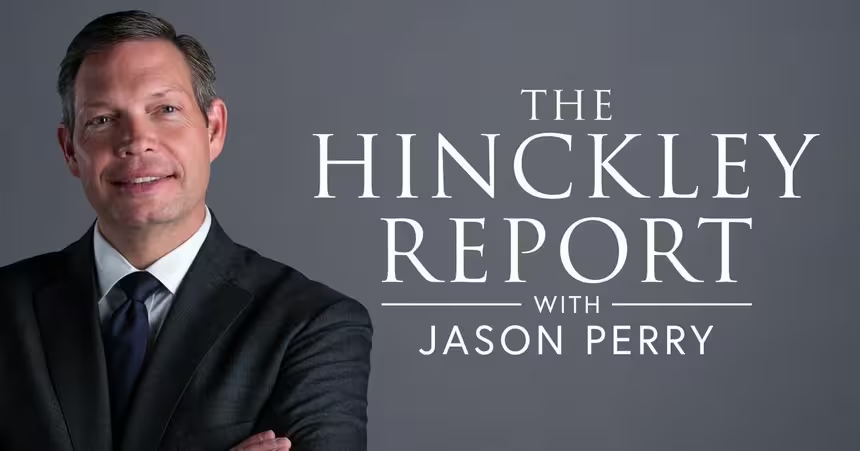
Hosted by Jason Perry, each week’s guests feature Utah’s top journalists, lawmakers and policy experts.Providing Support for PBS.org
Learn Moreabout PBS online sponsorshipJason Perry: On this season's premiere of "The Hinckley Report," surprising results from primary elections could change Utah's political landscape, major decisions at the federal level have a big impact on local politics, and our panelists reflect on the 25th anniversary of September 11. announcer: Funding for "The Hinckley Report" is made possible in part by the Cleone Peterson Eccles Endowment Fund and by donations to PBS Utah from viewers like you.
Thank you.
♪♪♪ ♪♪♪ Jason Perry: Hello, and welcome to the season 11 premiere of "The Hinckley Report."
I'm Jason Perry, director of the Hinckley Institute of Politics.
Covering the week, we have Doug Wilks, executive editor at Deseret News; Kate Bradshaw, mayor of Bountiful City; and Max Roth, anchor with Fox 13 News.
So glad to have you here as we premiere this season of "The Hinckley Report."
A lot has happened over the summer, even the last couple of days, all heading into elections here in November.
So many interesting things.
Thanks for being with us.
Doug, I want to start with you because we're talking about elections, we're talking about voter information files, and something interesting this week.
Our lieutenant governor got a letter, the kind of letter sometimes you don't want to get.
By the way, you're under investigation by the Department of Justice.
Talk about this for just a moment.
What is at the heart of this investigation and what we're going to see coming from it?
Doug Wilks: Well, the investigation, DOJ wants all 50 states to give up election records, to give up things that are public, but they want the things that aren't public, and Lieutenant Governor Deirdre Henderson has said, "No, we're not going to do that.
It's not the right thing to do."
She doesn't want to give up social security numbers and phone numbers and driver's licenses, so she's taken a stand against that.
And the main question is, well, what's the endgame that the federal government wants to take over elections?
Because one of the greatest ways to secure elections is to make sure they're done individually in all 50 states, not in a centralized place.
Jason Perry: Kate, it's very interesting, because the response from the Lieutenant Governor is, "No, I did not know that I was under investigation necessarily," but then you get into what happens with the state's rights versus what's happened to the federal government.
What do you think is at the heart of that right there?
Kate Bradshaw: I think at the heart of this is a battle for control, and I think that the White House is looking for, you know, more control, more control of outcomes, and more interest in some of those outcomes.
I think the state of Utah is asserting that this isn't, data and a power that belongs at the federal level, and so we're asserting some control and pushback at the state level.
We're not the only state that's pushing back.
I have appreciated that Lieutenant Governor Henderson has taken this stance.
She's, frankly, joined by a lot of our local county clerks who do the on the ground meat and potatoes hard work of elections.
Having been a candidate for elections, having sat as a board of canvassers, I have really great confidence in our local elections and in our county clerks and in our lieutenant governors.
I think she's conducted really great elections with a lot of transparency, and I think our public really enjoys how we have conducted these elections and feels really confident here in Utah.
Max Roth: I want to--I wanna push a little bit on one thing that you said.
They're not actually pushing, but you're so good at being diplomatic, but you said they want more control over outcomes.
That's an extraordinary thing, control over outcomes.
Kate Bradshaw: I think that is, it is an interesting pushback that we have seen, particularly from the Trump administration.
You know, there's still this underlying current that the Trump administration feels like an election was stolen from them, despite not being able to provide the data that shows that.
And I have some concerns about if they control the data, will the outcome that they believe magically be what comes out?
And I think part of having the diffused 50 state system ensures that we can have those audit checks and controls to give it confidence.
I do worry about that.
Jason Perry: Doug, weigh on that for just a moment too, because you start talking about why do you need more information, what does this get to in the end about sometimes they talk about election security itself, but in the end, does this impact the potential outcome?
Who shows up, the voter turnout itself, et cetera.
Doug Wilks: Well, you're talking about voter confidence, right?
And as you talk about, President Trump has famously talked about the election that he lost.
And so, it leaves the public going, "Well, is there something there or not?"
Utah, even before President Trump, wanted greater turnout and went to mail ballots, and the turnout went way up, and they were secure.
We've done state audits and not found malfeasance in the election system, so the confidence is built when you have strong people who are able to work the elections, and it's your neighbors who are working the elections, right?
And it's very hard to collude if you have 50 states doing it differently, and it's noteworthy that both former Governor Herbert and Governor Cox, they're very supportive right now of the lieutenant governor and Utah's position.
And it's not like these are progressive, liberal politicians fighting against Donald Trump.
No, they're looking at what's needed to be done.
Max Roth: The idea that comes to mind to me is the old Franklin Roosevelt, "The only thing we have to fear is fear itself."
And I think that's what we face with this.
We'll talk about 9/11 a little bit later, but there's no--there's just no evidence that we have a problem with American elections in terms of the actual process of voting.
I mean, political discourse, we can talk all about that.
And so, the problem is the fear, the insecurity, and sowing seeds of doubt in a system where every single arbiter looking at it has said no, nothing bad happened.
There was no malfeasance here, as you said, a good word to choose.
Jason Perry: Before we leave this one, Kate, I want to get a little data point here and then a comment, a graphic from our lieutenant governor.
What she's citing is she did a survey of--she investigated 2 million registered voters in the state of Utah, found 27 non-citizens were registered in that amount of time, and so she used this as a backdrop of sorts for this graphic where she is talking for certain about what's happening here with her office.
And she said, first, this is it.
"I don't take kindly to bullies.
I'm not going to be intimidated into doing something that I don't think is right."
This is sort of the backdrop she's coming, and put that together with this context.
This is a Republican administration in D.C.
making a request of all the states, including a Republican lieutenant governor.
Kate Bradshaw: Well, I've already mentioned I appreciate and I'm a fan of Deirdre Henderson.
And I'm appreciative of any leader who has done the research and done the due diligence.
We've had legislative audits, we've had audits by the lieutenant governor's office, and the data shows that that what's being talked about in the anecdotes isn't happening.
And so, she's willing to stand by that data and protect the information of each of our voters so that it doesn't become, you know, part of some national database that we can't control.
So, Deirdre is taking a firm stand.
I appreciate that as a leader, that she has done the work, done the checking, ensured that we have those protections.
Where they've--where they have found, you know, less than a hundredth of a percent where there are some issues, they have acted quickly.
Again, I've served on a board of canvassers for elections that we hold locally, and I've seen those reports as well where the--where you see that check and balance, you know, people that maybe, given our voting window, have passed away from the start of the voting window to actual election day.
They'll find those and they'll pull those.
There's a lot of checks and balances in the system, and I really encourage people to look at the options to learn about the transparency, to talk with your local county clerk, and again, as Doug mentioned, these are often your neighbors serving as the poll workers.
Jason Perry: Yeah, absolutely right.
Doug, I want to start with you on some of the primaries that we just had.
There are multiple races out there.
A couple of big, high profile leaders did not survive their primaries.
I want to get to that just a little bit.
Talking about first President Stuart Adams, the President of the Senate, Dan McCay is one of those, and Trevor Lee.
Talk about that a little bit because these were big names that did get beat.
Let's talk about the reasons for that.
Doug Wilks: Well, there was an anti-incumbent sentiment, and certainly the push for a data center in Utah and how that process went through impacted those races.
Stuart Adams has been, you know, in the legislature for 20 years, and he's been leading the Senate.
And there's no question a lot of the good that he's done.
I traveled with him.
I watched him in front of President Zelenskyy in Ukraine as Zelenskyy is asking Utah for help.
And because of the willingness of himself to serve and to work, he's done a tremendous amount of good.
I'm not his spokesperson, but I've just seen him do a lot of good.
He's also defended the Utah Compact.
He's been in there a long time, and Utah has, you know, its economic standing is always top five, if not the best in the nation.
Why he was defeated, I think, is because people get tired if you're in office a long time.
The data center, you can--if you've been in office 20 years, there's a few things over those 20 years where people can start to collect and say, okay, I'm gonna go for a change.
And with the others as well, I think we've just seen people getting tired, and they don't want to have anything pushed through.
And the data center particularly was something that people felt was pushed through.
Jason Perry: Mayor, we've got to talk about that.
These data centers, it does seem to be an underlying theme, not just in that particular race.
Races across the United States and here in Utah.
Talk about that and how you approach this particular issue, because I know it's coming to you.
We've got data centers all over the state, and it is starting to have an impact on how people are voting.
Kate Bradshaw: It is, the data center issue is one that brings together a lot of factors.
So, you have local land use decisions, where you're putting it, are there noise issues and complaints, are they gonna be using a lot of energy, are they gonna be using a lot of water, and then there's the question of, do they want some incentives to come, some tax increment incentives to come?
And so, you're seeing, nationally, entities look at what is that true cost of the energy?
Are we socializing that, or are they--are the data centers bearing that cost?
Are they being more water efficient?
And it does seem that data centers are moving towards being more water efficient, how they cool those systems.
And as they pop up everywhere, the question becomes, do they need to be receiving incentives?
Some of the early data centers in Utah did.
Maybe now that time has passed and run its course.
Some of this falls to the state.
The state gets to decide some of these incentive opportunities and things like that.
Some of it does fall to locals.
And then of course, how we handle that energy and water policy, particularly important to Utah, and you've got local governments that are starting to say maybe we need to do a pause and a moratorium.
You see some cities doing that, some counties, so that they can decide, you know, is this the right location?
Is this the right package for us?
Max Roth: And I think most Utahns had never heard of Mida before.
The Military Installation Development Authority, is that right?
And all of a sudden, they find out that this data center is coming in, and it's coming in because a small, you know, unelected board--they're appointed, you know, it's governmental, there's nothing illegal about it--but it's a small board of people went through this whole process before telling anybody and, you know, including the people who live next door.
Jason Perry: Doug, what do you think?
So, there's the process argument, which is pretty good, and Governor Cox has even talked about that particular one, the Stratus data centers not having good process.
Is it about the process or is there an underlying, deeper concern with voters maybe in Utah and around the United States?
Doug Wilks: I think voters are trying to figure out who the Republicans are, who the Democrats are, and how they align with their values.
We've heard from a lot of people who were MAGA supporters who are incredibly disappointed with Donald Trump because they feel like he's left what they want, which is no wars, and yet we're in a war with Iran.
They wanted immigration reform, and yet that seems to have stalled, even though clearly the border is tighter.
So, those who are supporting Donald Trump in MAGA are dissatisfied.
Those who are in the middle are trying to find a Republican Party that they can support.
The Democrats have gone to democratic socialism, and they're trying to figure out, well, we don't want to go that far.
Should we come back here?
So, really, the--I think everyone's confused, and if you're confused, you say, okay, I'm either not going to vote or I'm going to, quote, throw the bums out, not that they're bums.
Max Roth: Let me add something, because as we're talking about these groups, there's, you know, you talked about MAGA and then the Republicans who are more in the middle.
Remember, you talked about the people going towards socialism, but there are a lot of Democrats towards the middle as well.
And so, and I think we saw that in our primaries.
Kate Bradshaw: The lesson I took away from some of our primary results is that the electorate very much wants to feel connected to the decisions that the elected officials make.
They want high levels of communication, they want high levels of transparency, they want engagement, they want opportunities to be heard, and they want information being shared to them rapidly.
We're in a different environment.
Information needs to come really quick, and if voters feel like decisions are made in a room that they don't have access to and can't participate in, then they're pushing back.
And I think that very much has been a lesson for anyone who serves elected office from either side or the nonpartisan sides, to make sure that you are continually seeking to engage your residents, your citizens, people in your district with whatever is coming down that you're facing that need big decisions to be made.
Jason Perry: Hey, Max, before we leave this one, because I know you've talked to people about this too, underlying some of this data center seems to be this national concern about China, other countries, that this has become a national security issue on top of the resource issue.
Max Roth: Yeah, it's--and there are real concerns about that, I mean, surrounding AI in general.
It's something--it's a revolution that's, you know, a lot of people compare to Gutenberg and trying to figure out how the world is going to change with that.
And security, certainly, you need--you can't have such a powerful technology that's not--that you can't have some control over how it works within your system, so that is a real issue.
But I hesitate to give credence to the argument that that's why they need this government support to build a data center, because right now the entire economy is being propped up, the stock market rising because of AI.
Investors are investing in AI.
All the money is there, and so the notion that Box Elder County or the state of Utah needs to contribute to that needs to be put up against the fact that all the big money is already going to AI.
Doug Wilks: It is a security issue.
I mean, you can't ignore the fact that China and everyone else does want to control information, and AI is a way to do that.
I mean, AI has come after media, they've come after everything.
They scrape.
We'll write a news story, and within, you know, half a second, unless it's protected somehow, it's in there, it's in the system.
And there's a lot of lawsuits with media trying to pay to--pay us because we're putting out all the money to get it there, and AI is just taking it and collecting their check.
It's a real huge issue, and I think people are uncertain.
We hear from parents who say, what should my child study when they go to high school and college?
What job will be there when my child leaves?
I mean, there's an uncertainty.
Gas prices are high.
There's a lot of issues there that are making people unsettled, and I think that stretches to an election too.
Jason Perry: So Kate, this primary election is going to change some serious things with our legislature.
Brand new Senate leadership coming up.
Talk about that for just a moment, because that will influence not just the issues we've been talking about here, but the entire priority list for the upcoming legislative session.
Kate Bradshaw: It really does.
With President Adams losing in his primary as the sitting state Senate president, it really opens up the entire leadership team for the state Senate, and so everyone is jockeying for positions.
There's going to be contested races for Senate president, for whip, for, assistant whip, and majority leader.
All of those have different senators that are vying.
There are five new Republican freshmen that are coming in, as long as those races, of course, hold through the general, and I don't know that we've ever seen five freshmen have so much power and influence on leadership elections as these five because of the way the numbers seem to be breaking down.
The other senators have served together a long time.
There was a little bit of a shakeup two years ago in Senate leadership elections, and so, you know, there are some lines and alliances that have already been formed.
And so, those those new five senators, a few that have served in the House and so are very familiar with leadership elections in process, a few that are going to be new to the body entirely, will have an outsized role there.
But it will mean that you have a new team, whoever it is, the outcome of those leadership elections will take place usually about a week after the general election.
But that new team will need some time to gel, establish priorities, figure out how they're going to lead that caucus.
That'll take place in December.
In contrast with the House, where we don't expect probably much change in that leadership team, a team that already works well together, knows what their caucus priorities, those types of things, and so it'll set up a new dynamic between the state House and the state Senate in how they work together in the upcoming session.
Jason Perry: Absolutely, those five have a lot of quick friends as they get ready to vote on their leadership.
Let's get to some of our congressional races for just a moment, Doug.
So, the 1st Congressional District, this is where Ben McAdams is, he won 52% majority in that particular district.
There were some conversations in the state about whether or not even in the Democratic Party that he was going to be too moderate.
Turns out that's not the case for the Democrats, at least in terms of how they voted in this--for this primary.
Doug Wilks: It appears not.
It's still a very interesting race, you know.
There is a Republican challenger.
What is--McAdams is expected to win.
Of course, who knows, right?
We'll let the voters decide.
But what is the margin if he wins?
Is it 52%, is it 60%, is it 65%, or does the Republican win?
In other words, what really is going on in Salt Lake is going to be an interesting question to follow.
Kate Bradshaw: I think Doug has has identified this as a very interesting race to watch, for a lot of very good reasons.
One of the things I heard consistently in Republican circles with the maps that the Republican Party wasn't necessarily thrilled with versus--because of various court actions was, you know, will this new 1st District be pushed really far to the left because of the slate of candidates that were coming forward in their convention, in the Democratic convention, and then through signature gathering?
And I think it's interesting, for many years we've watched on the Republican side this process play out.
Often, the person that's, you know, not as strident has come out and been the person that moved forward to the Republican candidate for the general election.
And, you know, I thought it would be such an interesting thing to watch and say, look, our friends that are members of the Democratic Party have gone through a very similar process, and they've returned a candidate to be their general election candidate that actually, you know, kind of mirrors what you sometimes see playing out in Republican primaries as well.
So, it'll be interesting to see if that flows all the way through to the general for that new Utah 1st District.
But the outcome seemed to me to match what I've seen my Republican friends play out in a primary on their side.
Max Roth: I think that's true.
Also, I think that when you're looking at a primary, you're looking at the people who are more the diehards.
Now, we have mail-in voting, and so we tend to get more people voting, but still, Democratic primary, you would normally expect that those who are more on the far end and might get more excitement from the grassroots would do better.
And so, the fact that he got 52%, was it, or 51%?
Anyway, I forget, but right there above 50% in that, with that electorate, those voting in a Democratic primary, is really significant in terms of showing us where the left in Utah is.
Doug Wilks: Yeah, but there's another piece to this.
Independents can vote in a Democratic Party.
They can't in a Republican Party.
So, you have a lot of people who are independent, and they're independent because they're moderate and they have trouble finding a candidate on either side.
And a lot of the folks I spoke with who are independent said we want a moderate in Salt Lake.
We don't want Salt Lake to go the way of New York.
I mean, that was an actual con--many conversations that we had.
Max Roth: So, does that mean--do you think that Republicans, I guess, I mean, moderate Republicans must think that it was a mistake to close off the primary then, because they don't--because everything starts tilting towards the far end, and the moderates would--.
Doug Wilks: Well, you'll have to ask--I don't know.
I mean, I wish, I mean, I have my own desires that the primaries are open because that seems to be so significant.
But a, you know, a Republican wants to control their own party, right?
I mean, Kate, you can speak to that.
Kate Bradshaw: Yeah, I can, it is--it plays out in both parties.
There's definitely a wing of the Republican Party that is frustrated or mad when they feel like there's a certain segment of the population that quickly registers to vote in the Republican closed primary.
It's always an interesting kind of statistic to look at the registered voters in Utah.
The Republican Party has the largest amount of registered voters, but the second largest pool is the independents.
They haven't picked either party.
You know, they want to be able to weigh out both sides.
The Democrats have left their primary open, so it's easy for them to go over there.
It's a little bit harder if they decide they want to play in the Republican system, but it's interesting that we have such a large group who are choosing not to readily identify with either party.
Jason Perry: In our last couple of minutes, I want to talk about some things we need to remember, some things that we're commemorating this week.
One of those, Doug, let's start with it's been 25 years since September 11.
Of note is that we have a whole generation now who has no memory of that event itself, but yet it's impacting still our politics today.
Your thoughts, having been close to that and done some reporting as an event like this sort of transitions from memory to history.
Doug Wilks: There's such a need to capture our humanity, and we go through something like that 25 years ago, and I remember I was living in California, a journalist in California, doing special editions, everything you do when a disaster like that happens.
But neighbor after neighbor after neighbor were going out and finding a flag, not just to put on their house, they wanted it on their car, they wanted to drive down the street with something on their antenna, ribbons.
It was just trying to say, look, this was horrible, and people mourned with those who mourned.
It was a time of mourning, but also a time of resolve.
Let's do something about this.
And when that happens, sometimes good decisions happen and sometimes bad decisions, but the empathy, the humanity was ever present.
And so, a day like today, 25 years later, it's important to really look at it and really see, not glorify it, but remember it.
Jason Perry: Max, you're doing such great work on this.
You talk to so many people.
Put that into perspective for us a little bit now as well about how it has changed the political discourse, perhaps, or maybe something we need to continue to remember.
Max Roth: Well, I think you hope, and I think we saw this after September 11, that when there is something horrible like that--I don't want to say tragedy, because tragedy implies that it was just going to happen, and this was a crime.
It was an act of war.
But you hope that it's going to bring out the better angels of our nature, and in so many ways it did, but it also made us scared.
And that's why I brought up the fear quote before, "The only thing we have to fear," because I think it made us more scared, and we're still trying to get our footing as this force for good that is based not just on reflexive patriotism, not just on a flag, but on the fact that we try to do what's right and that we live by a constitution and by laws rather than by leaders and over authority.
Jason Perry: Kate, maybe respond to that, but also put into perspective.
This is the week we are also commemorating the killing of Charlie Kirk here in the very state of Utah.
Kate Bradshaw: Yes, so this morning I started the day at a bell ceremony with my firefighters and my police department, as we remember.
I was 20 years old and a college junior on that day, and, and time has passed, and we remember.
We also appreciate those people who still stand and do those very hard jobs, and it's important for them to be able to pay that forward.
As a community, we're working to transition to remembering but also turning 9/11 into a day of service.
Many local communities are doing that.
The state's working to do that, and I'll be spending tomorrow in a day of service with my community so that we take some of that feeling that Doug talked about right after and we continue to translate that.
You're right too, that this has been a significant week for the state of Utah.
We were the location for the assassination of Charlie Kirk, and we're still playing out how we're going to remember that event.
Very publicly in Utah, the murder trial is still progressing, and so it keeps it very much in front of us as the public.
How his supporters and others remember him is still a legacy that is transitioning, and we in Utah still have a group of students who were there in person and are experiencing that trauma too, so that one is still, I think, fresh enough that we're not sure exactly how it will end, but we remember.
Jason Perry: Thank you, that's gonna have to be the last word.
Thank you so much for your insights today, so much to watch.
And thank you for watching "The Hinckley Report."
This show is also available as a podcast.
Thank you for being with us.
We'll see you next week.
announcer: Funding for "The Hinckley Report" is made possible in part by the Cleone Peterson Eccles Endowment and by donations to PBS Utah from viewers like you.
Thank you.
 New Episode
- News and Public Affairs

Top journalists deliver compelling original analysis of the hour's headlines.
 New Episode
- News and Public Affairs

Today's top journalists discuss Washington's current political events and public affairs.
 New Episode
 New Episode
 New Episode
 New Episode



 New Episode

Support for PBS provided by:
The Hinckley Report is a local public television program presented by PBS Utah
Funding for The Hinckley Report is made possible in part by Cleone Peterson Eccles Endowment Fund