
State Convention Preview
Season 10 Episode 32 | 26m 53sVideo has Closed Captions
Utah's Republican and Democratic Parties prepare to meet for their state conventions.
As the state's two largest political parties prepare for their conventions this weekend, more accusations of wrongdoing are coming to light in the race for Utah's 1st Congressional District. Our expert panel discusses what's to come when Republicans and Democrats meet on Saturday. Rep. Doug Owens joins political insiders Becky Wright and Taylor Morgan on this episode of The Hinckley Report.
Problems playing video? | Closed Captioning Feedback
Problems playing video? | Closed Captioning Feedback
The Hinckley Report is a local public television program presented by PBS Utah
Funding for The Hinckley Report is made possible in part by Cleone Peterson Eccles Endowment Fund, AARP Utah, and Merit Medical.
State Convention Preview
Season 10 Episode 32 | 26m 53sVideo has Closed Captions
As the state's two largest political parties prepare for their conventions this weekend, more accusations of wrongdoing are coming to light in the race for Utah's 1st Congressional District. Our expert panel discusses what's to come when Republicans and Democrats meet on Saturday. Rep. Doug Owens joins political insiders Becky Wright and Taylor Morgan on this episode of The Hinckley Report.
Problems playing video? | Closed Captioning Feedback
Where to Watch The Hinckley Report
The Hinckley Report is available to stream on pbs.org and the PBS app.
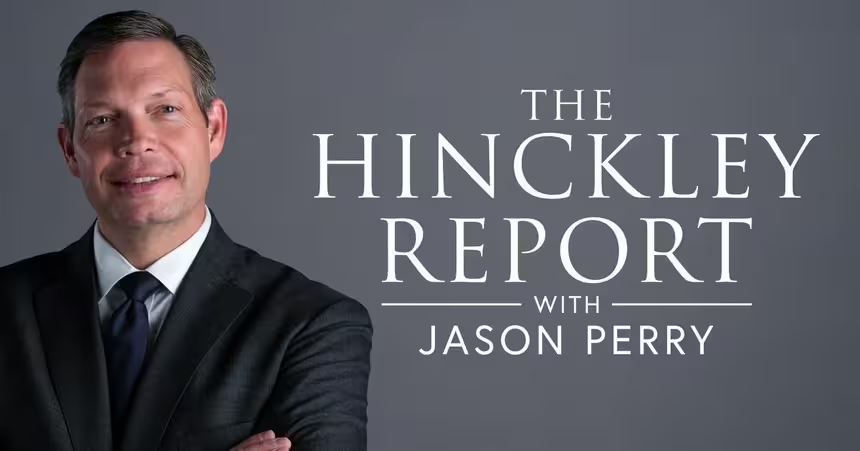
The Hinckley Report
Hosted by Jason Perry, each week’s guests feature Utah’s top journalists, lawmakers and policy experts.Providing Support for PBS.org
Learn Moreabout PBS online sponsorshipJason Perry: On this episode of "The Hinckley Report."
The support of county delegates swings with surprising results for well-known incumbents.
Party leaders prepare for competitive statewide conventions this weekend.
And new polling reveals how voters's attitudes about major issues have changed.
announcer: Funding for "The Hinckley Report" is made possible in part by the Cleone Peterson Eccles Endowment Fund, and by donations to "PBS Utah" from viewers like you.
Thank you.
♪♪♪ ♪♪♪ Jason Perry: Hello, and welcome to "The Hinckley Report."
I'm Jason Perry, Director of the Hinckley Institute of Politics.
Covering the week, we have Representative Doug Owens, a Democrat from Mill Creek in the Utah House.
Doug Owens: Good to be here.
Jason Perry: Becki Wright, founder and CEO of Proximity; and Taylor Morgan, partner with Morgan & May Public Affairs.
So glad you're all with us.
An interesting week in politics, and a big week coming up that I want to get a little preview for on the show.
I want to talk about the conventions that are coming up for just a moment.
Becki, we're gonna start with you for just a moment.
We'll have over 4,000 Republicans showing up at Utah Valley University, about 1,500 Democrats showing up at Jordan High School, sort of a big week.
Talk about what we can expect at these conventions, because there's a little bit on the line for some, a lot for others.
Becki Wright: Absolutely, the conventions are the time where delegates get to shine, and candidates have to appeal to the delegates in order to get the vote to go and progress to the primary.
So, pretty simple here.
It's a strategy that the candidates have to think through.
Are they going to go the delegate path?
Are they going to go the signature path?
And we've seen several candidates choose to do both.
Some do one or the other.
Jason Perry: Taylor, this is, of course, something you've been involved with for a very long time, because Becki just talked about, this is a discussion that will come up with some of these delegates.
And I'm gonna get to how they got there in just a moment.
But one of the issues is about the candidates they'll be voting for.
The signature path, the convention path, talk about that just for a moment, particularly since you've been heavily involved in the state on the Count My Vote initiative that has had a big impact on the signatures.
Taylor Morgan: Yeah, Utah is unique in the nation in that we have this dual path to the ballot with signatures, and we still retain that party caucus convention path to the primary ballot.
We're the only state in the nation that still gives that kind of power to a political party.
And so the purpose of that is for delegates to vet those candidates and then choose who they want to be on the primary ballot at convention.
Now Jason, what's difficult about this process is because so few party voters participate in caucus meetings, and caucus meetings is where delegates are elected.
Theoretically, party voters come together in their precinct, and they choose who they want as delegates to represent them at the party convention.
Well, we know that 10% or less of party voters attend caucus.
I would argue it's a lot less.
In my precinct, I was one of four attendees at my caucus, and I was the only one under the age of 80.
And so what happens at convention this weekend is really problematic because we know it's not reflective of the party voters because so few voters attend caucus meetings.
Jason Perry: Doug, talk about that for a moment, because it's on both sides of the aisle.
Talk about whether that's the case or not.
This is some polling that Taylor just mentioned that we actually did, The Hinckley Institute with the "Deseret News," and that was the number.
We asked Utahans whether or not they attended their caucus meetings, and 10% of people said yes.
Taylor said it might be an overstatement.
Seventy-seven percent said no.
Talk about that for a moment because there's a lot riding on these conventions when maybe the attendance was kind of small.
Doug Owens: Yeah, there still is.
I think the problem Taylor alluded to, where the conventions are not, the delegates are not very representative of the party as a whole, is less of an issue for Democrats.
I think that's been more of an issue for Republicans to deal with.
I think Democrats have tended to nominate candidates who are more representative of the party, and I think there was a good deal more energy.
I went to my caucus meetings, and there were a lot of people under the age of 80.
So I think there was a lot of energy among Democrats.
Democrats are feeling very energized this year.
Jason Perry: Becki, talk about that makeup a little bit, too, because it will come into these conventions and who comes out.
It has been the notion for a while that the caucuses tend to produce delegates that are a little more to the ends of the spectrum.
Is that still the case, both the far right and the far left?
Becki Wright: Absolutely, you're going to have the more extreme versions of the, you know, party each attending the caucus, but we have to really ask ourselves, "Is this a feature or is it a bug?"
Is it a feature where the most engaged and informed citizens are coming to caucus and representing their party, or is it a bug where we're not getting as much people participating?
So on the one hand, people are saying, "We only want people who really know, who really do their homework, who are sitting there vetting these candidates, knowing whether they would be good for the party.
And we're the party.
We're determining who gets to be on the ballot."
So, it's definitely something where people care either way, but it really presents a problem for these candidates because they either have to go towards the more extreme part of their party to appeal to these delegates or be a little bit more general for the general population in the primary.
Taylor Morgan: Can I make one point with the democratic process here?
I agree with Doug.
I think Doug's right, that Democratic delegates are perhaps a better reflection of Democratic Party voters than on the Republican side.
But ultimately, in the end, that is all undone because the Democratic Party is still holding an open primary for CD1, which means what happens at the Democratic Party state convention this Saturday really won't matter at all because this is an open primary in which Republicans and unaffiliated voters and all third party voters will be able to choose who wins the Democratic primary.
So really, what happens at convention this weekend, even though Democratic delegates do represent their voters, it is all undone by the fact that they're holding an open primary.
Becki Wright: And because we have that signature path that those candidates have chosen.
Jason Perry: Let's talk about the signature path for just a moment.
And Taylor, if you'll give us a little rundown on this, we did some polling on this, as I mentioned a few moments ago.
There was a time when you'd ask this question of your delegates, and they'd say, "Are you getting a signature or not getting your signature?"
And so we've asked Utahns just over the past two weeks, and this is the question: "When you consider who to vote for, does it matter whether they qualify for the ballot through the signature gathering process or through party convention?"
What's interesting is 44% overall said yes, 40% said no.
Let's break this down for just a minute because I'm curious whether some of these delegates get out, or they don't, and they're on the primary anyway.
Seems like this is maybe not the biggest consideration for Utahns.
Taylor Morgan: Yeah, you know, Utah voters in primary elections vote for the candidate, and they vote for the candidate that resonates with them, with their values, with the issues they care about.
Ultimately, Utah voters do not care how a candidate gets on the ballot.
Now, who does care in the past are party delegates, and that's because party delegates want to control that process, right?
And so they have established a litmus test in the party and excluded and tried to punish signature-gathering candidates.
Well, what we have seen consistently over the last 12 years is that candidates who win at convention, because they didn't gather signatures or because they're the delegate favorite, they go on to lose by large margins in the primary election.
Primary election candidates or candidates who appeal to all party voters in a primary election always do much better than candidates who are focused on that tiny handful of delegates.
Jason Perry: It's interesting, Becki, that even some of these--I've seen it in the Republican side.
And Doug, I'm curious about on the Democratic side.
We've even seen some of the times when these delegates are booing candidates that ended up winning these elections by a large margin.
Becki Wright: Yes, you've seen some of our most popular leaders, elected leaders, you've got Cox.
You've got, you know, Romney has been popular in Utah, different individuals, specifically on the Republican side, who are constantly being booed and, you know, downgraded in these conventions, and-- Doug Owens: That has not happened in our conventions.
Jason Perry: Talk about that for just for a moment, what's happening there and the difference.
Doug Owens: The divide between our electeds and our delegates, I think there's been a little more unity in the party that way.
Jason Perry: What's the approach, though, to signature gathering overall?
Because we do have some very high profile Democrats that are doing the convention, of course, but also did get signatures.
Doug Owens: I think there's just less of a willingness by delegates to punish candidates who have gone out and gotten the signatures, and I think it's great.
Taylor should be credited for helping moderate Utah politics and getting the ballot access given to signature gathering.
It opens up the ballot to less extreme candidates, because that's the tendency of those delegates, to put more extreme candidates there.
Anyway, I think it's been a tremendous change, and I think as time goes on and those delegate-only candidates who come out of convention and continue to lose in primaries, I think, hopefully, will learn the lesson that conventions should be more about electability and who's gonna appeal across a broad spectrum.
And it's a little feature of a very big issue in our country where candidates have gone more and more to appeal just to their base rather than to appeal across a broader spectrum, to run toward the center after they get a party nomination rather than to run to the extreme after they get a nomination.
And I think it's a healthy process to have people reaching for common ground after they get a party nomination.
I think it's been a helpful change in Utah politics to have that second route to the ballot.
Jason Perry: Before we leave that, that's an interesting commentary, too, Taylor.
Just a couple of seconds on this.
Do we have a permanent position in place now, you think, in the state of Utah?
There have been efforts in the past to get rid of that second option.
Have we found the sweet spot there, where it's going to continue, in your opinion?
Taylor Morgan: It will continue.
I think signatures are here to stay.
They're not going anywhere.
However, we need to make some important fixes to the signature path, right?
We should not be propping up an industry of paid signature gathering.
That was never the intent of the signature path.
The intent was to get candidates out engaging with voters personally, one on one, to get their signature to be on the ballot.
So we need to fix the thresholds.
We need to change some of the technicalities.
Voters should be allowed to sign for more than one candidate per race, and we need to deal with the timing of how we submit signatures and eliminate the incentive for fraud, the rush to turn in.
So there's some important fixes we need to make, Jason.
We've been trying to make those fixes, but unfortunately, legislative leadership and party leadership is not interested in improving the signature path because, for them, they're only interested in undermining signatures as a way to try to get more people participating in caucus convention.
I hope that and I wish that they would focus on improving their own process, getting more people to caucus, so that convention is actually reflective of the party.
Jason Perry: Okay, so helpful as a backdrop for the races we're gonna talk about.
Becki, let's get into a few of these, and we'll go, we'll march through those.
The county conventions just happened this past Saturday.
Couple of races to talk about there.
House District 16, this is Bob Stevenson, Trevor Lee.
Stevenson did get signatures, and he was able to do very well at this convention, but Trevor Lee's staying on the primary.
Becki Wright: Well, Trevor Lee has been a party favorite for years and really done well previously in the caucus convention process.
But it was interesting to see that, with the most recent scandals coming out, coming back to light with what's been happening with Trevor Lee, Stevenson performed very well and was a huge upset for Lee.
Jason Perry: Okay, did you have a comment on this one?
Taylor Morgan: No, I just think, yeah, exactly.
I agree with Becki on that.
I think the timing of what came out about Trevor Lee, there was no coincidence there.
Jason Perry: Do you both say that?
Taylor Morgan: I'm not saying that it's connected to the Bob Stevenson campaign.
I'm just saying it's no coincidence.
Jason Perry: Okay, very interesting.
I wanna talk about the Salt Lake County at large.
This is an interesting race, Doug.
We can talk about that for just a moment, because sometimes you have names of people who have been there for a little while.
This is Laurie Stringham, Republican Laurie Stringham, lost to Kathleen Anderson.
Laurie Stringham, 29% at the county convention, 69% to Kathleen Anderson.
Talk about this, sort of what you see out there as these changes seem to happen with incumbents maybe not being able to survive if they didn't get signatures anyway.
Doug Owens: Well, on the Democratic side of that equation, we decided at our county convention who our nominee would be, and it was very clear no one had gone the signature route to the ballot.
So the decision was made, and overwhelmingly for Zach Robinson.
So, I don't--I'm not really sure of the inside politics on the Republican side.
Taylor Morgan: This is one of the technical issues with the signature path we have to fix.
Currently, the law reads that to get on the ballot as a countywide candidate, you have to gather 3% of all voters eligible to participate in your party's primary.
For Republicans, that number is about 6,000 because it's a closed primary.
For Democrats in Salt Lake County, that number is almost 17,000 because everyone can vote in a Democratic primary.
So again, one important technical fix we need to change, otherwise we'll never see Democratic countywide candidates gathering signatures.
Jason Perry: Representative Owens, let's get to the first congressional district.
This is the Salt Lake-- Doug Owens: That's the marquee race for us.
Jason Perry: It is.
Give us a rundown for it, because tomorrow is big for this race.
Doug Owens: And we've got three candidates already qualified for the ballot through the signature gathering process, Mike Farrell and Nate Blouin and former congressman Ben McAdams.
But there's a lot in play tomorrow because other candidates, there's a dozen candidates in that race.
Any of the others might make it onto the ballot.
And so there's a--that's a big wild card, and lots of unknowns about how that's gonna play out.
And then the primary will be, you know, since it's a plurality in the primary, if there could be a lot of candidates on the ballot, up to four.
And it's gonna be a majority, sorry, just a plurality, so there's a lot of math at play about how that games out and that vote gets divided in the primary.
So anyway, tomorrow, whether there's a fourth Democrat on the ballot is going to be a big issue.
Jason Perry: Okay, four candidates, Becki, let's talk about this, have qualified for signatures, but an interesting development this week.
One of the candidates that did not get signatures, Eva Lopez Chavez.
Some controversy over the last couple of days.
Becki Wright: This is controversy that has actually followed Eva for years, prior to even her on the council.
And a lot of the people that have come forth have been talking with other people.
They've reported this at the time, and this is coming back again.
I think that the survivors of this sexual assault are very frustrated because she was--came out so strongly against Blouin and his remarks that also resurfaced this week.
So there's a lot of controversy that's happening in this race this week, and that's what I think prompted them to come forward.
Jason Perry: Taylor, let's hear a little bit more about this because it's interesting.
The accusers in this particular case, the accusation of that she restrained four women during some unwanted sexual advances, at least that's the allegation.
But the accusers are City Council Member Victoria Petro, Representative Hoang Nguyen, who I should mention is also a member of PBS's Utah Advisory Board, but also Senator Jen Plumb and Maggie Regier, a campaign staffer for Stan Penfold in 2019.
So there are some names that are known in these political circles.
Taylor Morgan: Yeah, and I think it's really significant that these allegations are not coming from anonymous sources.
And even more significant, they're coming from current office holders in the Utah legislature and on the Salt Lake City Council.
I think that's really significant.
And normally, let me be clear, not to diminish allegations of sexual harassment.
I don't wanna be cavalier about that.
That's important.
However, pointing to the timing, I think Becki makes a great point, that this came out at this time, I believe, in response to Eva's response to Nate Blouin's statements.
So, Democrats are a hot mess right now, Jason.
I don't have much more to say.
I'm sorry, Doug, y'all are not ready for prime time.
Doug Owens: Some candidates are, and there'll be some winnowing that goes on tomorrow, and that's what the process is about.
Jason Perry: Okay, let's get into the second congressional district for a moment.
Becki, if you'll take us to this one.
This is a very interesting race, particularly when it comes to Congressman Moore and Karianne Lisonbee.
Congressman Moore did get enough signatures to be on the--in the primary no matter what.
Representative Lisonbee did not get signatures.
That was a decision.
Talk about what's going to happen here, because this is a big one tomorrow.
Becki Wright: This is an interesting race because, as we know, Congressman Moore, previously as CD1, now with all of the map changes is moving down to CD2.
Lisonbee sees that as a problem because he's not actually living in his district, and so her big take is, you know, you should be living in your district.
You should be representing the people in your district.
But you know, there's some argument back and forth there.
It'll be really telling to see how Lisonbee does because she's had a lot of party support at caucus convention.
For years, she had a lot of leadership in the House.
And then, also, all of her former colleagues are endorsing her and saying, "Yes, let's go.
Let's do this."
Historically, Moore has not done well anyway, and still-- Jason Perry: At convention.
Becki Wright: At convention, excuse me, yes, and still does very well in the primary.
So he may not be worried about that.
He has those signatures.
It's not gonna be a huge problem for him, either way, to be onto the primary.
Jason Perry: Taylor, take us through some of these endorsements that Becki just mentioned for a minute, because it's interesting.
Moore has the endorsements of President Trump, Mike Johnson, the Speaker of the House, many of those other colleagues, and then, but you have the House leadership endorsing Lisonbee.
Taylor Morgan: Yeah, it's cute for Lisonbee.
It doesn't really do much for her, frankly.
Endorsements really do not matter in elections, you know, in this way.
However, I would argue that Congressman Moore's endorsements do matter because they come with a lot of money, right, from Speaker Mike Johnson, from the House Majority PAC.
Moore is gonna have the resources and the money.
To me, he will win running away in a primary.
Blake Moore has never won at convention, but he has never lost in a primary.
I think it'll be a repeat of that.
Jason Perry: Okay, let's get into this very interesting race, too.
We can talk about the Republicans and the Democrats, too, on this one, Representative Owens, because let's just talk about CD3.
So this is sort of the eastern part of the state down, Washington County and up.
This is Congresswoman Maloy and Phil Lyman.
Doug Owens: Raising a very interesting challenge there.
He's very popular in certain segments of the Republican Party, as he showed in that governor's race, and so that's a big one to watch.
I think Phil's got a lot of people who admire his philosophy of politics.
Becki Wright: Well, and Maloy actually lost Washington County in her previous race, and that's her bread and butter.
That's where she lives.
So it'll be interesting to see where Lyman, he did very well in Washington County when he ran in his gubernatorial race.
And so those two specifically, it'll be very, very interesting to see how that plays out.
Doug Owens: Phil is not gathering signatures, right, but is Maloy?
Taylor Morgan: He is.
Doug Owens: He--Phil, okay.
Taylor Morgan: He didn't meet the quality.
He didn't meet the requirement, but he did gather.
Doug Owens: And what about Maloy?
Taylor Morgan: She did.
She is on the primary ballot with signatures.
Jason Perry: Yeah, so she just, just this week, in fact, she finally got enough of those signatures.
Now, Taylor, talk about the money side of this a little bit, because it's interesting.
Congresswoman Maloy, she raised almost $300,000 in the first quarter.
Phil Lyman, less than $5,000.
So talk about how this plays, because it's not really--that's the fundraising part of it, but talk about how it resonates in this brand new congressional district.
Taylor Morgan: This congressional district is wild.
I mean, if you're combining Blanding with Saint George across the entire southern third of the state, you have to have the resources to communicate with voters.
You have to be able to communicate via direct mail.
You have to be on TV and on radio.
And as beloved as Phil Lyman is in that small southeast corner of Utah, he simply doesn't have the resources to communicate with voters at the scale required in a primary election.
Now, I believe Phil will do well at convention.
I think Celeste will actually do better than many expect.
She's worked really, really hard over the years to court those delegates and to represent them in Congress.
She was probably one of our hardest working members in the House in the entire country.
So, a lot of credit to her.
Phil Lyman, he may have the delegate support, but he simply doesn't have the wherewithal or the resources to communicate with primary election voters.
Becki Wright: Well, and to that point, even with resources, we've seen Maloy go across--she visited every single county that she wanted to--when she was running for Congress the first time, she prided herself in seeing the people, being with the people, regardless of how much money she had raised at that time.
Now, of course, she has much more support, but I think with or without money it's who's going to get there and talk to the voters, see what they care about, and show up.
Taylor Morgan: Yeah, and I would say that Phil Lyman has burned a lot of bridges in Utah politics over the last few years following the gubernatorial race with his just litigious, you know, allegations of all kinds of, you know, false claims of election fraud and so forth.
I just believe Phil has really tarnished his credibility, even in his own party.
Becki Wright: Well, he's burned bridges and he's burned money.
Taylor Morgan: Absolutely right.
Jason Perry: Representative Owens, before I leave this rural issue here, I'm just kind of curious your take on it, given your experience as well.
This new congressional district does not have the more urban part of the state, as we've had in these districts in the past, and you have two people running for this office that seem to be, you know, really making the case that it's important to have a rural person.
But talk about how that plays out as you see this coming in the future as well, when it's really sort of these--I mean, I don't know if you call Washington County necessarily rural anymore, but you have these people outside of the Wasatch Front kind of competing against each other for this race, and how that might play out in the long term.
Doug Owens: Well, I think it's premised on the fact that if we hold on to this first district that stays compliant with Proposition 4 criteria that keep Salt Lake County mostly unified, it will make it so that we've got a large urban district up north, and then that pushes us to have those rural districts, you know, where you're having rural people challenging each other.
Jason Perry: Very interesting.
I'll watch that one very closely.
I want to talk about a couple of things really quickly.
So, Becki, President Stuart Adams, President of the Senate, Speaker Mike Schultz both have challengers, and so this is a big one for them tomorrow.
Becki Wright: Absolutely, they'll likely do very well in convention as House leadership and Senate leadership.
That's not going to be a huge surprise, but they do definitely have challengers.
And specifically President Adams actually has multiple challengers that are saying, with the allegations that's come across in the past year and some of the scandal that we've had resurface, people are saying, "We actually want to see what else we can do."
Doug Owens: And one of those opponents has outspent him.
Becki Wright: Yes, absolutely.
Doug Owens: By quite a margin.
Jason Perry: A couple other ones to look at, House District 6, Congressman Rob Bishop, Taylor.
He's back, running in this against the position that was formerly held by Representative Matthew Winn.
Brad Barrows, neither one of them got signatures.
Talk about that.
It's just so interesting.
Taylor Morgan: Are we allowed to speculate irresponsibly on "The Hinckley Report," Jason?
Am I gonna get in trouble?
I think it's highly convenient that Rob Bishop is reinserting himself into Utah politics right before the 2028 gubernatorial election.
Interesting thing to watch there.
I think Rob Bishop will do very well, obviously.
I think the delegates love him.
You know, perhaps he should just retire, spend some time with the grandkids, you know, maybe golf more.
But for whatever reason, he can't stay away from politics.
And Jason, I think there's more to it.
Jason Perry: Okay, one last thing, Becki.
I want to get into one more thing about recent polling that we just did, because we talked about endorsements, whether or not they help or not.
Taylor didn't think it helps that much.
I'm curious about the Trump endorsement, however, because in Utah, we have had a significant decrease in the approvals of President Trump.
This is statewide.
The approval has dropped below 50%, at 44% approval and 53% disapproval.
Talk about that because he has not been underwater in Utah for quite some time, but he definitely is now.
Becki Wright: Well, Utah is actually following the national average.
We're following what nationally has happened.
Trump's approval rating has gone down significantly in the last several months, actually.
But really, what's been happening with gas prices and with some of the memes and things that have come out.
The war in Iran is really unpopular with Utah voters.
So you're seeing specifically our demographic here and the cultural group of Utahns here really unhappy with how that's-- what's happening.
Jason Perry: Representative Owens, is this an opportunity for the Democrats with this happening?
Doug Owens: Yes, I think even the Senate, by some accounts, is in play nationally.
And I think the focus--I think people voted for Trump because they wanted to see the economic issues shaken up for common folks who are working hard, having two earners in a family to make a living, and I think he's taken his focus off the economics.
I think people saw him as somebody who was in the court of a blue collar worker, and I think he's lost that.
I never thought it was legitimate to begin with, but I think with the making of war that has caused inflation on energy and other issues, taking the focus off economic affordability and other related issues, I think what people voted for him for.
I think it's a big misstep on his part, and we'll see some interesting things this year nationally.
Jason Perry: Thank you, and that's gonna have to be the last comment.
Thank you for your insights, and thank you for watching "The Hinckley Report."
This show is also available as a podcast.
Thank you for being with us.
We'll see you next week.
announcer: Funding for "The Hinckley Report" is made possible in part by the Cleone Peterson Eccles Endowment Fund, and by donations to "PBS Utah" from viewers like you.
Thank you.
♪♪♪ ♪♪♪
 New Episode
- News and Public Affairs

Top journalists deliver compelling original analysis of the hour's headlines.
 New Episode
- News and Public Affairs

Today's top journalists discuss Washington's current political events and public affairs.

 New Episode
 New Episode
 New Episode
 New Episode
 New Episode

 New Episode
 New Episode
 New Episode
Support for PBS provided by:
The Hinckley Report is a local public television program presented by PBS Utah
Funding for The Hinckley Report is made possible in part by Cleone Peterson Eccles Endowment Fund, AARP Utah, and Merit Medical.