
Readers Club- Debbie Horsfield | The Forsytes
Season 2026 Episode 11 | 32m 36sVideo has Closed Captions
The PBS Books Readers Club takes on John Galsworthy's classic novel series The Forsytes.
The PBS Books Readers Club takes on John Galsworthy's classic novel series The Forsyte Saga, a historical drama series and the inspiration for the highly anticipated PBS Masterpiece program, The Forsytes. In this special episode, the PBS Books Readers Club welcomes one of Britain’s most celebrated television writers, Debbie Horsfield, Head Writer of The Forsytes.
Problems playing video? | Closed Captioning Feedback
Problems playing video? | Closed Captioning Feedback
Readers Club- Debbie Horsfield | The Forsytes
Season 2026 Episode 11 | 32m 36sVideo has Closed Captions
The PBS Books Readers Club takes on John Galsworthy's classic novel series The Forsyte Saga, a historical drama series and the inspiration for the highly anticipated PBS Masterpiece program, The Forsytes. In this special episode, the PBS Books Readers Club welcomes one of Britain’s most celebrated television writers, Debbie Horsfield, Head Writer of The Forsytes.
Problems playing video? | Closed Captioning Feedback
How to Watch PBS Books
PBS Books is available to stream on pbs.org and the free PBS App, available on iPhone, Apple TV, Android TV, Android smartphones, Amazon Fire TV, Amazon Fire Tablet, Roku, Samsung Smart TV, and Vizio.
Providing Support for PBS.org
Learn Moreabout PBS online sponsorshipMore from This Collection
The PBS Books Readers Club is a monthly digital-first series that brings its members into conversations behind the stories of your favorite books & shows. You can watch the online on the PBS App, with extended interviews available for PBS members on PBS Passport.

Readers Club | 302 Book Picks for Black History Month with Lauren Smith and Princess Weekes
Video has Closed Captions
PBBS Books Readers Club recommend their favorite Black History Month reads. (16m 16s)
Readers Club | Ep 301: Charlotte McConaghy | Once There Were Wolves
Video has Closed Captions
PBS Books Readers Club hosts author Charlotte McConaghy to discuss her novel Once There Were Wolves. (58m 55s)
Readers Club | Ep. 212: Our Favorite Books of 2025
Video has Closed Captions
PBS Books Readers Club celebrates the wrap of its second season with a highlight of 2025 (47m 55s)
Readers Club | Ep. 211: America's First Daughter | Stephanie Dray & Laura Kamoie
Video has Closed Captions
PBS Books Readers Club welcomes co-authors Stephanie Dray and Laura Kamoie (1h 1m 45s)
Wed Oct 29 2025 | Readers Club | Ep. 210: Richard Osman | Thursday Murder Club
Video has Closed Captions
PBS Books Readers Club welcomes celebrity writer Richard Osman to discuss his best-selling novel (52m 44s)
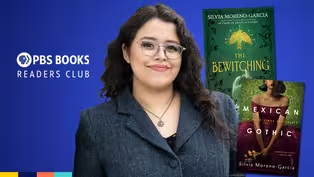
Readers Club | Ep. 209: Silvia Moreno-Garcia | The Bewitching and Mexican Gothic
Video has Closed Captions
PBS Books Readers Club welcomes award winning author Silvia Moreno-Garcia to discuss her new book. (52m 42s)
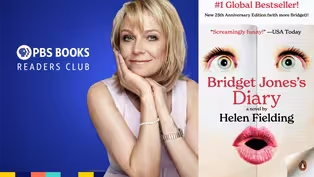
Readers Club | Ep. 208: Helen Fielding | Bridget Jones's Diary
Video has Closed Captions
PBS Books Readers Club welcomes beloved British author Helen Fielding to discuss her iconic novel (59m 30s)
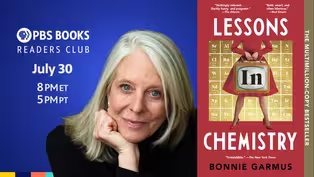
Readers Club | Ep. 207: Lessons in Chemistry | Bonnie Garmus
Video has Closed Captions
PBS Books Readers Club welcomes international best-selling author Bonnie Garmus to discuss her novel (49m 3s)
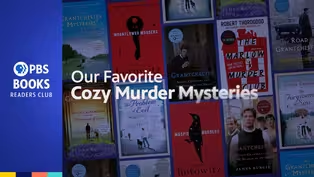
Readers Club | Ep. 206: Our Favorite Cozy Murder Mysteries
Video has Closed Captions
PBS Books Readers Club hosts a special event sharing Our Favorite Cozy Murder Mysteries (52m 32s)
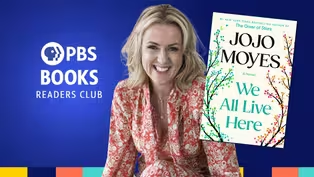
Readers Club | Ep. 205: We All Live Here | Jojo Moyes
Video has Closed Captions
PBS Books Readers Club welcomes international & New York Times best-selling author Jojo Moyes (57m 37s)
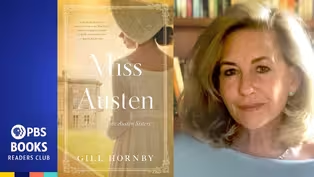
Readers Club | Ep. 204: Miss Austen | Gill Hornby
Video has Closed Captions
PBS Books Readers Club welcomes international best-selling author Gill Hornby to discuss her novel (51m 18s)
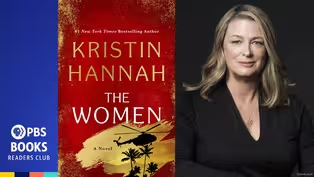
Readers Club | Ep. 203: The Women by Kristin Hannah
Video has Closed Captions
PBS Books Readers Club welcomes international best-selling author, Kristin Hannah to discuss novel. (53m 29s)
Providing Support for PBS.org
Learn Moreabout PBS online sponsorship(lighthearted music) - Seeing those lines on the page come to life, it's also really scary, to be honest.
I always think, when we do the table read, I hate those.
It's the first time I, you know, you hear the whole script read aloud, and it's the moment where you kind of go, oh my God, what if this doesn't work?
(lighthearted music continues) - Well, hello and welcome to the "PBS Books Readers Club."
- Today, we're thrilled to welcome one of Britain's most celebrated television writers, Debbie Horsfield, head writer of the brand-new, highly anticipated PBS "Masterpiece" series: "The Forsytes."
- "The Forsytes" is a sweeping drama about a powerful Victorian family bound by wealth, tradition, and social expectations.
Drama ensues as family members are tested by love, ambition, and betrayal.
As fortunes rise and fall, one question echoes across generations: Do you adhere to duty or do you follow your heart?
- The stunning re-imagining of John Galsworthy's classic "Forsyte Saga" novels offers a fresh entry point and a deeper look into the world of the Forsyte family.
Part prequel, part reexamination, the series expands the story by bringing the women of the family to the forefront, revealing the personal costs of privilege in late-Victorian England.
It's a lush, emotionally-rich epic filled with romance, conflict, and unforgettable characters.
- Hi, I am Fred Nahhat, here with Lauren Smith from PBS Books, and of course, we want to welcome you and all of your fellow Book Clubbers.
- We are excited to take you behind the scenes of what's sure to be your next "Masterpiece" obsession.
It's so good.
The series airs Sunday nights on PBS at 9/8 Central, and you can catch up on the PBS app, on your smart TV, or on pbs.org.
- Head writer Debbie Horsfield is standing by.
But first, we wanna hear from you.
Let us know in the comments where you're watching from.
Have you read "The Forsyte Saga" or any earlier adaptations?
And if you've already started the new series, what are your first impressions?
We love reading and responding to you right in the chat.
- You can connect around books all month long too by joining the PBS Books Readers Club Facebook group to share recommendations and discuss your favorite reads anytime.
- It's the best book club ever- - It really is.
- And great stories are meant to be shared.
So click Share right now.
Your support means the world to us, and we know that you'd never let your book buddies miss out on a great story.
- And make sure you stay in the loop on all our PBS Books author talks.
Sign up for our PBS Books e-newsletter at pbsbooks.org/subscribe for exclusive book recommendations, author interviews, and more.
It's the best way to get the latest updates straight to your inbox - Well, and then click over to YouTube and hit Subscribe for hundreds of author interviews.
Geraldine Brooks, Percival Everett on his Pulitzer Prize winner, "James," Kristin Hannah on "The Women," Richard Osman's "Thursday Murder Club," there's plenty to inspire your next great read.
- And don't forget, PBS Books is supported by viewers like you.
Now more than ever, we need your help.
So, please, if you can make a gift today by going to pbsbooks.org/donate, you'll be taken to your local station's giving page, where you can select one of our special PBS Books Readers Club gifts as our thanks.
- Well, let's turn the page and now welcome in our guest this month, Debbie Horsfield, head writer of "The Forsytes."
Welcome to the "PBS Books Readers Club."
Thanks for joining us.
- Very nice to be here.
- Well, we're delighted by the series.
For folks who haven't seen it yet, give us a little bit about what the series is about, what's the show about, and what can we be excited about to see in season one of "The Forsytes"?
- Gosh, well, I guess the thing that excited me about the source material, because obviously it is inspired by Galsworthy's "The Forsyte Saga," but I think we were always very clear from the start, and PBS very clear from the start, that what we didn't want to do was just do another straight adaptation of the books.
There's already been some terrific adaptations of the books.
We were invited more to look in the direction of what were the themes that really excited us, what was it about that particular period of history that excited us, which were the particular characters that excited us and intrigued us and that we wanted to learn a little bit more about?
So that was really the starting point.
Obviously, the books are fabulous and there are some amazing characters in them.
One of the things that, I think, that intrigued me about the books is that a lot of the, the male characters are fabulously well drawn, very detailed.
Some of the women, a lot less so.
And obviously, this is a really interesting period in history for women because it's around the time that the Married Women's Property Act comes into being, which means that women don't have to give up all of their property as soon as they're married.
But it still means that, for instance, if a woman divorces and there are children, the husband takes the children, not the wife, you know?
So there's all of, oh, and of course the key thing is that, you know, there is no kind of, women don't really have any rights in terms of, you know, let's face it, in the bedroom.
If a husband wants to be intimate, then the wife is not legally obliged to say no.
So that just kind of interested us because we felt that, actually, the women in this story have to try to really fine line in terms of if they wanna have power and agency, they have to do so in a very particular way.
They have to be, you know, if you are a high society woman, you have to have influence on your husband's life, but you don't necessarily have that much influence in your own life.
You know, I wanted to pin down for myself what was about this story that really spoke to me.
And I have, I guess I've always been really interested in everything I write in family sagas, intergenerational conflict, how one generation's demands and expectations plays out with the subsequent generations.
And of course, within the source material, there are four generations.
And so that was really our starting point.
And, you know, this is what the first episode really explores.
What is it like to live in a multi-generational family?
We have the two families living side by side, so the rivalry between them is really quite extreme, although they appear on the surface to be quite friendly with each other.
So we, you know, that was a juxtaposition that we created, it's not there in the books, but we felt that it set up really nicely the conflict between two branches of the family and then set the stage for all of the other kind of conflicts which come from there.
- If your assignment was to redraw stronger female characters, you certainly succeeded.
They do jump off the screen.
Talk a little bit more about that process, living inside those characters and giving them this stronger, more commanding presence, which, to me, really is driving the story.
- Well, I think one of the things that we wanted to do, you know, really dig into, was, you know, we have a historical advisor, we had a couple of historical advisors, actually, because we really wanted to interrogate what would life have been like for women of that particular class and background, in that particular era of society in London.
And then, obviously, then you kind of begin to use your imagination about what kind of things they might encounter, what barriers they might encounter.
You know, we used a lot of the material from the book, but also particularly, as I say, with Frances and, say, with Irene, wanted just to give them more of a hinterland.
I wanted, I felt that I wanted Irene to kind of be at odds with the family in terms of her, you know, in terms of her profession, in terms of her values, to have come from a completely different background.
And it seemed that she needed to do something creative because their creativity was expressed in making money, and hers would obviously be expressed, I thought, in something physical.
So, you know, we kind of invented this background for her that she had always longed to be a dancer, which would've, and does, as you know, if you watch the rest of the series, the family is horrified.
Because dancers, ballet dancers, were regarded as, you know, almost akin to prostitutes in that particular era, in the way that actresses had been as well.
And yet I felt that somebody who expressed themselves through movement was ideally the person to kind of shake up this rather buttoned-up family and, you know, literally set cats amongst pigeons, really.
- Well, I think it's so interesting the way that you wrote the women.
And of course, it's Women's History Month in March, and so I love exploring this, because as you pointed out, the way that the women had to find their power and their agency took a little bit of special navigation in those times.
- Yes.
- And in some ways today, it's very different, we have rights.
But in other ways, it's not so different.
And there are still, you know, subtle differences that women even today need to go about in holding a position of power or using their agency.
And so I'm intrigued by sort of the parallels between the women that you wrote about and what we as women can take away from that today in watching.
- Well, I think that, you know, we had various discussions to begin with about, you know, for instance, the journey that Irene goes on.
Because I think one of the things I've noticed having been, you know, writing for television for a long time now is that there is always this kind of, in recent years, there's always been this kind of demand that women always must have agency.
They always, you know, their story must, they've gotta have power in their stories.
And I was arguing that, actually, Irene does get to a place where she has agency and where she has, where she takes the power, you know, takes matters into her own hands, but obviously she has to go on a journey.
And it's a completely, it's a ridiculous expectation to expect her to have agency from the word go.
And she has to, I think all of the women have to find their own route through it.
Even the character like Emily, who is Soames's mom, who is a particularly traditional wife in a way and has kind of played the game in terms of knowing what her role is and not really wanting to step outside that, as opposed to, say, Frances, who very clearly wants to wield power, but knows how to do it.
But in the end, it was, you know, even see Emily be the kind of worm that turns, because ultimately, she isn't prepared to be kind of downtrodden and just be disregarded.
I think if she had been valued and respected, she could have been happy with that role.
But there comes a point where she feels she's not being respected, and respect is a big number, I think, in this series.
When the women are feeling not valued and disrespected, they start to rebel.
And I think, you know, in truth, that is, that's always been the case.
You know, it's the case now, it was the case, really, 500 years ago.
And in a way, I think that's why, hopefully, this story, it doesn't feel, it feels quite modern in its concerns.
- It does feel quite modern.
There's some wonderful casting choices, the actors, literally compelling from the first moment.
Wondering in the adaptation process, how involved were you with casting and those choices?
- I always am involved with the casting 'cause I'm also an executive producer and the... So yes, I'm involved in the casting.
We do have an amazing casting director who will shortlist.
She will come up with suggestions and she will shortlist, but then we do interviews and we meet people.
And yeah, it's a very exciting part of the process, actually.
You know, just seeing those lines on the page come to life.
It's also really scary, to be honest.
I always think, when we do the table read, I hate those.
It's the first time I, you know, you hear the whole script read aloud, and it's the moment where you kind of go, oh my God, what if this doesn't work?
Now, you always feel it.
You always think this will be the time where people go, "Oh, she can't write."
You know, it's that kind of, the dread that, you know, this is the one that's not gonna work.
But fingers crossed, it has, and the cast is amazing.
- Yeah, I think that's so interesting that for a screenwriter, it's different than someone that writes books, 'cause you do have to sit there in a room full of people that are reading your work out loud.
That must be a nerve-wracking experience.
- I think also it's... Look, before I did "The Forsytes," I did several series, a series called "Poldark."
And that was the first time I'd ever done an adaptation.
Everything else in my career was original.
And what I realized with "Poldark," and have subsequently realized with "The Forsytes," is when there is some source material, as opposed to when you just make stuff up from, you know, everyone has an expectation of how you're gonna tell the story, right down to what bits from the book you're going to use, and even what the characters look like.
There are, you know, you get people going, "Well, that's wrong because she should have had blonde hair."
And you kind of realize that everybody has their own version in their head, if it's a classic book.
And I would say I am the same.
You know, take a, you know, a Jane Austen book.
You know, my image of Elizabeth Bennet is not like any other, anything that I've ever seen.
It doesn't mean that I don't love the versions that I've seen on film and TV.
It just means it's different in my head.
And you realize when you're dealing with something that exists in people's heads, you're probably never, ever going to be satisfy everybody.
And in a way, you shouldn't even try because everyone has their version.
- Yeah, in this version, one of the thought lines through is marriage for business, for status, for success, marriage for the ideal of love.
How did you navigate those storylines?
And we all expect at some point those realities bubbling underneath with even more pain and conflict between couples.
- Well, I think one of the themes of the series is, you know, do you follow your head or do you follow your heart?
Well, even if you follow your heart, does it guarantee that it's the right decision?
If you follow your head, does it guarantee it's the wrong decision?
Is there a way that people who have married, you know, as a marriage of convenience, might that actually work?
Does it follow that if you follow your heart and marry against everyone's advice that you're gonna live happily ever after?
Those are the questions that we ask.
Because obviously, you know, we all expect that if you follow your heart, you're just gonna be happy.
But this story hopefully gives some more kind of realistic, yeah, interrogation of that.
- One of the things I am loving about the series, and this is really all down to you as the writer, is some of these very well-mannered but still scathing lines, you know?
Just this, like, very, this way of insulting someone, but you're still being very polite about it.
Like, I wanna store them away for future use.
Even like, I think it was the opening scene, and little June looks up at her stepdad-to-be and is like, "Do I have to like you?
I don't like anyone."
- Yeah, yeah.
- I love that!
Talk about writing some of those lines.
- I mean, she can get away with that 'cause she's, you know, she's a child.
I've really enjoyed writing lines for someone like, well, like Ann because she, as, you know, the kind of matriarch of the family, she can absolutely get away with.
Nobody's gonna tell her to shut up.
They have to put up with everything that she says.
And then similarly, I've always loved writing lines for, say, Jack Davenport, who plays James, because he's very cutting and very kind of wry in his humor.
And obviously the butt of his jokes, his, kind of, comments, is often Monty, who's a complete idiot.
And that's a load of fun to write for as well because, you know, writing for someone who's just a complete buffoon is such fun.
- Yeah, I'm curious about some favorite moments, the transition from the page to the screen.
Are there some moments that you knew would work and still inspire you?
Or are there some passages that you wrote that you were delightfully surprised, continue to just give you a chill when you see it play back?
- Oh, I mean, you always want that to happen.
You know, you kind of want the the actors to be even better than you'd imagine.
And that has happened a a lot.
I mean, there have also been times where I've written something and thought, we'll never get this to happen, this will never happen.
So, I mean, the classic one for the season was, I wrote some scenes set in Venice, but I never dreamt that we would actually get to go to Venice.
You know, we film in Bristol in the UK, and there's a load, that they have a few canals there with bridges over.
And in my head, I thought, oh, we'll just be on some, you know, dingy canal with some horrible little bridge over it, and we'll have to do a lot- - As the executive producer, you're like, "Oh, the budget's not gonna make this work."
(Lauren laughs) - It'll be like, you know, it'll all be done in special effects afterwards.
And then to actually be able to go to Venice and, you know, film in some really iconic places.
You know, there's the scene where Jo is painting, and he's looking out over the lagoon at the view that, you know, people like Monet and Whistler had painted that very view.
To actually be able to go and do that, that was an absolute dream.
So I feel very lucky that we are able to do things like that.
- If it happens next season and you need some help, (laughs) you know who to call.
We'll be there in a heartbeat.
- The most glamorous, you know, location I've ever been able to wangle in the show.
- Oh, well, I mean, it's gorgeous.
And it shows up.
I think it was well worth it in the way that- - I mean, it looks gorgeous, doesn't it?
- It does look gorgeous.
I mean, everything from the settings to the costumes.
I mean, get into some of that, like, visual creativity.
Because you are an executive producer too, so it's about the words but then having some of those visuals come to life in tandem with what you wrote.
- Yeah, absolutely.
Because we do have, so we have very detailed conversations with, obviously with the directors, with the designer, with the costume designer.
And, you know, so the designer and the costume designer, they all come up with lookbooks alongside the director in order that we can kind of all agree on what the tone, what the look of the show is.
And, you know, we knew we wanted it to be really kind of opulent and kind of glamorous, really.
We wanted the costumes to look just gorgeous.
And the houses that they live in, that each has its own special character, and they're always trying to outdo each other.
So, you know, we have... It's who's, you know, we're looking at who's following what the latest trends are in- - Who's gonna get the electric lights first.
- (chuckles) That's right.
(Lauren laughs) - And, you know, who's decorating their house in the style of wallpaper that is the most fashionable so they can kind of get, even if it's not necessarily on the page, you know, you want to feel that there is a rivalry going on between them.
And similarly, the costumes, although, to be honest, the women don't seem to have the rivalry that the men seem to have.
But, you know, such attention to detail.
I'm always in awe of the, you know, the designer, the costume designer, makeup designer.
Because I mean, some of, for instance, some of the hairstyles that the women have, they are so intricate.
And I have to pay tribute to the makeup artists and to the actors themselves.
Sometimes they're sitting there for two and three hours having those hairstyles done.
And, you know, you can imagine those costumes are very hot, and we film in the summer.
You know, I don't know, but some people think it's a really easy job being an actor.
(chuckles) And I can tell you, it can be utterly, utterly grueling.
- Well, it all paid off, I think.
I mean, the way that those visuals, the beauty of it all, it really adds to the story and it just makes it a delight to watch.
So, it was worth it.
- And also, you know, we're very lucky because we, the interiors we build in the studio, which means that, from my point of view, I can just wander into a set and sit down and think about how I'm going to stage a scene.
You know, if I'm, for the second season, for instance, I already knew what the locations were like, and I could go and sit down with my laptop and just kind of create something, knowing exactly how it would be set, which is a great luxury, I have to say.
- That's amazing.
- Well, a couple fun questions.
Did you always know that you were gonna be a writer?
And how did you make this transition to writing for the screen?
- Well, the funny thing about that is, when I went to school, 'cause my grandmother had taught me to read and write before I went to school, so I was writing little stories when I was five when I first went to school.
And my first teacher said to me, "Oh, you'll be a writer when you grow up."
I mean, and of course I never thought anything of that.
When I was at university though, I started writing, well, I actually used to write little plays for my brother and sisters to be in.
And when I went to university, I started writing for the theater, plays, and took a play to the Edinburgh Festival, actually, to the Edinburgh Festival Fringe, and got picked up by an agent and started writing for the theater.
So my kind of, my learning curve was really writing for theater for maybe three or four years before one of those plays got picked up for television.
And then I've pretty much written for television ever since.
But I think I've always been... My dad used to tell me stories all the time.
I think I've always just been fascinated by storytelling.
And I have to thank my grandma for teaching me to read and write so young because I was able to start creating stories very young.
- Well, let me ask you about some of your all-time favorite books, or maybe particularly your favorite book as a child.
- Whoa, as a child.
God, I think one of my clear memories is reading "Little Women" when I was about nine and then reading the whole, because obviously there's books that follow on from that, and it was reading the book where the character of Beth dies and being completely shocked.
I remember sitting in my, lying on my bed on a summer's evening reading the description of the death of Beth, and being so shocked 'cause I didn't think it would happen, and sobbing.
I mean, just lying on my bed and sobbing.
And I guess that's the first time I realized the power that storytelling could do, and I've never forgotten it.
I can close my eyes and think back to that moment of me just howling with grief at that.
So, that's the power of storytelling.
- Truly.
So you've written many incredible characters.
If you could invite any of the characters, whether it's from "Poldark" or "The Forsytes," if you could invite anyone to dinner or to tea, who would you invite and why?
- Gosh.
If I was wanting to have a fun time, you know, I would probably invite Monty because he's such an idiot.
(Lauren laughs) But one of the characters that I find fascinating, 'cause he's so complex and he's such a man of his time, is the character of Soames, actually.
Because he's a, I think of him as a very tortured character because he's the product of his upbringing, he's the product of attitudes of the time, and yet there's a little spark in him that wants to be different.
And that when he sees something in Irene that ignites that spark, and for a brief time, there is a chance that he could become a different kind of a person.
And that really does fascinate me, as it fascinates me when anybody is a product of their upbringing, they're kind of trapped in the expectations of their background, their family, and their upbringing, that has always fascinated me.
And so, kind of like to have a dinner conversation with Soames.
- Love that.
- That is amazing.
Wendy and I were watching, and we literally spoke out loud, we could not figure out, this is not a classic villain.
You could not figure out what his intentions were with respect to business and how that was gonna balance with this really idealized approach to love.
And we literally spoke of that out loud.
- Yeah, well, I'm glad that came across because I don't like to create out-and-out villains.
I think that no one is born a villain.
There's always a journey to get to the point where we would call someone a villain.
And I just wanted to interrogate that a bit.
- We are so grateful that your grandmother inspired your love of storytelling.
Beyond that, what's the best advice you've ever received about writing?
- You know, I don't know that I have received advice because, you know, I kind of picked it up as I went along.
But one of the things that I have learned, and which I do tell myself, and when anyone asks me and says, "I wanna start writing," I just go, "Well, write."
And what I mean by that, I don't mean to be facetious about that, you will never know until you start, until you make a start.
And you will never know whether it's, and it's bound to be rubbish to start off with.
I mean, you know, it took me many years to realize that what I wrote first thing in the morning was not gonna be great.
But the good thing is I could go back and I could edit it.
But if I never started the process, there wouldn't be an end product.
So, basically, I would always say, "Make a start," because you can always refine it.
But if you never make a start, you know, an idea is great, but it doesn't exist until you get it down on paper.
So I would always say, "Get it down on paper and then you can decide whether it works or not."
- Well, we will hang on to that, put that in our little notebook of advice.
I love that so much.
Finally, Debbie, is there anything that you'd like to say to your viewers?
- Well, I hope that we have created a story that makes you want to engage with the characters and go on a journey with them.
And I hope that that journey is unexpected but ultimately rewarding, and that you'll come back for series two.
- Well, it has been for us, and we definitely will.
Debbie Horsfield, head writer, "The Forsytes" on "Masterpiece," thank you so much for joining us on PBS Books.
- Thank you for inviting me.
- Well, I just love getting that behind-the-scenes look at our favorite "Masterpiece" shows.
It makes watching them just that much more fun, especially when they're adapted from and inspired by books.
It makes me wanna go back and reread and then compare the two.
- Well, absolutely.
And what surprised you the most about the scripting process?
Did the conversation inspire you to watch the show if you haven't already started?
Tell us in the comments.
- Well, thank you, book friends, for joining us for such a delightful conversation.
If you love period dramas filled with forbidden love, devastating betrayal, and decadent costumes, then you are going to love "The Forsytes" on PBS "Masterpiece."
You can catch up on past episodes and stay up to date with season one on the PBS app and on pbs.org.
And new episodes premiere Sundays at 9/8 Central on PBS.
- And we wanna invite you to join the PBS Books Readers Club Facebook group.
Subscribe to our YouTube channel and to our e-newsletter at pbsbooks.org/subscribe to stay in the loop on future author talks and discover our latest book recommendations.
- And know that you play a major role in making PBS Books happen.
This and all of your favorite PBS programs rely on donations.
Now more than ever, we need support from viewers like you.
- So join your book friends in supporting these events.
Just click the link in the description or comments or visit pbsbooks.org/donate.
- You'll be taken to your local PBS station's donation page, where you can find PBS Books swag as our thanks for your donation.
I'm personally obsessed with the PBS Books Readers Club book bag.
It's my go-to for library hauls and everything else.
You can also snag the official PBS Books mug, "My Weekend is Booked."
Although I might need to change that to "Do I have to like you?"
(Fred laughs) It's my new favorite line.
Plus, as a member of your PBS station, you can stream hundreds of inspiring PBS shows, concerts, documentaries, and, of course, full seasons of "Masterpiece" dramas like "The Forsytes," all with PBS Passport.
- [Fred] And find out about our next book picks and upcoming author interviews in the PBS Books e-newsletter.
- Visit pbsbooks.org/subscribe to make sure you don't miss our next book pick announcement along with other great book recommendations.
- And subscribe to our YouTube channel for more amazing reads and literally hundreds of author interviews.
- We'll see you next time.
Thanks for being a part of the "PBS Books Readers Club."
(lighthearted music) (lighthearted music continues)












Support for PBS provided by: