
Primary Election Season Kicks Off
Season 10 Episode 29 | 26m 45sVideo has Closed Captions
As election season kicks off, a contentious citizen initiative fails to qualify for the ballot.
As the debate over election security continues at the national level, primary election season is officially kicking off in the Beehive State. Plus, a contentious citizen initiative will not appear on ballots this November after all. Our expert panel explains why the effort to repeal Prop 4 failed. Political insider Leah Murray joins journalists Max Roth and Robert Gehrke on this episode.
Problems playing video? | Closed Captioning Feedback
Problems playing video? | Closed Captioning Feedback
The Hinckley Report is a local public television program presented by PBS Utah
Funding for The Hinckley Report is made possible in part by Cleone Peterson Eccles Endowment Fund, AARP Utah, and Merit Medical.
Primary Election Season Kicks Off
Season 10 Episode 29 | 26m 45sVideo has Closed Captions
As the debate over election security continues at the national level, primary election season is officially kicking off in the Beehive State. Plus, a contentious citizen initiative will not appear on ballots this November after all. Our expert panel explains why the effort to repeal Prop 4 failed. Political insider Leah Murray joins journalists Max Roth and Robert Gehrke on this episode.
Problems playing video? | Closed Captioning Feedback
How to Watch The Hinckley Report
The Hinckley Report is available to stream on pbs.org and the free PBS App, available on iPhone, Apple TV, Android TV, Android smartphones, Amazon Fire TV, Amazon Fire Tablet, Roku, Samsung Smart TV, and Vizio.
The Hinckley Report
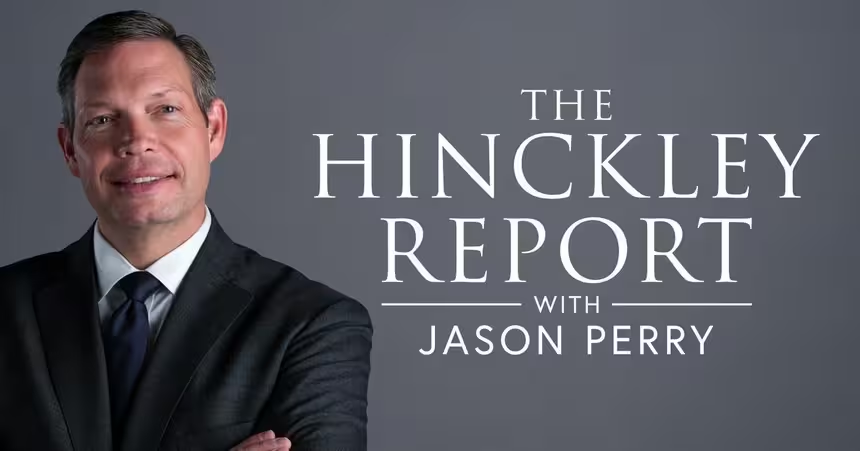
Hosted by Jason Perry, each week’s guests feature Utah’s top journalists, lawmakers and policy experts.Providing Support for PBS.org
Learn Moreabout PBS online sponsorshipJason Perry: On this episode of "The Hinckley Report."
Political party leaders shore up support as the debate over election security heats up.
A contentious initiative fails to hit the signature threshold for November's ballot.
And candidates start to make their case as primary election season begins.
male announcer: Funding for "The Hinckley Report" is made possible in part by the Cleone Peterson Eccles Endowment Fund, and by donations to "PBS Utah" from viewers like you.
Thank you.
♪♪♪ ♪♪♪ Jason Perry: Hello, and welcome to "The Hinckley Report."
I'm Jason Perry, Director of the Hinckley Institute of Politics.
Covering the week, we have Leah Murray, Director of the Walker Institute of Politics and Public Service at Weber State University; Robert Gehrke, reporter for "The Salt Lake Tribune;" and Max Roth, anchor for "Fox 13 News."
So glad to have you all with us on the program.
So many interesting things happening in the political world in Utah, even federally impacting us here.
I want to get to some of those big, big items here for the program today.
Leah, can we start with you for a moment?
Utah is one of those states that's really big on mail-in ballots, and an executive order came out from the Trump administration this week on mail-in voting.
Specifically, a couple of things.
It creates what's called the citizenship list.
For the states that have mail-in ballots of eligible voters, the list will be shared with the United States Postal Service, and they've been directed to only deliver ballots to the people who are on that list.
Talk about that for just a moment because that's a big implication for Utah.
Leah Murray: Yeah, I mean, a little.
Don't we already have that list?
It's called voter registration.
I feel like you have to prove to be a citizen to register to vote.
And a little, I don't understand why the president keeps thinking the federal government gets to tell states how to handle elections.
But I read it as, so now this postal worker is gonna have to check this list before they send the mail.
This is just a lot of drama for no good reason.
Max Roth: It does strike me, Leah, too, even if this were passed by Congress, even if this went through a process, there would still be constitutional questions and challenges about whether the federal government has any role in saying how you hold elections, just as Leah said.
And so the idea that an executive order could do something like that, it just sounds dubious.
Robert Gehrke: Yeah, and I think we've seen the Trump administration, they've sued, I believe, 28 states, trying to get access to their voter rolls.
And the whole driving force behind this is this notion that there's some sort of huge, massive electoral fraud, but we haven't seen any specific instances of it.
And in fact, the lieutenant Governor did a review of Utah's voter rolls, 2.1 million registered voters, and found 1 person who was a non-citizen who hadn't voted on the voter rolls.
Now, there's there's a couple hundred that they're still checking on, but this is not some massive fraud scam that's, you know, tainting our elections.
And I think that what the president's doing is casting doubt.
It's undermining the trust in those electoral systems.
Max Roth: That is, I think that's going to be a--that's kind of a common thread these days, is that we're hearing, we hear so much rhetoric that says that there's a problem, that there's no proof there is.
And that's what's really hard to to deal with and understand, is that, you know, this notion that we have these fraudulent elections, and that there's been this widespread, these widespread attempts to undermine our voting system.
And the proof's not there.
Leah Murray: Right, but I'd also, I just wanna push back a little bit and say, but I'm not sure voters are buying it, right?
So what is the data we're seeing on Utah voters thinking that vote-by-mail is secured?
Somewhere in the high 80s, right?
Like, I think somewhere close to 90% of our voters in the last election, after the president was making all these claims, still use vote-by-mail.
So he can say it, right?
And he can, I think, attempt to undermine the system, but I think Utah's voters know better.
Jason Perry: Yeah, Robert, a couple of those numbers are very interesting.
And some polling that we have done here in the state, this was in the last, in the 2024 election: "How confident are you that government officials conducted a fair and accurate election?"
Leah was right.
It was 81% of Utahns were confident, and that's with 85% of Utahns using vote-by-mail.
Robert Gehrke: Yeah, but I think we also saw after the 20, you know, on January 6, the impact of having even a small segment of the population who doesn't believe in the legitimacy of the elections.
I mean, it can instill some pretty dire consequences.
Plus, I think it discourages people from voting if there's any, even a hint that the election's not working.
Now, we did see during the past legislative session, there was a big push from the House to try to get rid of vote-by-mail in Utah and have, you have to return your ballot physically to a dropbox.
That didn't pass.
There was pushback from the Senate, so there is still a bulwark, I guess, against trying to get rid of it in Utah.
But it's had a profound impact on our electorate, on our voter turnout.
Max Roth: And I also worry, because even though Utahans, absolutely right, express this confidence in elections, although the fact that 19% don't, Robert, you brought that point up, is a real concern.
But the other thing is that, the point that's being made at the national level is, "Well, it's the blue states," you know?
And so, yeah, "Utah, maybe Utah doesn't have fraud with mail-in voting, but boy, Minnesota," you know?
And this assumption that a state that may largely not agree with your perspective is also going to be fraudulent and going to be dishonest is a really troubling thing in American politics, where we rely on an assumption of goodwill between opposing parties.
Jason Perry: I want to get to this a little bit.
Leah, maybe I can show you a quote, because the person in the middle of a bunch of this is our lieutenant governor who oversees the elections here in the state of Utah, and she had some responses, in fact, an interesting one to the president's executive order, given these things are within her purview.
I want to read that quote to you, and then give us some thoughts about where she is on this particular issue.
This is to President Trump.
The quote says, "POV: When the latest Executive Order reminds you of that time when you were a senior in high school and you performed in a one act play called 'Jack or the Submission' by absurdist playwright Eugene Ionesco and it was super weird and the script was full of nonsensical dialogue."
Talk about that, because that's just right to the executive order.
Leah Murray: Yeah, so like, one, I wanna just be clear, I don't know the reference, so I do apologize for not having been in that play ever.
But two, she's totally right to call him out, right?
So she is in charge of the elections for a state that voted for him.
I mean, what are we even talking about?
So if there was voter fraud, does that mean Kamala Harris won in this state?
Of course not, right?
This is ridiculous, so it is nonsensical dialogue.
It is absolutely absurd.
She absolutely should be calling him out on it, and I kind of like it.
Like, I like that she was like clapping back at him.
Robert Gehrke: And all the kids can't get enough of "Jack or the Submission."
I know it's sweeping the nation.
Jason Perry: Is it now?
Robert Gehrke: Yeah, but I think it's kind of interesting because Utah has this sort of suspicion of the federal government, right?
And I think if you had a Democratic president who was trying to go out there and sweep up control of the elections, you'd get--there'd be outrage here in a red state like Utah.
So I think she probably sees that this is, you know, not the proper role of the federal government, as the Constitution makes pretty clear.
And so, you know, she's pushing back on it.
She's pushed back on the attempts to get access to the unredacted voter rolls.
And I think we have, in this state in particular, had a, I don't know, fiercely defended that those states's rights arguments.
And so I think it kind of falls into that vein.
Max Roth: But another thing that is concerning--or maybe not, concerning might be the wrong word--but if you pay attention to the media on the right in Utah, social media, radio, those kinds of things, there's really virulent upset about Deidre Henderson.
The things that they say are, you know, I would be a little worried if I were her, you know?
Just that the way that the language, the language that goes her way.
So she is, she's facing pushback on this, even though it does, it doesn't sound like that unsensible of a thing to say.
Robert Gehrke: I guess I'd also just point out that there's a good reason that we have this dispersed system of elections, and that is particularly so they can't be hijacked, right?
If we're running 29 elections in Utah, you can't just sort of hack into one system and take over the election.
It's 29 different elections, and you replicate that across 50 states.
That diffused nature of our electoral process is a security feature, not a flaw.
And so when you have any centralized government trying to control that and get rid of that, I think it undermines the election security.
Plus, again, I don't think that Republicans would be a big fan, you know, if the administration turns over, and we have a Democratic control of government.
I don't think the Republicans in Utah are going to be supportive of centralized electoral processes.
Leah Murray: Yeah, and the answer is, if anyone's angry with her, they're wrong, right?
The whole country is built on checks and balances, not just in the election sphere, but across the board.
Every single state leader should be clapping back against any federal encroachment of their prerogatives.
She's totally right.
Max Roth: Yeah, I mean Vladimir Putin wins 99% of the vote each time he's up.
You know, it's uh--do we believe that?
Well.
Jason Perry: Well, this is all gonna shape, kind of shape up as we get into the election cycle.
We get to see what kind of impact it has on participation in particular.
I want to get to a couple of items, because who will be participating in the primaries?
We just hit a very important date here in the state of Utah.
April 1 is the deadline to affiliate in the state of Utah.
This was a law that was passed in 2021.
Within three months of the primary, you have to pick your party, and that's what has just happened.
And Leah, some very interesting changes have happened when it comes to your affiliation, particularly in Salt Lake County.
Leah Murray: Right, well, I think a little bit, all of a sudden, you know, like if you watch sports, you only really watch the Super Bowl if it's competitive, so a little bit, Congressional District One just became competitive, so all of the fans of that team are showing up, right, and maybe no longer wearing the jersey of the other team.
Like they are going to be all in for the Democrats, so we're seeing shifts in registration, right, strategic Democrats maybe unregistering as Republicans and coming back home.
And then also in those caucuses, a ton of people arriving.
It's very cool.
Jason Perry: Robert, can--oh, go ahead.
Robert Gehrke: I think Leah's right.
I mean, I think the only explanation for people shifting to the Democratic Party is that sort of enthusiasm factor, because you don't have to be a registered Democrat to vote in their primaries.
You can be a registered Republican and vote in the Democratic primary.
So I think that, I think there's sort of the coming home feature is 100% a reflection of, you know, people are excited to be able to vote for a congressional, in a congressional race where it might matter.
Max Roth: And I think it's also a reflection of a national trend as well.
There's enthusiasm on the left for getting out to vote because they're more upset about things right now, and less enthusiasm on the right that way nationally, so I think that's also reflected there.
But another thing is that both parties are essentially getting what they want.
You know, the Republicans don't want people to register as Republicans if they're not Republicans.
They don't--they want a closed primary, and that's why they do it.
And Democrats are thrilled that they have more registrants.
Jason Perry: Yeah, Robert, talk about that historically too, because we've talked about this before.
The phrase you said, "These are the party raiders in Utah."
You know, you would join a party, and maybe it wasn't your own, or Democrats would do, join the Republicans just to have a say in the candidates.
Robert Gehrke: Yeah, well, there's some logic to it, because when we don't, when we have these elections that aren't competitive in November, you know, between the two parties, it's that primary that actually matters.
And so if you want to have a say in who's going to be the governor, who's going to represent for a long time, it was all four congressional seats, Republican, the only time you can have a say in that is the primary.
Your vote in November doesn't necessarily matter as much.
So there was some logic to it.
We saw a lot of it during the gubernatorial contest that included Jon Huntsman and Spencer Cox.
And so I think there, you know, we don't know the numbers of people who did it.
It obviously was not a huge, massive--it didn't sway the elections necessarily.
But if people wanted a voice, that was the way they did it.
Now they feel like they can have a voice by being on the team that they support naturally.
And so I think that's what is reflected here.
Jason Perry: You know, Leah, it certainly played out with the caucus attendance this year, particularly with the Democratic Party.
Leah Murray: Yeah, well, I was--yeah, the Democrats had a lot of people, right?
But I was in a group chat with friends who were at Republican caucuses, and there were like three or four people at each, you know, so each person's like the delegate, and the county delegate, and the treasurer, so a little bit.
But then I do wonder, and maybe you all tell me if I'm wrong, if I'm going gathering signatures on the Republican side, and the last convention they had at state I think was 17 hours long, I mean a little bit.
Maybe it's not, might not be so much about this what we're talking about, but a little more about, "Man, I could just stay home on that Saturday, and I could vote in a primary."
So I don't know if those low numbers is a result of that.
Max Roth: Another thing that you realize reporting on this, when you first start, you know, and you go to your first caucuses, you go to a Democratic caucus, and you think, "Oh my gosh.
This is so crowded."
And then you realize it's because half the Salt Lake Valley is in this elementary school for Democrats, and the Republicans are in a house here, and a house there, and in the neighborhood, you know?
And so it tends to be a bigger room for the Democrats.
That's not always an indicative, but those numbers are that you shared.
Jason Perry: I want to get to another big issue this week.
And Robert, I'm gonna start with you.
You've done such great reporting on this, too.
The repeal of Prop 4, the initiative itself, enough signatures were gathered, but you have to have 26 of the 29 Senate districts.
One fell off already.
Talk about that one, because there's one district that enough signatures were taken off of the list and maybe one more to come.
Robert Gehrke: Yeah, this would repeal Proposition 4, which was the statewide ban on partisan gerrymandering.
And the Republicans were trying to restore the legislature's ability to gerrymander by repealing this.
They submitted over 220,000 signatures, so they reached that statewide threshold with quite a bit of room to spare, but the legislature made it really, really difficult to get these initiatives on the ballot.
And so they kind of came back and bit him a little bit in this instance because they did get to--you have to get 8% of the registered voters in 26 of the 29 counties, as you mentioned.
They got to the 26 with about 700 votes, signatures to spare in Senate District 15, but they also--there's a 45-day repeal window where voters can rescind their support.
And there was a concerted effort to get people to do that.
The legislature even changed the law to make it more difficult for voters to do that.
At the end of the day, over 1,000 people in that Senate District 15 withdrew their support, 10,000 now statewide have withdrawn their signatures.
And so you've seen this what looked like a foregone conclusion.
I mean, Rob Axson was very outspoken.
They were spiking the football when they turned these signatures in, saying they've easily qualified for the ballot.
You just saw that balloon deflate over the span of several weeks.
There's still almost three weeks left for more signatures to be withdrawn, and it looks like they probably will lose at least one more Senate district and possibly two.
I think this is a huge black eye for the party, frankly, because they had support from Donald Trump, JD Vance, Mike Lee, Spencer Cox, all of these heavyweight Republicans.
They had $4 million from this Trump-affiliated PAC that was spent on this effort, and it didn't make it.
And we saw the unions, for example, turn out twice as many signatures in 30 days versus what they were able to do over 100 days.
I think it's a real setback for the Republican Party, but it's not over, as we-- Jason Perry: Yeah, signatures can come off until April 23, but I want to get to this point that Robert just made, Max, if we can, because it's interesting, because once you have the signatures, you can start looking at your Senate districts, and you can focus your efforts on those.
Tell us what you make of this, because this Senate District 15, this is Senator Kathleen Riebe's district, a Democrat.
She's gonna be running for Congress also, which is interesting.
And also, Senate District 12 is Karen Kwan, another Democrat.
It's just an interesting dynamic, too.
Those two Senate districts that might be popped off are in the hands of Democrats, because this is interesting how this plays out.
Max Roth: Well, yeah, and you wonder if, when the law was passed, they intended to give that kind of influence to each Senate district.
I mean, when you can only exclude 3 of 29 county, or no, 29 senators, and 26, you have to have 26 of their districts, and if they realized that they were giving this kind of power to districts that regularly elect Democrats.
So yeah, I think that's a, that is what came back to bite them.
But the other thing, and the other thing that I see here is that this is--I was talking about the message and rhetoric, and I think what we just keep seeing with discussions about propositions, language used that confuses people.
And so when I went out reporting on this, I was up at the university talking with people on different sides.
And they have such different understandings of what the proposition would do.
And so as you--you read that quote from Rob Axson about, and he said the media was biased about this.
You know, I know where he gets that, but I think where he gets that is we went out and interviewed people.
And I would get through half of an interview with people saying that "Oh, yeah, the petitioner was really helpful," and all this kind of stuff.
And then halfway through, they realized, "Wait a minute.
I signed for that?"
They didn't understand what they had signed for.
Jason Perry: I want to get to what happens next, and since we've referenced this quote from Rob Axson, I want to read it because it kind of gives an indication at least where the Republican Party thinks they're going to go with this particular issue.
Let me read it, and then Leah, if you can give us a comment about it.
This is what we've been talking about.
Rob Axson said, "Utahns spoke loudly in the face of an unprecedented onslaught of biased media coverage, outside influence and judicial interference.
Whether now or in the future, by litigation or initiative, we will repeal Prop 4.
This fight is not over, but just beginning."
Leah Murray: Yeah, I don't think Utahns spoke loudly, so I like the point that Max was just making.
The number of stories, anecdotes I heard, right, of people not being aware of what they were signing, of people in a home being like, "Don't sign that," whatever is at the door.
We had people on our campus signing for the petition as well, and my students reporting, "I don't really know what they're doing," so I'm not sure where the loud Utah voice is that he's hearing, right?
Like I'm not sure where it was clear that the Prop 4 from 2018 all of a sudden became such a problem for Utah writ large.
Max Roth: And I would say that there's strong legal arguments on both sides, but on Rob Axson's side there, but it's that escalation in language.
You know, when you read that, you realize that he's saying, "Well, we lost, and so all the people who made us lose must be wrong, and they must be against us.
They must be maliciously against us," not just that they're, you know, "that they're intending to do us wrong," rather than, "This is politics, and we lost this one."
Robert Gehrke: I'm not entirely convinced that this isn't, that the Republicans shouldn't be breathing a sigh of relief on this, because the only polling I've seen, the Sutherland Institute did a poll that said 85% of Utahns want an independent redistricting commission involved in the process.
So had it made it on the ballot, I'm not sure that it would have been a good thing.
But the legislature is still talking about running a constitutional amendment, Senate President Stewart Adams.
It didn't come out this past session.
There's talk of a special session, and it would clarify that the legislature can repeal or amend initiatives if they choose.
So you know, there's still that path that they could go down, even though this initiative fell short.
So I think Rob is right in the respect that this is not over yet and probably just beginning.
Leah Murray: Yeah, and I just wanna add, which maybe doesn't make me popular here, but I grew up in a state where we did not have initiatives, right?
So a little bit, there's a very interesting conversation to be had about what legislative authority is, where's the organ of legislative authority in the state, and when it comes to districting, what does that look like?
And the answer cannot be that you can never change a law.
So if we act as though initiatives come in like the Ten Commandments, you know, on a stone tablet, that's a problem.
And that's a super interesting conversation to have, which is not helpful if we have ratcheted up rhetoric, right?
Like, yeah.
Jason Perry: Robert, is that resolved at all, do you feel like, that question that Leah just brought up?
Robert Gehrke: About whether the initiatives process should be an option?
Jason Perry: Yes.
Robert Gehrke: Well, I think, yeah.
I mean, I think the court made pretty--it it is in the Constitution, and I think the court made pretty clear that if the legislature can just arbitrarily repeal anything they don't like, then it becomes a meaningless power.
So they're trying to provide some protection for that, but I agree with you.
I mean, the idea of the super law that the legislature keeps coming back to isn't necessarily the ideal way either.
Now, the legislature, under the court's ruling, can change a law if it facilitates the spirit and the intent of the initiative.
So they're not quite as powerless as they make it out to be.
But you know, it's an ongoing, it's an evolving process that I think will continue to evolve.
Jason Perry: Okay, well, since we're at the end of the legislative session, the governor just finished his window to veto bills.
And so Max, he did, vetoed two bills, one in particular, House Bill 462, school bus internet access.
This would have allowed 3,000 students to apply for a grant to install Wi-Fi into school buses, particularly in rural parts of the state.
So the governor didn't like that one.
Max Roth: If you go to high school in Snowville and you live in Grouse Creek, you really need to--it's important that you look at all those same dry weeds on the way.
Actually, it's a beautiful part of the state.
I've been, so I don't--I'm not trying to criticize that.
I love Box Elder County, but you know, you're doing this drive for an hour or more every single day, and both ways, so it is interesting that he thinks, you know, screen time's a bad thing there.
But you know, I mean there are--screen time, I think, is--I'd like kids to have less screen time, so.
Robert Gehrke: He's clearly made that a key issue for him, is reducing screen time, but I kind of agree with Max.
This feels like, if you're going to be on the bus for an hour a day, you might as well have that ability to do homework or to, you know, it doesn't mean you're necessarily Snapchatting or whatever, watching "Jack and the Submission."
But you know, it's--you can make good use of that time, and I think kids are going to be on their phones regardless, even if there isn't Internet access.
But this is where he's chosen to draw the line, and I guess he had a veto pen he wanted to use this session, so this is the one that got it.
Leah Murray: Right, and a little, I think he's wrong, right?
Didn't we pass a law that said we're not going to have screens or cell phones in school?
So he won the argument during school time.
And basically, now what just happened is the digital divide.
So I made it the case that the kids who are wealthy enough to have good cell service are going to have phones on the bus, and the kids that don't are gonna be sitting there looking at the cows.
Max Roth: They have the Chromebook that they get from school.
Leah Murray: Yeah, exactly, not fair.
Jason Perry: I wanna do one more bill.
Rob, if you'll walk us through this for just a moment.
There's one bill that went into effect without a signature, which is an option for the governor.
He can sign, veto, or no signature.
This is the precious metals amendments.
Second year in a row for Representative Ken Ivory, a precious metals-backed electronic payment system.
Robert Gehrke: Yeah, yeah, so this bill passed last year, like you mentioned, and the governor vetoed it last year.
They brought it back this year.
What it would allow state vendors, if you have a contract with the state, you can get paid in gold.
Or you actually get paid, and it gets transferred into gold.
It's not--nobody expects that this is going to become the way that we transact all official government business, but it's an effort that they're trying to add some legitimacy to transacting in gold by getting the state on board with it.
The governor didn't really like, he obviously didn't like the bill last year.
It came back.
They passed it again overwhelmingly.
He didn't like it this year, he said, but the legislature, he said, seems intent on getting this in place, and so he let it become a law without his signature, which he can do.
Sort of an expression of his distaste for it.
It was interesting watching this one this year, though, because there were a couple key people, including one of the big vendors that would provide this service, who supported it last year.
This year, they came in and opposed it.
It failed.
It came back.
It failed.
It came back, and it was kind of a circuitous path it took to getting into law.
Max Roth: I just imagine the "Bugs Bunny" cartoon with the big, you know, the dollar sign on the bag full of gold that you're taking in.
Jason Perry: We've got 20 more seconds on this one.
Your take on this, Leah.
Leah Murray: Oh, I just, I don't know.
I'm just like, so if the answer is the money is on the phone, like it's an app that I'm--then what is the difference?
Jason Perry: It seems like that's how it's going to work, right?
Leah Murray: Right, right, so.
Max Roth: It's as real as crypto.
Robert Gehrke: But you know, the state also has about $600 million, I believe, in gold.
It's sitting in a vault somewhere.
Maybe it's $60 million.
Jason Perry: I think I've seen a picture of that.
Robert Gehrke: But yeah, it's--we've been building this storehouse of gold, and the state really likes that, and they like their hard money.
Jason Perry: Okay, thank you so much for your insights on these very important issues, and thank you for watching "The Hinckley Report."
This show is also available as a podcast.
Thank you for being with us.
We'll see you next week.
announcer: Funding for "The Hinckley Report" is made possible in part by the Cleone Peterson Eccles Endowment Fund, and by donations to "PBS Utah" from viewers like you.
Thank you.
♪♪♪ ♪♪♪

- News and Public Affairs

Top journalists deliver compelling original analysis of the hour's headlines.

- News and Public Affairs

FRONTLINE is investigative journalism that questions, explains and changes our world.











Support for PBS provided by:
The Hinckley Report is a local public television program presented by PBS Utah
Funding for The Hinckley Report is made possible in part by Cleone Peterson Eccles Endowment Fund, AARP Utah, and Merit Medical.