
New Leaders On the Hill and in City Hall
11/20/2026 | 26m 46sVideo has Closed Captions
On the heels of a "blue wave" election, are Utah's leaders signaling a shift in direction?
On the heels of a "blue wave" election, Utah's elected officials could be signaling a new shift in direction. Our expert panel examines what new legislative leadership means for state politics. Plus, Salt Lake City's Mayor says she won't seek a third term. We explore the contenders to succeed her. Journalists Ben Winslow and Sean Higgins join political insider Leah Murray on this episode.
Problems playing video? | Closed Captioning Feedback
Problems playing video? | Closed Captioning Feedback
The Hinckley Report is a local public television program presented by PBS Utah
Funding for The Hinckley Report is made possible in part by Cleone Peterson Eccles Endowment Fund
New Leaders On the Hill and in City Hall
11/20/2026 | 26m 46sVideo has Closed Captions
On the heels of a "blue wave" election, Utah's elected officials could be signaling a new shift in direction. Our expert panel examines what new legislative leadership means for state politics. Plus, Salt Lake City's Mayor says she won't seek a third term. We explore the contenders to succeed her. Journalists Ben Winslow and Sean Higgins join political insider Leah Murray on this episode.
Problems playing video? | Closed Captioning Feedback
Where to Watch The Hinckley Report
The Hinckley Report is available to stream on pbs.org and the PBS app.
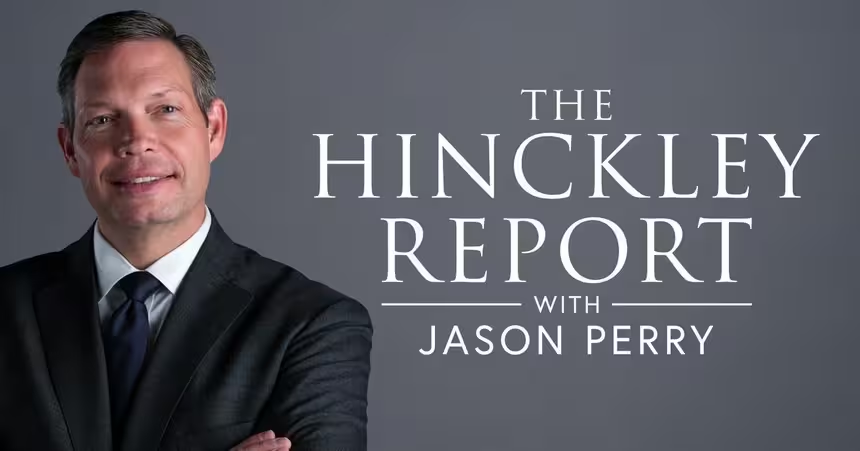
The Hinckley Report
Hosted by Jason Perry, each week’s guests feature Utah’s top journalists, lawmakers and policy experts.Providing Support for PBS.org
Learn Moreabout PBS online sponsorshipJason Perry: On this episode of "The Hinckley Report," elected officials signal a shift in direction as they elect new legislative leadership.
Recent announcements indicate major changes in local Utah politics, and our expert panel discusses the top issues lawmakers are prioritizing ahead of the legislative session.
announcer: Funding for "The Hinckley Report" is made possible in part by the Cleone Peterson Eccles Endowment Fund, and by donations to PBS Utah from viewers like you, thank you.
♪♪♪ ♪♪♪ Jason Perry: Hello and welcome to "The Hinckley Report."
I'm Jason Perry, director of the Hinckley Institute of Politics.
Covering the week, we have Sean Higgins, politics reporter with KUER and co-host of the "State Street Podcast;" Leah Murray, director of the Olene Walker Institute of Politics and Public Service at Weber State University; and Ben Winslow, reporter with Fox 13 News.
Thank you so much for being with us.
Very interesting week on the political scene.
Lots of changes, new legislators getting ready for the upcoming legislative session, and the most important part of what's to come is new leadership in the House and in the Senate.
I want to break that down for just a moment.
Sean, we'll start with you because I want to get through some of these new leadership changes.
The new president of the Senate, Evan Vickers from Cedar City.
Majority leader is Chris Wilson from Logan.
Majority Whip Mike McKell from Spanish Fork, and Majority Assistant Whip Keven Stratton from Orem.
This is a brand new group of leaders.
Talk about this sort of the behind the scenes of this secret ballot that elected these officials.
Sean Higgins: Yeah, so post-election, what happened on the Republican side of the Senate to me was the biggest surprise of election night.
We had Evan Vickers, who was a majority leader for a period a few years ago, lost that seat to Kirk Cullimore.
Kirk Cullimore, as everyone knows right now, lost his election and is no longer in the legislature.
He was seen as the heir apparent to Stuart Adams, who also lost his primary, so there was going to be a lot of shakeup going into this year already.
And then with Cullimore's loss in the general, the door was wide open, and the stage was there for Evan Vickers to step into that presidency.
Below him, Chris Wilson was in leadership last year and the year before as well, so he's bumping up one.
But, I mean, Mike McKell is still there.
He's been in leadership a little bit, but having Stratton step in to assistant whip, that's a completely new face as well.
So I think this says a lot about the direction of where the Republicans in the Senate want to go.
Vickers is seen as someone who is very easy to work with on both sides of the aisle.
Democrats who I've spoken with are very excited at the prospect of working with an Evan Vickers who's heading up the Senate, and there was some rumbling a few years ago when he got bounced from leadership that he got bounced because he was too moderate.
And so there's been a lot of talk of working across the aisle a little bit more possibly with Democrats in the Senate, and that is what really we're looking at right now, a completely new face of leadership and a true vibe shift, I think, in the upper chamber.
Jason Perry: Leah, talk about that potential direction if it may change very much.
It's been a very long time since we had a president that was representing kind of rural Utah.
Leah Murray: Right, and I would argue southern rural, right?
So a little bit, I feel there might be a shift in conversations around-- how do I say-- the Great Salt Lake is not everywhere in the state, right?
So for southern Utah, they have different water issues, and I wonder if having Senator Vickers as president, does he elevate some of the other conversations, issues around education?
We know that there's some conversation about what that looks like, and southern rural education issues are different conversations, right?
So I just-- I'm very interested about what this looks like as-- I'm from New York.
We would have said downstate.
I don't know what y'all are going to call it here in Utah, but when, like, the southern part of the state starts to arrive, you know, it'll be fun.
Jason Perry: What do you think, Ben?
Is this more than just personality and geography?
Is this going to be substantially different in terms of direction and maybe even leadership style in the Senate?
Ben Winslow: I think largely the same, really, of what we've experienced in terms of the Senate will still be the collegial body that will be the, you know, the more deliberative body in approach to legislation.
You may see some personality differences just in terms of-- as Sean pointed out, you know, there is-- President Vickers now enjoys a reputation for being a collaborator, especially I think about, like, cannabis legislation.
He worked very closely with Senate Minority Leader Luz Escamilla and now House Minority Leader Jen Dailey-Provost on cannabis bills, and he has-- when he was elevated to Senate president, I reached out to the Utah Patients Coalition.
They were thrilled, you know.
This is a group that is sometimes antagonistic or opposite of the legislature's viewpoints on pieces of legislation, but they're like, "This is someone we can work with.
This is someone that we have-- we may not get everything we wanted, but he's willing to listen to us," and that's what I've heard a lot about Evan Vickers's leadership style.
Jason Perry: A pharmacist as president, we'll see how that goes.
Leah, let's talk about the House for just a moment.
So, some of the leadership stayed the same, but some changes also.
Speaker continues to be Mike Schultz from Hooper, Majority Leader Casey Snider, Majority Whip Candice Pierucci.
There's a change, and then Majority Assistant Whip Cal Roberts from Draper.
Leah Murray: Yeah, I mean, I feel like in the House it's a different conversation entirely because the minority there-- do they double in size?
Like, I just wanna be, like, they doubled in size.
I wanna make sure I do the math well, and then also that doubling in size means they no longer have a supermajority, so it's all conversations around you maybe used to let people vote their conscience a little bit, and you might got away with it, and now that's not gonna be true.
That whip role is gonna be really important, making sure that they can whip all their votes and know what's happening.
And then also, I just think all those incoming Democrats, which I think we'll talk about in a second, they don't really all know who they are or what their vibe is, right?
Like, so managing all of that-- Ben Winslow: Some of them don't even know where the bathrooms are at this point.
Leah Murray: It's adorable.
It's adorable.
Like, they are-- were not expecting to win-- this historic election has changed everything, and I do think you see the speaker being cognizant of that.
But still, really, he doesn't know what's coming down the pike.
Jason Perry: Sean, I want to get to the Democrats, and we'll see how this will play out with how you have to govern and manage after this.
But interesting in the Senate: Minority Leader Senator Luz Escamilla from Salt Lake, Minority Whip Senator Karen Kwan from Salt Lake, Minority Assistant Whip Jen Plumb, also Salt Lake, and then caucus manager-- here's the new one-- Senator-elect Silvia Catten.
Interesting to hear from the Senate.
Let's talk about the dynamics there.
Sean Higgins: Yeah, I think to Ben's point about the operations of the Senate largely staying the same, I think to see that the Democrats largely chose to stay the course.
We had one senator-elect come in to be a caucus manager, but I think someone like Senator Luz Escamilla has great relationships across the aisle, certainly with Senator Vickers.
She and Senator Vickers are quite close, so I think it's a smart move to keep things as they are if you're a Democrat in the Senate, partially because that caucus is so small.
All of them could probably fit at this table.
There's only a handful of them there, and the numbers didn't really change nearly as much as they did in the House.
So I think the talk of the dynamics in the Senate staying largely the same is accurate, as Ben was saying, and I think Democrats saw the writing on the wall there and chose to stick with what they had been going with.
Jason Perry: Okay, Leah, not quite the same in the House.
Leah Murray: Yeah, and again, right, so the answer is they got rid of minority-- former minority leader Angela Romero.
To pick up what you talked about earlier, right, that Representative JDP, right, coming in, yeah, being in charge and a little bit-- I think they might be feeling feistier, so-- and if you read-- and you all maybe know this better than I do, but if you read, like, how we're choosing, and if our leadership is a signal of what we are looking for, where we read the Senate as maybe staying the course, right, and having it look like it did before, I read the House as ready to rumble in the best way.
Jason Perry: Ben, let me give you the names and then will you tell us the kind of the backstory here?
So, minority leader, Representative Jennifer Dailey-Provost, Salt Lake County, minority whip, Representative Doug Owens from Millcreek, yeah, Assistant Whip Ashlee Matthews from West Jordan, Kearns, and caucus manager Representative Verona Mauga from Taylorsville.
Ben Winslow: And what you're seeing here is just a changing of the guard.
The caucus votes in their secret deliberative votes, and they've decided to go a different direction than House minority leader-- now former House Minority Leader Angela Romero.
This happens and-- but what is going to be the challenge for the House Democrats is can they hold the line?
The Republicans still are in charge.
Let's be clear, they have the majority.
They also need to keep their members in line if they want to pass their priority bills.
The Democrats have a little more room to negotiate now if things start fracturing, but the Democrats have the same issue.
They've got to keep their caucus in line to hold the line.
So this is going to be interesting when you get some very contentious bills during the upcoming legislative session and you start seeing these fractures, and we've seen this before in the supermajority, you know, I think of the tax reform legislation, when the Republicans were divided quite a bit and they needed the Democrats's votes, so there was a lot of meetings with the Democratic-- House Democratic leadership to try to get some of those votes on board.
And then now this is gonna be even more of an issue because, again, you're gonna have to negotiate if you want some of those votes, especially if your own caucus starts fracturing, and this is going to be an interesting session to watch with some of these contentious bills where the lines are held.
Sean Higgins: I think Democrats have a bigger problem on their hands than Republicans in many ways because if you look at the numbers and the seats that they picked up, all but maybe four or five, so we're looking at maybe ten seats, those are Republican red seats in any other normal election, and we had Democrats come in and sweep those seats.
So I have to think the Republicans are chomping at the bit to claw all of those seats back in two years.
I think the Democrats are gonna have a big challenge on their hand, keeping the caucus organized, particularly when it comes down to some of these more contentious votes, and obviously the Democrats in these seats want to hold on to office.
They might have to break with the party quite a bit.
Ben Winslow: But worth pointing out, I mean, the majority of legislation that passes is bipartisan and often unanimous.
It just-- it's keep-government-going bills.
Leah Murray: I wanted to add something to this too, and maybe you were planning on talking about it later, Jason, but also now I think the governor is important, not that he wasn't always important, but a little bit-- now his veto is a veto, right?
And so I think when we talk about negotiations, it's not even just, like, how do I keep my fractured caucus together and what's happening in that chamber, but also now you've got Spencer Cox could weigh in on any given issue.
And what he says now, I think, has a lot more value anyway, so I just-- Ben Winslow: No, I think there's definitely a veto pen, to your point, that is a lot more influential.
Jason Perry: Sean, a little bit-- one more on this.
When you have more Democrats there, as you're seeing sort of the-- what's going to happen during this legislative session, there's kind of this question: Are they going to be able to stop more things, or are they going to be able to promote more things?
Sean Higgins: I think the question of stopping more things, maybe not, because it's still a significant Republican majority in both houses.
It's still a supermajority in the Senate.
It's a significant majority in the House.
I think what we will see, as Leah was saying, in conjunction with the governor, a lot more negotiation on what amendments do and don't get squeaked through into some of these other bills because I think Governor Cox has hinted, maybe not so subtly, that he's gonna be much more forceful this session on getting what he actually wants into bills, and I think when it comes to things like constitutional amendments, they need Democratic support now because you need a two-thirds majority in both chambers to do that, and they simply don't have the numbers to just do it on their own now.
So no constitutional amendments, certainly veto overrides, you need Democratic support now.
So if it comes to a fight between the majority and the governor's mansion, Democrats are gonna be the decider there.
Jason Perry: Before we do this entirely, anyone know where our two independents are going to caucus, who they'll be with?
Sean Higgins: As of right now, no.
I've spoken with both of them.
This was a couple of weeks ago.
They have had conversations, I've heard, with the Democrats, maybe a little bit more frosty on the Republican side, but as of right now, I have not heard that they will caucus with either party.
Jason Perry: Okay, I want to get into the legislative session for just a moment.
I checked it out.
As of today, 1,159 bill requests.
Ben Winslow: But how many of those are not going to be here come January?
Jason Perry: Oh, there may be some of those, right?
That could be as well.
But I wanna talk about how we're starting this, and Ben, you've done some great reporting over the past couple of months as well.
We start looking at the money side of this session, and one of the big issues right from the beginning will be Medicaid expansion issues.
We may be $100 million to $200 million in the hole to start the session.
Ben Winslow: Right.
And this is a result of people dropping off from COVID and budget forecasting tools that just didn't work quite well.
What I understand, and what I reported at the time, and it still seems to be the case, is they will dip into rainy day funds to cover the shortfall.
Going forward, though there will probably be some very uncomfortable conversations about funding these things and benefits that are offered, just in terms of how we manage this financial issue because you can't run a government in the red.
That's just not allowed here in Utah.
So that at least appears to be the plan for right now.
Leah Murray: I was going to say, maybe they should have timed their Amendment B for after this session, when it comes in as a deficit, because now all of a sudden maybe that amendment makes more sense and making sure that if you have a Medicaid expansion bill that adds tax risk, or I'm not sure what the right word there is, that we should be talking about that in a different way.
Sean Higgins: They call the budget the bill of bills for a reason on Capitol Hill.
The state does not function without a balanced budget, constitutionally, it cannot, and we've kind of seen this fight or this perceived fight or this expected fight ramping up over the last few years.
We had a huge influx of federal money during the COVID years that started to wane off, and then the Big Beautiful Bill cuts that came in the last year or so, and then this looming Medicaid issue-- it's just been a slow ramp up, I feel, over the last couple of years where the budget is becoming more and more of a central focus during the session.
Jason Perry: As we talk about what the priorities are going to be for the session, we're starting to hear them, including from legislative leadership.
I wanna read a quote from Speaker Mike Schultz really quick, and then Leah, I think you even talked to him about what his top priorities are.
Let me talk about how he's going to approach it, and then I wanna talk about school funding and for teachers.
Here's what Mike Schultz said, the speaker of the House.
He said, "I think people feel like we're not listening to them, and for good reason.
When you're in a majority and you get complacent, we don't want to ever get to that point again."
He says this and he talks about one of his top priorities is going to be class size.
Leah Murray: Right, right, because the answer is right now children in Utah are going to classes and the classrooms have, like, 30, 35 kids in them, and also maybe we've got the case that schools might be closing because there's not enough kids for all the schools.
And it feels like maybe an obvious answer is keep the buildings open and, you know, like, move the kids out and try to get our class sizes down to 25.
And what I feel good talking about, like, negotiating with people, everyone, I think, would be on board with that, thinking about how we support teachers.
There's more teachers in those classrooms, you're funding more teachers.
I mean, everyone would like to have their children in smaller classes.
Feels like an easy win.
Ben Winslow: But the devil's gonna be in the details.
How do you fund this, how are you going to pay for this?
This may require capital investment if, as the speaker has floated to me, the idea of maybe keeping some of these closing schools open, that's gonna require capital, that's gonna require money.
There's a certain amount of the income tax that's already earmarked for public education.
Are you dipping into additional funding?
Where are you going to get that money, especially in what could be, you know, maybe a tight budget year?
Leah Murray: Right, except that if their number of students are lower, then it's a different-- how do I say-- when they were trying to raise or lower, excuse me, reduce the class sizes a few years ago, what was the bill-- was like billions of dollars and really not a lot of impact.
If we have fewer children, we can do this.
You might be able on the other end of it-- I hear you on keeping those buildings open, but it might-- Ben Winslow: Still gotta staff them.
You still gotta do all that stuff, yeah.
It's just gonna be a funding issue, I think.
Jason Perry: I wanna get to a couple other issues that are going to come up, we understand, and they already had sort of their hand in the leadership election.
Let's talk about data centers for just a moment, and I know several of you are following this, Sean and Ben.
I think you reported on this very week.
Let's talk about what's happening with data centers in Utah.
We've got some polling about where Utahns are on this, but some things have started in Salt Lake, a moratorium, Sean, a moratorium for six months on data centers, already happening this week.
So talk about that and what's happening statewide.
Sean Higgins: Yes, so Salt Lake City, Salt Lake County, and I believe Box Elder and one more county up in northern Utah have all passed at least limited moratoriums on the new data centers, and what we're hearing from city staff is this is really to wrap their heads around it and maybe write some new code, write some new city rules on things like energy, water, heat, noise, things like that, things that have really captured people's attention.
And that all harkens back to what happened earlier this week during the interim session where we got a first preview on what I'm expecting to be a gargantuan bill on how the state handles the issue of data centers.
So this is going to cover everything.
From how they get approved to how the environmental impacts of it to the sweetheart tax deals that some of these facilities get.
So I think there's maybe probably, like, four or five bills that they're trying to go into one-- in one big bite at the apple here.
And it's a lot.
We don't have bill language yet.
We were told that it will probably be a while before we get bill language.
There are so many stakeholders, people in the House, people in the Senate, people in industry, people in local government all need to weigh in on what they're proposing.
And it sounds like this is going to be one of the biggest bills that gets pushed through the session this year, and the timeline on that-- this could be something that they are discussing from day 1 until day 40, I feel, because it's just such a salient issue for everyone in the state right now.
Everyone's talking about data centers.
It was such a big issue, particularly for some of these legislative races in northern Utah.
And I have to feel like the legislature is feeling the pressure on this one right now.
Ben Winslow: This ushered in a lot of new members, and they were sitting there in the committee room taking notes, typing on their phones fast and furiously, and some of them signaled afterward that they're not exactly fans of what was proposed.
Some of them would like to see a moratorium on a statewide level.
That may not be possible, and this is where you start getting into the fracturing and amongst the caucuses and negotiations.
But this policy is going to be huge, and it is going to have a lot of public input because the public has feelings about this.
The left and the right have united in their common hatred of a data center, and so it's going to be a hot-button issue, probably the dominating issue, to your point, Sean, about the session.
Leah Murray: Yeah, I think it's, like, a valence issue of hatred, but don't you feel like it's a little shallow?
So, like, we don't actually-- first of all, how much do we need these data centers?
So all these people who hate them at the same time pulling out their phone and using their AI to, like, travel around places.
So a little bit-- what a tricky issue.
Not to defend legislators, but I think they actually don't know, other than hate, where people are on it.
You don't know how to message it as you're building this big bill, and you can talk about it all you want, and if people are paying attention-- Anyway, I just think it's tricky.
Like, it's gonna be fun.
Ben Winslow: It's gonna be so messy, and there is a point.
Utah State University yesterday released one of its reports and showed that there is some interesting research about public opinion on data centers.
Three out of four Utahns oppose data centers, but there is room to negotiate with the public on this when they feel like they have a say in what's happening with land use authority, when they have a say on what's happening with water and other environmental resources, air quality, heat effects, things like that.
So it is going to be a big task for the lawmakers who are pushing this legislation.
Representative Paul Cutler has been tasked by the House majority, and Senate Majority Leader Chris Wilson has been tasked by the Senate with this.
It's gonna be a big task to thread this needle.
It may be one of those pieces of legislation where everybody gets some of what they want, but none of what they want.
Sometimes on Capitol Hill they say, "That's a really good bill if nobody's happy."
Sean Higgins: I really got the feeling, and this was said explicitly by these two lawmakers, that this is really so much about smoothing out the process.
They do not want another Stratos situation to happen where even the county commissioners felt like they were being forced to do something they did not want to do, given the rules and how MIDA factored into all of this, and they just want to avoid that at all.
Ben Winslow: MIDA is now being cut out, which is quite surprising to me that this entity that was created to really, you know, kind of speed these development projects through is now getting the brakes put on it.
Jason Perry: I want to talk about another issue that's likely to come up this legislative session, these Flock cameras.
Leah, what's a Flock camera?
And it's certainly getting everyone that understands about it to have an opinion about it.
Leah Murray: Isn't it like a more government surveillance version of, like, I don't know, Google Earth or something like that?
There are, like-- there are cameras everywhere, and I felt like we had this argument a couple decades ago, like we didn't really want our license plates having pictures taken when they went across state borders, and then I guess I thought the issue went away, but I was wrong.
So they put the Flock cameras up everywhere, and they're scanning everywhere we drive and then also selling that data to law enforcement agencies in other states.
And I just think part of it, kind of like on data centers, I didn't think they were Flock cameras, and then all of a sudden you know, and then now we're talking about it.
Ben Winslow: It's one of those things when you see them you see them, everywhere.
Leah Murray: Right, once you know what they are.
Ben Winslow: Yeah, and this is going to be also contentious legislation because there's going to be a balance.
You have certainly a very big appetite on Capitol Hill to put some guardrails around this, and you will see something, whether or not it appeases, you know, people who really want privacy and really want, you know, certain civil liberties protected to a robust measure or whether it's something in between, TBD.
Jason Perry: Sean, give us a final word on this too.
So these are these automatic license plate readers.
There's over 1,000 of them, a lot of them along the freeway.
Law enforcement is saying this helps us solve crimes.
It protects abductions for children, those kinds of things, but you certainly have the other side of this.
Sean Higgins: Yeah, I mean, I think this is another one of those needles that needs to be thread very carefully because there is data that shows that these types of cameras do reduce crime.
They do help investigators find people who are actually doing bad things, but I think, like we were saying, the civil liberties aspect of this, none of us want to live in a surveillance state.
That's just in our DNA as Americans, we don't-- we do not want that.
Leah Murray: Or if we do, we want to know that it's happening.
Like, I think the thing that stunned people was, like, "What do you mean you are sending all this data to other law enforcement?
I didn't know that I understood that was a thing.
Ben Winslow: Or selling it privately.
Leah Murray: Or selling it privately.
So a little bit it's about let me know before I'm being surveilled, and then maybe I'm okay with it, maybe not.
Jason Perry: Yeah, we'll watch this one closely.
I want to end with a very interesting announcement, Ben.
This week we're talking about the Salt Lake City mayor.
We had thought the Mayor Mendenhall was going to run again.
She announced that she is not.
Talk about that for just a moment because there are a lot of implications for Salt Lake City, the most populated part of our state.
Ben Winslow: There is a big amount of implications, starting with everybody's going to be running for this.
Mayor Mendenhall has chosen not to seek a third term.
Worth pointing out, it appears voters don't really like three terms.
They give you two and call it good.
We've seen that-- Ted Wilson, I believe, was the last mayor in Salt Lake City who had three terms, and even in Provo, we saw Michelle Kaufusi, very popular, who did not win a third term.
Voters just appeared to want to change, and maybe Mayor Mendenhall saw this and, you know, maybe the odds on the calculation weren't there.
I don't know, but you will see a lot of people already jumping in.
I mean, Senate Minority Leader Luz Escamilla's name has been floated.
Peter Corroon sent out a press release within an hour of this happening.
I've heard other names.
I think we're gonna have, like, a baker's dozen by the time we get to a primary.
Jason Perry: What does this mean for our capital city, Sean?
Sean Higgins: I think this is gonna be the big question going forward because Mayor Mendenhall really billed herself as a negotiator for the city on Capitol Hill and not as a bomb thrower.
Yes, she's a Democrat.
She's in an unaffiliated position as a mayor right now, but it's pretty obvious what her politics are, and she-- the reason why she was elected twice was largely because she billed herself as someone who could work with the legislature on some of these really contentious issues where the city and the city council really is up against the supermajority and what they see as some really punitive measures over the last few years that the legislature has really tried to force Salt Lake City's hand on.
Mendenhall has really been the negotiator, the point person to talk with House and Senate leadership and the people running these bills on whether it's who can control city streets, the flag bill for sure from a few years ago.
So I really think who steps into that role and the debate around who would be the next mayor of Salt Lake City would really center around what type of personality and what relationship do you want the city to have with the state.
Jason Perry: Fifteen seconds.
Ben Winslow: And that's gonna be a reckoning, I think, for voters is what type of person do you want?
Do you want someone who's gonna challenge City Hall or challenge the Capitol, or do you want someone who's going to negotiate?
Jason Perry: It's gonna have to be the last word, so interesting.
We'll watch very closely, big time in politics these days.
Thank you very much, and thank you for watching "The Hinckley Report."
The show is also available as a podcast.
Thank you for being with us.
We'll see you next week.
announcer: Funding for "The Hinckley Report" is made possible in part by the Cleone Peterson Eccles Endowment Fund, and by donations to PBS Utah from viewers like you.
Thank you.
♪♪♪ ♪♪♪
 New Episode
- News and Public Affairs

Top journalists deliver compelling original analysis of the hour's headlines.
 New Episode
- News and Public Affairs

Today's top journalists discuss Washington's current political events and public affairs.

 New Episode
 New Episode
 New Episode
 New Episode

 New Episode

 New Episode

 New Episode
Support for PBS provided by:
The Hinckley Report is a local public television program presented by PBS Utah
Funding for The Hinckley Report is made possible in part by Cleone Peterson Eccles Endowment Fund