
Legislative Recap & Election Season Kicks Off
Season 10 Episode 27 | 26m 49sVideo has Closed Captions
We review the recent legislative session as election season in Utah heats up.
As the dust settles on the 2026 legislative session, our expert panel discusses which issues won and which were voted down. Plus, Utah voters attend their neighborhood caucus meetings as election season really heats up. Journalist Ben Winslow joins political insiders Amelia Powers Gardner and Wes Smith on this episode of The Hinckley Report with Jason Perry.
Problems playing video? | Closed Captioning Feedback
Problems playing video? | Closed Captioning Feedback
The Hinckley Report is a local public television program presented by PBS Utah
Funding for The Hinckley Report is made possible in part by Cleone Peterson Eccles Endowment Fund, AARP Utah, and Merit Medical.
Legislative Recap & Election Season Kicks Off
Season 10 Episode 27 | 26m 49sVideo has Closed Captions
As the dust settles on the 2026 legislative session, our expert panel discusses which issues won and which were voted down. Plus, Utah voters attend their neighborhood caucus meetings as election season really heats up. Journalist Ben Winslow joins political insiders Amelia Powers Gardner and Wes Smith on this episode of The Hinckley Report with Jason Perry.
Problems playing video? | Closed Captioning Feedback
How to Watch The Hinckley Report
The Hinckley Report is available to stream on pbs.org and the free PBS App, available on iPhone, Apple TV, Android TV, Android smartphones, Amazon Fire TV, Amazon Fire Tablet, Roku, Samsung Smart TV, and Vizio.
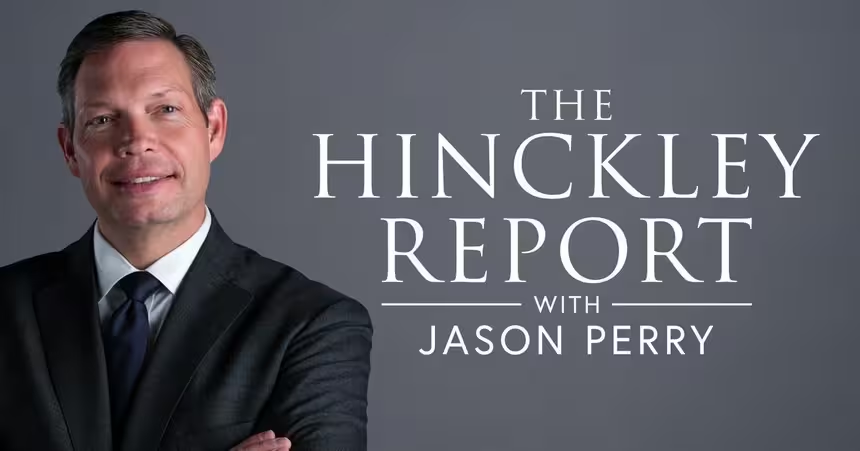
The Hinckley Report
Hosted by Jason Perry, each week’s guests feature Utah’s top journalists, lawmakers and policy experts.Providing Support for PBS.org
Learn Moreabout PBS online sponsorshipJason Perry: On this episode of "The Hinckley Report."
As the dust settles on the legislative session, our expert panel breaks down which issues won and which ones got voted out.
Utahns attend their neighborhood caucus meetings and set the stage for the midterm elections.
And new polling reveals key issues and popular opinions.
male announcer: Funding for "The Hinckley Report" is made possible in part by the Cleone Peterson Eccles Endowment Fund, and by donations to "PBS Utah" from viewers like you.
Thank you.
♪♪♪ ♪♪♪ Jason Perry: Hello, and welcome to "The Hinckley Report."
I'm Jason Perry, director of the Hinckley Institute of Politics.
Covering the week we have Ben Winslow, reporter with "Fox 13 News;" Amelia Powers Gardner, a Republican on the Utah County Commission; and Wesley Smith, partner with Northbound Strategy.
So glad to have you all with us.
The legislative session is over.
Now we get to think about it a little bit, all that happened.
The governor's looking at some vetoes, and there's a lot of other political things happening in the state, a lot of really big ones with big implications on the country and on the state.
But I want to talk for just a moment at the end, sort of the analysis, Ben, on the number of bills, because we're talking about how busy the legislature was this past session, the bills that were proposed and the ones that did not get through.
One thousand sixteen bills introduced.
You read most of them.
Ben Winslow: And I read every single one of them, I'm sorry to say, Utah.
Jason Perry: Because you did it for us, right?
Ben Winslow: Right, I did it for you.
They are--this was a new record.
Every year we always joke, "Oh, they break their own record."
It's the number of bills requested that they usually break the record, which is like 1,300 or so.
This year, there was the number of bills introduced.
What was really interesting, though, is they didn't pass nearly as many as they did last year.
Like, there was a lot that died, and it died quickly.
Jason Perry: Yeah, Amelia, talk about that for a moment because it was.
There was 542 passed of those, which was not even close to the record.
Explain that just a little bit, because I know you were watching it so closely.
Amelia Powers Gardner: Yeah, I honestly wonder if one of the reasons that less bills passed is because so many were introduced, that there really wasn't time to give the bills the effort, right?
When you're a legislator, and you're trying to read every single bill, every time you're doing that, you're spending less time working on a bill.
The other thing that I thought was interesting was that there were 411 substitute bills.
I think this year in particular there was a big difference between what the House wanted to pass and what the Senate wanted to pass.
They were not on the same page.
Jason Perry: Yeah, definitely different strategies and objectives.
Wes, what comes after this oftentimes is this period of time after the session when the governor has an opportunity to review all the bills.
We know from his press conferences this week he's going through each one of the bills that passed.
Are you seeing anything on this potential veto list?
Wesley Smith: It's remarkably quiet from the veto front, right?
I don't think that--I haven't heard anything that is imminent.
And I'd be interested, I'd actually be interested to hear if people know of things that the governor-- Ben Winslow: I have nothing, yeah.
Amelia Powers Gardner: I've heard nothing.
Jason Perry: So we've even heard the governor talk in the past in one of his speeches, "I'm gonna--I plan on vetoing some things."
Ben Winslow: Yeah, last night of the session, I asked him if there was anything that was cruising for a veto in his mind, and he said no.
He just didn't see anything that right now rose to the level.
It's not to say that as you're going through the bill review process, you don't find something that's legally problematic, or could have, you know, cascading effects that merits a veto.
But so far, he's found everything fine.
It seems like the Senate or the House, whichever chamber the bill was going through, did the work for him, that if there was something he didn't like.
Jason Perry: There's something about engaging during the process, right, Amelia?
Amelia Powers Gardner: Yeah, and during these 45 days, a lot of people look at politics.
But the rest of the year, those of us that are in government full time, we have to implement these bills, and we have to actually do the business of the people on a daily basis.
Oftentimes a bill gets vetoed when it made good political sense to pass it for the legislators heading into an election, but it doesn't actually work for governance.
The fact that we don't have any big bills is a good thing.
That means that nothing was passed that is highly problematic.
Jason Perry: So we go from the legislative session, the governor goes through all these bills.
And Wes, now we get to the sort of the start of the crazy political season.
This is the week for caucuses.
All right, talk about that for just a moment.
The Republicans and the Democrats held their caucuses this week, some observations.
Wesley Smith: We always love to talk about that like as a chattering class, as a, you know, "Hey, what, what's going on?"
The part about this that goes under the radar a lot is I think that the precinct caucus system has lost a lot of its interest for practical outcomes now, because there is a signature route to it.
But we look at these precinct caucus systems, everybody gets excited about them, and they say, "Okay, what happened?
Were there a lot of Republicans?
Were there a lot of Democrats?"
And the truth is that's, like, that's something we could talk about, but the actual impacts, what if there were a lot?
What if there weren't a lot?
The same candidates are going to get on the ballot if they go through the alternative process.
Jason Perry: Yeah, so--oh, go ahead, Ben.
Ben Winslow: But I could see the caucus system as a bellwether.
Acknowledging the signature path now is the reality, too, but this is sort of the energizing how are people feeling?
Going into, say, like now the midterms, how are people feeling about the general election?
Who are they backing?
Who are they excited about?
What issues are bringing them out?
I mean, I saw that, I was in the Democratic caucuses covering that in the first congressional district, the new first congressional district.
It was packed.
People were excited.
They were energized.
They felt like, you know, as a result of the redistricting rulings that they were going to have a say in all of this, and they were just excited for this new Salt Lake County centric district that they believe the Democrats can win in.
Jason Perry: Amelia, I want to give you a little bit of historical perspective if you don't mind on this because there's a lot of big turnout on the Democratic, particularly in the first congressional district.
And we saw sort of packed houses and not so much in some others.
But in the day, this was an opportunity for a candidate to truly solidify some support, to Ben's point here just a moment ago, not just to secure the delegates, but also some of these primary issues they would want to run their platforms on.
Amelia Powers Gardner: Yeah, I think if you look at this historically--so I've always been a convention-only candidate.
Every election I've ever run, I've been a convention-only candidate, and I've won every convention I've run in.
But my first year, it was huge for me because I was a relatively unknown to the voters.
And it gave me the opportunity to get my platform out there and to really get that base of support, to your point, Ben, as a bellwether.
But what's interesting is a lot of people, there was really low turnout, in in my view, on the Republican side.
I think the average caucus on the Republican side probably had about a dozen people in it.
In the past, it's had 50, 100, sometimes even in big years, 200 people per room, and we were down to maybe a dozen.
And folks want to blame that on the signature path, but in the first congressional district on the Democrat side, they had packed caucuses, and every one of their candidates is getting signatures.
I don't think it has as much to do with the signature path as it does the excitement in the party.
The Democrats are excited.
They showed up.
The Republicans, if you look at the past right now, there's really no exciting races on the Republican side.
I mean, you can argue at maybe some congressional races, but there's really not any exciting races.
Number two, two years ago, a lot of people had a hard time at caucus, and the convention lasted like 18 hours.
And people didn't want to be a delegate because they had a poor experience two years ago.
And then I think the third one is this negative attitude.
There has been a faction of the Republican Party over the last few years that has just been really negative, and negativity in politics kills the grassroots.
People get involved in grassroots politics because they want to be inspired.
They want to make a difference.
I think that's why the Democrats showed up in CD1, because they want to be inspired and be a part of something.
They don't wanna have their--they don't wanna have anger and rage and hate thrown at them constantly, and we've seen a lot of that with the faction of the Republican Party these last two years.
Jason Perry: Wes, what was your observation of these caucuses, what you heard and what you experienced, too?
Because if you go back to like the days of Senator Orrin Hatch, for example, what you would do if you wanted to get your delegates is you would show up to a caucus with all the people that are going to be voting on who their delegates would be sort of to secure your spot.
Wesley Smith: I mean, you would recruit, right?
You'd have a caucus strategy.
You'd find your champions within neighborhoods, and you'd say, "Hey, will you go be, you know, the precinct chair?
And will you make sure that we get the right delegates?"
And that was a mini campaign, right?
And then, you know, I mean, over time, I think that the Herbert experience, where he lost by 10 at convention, and then a couple of months later he wins by 44 points in a primary, you have a few of those, and you realize, "Oh, wait a minute.
If I'm a candidate, do I really want to go through that recruiting pro--do I have to do that?"
And frankly, you realize, too, if you're a more moderate candidate, "I don't have to do that anymore."
So I think that's had an impact on how we think of the precinct caucus system and who shows up now.
Jason Perry: Let's break this down for just a minute, too, Ben, because you've been involved with this for so long.
How does this really play out, then?
Because you might say only a certain kind of candidate is going to get the approval of the delegates, but they all mostly do still show up, even though it's clearly not fatal to your potential future as a winning candidate to lose at convention.
Ben Winslow: Yeah, but it can certainly give you a lot of support, and it's not to rule out the caucus convention system entirely.
I think that you just have this new reality of the dual path, which has--it appears to be here to stay, barring any future legislative actions.
But you can still get that groundswell of support, and being it is a path to getting on the ballot, it is a path to potentially victory, is still through the caucus convention system, regardless of your political party.
Or you gather signatures, and sometimes it's just a prudent strategy to do both, really, just to make it.
Wesley Smith: At this point, I think it is political malpractice not to collect signatures, unless you're Mike Kennedy.
I mean, there are maybe one or two-- Jason Perry: 'Cause who's not?
Wesley Smith: Yeah, I mean there might be a couple candidates who can do that, but pretty much now if you're not doing that, that's a risky strategy.
Jason Perry: Yeah, so Amelia, talk about that, because there was a time in conventions in the past where that was actually a question you'd be asked if you want to be a delegate, is what's your opinion about someone who gets signatures or doesn't get signatures?
Is this a sign that maybe that has changed a little bit?
That's not the primary concern for delegates?
I mean, you've been in this position yourself.
Amelia Powers Gardner: So, one of the things that I think to keep in mind is there's another Mike who happens to be a delegate darling, and that's Mike Lee.
But yet, he has collected signatures every time.
Phil Lyman, who won a convention two years ago against the governor, is collecting signatures in his race.
And, but yet, Celeste Maloy, Congresswoman Maloy, she's collecting signatures for the first time.
I think that we'll have to see what this crop of delegates says.
Two years ago, it was still a huge question.
Did you collect signatures?
Well, now that some of the people that haven't collected signatures in the past, Phil Lyman, are collecting signatures, I think that it's going to be less of a question.
The other question is, who got elected as a delegate?
Jason Perry: Last comment on that, as you can see-- Ben Winslow: Delegates can still make decisions, and I wouldn't rule them out.
I think that's gonna be a big X factor in both the Democrat and Republican parties, particularly, is how delegates do feel, and who they are, you know, what kind of delegates we're getting at these conventions.
Jason Perry: Okay, we'll watch that one closely, and it certainly does have an impact on the rise and fall of some of these candidates, too, depending on how their message gets out.
Let's talk about CD1 for just a minute.
You didn't start at the top.
The top of Utah is not number one.
Salt Lake is district number one here, and it kind of goes up and around.
Amelia, eight Democrats had filed, one dropped out, so we have seven Democrats running for that congressional seat, and all of them are getting signatures.
Break this one out just a little bit, because there does seem to be a lot of interest.
Amelia Powers Gardner: Yeah, I think the most obvious is Ben McAdams.
He's a known figure, and he already has his signatures.
Senator Nate Blouin is close to getting his signatures.
The one that I'm excited about and the one that I'm watching is Eva Lopez.
She's halfway to her signature threshold right now.
I think she's the dark horse in this race and the one to watch.
I've been on panels with Eva many times, and she's highly competent, well-spoken, and she's a true public servant.
Jason Perry: Wes, break this out a little bit more, too, as someone who's been involved in campaigns for such a long time.
This is a little bit of a new dynamic for the Democratic Party.
Wesley Smith: It's really hard to know and to predict, to say, "Okay, we don't have historical data on this district."
We know that it's pretty progressive.
I mean, it may be--I've heard it said multiple times, it's one of the most progressive districts in the country at this point.
And you know, the idea of having like Bernie Sanders come in and campaign in the state of Utah, it's gonna be really interesting.
The thing that I'll note is Ben's really good at electioneering.
He's, you know, he's been around.
He knows this area really well, so I would say he's really formidable.
And all of the interest, though, and that's brought so many challengers, that's new to him, too.
So I think that this one's a tough one to predict.
Ben Winslow: I think on this one, the Democrats are finally gonna get a taste of what the Republicans have experienced for years now with big fields of candidates, different viewpoints, different things.
And to Wes's point, yes, this district, I have observed, is very progressive-leaning it appears, based upon the people that I've talked to who are excited about this.
This is also a critical district for the DNC.
I talked to DNC chair Ken Martin who has eyeballed this for potentially flipping the balance of power in the House.
So you will start probably to see national engagement, just to make sure that this election goes the way for the Democrats that they want, so that they could potentially use it as part of their flipping the House.
Wesley Smith: I think the national engagement point is really good--for a couple of reasons.
That is one.
Clearly you have some really big names that are thinking about coming to campaign here, but also the White House is watching this, and they're watching from a Prop 4 perspective.
You know, what's gonna happen, "This is what happens when, you know, gerrymandering goes wrong, and this is why, you know, red states should be, you know, in this fight more," et cetera.
So I think you'll see that from the White House watching this.
And I also think if, you know, if you do see Prop 4 on the ballot, this could have a huge impact, depending on who wins.
And if you see a really progressive candidate, that might get people more fired up in Utah to say, "Wait a minute.
What's happening here?"
And the same in District 3, frankly.
If you see a really conservative candidate come out of District 3, you might see the same kind of impact nationally.
Jason Perry: Yeah, well, while we talk about what the White House administration is looking at in the state of Utah, we have to get to a piece of federal legislation.
Amelia, if we'll talk about this for a minute, the Save America Act.
You're in a unique position, a former elected official, but also a former clerk, right, county clerk.
Talk about this for a second.
What does the Save America Act do that has just been put out this week?
Amelia Powers Gardner: Yeah, the underlying premise of the SAVE Act is one that I actually agree with, and that is that you should be a United States citizen to be on the voter rolls, and that you should have your identity verified when you cast a ballot.
I think most people, even across party lines, agree with those sentiments.
The controversy with the SAVE Act comes in two areas.
Number one is how?
It's the nuance, right?
It's the how.
For example, in Utah, we did an audit.
We found that there were almost no--well, there was one illegal person on our, illegal citizen, on our voter rolls, and they didn't vote.
So this is not a problem in Utah.
But yet the SAVE Act, as written, could disenfranchise tens of thousands of Utahns and compromise their constitutional right to vote.
And so it's a solution looking for a problem.
The premise is not necessarily bad.
It's how it's being administered.
The other aspect of that is federalism.
In the state of Utah, we believe in states's rights.
We believe heavily in states's rights.
Our Attorney General, Derek Brown, has an entire division that he's spinning up to talk about states's rights.
And when the Democrats tried to do HR1, which was a federal takeover of elections, we fought it.
Republicans should be consistent on this.
We believe in federalism, and it's taking over.
The other aspect of the SAVE Act is now they're starting to tack on a whole bunch of riders onto it that don't have anything to do with voting.
And so I can see that the SAVE Act has become a really hot political issue.
I do know that there are members of our federal delegation, both in Utah and outside of Utah, that have started receiving significant threats and protests over this issue.
And they don't even necessarily disagree with the premise, maybe just the how.
Jason Perry: Go ahead, Wes.
Wesley Smith: From a political perspective, from a communications perspective, what Amelia has said is something that I think a lot of people recognize, and that is the premise of it is really powerful, right?
And when you're out there, and if you think of this from a Trump administration standpoint, you think of this and say, "Okay, well you have to have ID to fly.
You have to have ID to buy alcohol.
You have to have ID for a ton of things in this, in our community.
Why not voting?"
And that's really powerful.
And then you get to the nuances of it, and you start, and that's a harder communication message to win, are the nuances.
So I can see why the administration is moving down this road, especially because it is so personal to the president.
If he loses the House or the Senate, he immediately has oversight hearings.
He immediately goes into impeachment mode.
So I think that he's got a lot riding on this election, and this messaging is really strong for him because he can go out and give the simple messaging, and you don't have to get into the weeds on, "Well, you know, how do you prove that you are a citizen?"
And by using driver's license, well, you know, in some states, have they issued driver's permits and driver's licenses to people who aren't here legally?
Then you get into, like, some of the details that he doesn't have to worry about, and that side won't worry about.
They're just big picture messaging on, "You should have an ID to vote."
And most people, I think, agree with that general premise.
Amelia Powers Gardner: Yeah, I would agree with that.
Jason Perry: Ben, one of the additions to this, too, has something that is kind of ingrained in Utah, is the mail-in ballots.
And that seems to be an effort also as part of the SAVE Act, is sort of an opt-in provision if you want to vote by mail or not, or otherwise just special certain categories of people would be able to vote by mail.
Talk about that, because there are implications for sure in terms of participation otherwise.
Ben Winslow: Well, and it could impact Utah.
And we've, you know, and Utah is sort of an outlier in that we are a reliably red state that really likes vote by mail.
Lots of people love it.
I mean, the polling is what, 80% still Utahns like vote by mail?
They like doing that.
You know, maybe they don't put it in the post office, but they take it to the dropbox, or people just enjoy that method of voting, and this could certainly upset that.
What another thing about all of this I found really fascinating to observe is our lieutenant governor, a Republican, is also critical of the SAVE Act.
She has been on Threads really just posting up a storm about this, you know, raising a lot of concerns that you raised, Amelia, about just how these things, this could really impact Utah.
And it's just been interesting because Senator Mike Lee is one of the biggest proponents of the SAVE Act.
He's been championing, he's been tweeting up a storm over there on X, and then she's posting, saying, "Here's how it's gonna impact Utah if we have to implement this.
We don't even know if we can implement some of the measures of this."
But yeah, this would also have a big impact on vote by mail.
A lot of things that, you know, when you start reading into the details, or you start getting the details, there are concerns that a lot of the states do have about how this actually gets carried out.
Jason Perry: One of those from the lieutenant governor specifically was to something you mentioned, the federalism issue, that these are the issues that should be left to the state itself to decide.
Amelia Powers Gardner: Yeah, absolutely.
One of the things that actually makes our election system so secure is the fact that every state votes differently.
We have 50 states, and we have 50 methodologies for voting, and that actually creates security.
If you were trying to hack an election, you'd have to hack it 50 ways.
And so when we remove that federalism aspect of our elections, we're actually removing some of the security features that are built into the system.
And that's kind of the irony here: The SAVE America Act is supposed to be helping increase security, and it would actually reduce it in many areas.
Jason Perry: I want to get to one more issue that's sort of the federal issue connected to the Utah.
Wes, if we can talk about the ICE detention facility.
This is all in the news, and this did happen this past week.
ICE purchased a 50,000-square foot warehouse in Salt Lake County.
Talk about this because we're hearing a lot.
Wesley Smith: Well, I mean, Amelia will probably have some really good insight on this from, you know, from a county perspective.
And I can see where Salt Lake County, Salt Lake City, the state of Utah may all have different concerns about what's happening here.
Generally speaking, I will say, it seems like this is an opportunity for Utahns to craft unique solutions or work closely with the federal government to implement in a way that fits Utah's political temperament as well as ideology.
And I will say this, I know that we're a red state.
But I do think, especially on immigration issues, that we're a very reasonable red, and that you're not gonna find a lot of--well, you'll find a lot of strength for a moderate response.
So I just think this is a great opportunity for us to be able to work with the federal government, to say, "Okay, what does the facility look like?
How can we shape this?
How can we have an impact on it?
How can this benefit local law enforcement efforts and other things?"
They're going to put facilities in the United States no matter what.
They have to do that if they're going to deal with this, with the scale of the issue.
Jason Perry: Ben, talk about the political dynamics of this, because we have some elected officials that have been supportive.
Some have been not saying too much about it as well, just kind of letting the process play out because it is a federal issue, as been portrayed to us.
Ben Winslow: Yeah, and we finally got a chance to ask the governor about it yesterday, and he said that he is supportive of an ICE facility.
But he expressed some frustration, along with Salt Lake City's mayor, Salt Lake County's mayor, that the federal government just hasn't talked to them at all about what they intend for this facility, what they want to accomplish with this, how they're going to implement this.
You know, there's just been radio silence from the administration to even the governor about all of this, but the governor has said he supports it.
Obviously, you know, Salt Lake City Mayor, Erin Mendenhall, Salt Lake County Mayor, Jenny Wilson, and others really, really hate this idea of this being here, but we don't even know what it is that DHS is planning for this facility at this point.
Is this going to be a mass detention center?
Is this going to just be processing undocumented criminal, you know, people?
We don't know at this point because we're just not getting any kind of answers about this, at least to satisfy political leaders.
Others on Capitol Hill, they are watching it play out because this is--immigration is the purview of the federal government.
But certainly, they need to involve the locals.
And the locals are saying, "We got to know how this is going to work, if the infrastructure is even there, if this is going to impact public safety, if this is going to, you know, stir up big protests like we saw in Minnesota."
We just don't know what's going to happen yet, and I think that's why you're seeing some frustration, even from people who are supportive, at least, in concept of an ICE detention facility, because as the governor said, the nearest one is Las Vegas.
Wesley Smith: Process is really important on it.
The substance is one thing, but you know, Ben brings up some really good process points.
And sometimes you can sink substance by bad process, and this might be an instance where, you know, the wrong foot was put forward with regard to the process of how it's taken place.
I think substantively, if we can get around that and begin, you know, to figure these things out, it's a good thing for Salt Lake.
Jason Perry: In the last 30 seconds, Amelia, your hat as a commissioner.
Amelia Powers Gardner: Yeah, so we've been working on this issue for a decade in the state of Utah.
There is no detention facility here.
I think our citizens would agree that when we catch an MS-13 hitman in Spanish Fork, which we have done, we want them to go through the ICE facilities.
We want them to be deported.
Utah County used to have a contract with ICE until about 2018 where we would take criminals that were being deported, and we would house them.
Due to some logistics, we had to cancel that contract.
They have tried multiple times under the Biden administration and the Trump administration to work with us.
We don't have room.
We need to make this not political.
I mean, frankly, have you seen the conditions in the Salt Lake County Jail?
The new ICE facility might be a superior facility.
Jason Perry: It's gonna have to be the last word on that.
Such great insights this evening.
Thank you for breaking it down for us, and thank you for watching "The Hinckley Report."
This show is also available as a podcast.
Thank you for being with us.
We'll see you next week.
announcer: Funding for "The Hinckley Report" is made possible in part by the Cleone Peterson Eccles Endowment Fund, and by donations to "PBS Utah" from viewers like you.
Thank you.
♪♪♪ ♪♪♪

- News and Public Affairs

Top journalists deliver compelling original analysis of the hour's headlines.

- News and Public Affairs

FRONTLINE is investigative journalism that questions, explains and changes our world.











Support for PBS provided by:
The Hinckley Report is a local public television program presented by PBS Utah
Funding for The Hinckley Report is made possible in part by Cleone Peterson Eccles Endowment Fund, AARP Utah, and Merit Medical.