
Lawmaker Charged & Election Season Kicks Off
10/2/2026 | 26m 49sVideo has Closed Captions
A state lawmaker resigns amid criminal charges, plus election season officially kicks off in Utah.
On the same day prosecutors filed criminal charges against him, Rep. Trevor Lee resigned his position in the Utah House of Representatives. Our expert panel discusses the political ramifications. Plus, election season officially kicks off with the first of several congressional debates. Rep. Neil Walter (R-St. George) joins political experts Mary Weaver Bennett and Shawn Guzman on this episode.
Problems playing video? | Closed Captioning Feedback
Problems playing video? | Closed Captioning Feedback
The Hinckley Report is a local public television program presented by PBS Utah
Funding for The Hinckley Report is made possible in part by Cleone Peterson Eccles Endowment Fund
Lawmaker Charged & Election Season Kicks Off
10/2/2026 | 26m 49sVideo has Closed Captions
On the same day prosecutors filed criminal charges against him, Rep. Trevor Lee resigned his position in the Utah House of Representatives. Our expert panel discusses the political ramifications. Plus, election season officially kicks off with the first of several congressional debates. Rep. Neil Walter (R-St. George) joins political experts Mary Weaver Bennett and Shawn Guzman on this episode.
Problems playing video? | Closed Captioning Feedback
Where to Watch The Hinckley Report
The Hinckley Report is available to stream on pbs.org and the PBS app.
The Hinckley Report
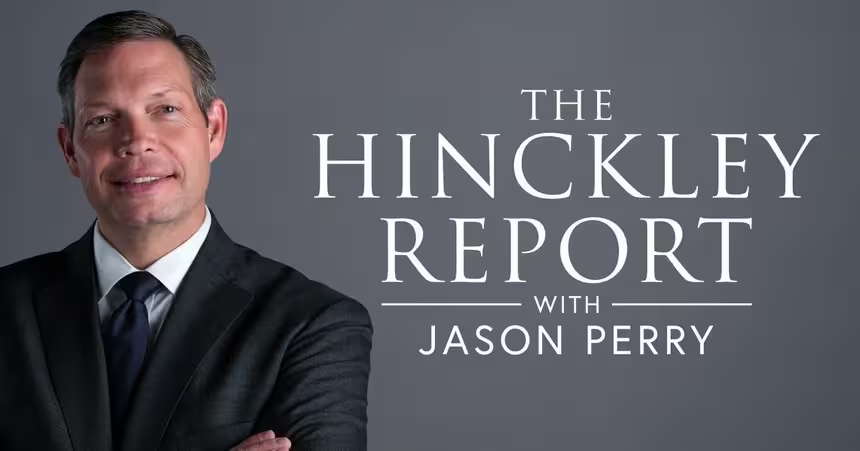
Hosted by Jason Perry, each week’s guests feature Utah’s top journalists, lawmakers and policy experts.Providing Support for PBS.org
Learn Moreabout PBS online sponsorshipJason Perry: On this episode of "The Hinckley Report," a big controversy shakes up local politics.
As election season kicks into high gear, congressional candidates make their case to voters.
And polling reveals voters's priorities and what is driving them to the ballot box.
announcer: Funding for "The Hinckley Report" is made possible in part by the Cleone Peterson Eccles Endowment Fund and by donations to PBS Utah from viewers like you.
Thank you.
♪♪♪ ♪♪♪ Jason Perry: Hello, and welcome to "The Hinckley Report."
I'm Jason Perry, director of the Hinckley Institute of Politics.
We're coming to you today on the road from the campus of Utah Tech University in Saint George.
Covering the week we have Representative Neil Walter, a Republican from Washington County in the Utah House; Mary Weaver Bennett, director of the Leavitt Center for Politics and Public Service at Southern Utah University; and Sean Guzman, a political expert and former St.
George City Attorney.
So glad to have you all with us.
We're so glad to be here in St.
George, southern part of the state.
So much happening here, and certainly the political world is just as hot here as sometimes the weather.
So I want to talk about a couple of those things.
First, we're here today not just because we want to be part of the political process here, but we're also having a debate here at Utah Tech University, the Third Congressional debate.
I want to get into debates for just a moment.
And we'll start with you, Representative.
We did have the 1st Congressional debate earlier this week.
It was held up in Salt Lake City.
Republican Riley Owen and Democrat Ben McAdams.
Some key takeaways from this very interesting district which has brought back one of those historical notions of sort of the doughnut hole approach to our districts here with these new congressional maps.
A couple of takeaways.
Neil Walter: Yeah, first of all, the issues are important to Utahns.
They care about cost of living.
They care about housing.
They care about energy costs.
They're concerned about education, fundamental issues that are important to families.
But I think the bigger issue, at least from my observation, is we're seeing a seesaw over the Salt Lake County politics.
Is it going to just lean Republican, just lean Democrat?
This particular race leans Democrat, but that is the bigger--that's the bigger conversation, at least from my perspective, which way is Salt Lake County going to go?
Jason Perry: Mary, what is your observation of that particular point, because it did become part of the conversation from both Ben McAdams and from Riley Owen.
Mary Weaver Bennett: I think what we saw is the classic method that candidates use, which is they run to the outside rim of their parties in the primary, and they come to the center, and both were very centrist in their comments in the general debate election and general election debate.
And so, I think we're seeing it to your point that both candidates are coming to the center to try to cover what may be a gap between leaning Republican, leaning Democrat.
Jason Perry: Well, how does this play?
Because in both responses from these candidates, Sean, the Trump factor was very clear.
Riley Owen was talking a little bit about the party after Trump, what happens after the next two years, and Ben McAdams was talking about he would be the push against the Trump administration.
How does that play out when you put the Utah perspective in mind?
Sean Guzman: You know, it was interesting because he did also bring up the fact that he worked in the administration, but he didn't highlight that, and so I think that he was walking the line there of trying to say those of you that align with Trump, I'm with you, and those that are Republicans but don't necessarily align with Trump, I'm still with you.
And so, in the end, I agree with Mary.
They both moved towards the centers.
If I had one takeaway, well, I would say this, first of all, is we didn't see anything new from Ben McAdams.
We know Ben.
We've known Ben since he worked with Mayor Becker in Salt Lake City.
He was a state senator, and of course, in Congress.
And I see that he is still the same person that we saw before, that he's pragmatic, definitely a Democrat, but he has--he is more of a center than center left.
And I think the takeaway I took from this was Riley Owen really I think established himself as an up and coming star in the Republican Party in the state of Utah.
It will be interesting to see what happens in the future with him.
Jason Perry: Representative, before we leave the 1st Congressional District, talk about that Trump factor, because we heard the president talk about this midterm election.
Assume he's on the ballot and vote and show up as if he is on the ballot.
Do we see that as part of this sort of in this conversation between either one of these candidates or even with Riley Owen?
Neil Walter: I think it is a factor, but I also think that Utah is very nuanced, and you saw that in the election.
There are people who are very, very strong Trump supporters.
There are some in the Republican Party who are not.
We have a solid group of independents or unaffiliated, and so I think it is definitely a factor, but I also think it's nuanced in Utah.
I also think the issues are really tough.
I just want to give you one example.
There's a lot of talk about, for example, gas prices and the cost of diesel, and they are significantly up.
It's hurting Utah families.
It's impacting cost of living.
But it's more nuanced than just Iran.
You've got Venezuela, which has been reducing production for decades under Chavez and Maduro, which is impacting the whole Western Hemisphere.
You've got Russia and Ukraine engaged in battle which is impacting Russian exports, which have been the largest exporter.
And then here domestically in the United States, Utah is being significantly impacted specifically by Las Vegas demand because of California cutting their refining capacity, as reported by "The Wall Street Journal," in half over the last 30 years.
Well, that significantly impacts what happens here in Utah.
So, all of these issues are more nuanced than just, for example, Iran is driving the price of fuel in the United States.
Jason Perry: Let's see how these nuances play out here in the 3rd Congressional District, Mary, because I'm curious what's happening here.
We have the debate now, and we have very interesting changes with these redistricting with what's happening here in the 3rd Congressional District.
The two candidates, Kent Udell, the Democrat, Celeste Malloy, the Republican.
The debate tonight is gonna be moderated by Bob Evans of Fox 13 News.
I'm kind of curious about this district.
Describe it a little bit for our viewers because this new 3rd Congressional District, this is so much, it's all eastern and southwestern Utah, the biggest geographic district we have in the state.
Mary Weaver Bennett: Yes, and I--it's actually one of the top ten largest in the country for a congressional district, so it's a huge swath, and it encompasses all that is Utah in that you have rapid growth in Washington County in southern Utah.
You've got density coming to Park City in the north part of the state or of the district.
But you've also got wide swath in the middle of rural communities and energy development and ranching and all of those industries that happen in rural communities, and so it's really, I think, a challenge to be a member of Congress to represent a district of this size.
Jason Perry: Well, Sean, that's totally true.
The geography is so broad.
The economies of these cities is very interesting.
And it gets to this, the heart of this argument for a while about whether or not you want a representative that has a lot of urban and a lot of rural in that district, and I'm kind of curious when you look at this new district, is this better representation for this part of the state or is it just different representation?
Sean Guzman: Well, I would say this.
We were happy down here in Washington County to finally get a district that was Southern Utah-based, and when this new district alignment came out, the concern was how much do we have in common with Provo and Orem?
I like to say that we're rurban down here.
We're the fifth largest city in the state now, but we identify more with our sister counties next door, Kane County, Garfield County, Iron County, than we do with Utah County.
And so one of the concerns is, will this take away in the future our representation because someone from a more populous area will represent us on the Wasatch Front as we've had in the past?
So, but I do think that Celeste Malloy is very popular in the rural areas, and so that helps her in those rural parts, but she does have experience, again, with Washington County, with urban areas too, so I think mostly it's we have to live with what we have right now.
What's going to be interesting is in a few short years we'll have a census, that we will most likely gain another seat in Utah, and it will be interesting to see how they draw the boundaries then.
Jason Perry: How are you going to draw the boundaries then?
Neil Walter: Well, I just want to comment about this 3rd District.
One of the really interesting dynamics is it takes longer to drive from St.
George to Blanding than it does from St.
George to Salt Lake.
It's not actually a compact geographic district, top ten in the country.
So, serving it is really challenging, but I wanna shout--give a shout out and compliments to Celeste Maloy, who's worked really, really hard.
I think one of the big stories in this election is people have gotten to know her and her work ethic and her commitment to the state of Utah, and one of the reasons why she's doing so well is because of that commitment.
Jason Perry: And Mary, not just geographically the biggest district, but also it leans the heaviest towards the Republicans in this district.
Talk about the dynamics of that, particularly when you kind of go with these comments from Representative Walter about where we are with Salt Lake County in the first district.
Mary Weaver Bennett: Well, it's interesting because I think, you know, Utah has room for all Republicans.
As we've seen in CD1 debate, both candidates going towards the center and maybe disowning themselves on a few points for their party leadership, but yet we have one of the most vociferous supporters of President Trump in Senator Lee.
And so, obviously, District 3 is going to contain all of those Republicans, whether you have devoted people to President Trump or you've got people who are moving towards the center, maybe perhaps in the more urban areas.
So, it's home for all Republicans, and especially in District 3.
Jason Perry: Before we leave this entirely, Sean, given your background, your history here in this part of the state, it's interesting to see what I would say is the rise of the political power of this part of the state of Utah.
Is that what you've recognized as well, and to what impact?
Sean Guzman: It's had a great impact.
Yes, I've seen that rise.
We have a very effective group of legislators from down here that have influence on the Capitol where maybe 30 years ago that wasn't the case, and I think that that's going to continue to grow.
We're a fast growing region.
Iron County also is growing fast, so I think you're going to see more of that conservative Republican sentiment down here.
In fact, I would say that most of the people that are relocating here from my experience are what we call refugees from California and other states that they view as more liberal, and they tend to be very conservative that are moving here.
So, I think that as we have the move-ins, it will continue to get more conservative.
Jason Perry: I want to switch gears a little bit to something that did happen in our legislature this week, and Representative, if we can start with you on this.
Representative Trevor Lee, we've heard some of the issues over the past couple of months during the legislative session, particularly this week where he was charged with one count communications fraud, mortgage fraud, forgery, and possession of forgery is how the information came out, and he resigned almost immediately.
Talk about the implications of this, particularly through your lens as a legislator when in your own body some action has to be taken.
Neil Walter: So, first of all, I appreciated the fact that Trevor Lee resigned and that process will play out as it should.
We've had some other resignations.
We talked about the courts this year, and so the big thing for me is that our residents expect a level of trust, and they want to have confidence in their elected officials, the people that have, access to the reins of power, if you will.
And when we breach that trust, it actually hurts our state.
And so, in this context, I just--it's just a reminder, it's an important reminder that we have to be good fiduciaries of that trust and act honestly and ethically and uphold the expectations that the constituents have for their elected officials.
It's really important to them, and it's really important to the success of our state.
Jason Perry: Talk about the implications for our students.
You are so closely connected, Mary, to how this impacts the students and the trust in institutions themselves.
How are you addressing that?
How are you talking to the students about that?
Mary Weaver Bennett: Well, it is important.
You know, we find in a lot of polls that elected officials are low in public confidence and public trust, and an instance like this doesn't go any further to advancing trust.
So, what I like to talk about students is there are public servants who are in it for the right reasons, and who I try to highlight examples of public servants who are doing good and not necessarily in it for any ulterior motives, but it is a challenge in this environment where the distrust of elected officials is so high.
Neil Walter: Jason, if I could just add, one of the things that I was really pleasantly surprised when I came to the legislature.
I knew members of the legislature, but I was impressed with in general the quality of the individuals and the intentions, really, really good intentions from people trying to do the right thing.
And so, I think that when you have negative things like this happen, that sometimes it starts to cast aspersion on a lot of really good people who are trying very hard both in the executive branch and the legislative branch, in the judiciary, who are trying to do the right things, and I would just tell my fellow citizens in the state of Utah that we do have a lot of really great people trying really hard to do the right thing for Utah.
Jason Perry: Before I leave this entirely, it does create some interesting politics, right, Sean?
So what happens?
So, Trevor Lee resigns immediately.
We've got a couple of months before the results of this election.
Bob Stevenson, he got signatures, he won convention, he won the primary, so he's, you know, they're looking to--.
Sean Guzman: He absolutely won the primary.
Jason Perry: So, let's talk about what happens right there, can you speculate a tad?
Sean Guzman: You know, the natural thing to do would seem to be to appoint Stevenson to the seat.
Or, you know, when they go through their election to elect him as the party.
But you know, there are those out there that have a sentiment that Steve Handy, former Representative Handy, who Lee beat, would be a good caretaker for that time being and are supportive of him.
He's still very popular, but one wonders, you know, I think first of all that he did the right thing, I agree with Representative Walter, for the whole institution to resign, right?
But one wonders if the fact that his mother is running for county commissioner, she's the Republican candidate for county commissioner, and she barely beat the two-term incumbent by about 700 votes, if maybe that also factored into his decision to maybe not harm his mother, a former county commissioner running as unaffiliated, but we all know as Republican.
Bret Millburn is running, and wondering if maybe this might boost his campaign.
Don't know, but it's just interesting politics for Davis County.
Jason Perry: Very interesting, the Davis County party gets to pick this person, so I guess that's the big question, whether or not we have a caretaker for a couple of months or before the cycle ends and the official representative starts.
Okay, let's get to a couple of other things that are gonna be on the ballot.
I wanna talk about some of these constitutional amendments for just a moment.
Representative, can we start with Amendment A. So, this is going to be on the ballot.
Utahns are going to have a chance to look at this.
Very interesting one where Utah voters will decide whether to change the constitution, constitution requirement, how you have to publish that information, whether or not it is a proposed amendment before an election.
Right now you have to publish whatever the constitutional change is 60 days in every county for 2 months before an election.
This is going to change under this amendment.
Describe what's going to happen.
Neil Walter: Yeah, first of all, this is really about feasibility.
If you start to look at newspapers in general, there's an overall decline in the news in newspapers being published.
I'm one of the very rare ones that still takes a daily newspaper.
I receive the Wall Street Journal at my house in print still, which is very, very unusual.
I used to take the local newspaper here in St.
George, which is the Spectrum also, but about ten years ago I stopped, like many other people, so this is really about feasibility.
We're reminded of this when this week it was announced that the San Juan Register, which has been publishing for over 100 years, will publish its last newspaper.
There has to be a new way to meet the requirement for notice and disclosure to residents.
We're moving online, which is where people are.
Jason Perry: Yeah, it's interesting, Sean, because it's been one of those things that people talk about for a long time where there's sort of this antiquated approach.
How do you fairly apprise the people of what the constitutional amendment is going to be?
The publication of a paper, at least in 2024, the court said, you know, you didn't--the legislature did not publish a couple of things correctly, and therefore they were off.
Sean Guzman: And I think that factors into this, but this is something that I think the local governments have been pleading with the legislature for years on, is that people have migrated to online, and I would dare say that probably 90% of the people here receive all of their news online, whether it be the news or the Trib or local St.
George News or Spectrum, that they do it online.
And that's the best way for us to communicate these ballot initiatives and changes, and I think that's--I think it's just coming into the 21st century.
Mary Weaver Bennett: If I could, what I don't see is why we have to forsake one for the other.
There are communities in rural counties in Utah where there is a daily paper, and that is the main venue of communication for that community, Iron County being one.
I know everything, every announcement that you need to make, you've got to run an ad in the print paper.
And so, I'm just not clear on why we're forsaking one for the other.
Jason Perry: Go ahead.
Neil Walter: I should say, this one, this one, if I recall correctly in the House of Representatives passed unanimously.
This wasn't a Republican issue, a Democrat issue, a rural issue, an urban issue.
I think that Amendment A is going to pass.
Jason Perry: Sean, let's get to Amendment B for just a moment because it has big implications on initiatives themselves here in the state of Utah.
Amendment B would require any initiative that would create, expand, or increase taxes to get 60% support from the voters, that's the increase, not 50% plus 1, 60% for this tax-related area.
Talk about that for a moment because there are some issues historically that would have been captured by this.
Sean Guzman: That's exactly right.
There would be some issues in the past that have passed that would not have passed under this amendment.
I think the biggest concern for me is that while I do not see a problem with the 60% threshold, the definition of raising taxes is so broad that I think that could be a court battle that we'll have on many initiatives in the future because that definition just read can encompass anything.
I mean, almost anything we pass could potentially have an impact on taxes or expenditures of the state, and I think that needs to be clarified a little better.
Jason Perry: Representative, this is what you have to consider as an elected official with these bills that come forward.
But the initiatives themselves, talk about this, because, you know, Sean mentioned whether or not this is a broad category if it expands taxes necessarily.
Make sure we understand the nuances of this as we're looking at Amendment B. Neil Walter: I think that we start talking about Utahns, what they're concerned about.
They're concerned about cost of living.
They're concerned about affordability.
They're concerned about accessibility of housing.
And I don't have anybody in my district coming to me saying, "Hey, we should raise taxes," and there's a lot of concern about the process for raising taxes, how much taxes might be raised, and I think in this particular case, me and my colleagues, what we're saying is we want to be--we want to have an extra level of caution about processes that might raise taxes.
And in this particular case, we're looking at a ballot initiative that could pass by 50% plus 1 vote, and we're saying we're supporting a higher standard for raising taxes via ballot initiative.
Jason Perry: Mary, talk about how this plays out a little bit here too, because, you know, people will talk about this.
It's a higher hurdle for these initiatives, might be perceived by some as a restriction on the initiative process itself.
Mary Weaver Bennett: I agree, because I think you vote for a candidate for office, I'm sure, based on partially their position on taxes, and so to win an election as a candidate, you're needing 51%.
And yet, when you're talking about an initiative that has a tax impact, it has to be 60%, and I don't understand why an initiative has to have more votes than a candidate, both involving tax policy.
Jason Perry: Sean, last word on this.
Sean Guzman: Well, I'd say that there's a lot of times, the Medicaid initiative, for example, is a good one in that it was voted for and a lot of people like the idea of spending more money on Medicaid to help those at 138% of the poverty level, which if you saw what that is, that's nothing.
You know, people can't live on that, but they also didn't know all the implications to the state of how much that would cost.
And I wish that had been clearer in there.
I still think it might have passed, but that's where I think maybe this would serve people well in maybe letting them know that there's a potential here of raising your taxes.
Neil Walter: I know you said last word, but I just want to at least add a little bit of nuance that Sean referenced.
In the state of Utah, people care a lot about education, and in some ways Medicaid is crowding out education spending.
And that wasn't clear at the time.
And so, I think having a higher hurdle is the right approach.
Jason Perry: We'll watch this closely.
Certainly implications.
Okay, we'll watch that amendment.
Can we talk about polling and how people feel about elections, Mary, for just a second?
I thought it was interesting.
We asked the question, this Hinckley Institute with the Deseret News, and we asked Utahns this question.
Describe how you were feeling about this year's elections.
We give them a couple of ideas here, select a couple of responses.
What I thought was interesting is this is overall Utahns, 47% hopeful, 46% anxious.
It's kind of an interesting connection right there.
We're equally hopeful and equally anxious.
Mary Weaver Bennett: That is incredible.
I'm enlightened and happy about the hopeful part.
I would be curious to know if that breaks down on party lines, but it is a surprising number and one that's good to see.
Jason Perry: I'm going to break it down, Sean.
Tell us how this kind of perceived by you and others.
Here's how it breaks down: Republicans 57% hopeful, 37% anxious.
Democrats, and I'm gonna get to the independents, which is the most interesting part to me, Democrats 46% hopeful, 65% anxious.
So the Democrats are anxious, Republicans are hopeful.
Sean Guzman: I think it's surprising that that many Republicans are anxious too, but I think that's part of--that's a reflection of our Utah economy too.
We see the national trends.
There are concerns on the national trends, but in Utah we're doing relatively well.
Low unemployment, we're in an economic boom that seems to be continuing right now, so I think that plays into the fact that people are looking at the national level and saying I'm anxious on that level, but I'm hopeful in my own state.
Jason Perry: Let's talk about this translation to the independents, which is so interesting, which are many who are--who they affiliate to vote, representative, but this is where some of the interesting numbers are.
Of the independents, only 32% said they were hopeful, 44% anxious.
I'm kind of curious about that group right there because when we talk about all these debates, we talk about our congressional districts, people are trying to get to that particular group.
That's one people want.
You can come over to our side and vote.
Talk about that for just a moment because they're changing a little bit.
Neil Walter: I think, again, the nuance here is in the question.
So you ask the question, then the real question is what are they thinking about?
I'll give you a couple of examples.
If you talk about artificial intelligence, there's reasons to be hopeful and there's reasons to be anxious, and depending on how you see that issue, you might be more on one side of that issue or the other.
On the economy, the United States economy is very strong right now.
It's doing in general very well, but cost of living is an important issue, and it's really hurting Utah families and some of our residents nationwide.
And so you have these contradictory sentiments, one where you can be hopeful and another where you can at the same time become anxious.
And so as you ask, for example, independents, the question is which issue is really driving the answer to that question?
And then that becomes manifest in these numbers.
Jason Perry: The hope, of course, is everyone stays engaged, whether you're hopeful or anxious, right?
It's gonna have to be our last comment on it.
Thank you so much for your insights, and thank you for watching "The Hinckley Report."
This show is also available as a podcast.
Thank you for being with us.
We'll see you next week.
announcer: Funding for "The Hinckley Report" is made possible in part by the Cleone Peterson Eccles Endowment Fund and by donations to PBS Utah from viewers like you.
Thank you.
♪♪♪ ♪♪♪ ♪♪♪
 New Episode
- News and Public Affairs

Top journalists deliver compelling original analysis of the hour's headlines.
 New Episode
- News and Public Affairs

Today's top journalists discuss Washington's current political events and public affairs.

 New Episode
 New Episode
 New Episode
 New Episode
 New Episode

 New Episode
 New Episode
Support for PBS provided by:
The Hinckley Report is a local public television program presented by PBS Utah
Funding for The Hinckley Report is made possible in part by Cleone Peterson Eccles Endowment Fund