
We Shall Remain the Paiute
Special | 29m 2sVideo has Closed Captions
A powerful five-part-series on the five American Indian Tribes of the Great Basin Region
From KUED comes a powerful five-part-series on the five American Indian Tribes of the Great Basin Region we now know as Utah. This episode examines the Paiute indigenous peoples that have called Utah home for centuries.
Problems playing video? | Closed Captioning Feedback
Problems playing video? | Closed Captioning Feedback
We Shall Remain: A Native History of Utah is a local public television program presented by PBS Utah
The Utah Department of Community and Culture, the George S. and Dolores Doré Eccles Foundation, William M. and Kerry Armstrong, American Experience, R. Harold Burton Foundation, and the Lawrence T. Dee and Janet T. Dee Foundation.
We Shall Remain the Paiute
Special | 29m 2sVideo has Closed Captions
From KUED comes a powerful five-part-series on the five American Indian Tribes of the Great Basin Region we now know as Utah. This episode examines the Paiute indigenous peoples that have called Utah home for centuries.
Problems playing video? | Closed Captioning Feedback
Where to Watch We Shall Remain: A Native History of Utah
We Shall Remain: A Native History of Utah is available to stream on pbs.org and the PBS app.
Exclusive corporate funding for American Experience is provided by Liberty Mutual.
♪ Gentle Music ♪ The best way to fully understand this nation's history is through the eyes of those who experienced it.
Liberty Mutual.
Proud sponsor of American Experience.
Major funding for American Experience is made possible by the Alfred P. Sloan Foundation, to enhance public understanding of the role of technology.
The foundation also seeks to portray the lives of men and women engaged in scientific and technological pursuit.
Funding for We Shall Remain provided by the National Endowment for the Humanities, the Ford Foundation, the Arthur Vining Davis Foundations, Kalliopeia Foundation, and by the Corporation for Public Broadcasting and viewers like you.
Thank you.
Long before Spanish Conquistadors crossed the landscape... before trappers followed the rivers and streams... long before pioneering settlements dotted this region... before anyone else would try to write their history, five principle nations of indigenous people called the Great Basin their homeland.
Theirs is the first story of the people in this place.
I'm Forrest Cuch.
Join me as we step into the extraordinary world of the Paiute Indian Tribe.
[ Narrator: ] On a summer morning in Cedar City, Utah, American Indians from regional Tribes join members of the Southern Paiute Tribe of Utah in a parade down Main Street.
They are called the First Americans, uniting to celebrate their culture and history as a people, and to recognize a historic event that helped restore the hope and dignity of Utah's Southern Paiutes for generations to come.
[ Announcer: ] We Shall Remain: A Native History of Utah is made possible by: [ Chanting ] [ Karma Grayman: ] It has been written that we were botanists-- that we knew the plants, that we knew how to use them.
This is our land.
This is where we came from.
This is who we are.
[ Narrator: ] For a thousand years, the Paiutes were one of the largest Indian kindred group whose ties created a social network that spread throughout the Western Rocky Mountains, the Colorado Plateau, and the Great Basin.
In the early years, the southern Paiutes lived as far south as what is now southern California, migrating north to occupy southern Nevada, southern Utah, and northern Arizona.
Up until the 1600s, the Paiutes and Utes shared a similar lifestyle.
Southern Paiutes today include the Pahvant, Ute/Paiute, and several small related groups of Paiutes.
Present day Paiute bands in Utah include the Koosharem, Kanosh, Indian Peaks, Shivwits, and Cedar Bands, with ancestral bands living in Arizona and Nevada.
The Paiute people were very peaceful, also very timid and foragers and horticulturalists-- humble beginnings.
[ Narrator: ] Moving seasonally in small groups and families, the Paiutes gathered roots, berries and pine nuts, wandering in areas that include present-day Zion, Bryce, and Grand Canyon National Parks.
They fished and hunted deer, antelope, mountain sheep and rabbits.
In the green valleys of the Desert Basin, Paiutes developed sophisticated farms and gardens, growing corn, squash, beans and melons along the tributaries of the Virgin River.
[ Glenn Rogers: ] And they also dug irrigation ditches to where they diverted the water into that area.
And the plants on the water that they lived on, it just... like here you see, with the willow plant, for instance, it's right next to the water and it helped them make their baskets, their cradles and all these things of carrying water, the bowls.
They had to carry water from a long ways, you know, when they were out in the... down in the flat area during the winter, and so they had to rely on these little wickiups.
They had to build it so that it would be... Keep them warm inside, and the rabbit fur were their blankets so they had to, you know, kill a lot of rabbits.
[ Narrator: ] When the Europeans arrived in 1776, horses enabled the Utes and Spanish trading parties to raid, capture, and sell Paiute slaves-- mainly women and children.
Conflict continued with the arrival of Mormon pioneering settlements in the 1850s.
Never considered something that could be owned, the Paiute's favored lands were occupied throughout southern Utah.
Epidemics of disease soon swept the Paiutes, killing more than 90 percent of some groups.
For years to come, this quiet, independent people of the Great Basin found their lives challenged in unfulfilled promises, poverty, and dependence.
As a vulnerable and desperate people, the Paiutes were forced into roles of servitude and labor for the Mormons who, upon settlement, swiftly began a religious campaign to "Civilize, thus save the Indian."
I don't think they really even knew what they were doing, and they just did what the missionaries were telling them to do.
[ Narrator: ] Proximity to the Mormon settlements dragged the Paiute people into one of the most controversial events in Utah history.
In September 1857, more than 100 California-bound emigrants were attacked and murdered southwest of Cedar City in a clearing known as Mountain Meadows.
A handful of the youngest emigrant children were spared.
When the murders were discovered by the outside world, local Mormon leaders blamed the Paiutes for the attack and kidnapping of the surviving children.
And they said that we had taken these children, but these children... they were safe, you know, from what the great-grandmothers said, you know, if we had them, you know, we would have little white kids running around with us, you know, little half-breeds if we had adopted them or taken them or stolen them.
[ Glen Rogers: ] My grandma used to tell me, "The white people killed their own kind."
They were shot through the head.
They were killed.
They actually have bones through the skulls that they were killed like that, you know, and there's just so many things that aren't answered, even through the book that we're always in it... The Paiutes are always in it, and you know, back in those days, who would give a Paiute a knife, let alone a gun or a rifle?
And it's never going to fade away.
It never is because somebody has to take responsibility for it.
But the Paiute people-- we're not worried about it because we weren't involved.
But when they say Paiutes were involved, and that's when you think, "Well, how can they be involved "when our oral history says different?"
One of things that we look at as far as history is concerned has always been oral-- has been passed from one generation to the next, and that's how it's been carried.
We've not had the capability to write things down as other folks have-- that capability to document the dates, the time, who was involved.
So you have... On one hand you have it written, on the other you have it oral.
And so what we look at is oral history-- what we have heard from our ancestors, and from our knowledge, many Paiute people here say that they were not involved, and I too agree with that.
[ Narrator: ] More than 150 years would pass before the Mormon Church would acknowledge local members of their church as the moving force behind the Mountain Meadows Massacre.
[ Travis Parashonts: ] What termination really did is it made us lose our language, our culture, our pride, you know.
It really was devastating for us as a small tribe.
[ Narrator: ] In 1957, Congress terminated federally-recognized tribal status for the Paiute people, offering it as a means of assimilating them into mainstream culture.
It was an ironic twist.
Citing declining tribal numbers, the federal termination resulted in program cuts that would decimate the surviving Paiutes.
Tribes that were not fully aware or prepared to take that step-- those Tribes were not ready to take care of their own.
I think they were misled as far as what would be provided for them-- the citizenship, having to be rid of federal government aid, and so those Tribes were not even on the list to be terminated.
We were just out of harmony-- no balance there.
All of our elders were dying off.
No services, no money, nothing.
Poor housing.
No water.
Even right here in Cedar City-- we live right in the middle of the community... We had outdoor toilets, we had outdoor water, we had to haul coal, haul wood, you know.
It was that environment back in the '70s.
We had to get on welfare in order to take care of the kids, and even for health benefits.
I remember my grandmother had diabetes, and this is what she died from.
She had no medicine for it.
She wasn't treated for it.
My aunt-- about three of my aunts followed right after her, so it was a really hard time in my early years.
[ Travis Parashonts: ] We had some very powerful people on our side in the state of Utah at the time of restoration.
When we got federally recognized April 3rd, 1980, the pride just came back.
It just...to be able to own land again, you know.
Just the level of pride just shot up.
And we had health coverage, then more of our people started living.
Our age went up.
[ Lora Tom: ] Health, social services, economic development-- those types of services now are restored.
Now you see a healthier, now you see a positive, now you see a more educated group of individuals.
[ Travis Parashonts: ] Although we got restored, which is a plus and positive thing, there's still that injustice, you know, about what happened.
We still struggle, but we've come a long ways in 28 years.
[ Narrator: ] In celebration of their restored status, the Paiute Indian Tribe of Utah join together with Inter-tribal members and the community in an annual pow wow gathering.
[ Travis Parashonts: ] You go around the dance arena and you grow and you learn in that dance arena and you... Then you come full circle.
And then when you go out after the pow wow is over, you go out of that arena and it's over.
The same way as life-- you come in, you go around the circle and learn about life, you grow in this life, and then one day you have to leave and you go out.
Same way--circle of life... That's what they call it.
[ Narrator: ] As a dancer, musician, and educator, Shanan Martineau believes in a sacred meaning of the circle of life.
She is concerned for Paiute youth-- their cultural apathy and indifference.
Shanan believes the future of the Paiutes will turn on the cultural knowledge and opportunities provided to the young.
Me being out there with kids seeing me and coming up to me and asking me, "Did you make your outfit?"
or "How did you do that?"
So I'm there to tell them.
Maybe it will inspire them to do the same.
Like my kids--they enjoy going to pow wows now and they want to learn.
I'm proud to be a Paiute from the Shivwits Band and so anything I can teach anybody, I'm just willing to be there to help them out.
[ Narrator: ] A veteran of the Vietnam War, Clarence Brown is considered a cultural hero in his own community-- teaching Paiute children the traditional ways of their ancestors.
Clarence is also concerned about the future of the youth as he observes the Tribe's withering cultural identity.
It's dwindling away.
That's why it's important for us seniors to teach the grandkids and the rest of the children why they're performing and what the sacred ceremonies you have down there.
But just like our language is dwindling away because there's nobody... The seniors are all gone and they haven't had the chance to talk Paiute.
[ Narrator: ] Eleanor Tom is one of a handful of Utah's Southern Paiute elders who speaks the Paiute language.
She is a keeper of the flame-- carrying forward traditional skills and stories passed on from her grandmothers.
I listened my grandmothers when they told me all of these stories, and you had to stay awake.
Sometimes stories would last for two days.
[ Speaking Paiute ] [ Eleanor Tom, Translating: ] The Creator to us is the Shinangwav, and Tabuts was his brother, that's the wolf.
[ Speaking Paiute ] This is the story that they tell about these two-- what they did, and why we do the things that they did.
They're the ones that did a lot of the things that's happening in this world today.
[ Paiute Singing ] Lora, what are some of the major barriers to economic development of the Paiute Tribe?
Forrest, a very good question.
You know, there are several... There are several components that the Tribe looks at as far as barriers are concerned, and I think that demographic is probably one of our biggest.
We've got our Bands located in four different counties, and it's so hard to gather and to get them at one point.
I understand you have some problems with some creatures here... the prairie dogs.
We certainly do.
Those darn prairie dogs have given us some major problems.
They're everywhere.
Because they're on the endangered list, right?
They certainly are.
And you're prohibited from developing the land?
They are, and it really puts a constraint on the Tribe because we don't have that development that we do need.
We would like at one point to see possibilities of a stand-alone clinic.
We'd like to see a cultural center.
We may even see some other development with some homes, and so that's not... That's not possible because we will not develop until the prairie dogs are under control at this point, so the Tribe is in limbo.
Now what are some of the more successful developments you've had here?
What are your major successes?
Oh, there have been many.
You know, we look at the Tribe for the past 28 years and I look at... Taking a look at this fine building that we have in front of us here is probably one of our biggest successes.
The different Bands in different locations-- they too have many successes, not only with structures, but also with the education that is instilled in our young folks, and so they are now taking those leaps and bounds like everyone else.
[ Narrator: ] Suh'dutsing Technologies, a successful, tribally-owned information technology company located in Cedar City, offers one promising program for Paiute youth.
Through an educational incentive program, Suh'dutsing donates laptop computers to high school and college graduates from the Tribe's five Bands.
[ Travis Parashonts: ] What this does is it sends a message to these kids.
It gives them a goal to shoot for.
They've never... They've never received a gift like that-- to get a laptop.
You have to be there to witness the excitement in those kids' eyes, you know.
It's just a wonderful thing.
[ Robert Depoe: ] The Tribe is more than just our past.
We're also our future.
[ Narrator: ] 36% of Paiutes are 18 years or younger, attending public schools scattered throughout the Tribe's four counties.
Indian Education Coordinator Karma Grayman says American Indian children face daily, unique challenges.
My grandmother was a cradle-maker.
She was a weaver, and she tanned the buckskin, and she used the brain-- she used everything in that deer... In that kill that my father would bring home.
My grandfather was a salt song singer.
He was fluent in the Paiute language and he has an amazing story, so I think culture and knowing your history and your family has a lot to do with it, and now research says in education that the more that an Indian child knows about his culture, his history, the better he's going to be academically.
[ Robert Depoe: ] We want our students to know that they are American Indians.
We want them to know what that means to be American Indian.
I don't believe that our students have a very strong identity in who they are.
A lot of it has to do with parental support.
If we get involved with the school, with the teacher, then we'll find ways to help the kids become successful.
I want people to know that our children can learn.
They are capable of learning, and I've heard this-- that Indian children don't learn, that they're stupid, they're dumb.
But they're not!
They're creative, and you have to be creative to teach them.
And if you don't have that creativity or that desire like a teacher's supposed to, then you're not going to make it, and that child will not succeed.
What you have to do is you have to come down to their level.
What is their interest?
If it is a computer, put some cultural programs on the computer, you know.
Develop some games on the computer that are culturally oriented, or take them to somewhere that is culturally oriented that fits their interest, you know.
What's going on on the campuses?
What's going on in the native programs?
What's going on in Indian world?
Where we can bring in some of these things to help these kids see that there are successful natives in the world.
This is how they became successful in Indian world.
[ Robert Depoe: ] And we need to get the word out.
We need to let teachers know that, hey, the Paiute Tribe is here, and we want to help in educating not only our students, but others about the Tribe.
[ Indian Chanting ] [ Narrator: ] Nine miles west of St.
George on old Highway 91 is the enduring heart of a Shivwits culture that was here long before the arrival of the wagon trains.
The Shivwits was the first reservation established for Utah's Paiute people.
Out of 860 total Paiute members, the Shivwits Band is the largest.
29,000 acres of red cliffs surround a self-sufficient community, providing members with 40 homes, an on-site health clinic, and a cultural community center.
Economic development is an ongoing political challenge for the Band.
In the dry desert basin, water lease agreements play a crucial role in economic survival.
Future plans for the Shivwits Reservation include a gymnasium and cultural center, a market and gas station.
At the heart of the Shivwits' concern about the future is the rapid development of surrounding Washington County and its impact on the Paiute Nation's ancient history.
Development in Washington has just gone wild, and there's so much arch sites that are being disturbed.
The problem is is they're on private property, and a lot of these developers-- they don't care.
Not unless there's a body there... That's the law.
They have to stop everything to look at the body and take it out, and they say, "Well these were Anasazis around here before you, Fremont," and I sit there and I think, well, where did we come from?
Who were we back then?
But when you see things as far as being showcased, whether it's petroglyphs or any type of pottery, it's a shame you can see that on someone's mantel, but yet you don't have the courtesy to extend it to the Tribes, and so I'm hoping that we can one day overcome that.
[ Karma Grayman: ] We need to teach our children that this is who we are, and this is our land, and we need to take care of it.
But not right now.
We're, you know, sharing it with other people.
But we need to all respect it.
[ Travis Parashonts: ] You can have balance in the modern world, the white world, and you can have balance in the Indian world.
We walk the fence, and sometimes this fence is made up of all kinds of, umm, obstacles--the Mormon church, religion, culture, tradition, white world, Indian world, white education, Indian education.
Where do they fall in at, you know?
A lot of them get confused.
Where am I in life?
Who am I?
You know, because we live in a white world, yet we want to be Indian.
We want to be Indian, but we want all of the things that the white people have, so how do you find the balance?
It's a very fine line to walk, to go through, and for instance, on a reservation, you know, how do we balance this?
Because we have to look at economic development.
How do we say, hey, let's tear up the land.
Because we care about the land.
But you have to think of the people also too.
They need to live.
They need to have something to look forward to.
You can live both ways.
For instance, in southern Utah it's the LDS church-- you have to balance it through your culture.
[ Narrator: ] The relationship between the Paiute people and the Mormon Church has been uneven for more than 16 decades.
It has been less violent than many chapters of western history.
Missionary zeal generally replaced force of arms.
But historians note that the same ends were arrived at by different means.
The Paiute culture was dissipated.
Traditional land use was choked off.
And the Paiutes were challenged to survive around a different manner of viewing life and living.
[ Glen Rogers: ] The pioneers...what they did.
I'm still angry.
I get angry, but I learn to deal with it.
I'm a Mormon.
I went to the LDS Church and I understood their ways.
I understood-- here's this person here.
You have to talk to them like this.
You have to understand their side, and they're ignorant about your culture, and they don't understand it.
It has been rough for us, you know.
Me as a little child living here in the Cedar Band, Cedar City area.
I grew up here as a little girl, and I was called from a "wagon burner" to a "dirty Indian" to... you know, all of that stuff, and so I know the feeling.
[ Eleanor Tom: ] We have come a long ways... the Paiute people.
Lora, what does "We shall remain" mean to you?
We shall remain, and we always will, and we always have, and it's from what I see from the support from what we have in our Tribe, as well as the Tribes in the State of Utah.
When you have a Tribe in your own backyard and you don't recognize them and acknowledge that they're here and that they benefit the community... I think Congress and others want to, umm, either assimilate them or block them out.
It hasn't happened in past history.
It never has as they've tried to exterminate a lot of the Tribes.
We're still here.
We'll always be here.
Do you know what this is, baby?
Look, when you were little I used to carry you here... [ Shanan Martineau: ] I don't know what our future holds for us, just like the rest of America.
I want to say, "Yeah, we'll be here forever "and you're not going to take our traditions away," but you got to be realistic about that.
Our generation needs to instill in their kids who Paiute is and to make them proud of it.
I think they're just not proud of it when they hear it--Paiute.
We've been through slavery and the Mormons accusing us of a lot of stuff, and a lot of our ancestors have died and our lands were taken away from us, but we're survivors, and I think that we'll be here a long time.
[ Singing in Paiute ] A round dance song... [ Rattle and Singing ] You'd be surprised how many people call our office and want to see some of the-- some of our folks dressed up in our regalia.
They believe that we do that every day, but I come to work in clothes that I wear today.
A lot of them think that we're nothing but drunks and that we're probably just not even going to graduate and go just be drunks and do nothing with our lives, but being here we've learned a lot.
Like I may not live on the "Res," but I know that we're all the same, that we have moms and dads.
We don't have a lot of people, like we do not live in teepees.
We live in houses, we have running water.
It's like we're the same just like everybody else-- we're just from different cultures, and I am proud of who I am and I'm proud to be Paiute.
[ Narrator: ] To learn more about the Paiute Indian Tribe of Utah, go online at KUED.org.
[ Announcer: ] We Shall Remain: A Native History of Utah is made possible by:
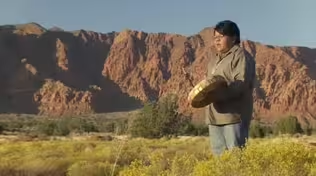
Paiute tribe member Mark Rogers demonstrates the Circle Dance Song. (2m 16s)
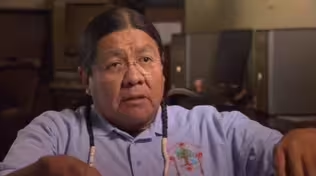
An excerpt of Paiute survival stories from the KUED documentary We Shall Remain. (4m 27s)

Alexis Ortega is interviewed as part of the KUED documentary We Shall Remain. (4m 52s)
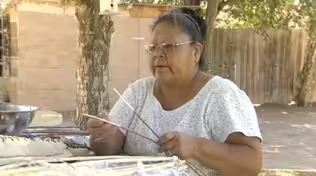
How to Craft a Paiute Cradle Board
Eleanor Tom of the Paiute Tribe illustrates how to craft a cradle board. (6m 25s)
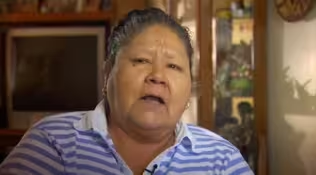
Eleanor Tom of the Paiute Tribe tells the creation story of her people. (7m 57s)
Providing Support for PBS.org
Learn Moreabout PBS online sponsorship














Support for PBS provided by:
We Shall Remain: A Native History of Utah is a local public television program presented by PBS Utah
The Utah Department of Community and Culture, the George S. and Dolores Doré Eccles Foundation, William M. and Kerry Armstrong, American Experience, R. Harold Burton Foundation, and the Lawrence T. Dee and Janet T. Dee Foundation.