
We Shall Remain the Navajo
Special | 29m 1sVideo has Closed Captions
A powerful five-part-series on the five American Indian Tribes of the Great Basin Region
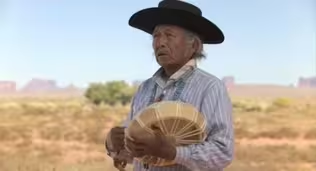
From KUED comes a powerful five-part-series on the five American Indian Tribes of the Great Basin Region we now know as Utah. Learn more about Utah's native Navajo peoples.
Problems playing video? | Closed Captioning Feedback
Problems playing video? | Closed Captioning Feedback
We Shall Remain: A Native History of Utah is a local public television program presented by PBS Utah
The Utah Department of Community and Culture, the George S. and Dolores Doré Eccles Foundation, William M. and Kerry Armstrong, American Experience, R. Harold Burton Foundation, and the Lawrence T. Dee and Janet T. Dee Foundation.
We Shall Remain the Navajo
Special | 29m 1sVideo has Closed Captions
From KUED comes a powerful five-part-series on the five American Indian Tribes of the Great Basin Region we now know as Utah. Learn more about Utah's native Navajo peoples.
Problems playing video? | Closed Captioning Feedback
Where to Watch We Shall Remain: A Native History of Utah
We Shall Remain: A Native History of Utah is available to stream on pbs.org and the PBS app.
Long before Spanish Conquistadors crossed the landscape... Before trappers followed the rivers and streams... Long before pioneering settlements dotted this region... Before anyone else would try to write their history, five principle nations of indigenous people called the Great Basin their homeland.
Theirs is the first story of the people in this place.
I'm Forrest Cuch.
Join me as we step into the extraordinary world of the Navajo.
[Native chanting] This is the land of Dinétah.
It was given to us by the Holy Beings and established within the Sacred Mountains.
We have been here since the Emergence of the Earth Surface People and here we will remain.
We are the Diné - the People.
We are Navajo.
We Shall Remain-- A Native History of Utah is made possible by is made possible by [Native singing] [Native singing] [Narrator] Creation Stories are passed down through generations.
They tell of struggle and evolution through three underworlds worlds and finally, to this one, the Glittering World.
Four sacred mountains were created to set the boundaries of Dinétah, the Navajo homeland - Mt.
Blanca, Mt.
Taylor, the San Francisco Peaks and Mt.
Hesperus.
This is to be the land of the Diné forever.
Monument Valley is a symbol of the strength and endurance of the people who call this home.
Since the beginning, the Chuska Mountains have provided water for us and shaped the deep gorges of Canyon de Chelly.
We are not the only people to call this home.
Ancient Puebloans left towns of rock and mud.
Art and architecture from another time.
We lived in hogans widely dispersed on the vast plains.
We hunted game on foot with bow and arrow and gathered wild plants.
Families were situated or organized by extended families and each clan were under a "Natani" or a leader.
[Narrator] At times, long journeys were made to pueblo trading centers like Chaco.
Many peoples and clans mingled to share ceremonies, traditions, and knowledge.
Driven by a search for gold, a Spanish army led by Vasquez de Coronado came to the Southwest in 1540.
By 1583 the Spanish had entered Dinétah.
When the Spaniards came, one of the things that they did immediately was to claim the indigenous people's resources-- their land, and immediately, also their labor.
[Narrator] The spaniards brought sheep which transformed out culture from hunting and gathering to shepherding.
And the introduction of the horse changed our people forever.
Navajo warriors mounted became formidable in terms of being able to, not only expand their territory, but also to be able to protect their homeland.
[Narrator] Mexico won independence from Spain in 1821.
The Mexicans claimed our land as their own.
War and raiding increased.
Many of our people were taken as slaves.
The slave taking of Navajo women and children was one of the primary reasons for the continual cycles of war and peace with the Spaniards and then with the Mexicans.
[Narrator] In 1846, under the leadership of President James Polk, the United States declared war on Mexico.
Colonel Stephen Watts Kearney marched his army West.
Our people met a new enemy, the American military.
Mexico lost the war and the treaty of Guadalupe Hidalgo was signed in 1848.
Mexico ceded land to the United States; a territory that included our homeland.
In 1849, one of our leaders, named Narbona, met with the American military, here, at Two Gray Hills.
And when he tried to broker a peace with the American soldiers, he was murdered by the Americans and scalped, and that was something that really turned the Navajos against the Americans.
The Americans built a fort in Dinétah and called it Fort Defiance.
Warriors Barboncito and Manuelito resisted the United States military conquest.
President Andrew Jackson's Indian Removal Act of 1830 called for removal of all native people who stood in the way of white settlement.
The United States, under the command of General James Carleton, declared war on our people.
Carleton was the mastermind behind the campaign against the Navajos.
It was Carleton who formulated the plan to create the reservation at the Bosque Redondo and to remove Navajos to that reservation.
[Narrator] Unlimited national expansion, Manifest Destiny, was under way and we were in the way.
This became known to our people as the "Fearing Time."
Manifest Destiny has meant to the Navajo people the loss of their land, the loss of their liberty, and the loss of their personal freedom.
Manifest Destiny has meant genocide to indigenous peoples.
[Narrator] In 1864, General Christopher "Kit" Carson began a "scorched earth" attack against our people with an army of New Mexico volunteers and enemy Indian scouts.
Navajos don't think much of Kit Carson.
He is, he was very uncompassionate and very unsympathetic and, under his command, hundreds and hundreds of Navajos died.
[Narrator] Destitute and starving, it is estimated that 2/3 of our people were rounded up and forced to march on a "Trail of Tears" from their homeland, over 350 miles East, to the Bosque Redondo in New Mexico.
Navajo refer to the Bosque Redondo as " Hwééldi "-- the Place of Great Sorrow.
More than 2500 people died.
Our ancestors went through a lot of incredible hardships beyond our imagination, and the stories, I think, act as a way to remind ourselves of our ancestors and their courage and their resilience.
[Narrator] General William Tecumseh Sherman was sent to negotiate with our ancestors who survived.
Our leader, Barboncito, objected to Sherman's plan to send the Diné to a reservation in Oklahoma.
He was a peace leader and probably best known for his role in negotiating the Treaty of 1868 and he spoke on behalf of the Navajo people and was able to persuade them to allow the Navajos to return to their former homelands.
The Treaty of 1868 was signed and the prisoners of Hwééldi were free to make the Long Walk Home.
When the elders saw... came within sight of our sacred mountain "Tsoodzil"-- Mount Taylor, they stopped and they cried because they were so happy to be returning to their homeland.
[Narrator] Compulsory education was part of the Treaty agreement.
[Dr.
Denetdale] And so, children grew up, in many cases, away from their parents for years at a time.
They lived in a military-like institution.
[Narrator] World War II Veteran, Samuel Holiday remembers his experience in boarding school.
remembers his experience in boarding school.
There was a real effort to keep Navajo children from speaking their language and practicing their cultural traditions and make them become Americans like white Americans.
And so it was very difficult and it was very traumatic.
[Narrator] Navajo leader Manuelito's two sons died of disease contracted at the Carlisle Indian School.
The Treaty of 1868 reduced our homeland to 1/5 its original size.
Presidential executive orders added land over time.
Present boundaries were set in 1934 and now total 17.5 million acres, larger than 10 of the 50 states.
By the 1930s, our sheep and livestock herds had multiplied to well over one million.
The government perceived a shortage of available grazing lands.
And so the Livestock Reduction for the Navajo people, which was a government mandate to reduce their livestock because of environmental deterioration, that was another trauma that equals that of the Bosque Redondo.
that equals that of the Bosque Redondo.
[Narrator] Government agents slaughtered large portions of individual flocks.
[Narrator] Government agents slaughtered large portions of individual flocks.
[Narrarot] An estimated 500,000 sheep and goats were killed.
Our people were never compensated.
For many Navajos, this meant the loss of self-sufficiency.
And were forced to seek another means to sustain themselves and thus had to move into a wage economy and you get the beginnings of a migration outside, off of Navajo land, in search of wage work.
[Narrator] This Navajo Veterans Cemetery is in Ft.
Defiance, Arizona-- the very place Navajos were rounded up before their forced removal to the Bosque Redondo.
Samuel Holiday was a Navajo Code Talker during World War II.
Code Talkers transmitted tactical messages by telephone and radio in our Diné language.
It was a code the Japanese never broke and contributed to success in the Pacific.
Samuel Holiday was awarded the Congressional Silver Medal.
The very language he was punished for using in boarding school.
Our Tribal Council was born in 1923 with Henry Chee Dodge as First Chairman.
The foundation was set for our present tribal government in Window Rock, Arizona.
The Diné people are members of the Five Fingers Intelligent Earth Dwellers called Diné people.
We're found here between the Four Sacred Mountains.
This has always been home... and we were once very independent, very fierce and very proud.
Somewhere in there they took that away from us, but we're working on getting it back today.
[Narrator] The Navajo Nation Council has become one of the largest and most sophisticated native governments in America.
As a nation, what we're trying to do is re-teach the language.
The secret to-- to the essence of being is the language, and we're working on that.
[Narrator] Today we are a nation of more than 300,000.
60% of our population is younger than 25 years of age.
Monument Valley High School is part of a Navajo educational system started in 1966.
Educators began teaching children about Navajo customs, history and language.
Dorothy Bigman is a Navajo literacy teacher.
[ Dorothy Bigman: ] I think teaching Navajo is very important because my parents taught me, and I would like to continue the language, and it's part of our culture and way of life.
[Narrator] Navajo Community College opened in 1968.
Renamed Diné College, it's the first Indian-owned and Indian-directed college in the United States.
There's only one way that we can grow, and this is to be Navajo, this is to speak the language, to have the color, to know the herbs, to know the sacred songs and the sacred stories.
Nobody else can grow that way.
To me, the difference is culture.
[Rooster crows] [Dog barks] Rose Begay says her morning prayer to White Dawn to welcome a new day.
[Native speaking] Pollen from corn tassels is offered.
It is symbolic of purity, peace and happiness.
Rose and her husband Dan have lived here most of their lives.
They live simply.
Neither speak English.
She cooks from memory.
Recipes are handed down from grandmother to mother to daughter.
Rose lives without running water or electricity.
Many of the things she uses, like this pot, are made by hand.
It says the origin of pottery hails back to the Hero Twins who were the children of First Man and First Woman.
Pottery connects us to Mother Earth.
Once you get the perfect balance of clay the beauty starts.
The creation happens.
All four elements are important to the creation of the pot-- water and earth in clay, and air and fire in firing.
water and earth in clay, and air and fire in firing.
Wearing turquoise brings good fortune to the wearer and insures spiritual favor.
Navajos take pride in our ability to create exquisite art.
Nowhere is this more true than in the beauty of silversmithing.
Navajo silversmiths credit Atsidi Sani as being the first Navajo silversmith.
At the Bosque Redondo, Atsidi Sani asked government agents for metal smithing tools so he could teach a valuable trade.
When the Diné survivors returned to the Navajo homeland, they took those tools with them.
Early Navajo silversmiths used Mexican and United States coins for their silver.
Hammers and chisels were their first tools.
The craft spread and today Navajo silversmiths are considered among the best.
Our story is, when the wind is blowing it is searching for turquoise.
it is searching for turquoise.
Rose is searching for medicinal herbs.
She has the gift of diagnosing ailments and healing with herbs.
Rose makes baskets in the traditional way.
Navajos believe that the Holy People, who originated with First Man and First Woman, made baskets for ceremonial purposes.
Coil baskets are made with flexible rods of Sumac twigs and bound together with strips of Sumac.
The art of basket making is passed down from hand to hand, from generation to generation.
Many of the rugs and blankets she owns are made by hand.
Navajo weaving is a sacred art embodying creation stories, prayers, and ceremonial practices.
Weaving preserves Hozh-- the combination of order, beauty, balance and harmony.
Spider Man taught the Navajo to make a loom from sunshine, lightning and rain.
Spider Woman taught us to weave.
Geometric designs are a form of prayer.
Just as stories and symbols are woven into rugs and blankets, it is also true with baskets.
The light center of this basket represents Emergence.
Black represents trials.
Red characterizes life's celebrations.
Celebrate with the First Laugh Ceremony.
When someone makes a baby laugh for the first time, they give a feast.
The salt has been blessed and is shared by the guests, and thereby the blessing is also shared.
When we are sick, we may call for the Medicine Man.
Sand paintings are sacred.
They are created to restore health and harmony to the one who is sick.
Off balance of spirituality may be the cause of the illness.
Each image is linked with a particular ceremony.
The Navajo word for sand painting, 'iikááh, -- means "the place where gods come and go."
The images are a gateway to the Holy People who aid in healing.
[Native singing] The Blessing Way is used to ensure good luck and prosperity.
It was taught to the Earth Surface People shortly after the Emergence into this world.
The Blessingway, Hózhójí, is the center and foundation of our entire Navajo ceremonial structure.
of our entire Navajo ceremonial structure.
Ceremonies live on through traditional Song and Dance.
We recreate the dances of our ancestors.
We dress in velvet, turquoise, and silver so that the Holy People will recognize us as their grandchildren.
We truly are a nation within a nation, and we push forward to a fuller definition of sovereignty.
To be sovereign means to remove ourselves from the status of being a domestic dependent on the United States Government.
It means to be self-sufficient.
It means pride, it means independence; it means doing for self.
It means being able to maintain economically and politically as a separate entity.
I say give us another 20, 30 years; we should be back to where we're a real-- independent, sovereign nation like we once were.
[Narrator] Our people still adhere to the values of our ancestors that made our nation strong.
Here, between the Four Sacred Mountains, we will remain.
The Diné are a unique people, a complex society of strong values and tradition.
Throughout a long and challenging history, they have not only survived, but found the means to thrive.
With a strength rooted in the past, they have embraced the future.
[Marching band playing] [Marching band playing] [Native chanting] [Native chanting] I'm your newly crowned Miss Northern Navajo.
I just got crowned last night.
Thank you all for coming... We Shall Remain-- A Native History of Utah is made possible by
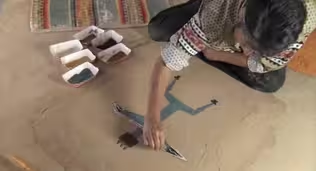
An excerpt from the KUED documentary We Shall Remain demonstrating Navajo sand painting. (2m 43s)
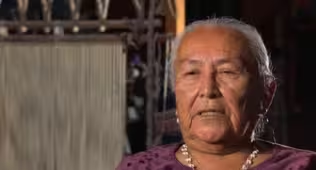
An interview from the KUED documentary We Shall Remain featuring Sarah Natani. (1m 52s)
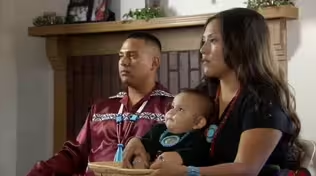
An excerpt from the KUED documentary We Shall Remain describes aspects of Navajo Culture. (5m 22s)
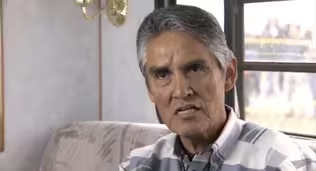
Navajo Tribe member Joe Shirley speaks his native language about what it means to be Diné. (24s)
Providing Support for PBS.org
Learn Moreabout PBS online sponsorship











Support for PBS provided by:
We Shall Remain: A Native History of Utah is a local public television program presented by PBS Utah
The Utah Department of Community and Culture, the George S. and Dolores Doré Eccles Foundation, William M. and Kerry Armstrong, American Experience, R. Harold Burton Foundation, and the Lawrence T. Dee and Janet T. Dee Foundation.