Roots, Race & Culture
Is AI Changing How We See Ourselves?
Season 8 Episode 3 | 27m 3sVideo has Closed Captions
How does AI blur our view of the world? Explore how AI can change our understanding and views.
Meet an artist who uses physical marks on a canvas to display the changes AI makes to our bodies, and the researcher who evaluates how AI impacts our lives. The two of them join forces to discuss how AI can change our understanding of what it means to be human, and the future of how we see ourselves and the world.
Problems playing video? | Closed Captioning Feedback
Problems playing video? | Closed Captioning Feedback
Roots, Race & Culture is a local public television program presented by PBS Utah
Roots, Race & Culture
Is AI Changing How We See Ourselves?
Season 8 Episode 3 | 27m 3sVideo has Closed Captions
Meet an artist who uses physical marks on a canvas to display the changes AI makes to our bodies, and the researcher who evaluates how AI impacts our lives. The two of them join forces to discuss how AI can change our understanding of what it means to be human, and the future of how we see ourselves and the world.
Problems playing video? | Closed Captioning Feedback
How to Watch Roots, Race & Culture
Roots, Race & Culture is available to stream on pbs.org and the free PBS App, available on iPhone, Apple TV, Android TV, Android smartphones, Amazon Fire TV, Amazon Fire Tablet, Roku, Samsung Smart TV, and Vizio.
Welcome to Season 7
Bold and honest conversations tackled with humor, insight, and empathy.Providing Support for PBS.org
Learn Moreabout PBS online sponsorship- [Narrator] Funding for "Roots, Race, and Culture" is provided in part by the Norman C. and Barbara L. Tanner Charitable Support Trust and by donations to PBS Utah from viewers like you.
Thank you.
(upbeat music) - Hello, my friends, and welcome to "Roots, Race, and Culture," where we bring you into candid conversations about shared cultural experiences.
I'm Lonzo Liggins.
- And I'm Danor Gerald.
Thank you for joining us.
AI is integrating into all aspects of our daily lives.
In fact, AI technology is approaching the singularity.
This is the point in which artificial intelligence surpasses human intelligence, and it's happening much faster than experts ever expected.
As we approach this new frontier in human history, how does AI skew our view of the world, and how is it impacting different cultures and our understanding of what it means to be human?
- That's right.
So to explore this topic, we have two experts with us who are studying and applying AI in their work and in their art.
Gretchen, introduce yourself please.
Hi, I'm Gretchen Andrew, and I'm very passionate about making parts of AI visible so that we can talk about it.
I'm particularly doing this through a series called "Facetune Portraits," where I look at the way that AI is changing our expectations of ourselves and of others by physicalizing the process of beauty filters that make lips bigger and waists skinnier.
And we see them all the time on social media.
We see them as a filter on Zoom video conferencing, but we don't really see what's going on.
I turn that process into a series of marks and scars so we can really see how is it that we're being told by AI that we're not good enough and that we should be different.
- And now we have Avery.
Please introduce yourself, Avery.
- Sure.
Avery Holton.
I'm chair of the Department of Communication at the University of Utah, where we have over $100 million investment in responsible AI uses.
What that means for me is researching and trying to find ways for people to integrate AI into their daily lives, but in really helpful ways so that AI can be a little less scary and maybe a little more fun to use, but also can have a significant and positive impact on people's lives and their well-being and happiness.
- Tell us a little bit about how you see AI changing the way that people see who they are.
- Such a great question, right?
AI is reshaping our identity, whether it's really the art that we channel that through or the ways we work or we find and discover ourselves.
And we can see that happening maybe most readily in our professional lives, that blending of the professional and personal, where AI has helped us with mundane tasks like calendars, emails, outlining, and maybe freed up a little bit more time for us to spend with our kids or spend skiing or spend on maybe art like Gretchen will tell us about, but really trying to find ways to destigmatize AI as just a negative tool, as just a tool to replace jobs or to threaten different elements of our lives.
And instead to see the benefit, how AI can help us and maybe even bring us back to the artisanal, the creative, the individual works by giving us more time and giving us a little bit more direction.
- So that's a great jumping off point there.
You specialize in working with the artistic aspect of what people look like and how AI is being used to reshape how people look.
- Yeah, so the truth is we're already using this AI through beauty filters, through an app called Facetune and many others.
These apps use AI to identify parts of our body and to enhance them, to make them more beautiful.
So really in my artistic practice, I don't invent any of the AI.
I take it from culture.
Whatever's trending on TikTok is the filter that I apply.
It starts as a painted photograph.
The photograph is wet.
It's made of oil paint.
I give it to a robot that then makes the same modifications that would invisibly move pixels around on TikTok or Instagram.
- I'd like to see an example of this.
We actually have a video.
- Yeah, let's jump to the video- - Let's play this video and see exactly what you're talking about.
- [Narrator] What is universal beauty?
This is the question that the Miss Universe pageant contestants aims to answer.
120 contestants from all over the world represent what quintessential beauty looks like from each country.
What happens when these universally beautiful women are subject to the algorithmic Facetune filters?
Facetune portraits explores AI beauty filters through traditional oil painting.
Using custom robotics, I translate social media filters into physical paintings revealing how AI driven beauty standards are homogenizing diverse faces and bodies across cultures.
Each portrait exposes the tension between natural features and AI modifications, making visible the digital alterations that silently shape our social media presence.
- Okay, not only do we have images on the screen of these beautiful paintings, but we actually have one here in the studio.
So let's have Gretchen explain to us, show us this image and what's happening and how it was created.
- Thank you.
So what you're looking at here is an oil painting where the initial photograph was created in paint.
This is me.
And while that painting was still wet, I gave it to a robot.
And that robot applied the same beauty filter that is used all the time on TikTok and on Instagram, on LinkedIn and Zoom.
But normally it's invisibly moving pixels.
But here, because it's moving paint, it makes a literal scar.
I say that this work shows the invisible scars of social media filters.
And so we see here it's making the lips bigger and it's making the boobs enlarged and straightening out my extremely crooked nose.
And what we see in this is everywhere there's a painted mark in these red and white lines is somewhere that AI disagrees with how my body looks.
And this allows us to see those differences that are normally hidden and to talk about whether or not we think that's okay.
It's amazing to me that with what is less than eight brush strokes here that a robot does create, this begins to not look like me so quickly.
And it almost looks like the uncanny valley in reverse, where to me this begins to look like an AI generated person who's failing to look real.
And we are actually meeting that AI aesthetic halfway.
We are changing our bodies digitally and then through plastic surgery to look fake.
- Yeah, that's great.
So let's take a look at more paintings here that were created by Gretchen.
Can you tell us a little bit?
We have Miss USA, Miss Puerto Rico.
What year is this?
What are we looking at?
- So I've been working with the Miss Universe contestants because they are already gorgeous.
They're from all over the world.
They should look completely different.
And what also is happening with these apps is there's a homogenization of the beauty standard that is internationally spreading like wildfire because of AI And so in working with the Miss Universe contestants, we can see the absurdity and also the diversity compression that's occurring.
And really, nobody knows better than them how absurd it is that they aren't good enough.
If they're not good enough for these algorithms, for this AI standard, no one has any hope of ever being good enough.
- Because you mentioned something, Avery.
You said $100 million that's being used, that's being mostly used towards making AI helpful.
What about AI do you think isn't helpful?
What do you think about AI that could be harmful, that is out there, that could be causing issues, in your opinion?
- Yeah, I think one of the things that we can do is remember that AI, even if it feels robotic or digital or distance, begins with us, right, with human beings who are creating this and we're flawed.
And even if we're creating algorithms to drive AI, they're being driven by our own biases, our own perceptions, our own stigmas, and in just the ways that we can see in the artwork, right?
Perceptions may be of beauty that are standard in the U.S.
that maybe aren't in Europe or in other countries, but if the builders of these systems are positioned in one specific area and aren't able to go international yet, that can really present problems.
It can present a negative to us because it peripheralizes certain communities, it makes certain assumptions about people and their own standards, whether it's beauty or socioeconomics or something more culturally related.
That can be a significant challenge.
- When we say helpful from both of you, what do you see when you hear the word that AI can be helpful?
And I'm curious, on your end, Gretchen, how you think AI would be actually helpful when it comes to the research and the work that you're doing?
Well, one of the things I think we see with AI is it does allow us to do things quite quickly.
But what's happening also within that is every website now looks the same, every home is now designed the same, everyone now has the same face.
And there's so much focus on AI as an explosion of productivity and creativity.
But I actually think that we're going to see it playing out in our lives as a system of control and of surveillance and of normalization, because that's just what the machine finds easy.
And if we're all using the same tools to write the next great American novel, we're going to get a lot of the same great next American novel.
- Okay, so okay, I'm curious about this and let's just sort of throw this out for everybody.
What happens to communities that are already marginalized who don't have access to this technology?
Can AI be used to help educate those people or is it something that they're going to get left behind because they don't understand or they're not using this stuff on a regular basis?
So like, you know, you know, the person who gets the job is the person who's most productive and that person usually uses AI So then so what do you guys think about that for people who are already struggling?
How do they keep up?
- Yeah, I can kick that off with some data from the research side.
So we know now that many K-12 programs in the U.S.
are using AI and making use and making it accessible through partnerships with larger corporations like Microsoft or NVIDIA or Adobe and other systems.
And that's great.
That's a really good starting point.
If more than half of our K-12 programs are already using that and centering AI as a tool to achieve success or to find happiness or to make tasks easier, that's fantastic.
What we're running into, though, is that accessibilities of digital technology and also the creation of those technologies have long been driven by particular stigmas, by particular peripheralizations, right, that tend to focus on the populations that are easier to deconstruct or easier to understand or they're just seen more, right?
So, for example, if we see more white bodies in TV programming and on the media and then we ask AI to assist us in creating a journalism broadcast, what we're likely to see are those same white bodies.
So we're asking different communities now to go further into AI and have to actually ask different questions.
- What about you, Gretchen?
What are your thoughts?
- Yeah, so I'm a big fan of what I call productive uncertainty in our own lives, where we bring kids to an art museum or we as adults experience art.
One of the things that happens is we see something that we wouldn't have made, something that could not have come from us.
And our brains don't really know what to do with that otherness.
And that otherness, that disruption of the system is, I think, why art is so powerful.
It expands us.
But when AI is forced to reconcile something that it can't take as an input, it just disregards it.
So if you take embodied knowledge, oral history, other traditions that are more prevalent outside of the West as forms of knowledge, they're not part of AI because AI can't go around and ask us all how we're feeling and how that was danced and what knowledge is passed in ways that are not text based, image based, Western in its standards.
And so not only is that knowledge not incorporated into AI, it is disregarded because it's a different form.
- We actually asked a question.
We had a producer ask a question to ask what a story, a log line of what our show would be like.
This is the prompt.
The prompt says, hi, what can I help you with?
It says, please create an image illustrating a talk show with two hosts.
The topic of the talk show is about the experiences and perspectives of BIPOC people in Utah.
Enter.
- Okay.
- Yeah, that looks like me.
You?
That's good, though.
- Not you.
You turned me into a girl.
- (laughs) That's not bad.
I mean, it's this is generic.
- It's done by Microsoft Copilot.
And it's, what are your thoughts as you see this image?
I'm curious what you guys think.
- I notice actually at first the, the dress and there's a lot that's also going on with AI's use on LinkedIn, where people are feeding it a bunch of images from parties or their personal lives and asking to be made into a professional image.
And that professionalization that we saw on that image is a very Western specific idea of what it would mean to be a talk show host.
And I much prefer what you guys are wearing.
(both laughing) - Avery.
- I'll say, I mean, this is pretty good, right?
So Copilot hit it here pretty well.
It's interesting, though, too, to see that the prompt itself said nothing specific to who the hosts were, gender, race or otherwise, what you're wearing, what the actual feel of the show might be.
So for Copilot, right, that it only has a certain number of clues that we've given it, but it's chosen to be somewhat gender neutral, which is interesting, but it's also chosen to see the topic of the show and then to assume what the hosts would look like.
Right?
Without asking for any more input.
Certainly we could go down the prompting pathway and eventually actually get to something that looks like the set here and the both of you as well.
We have to take all of those steps again and have that conversation, which there's a benefit, right, to having that conversation with AI But there's also a drawback knowing, hey, if we just give one prompt, this is exactly what it's going to tell us this should look like.
- In what areas is AI really going to help us in society?
- Thinking about it two ways professionally and then personally helps.
Right?
So professionally, we've seen AI speed up tasks, right, when it comes to cancer research, for example.
We've seen it be able to take on large amounts of information and data and point researchers in new directions or help them think about directions they haven't been on or help astronomers identify distant stars or the makeup of those in a much quicker pace that allows for a whole new realm of exploration here.
Right?
Frees up time for our scientists to be thinking about those things.
- Now, Gretchen, we had some conversations before the show and you've done a lot of research as well.
Some things that aren't really being looked at in other ways.
Can you tell us what's been most exciting or revelatory in the research that you've done?
- Well, exciting because I think it's important.
So one of things that's also happening is young people are seeing faces and bodies that literally do not exist.
- Right.
- We used to have celebrities on the silver screen, on the big screen.
Now our celebrities are on our phone and we might see a photo of Kim Kardashian and then ourselves and then our friend and then another celebrity.
And the context compression that's happening there is young people are comparing themselves and saying, 'I could never look like that.'
They don't even look like that.
And even when we have that literacy, it's really disrupting our expectations of how we are supposed to look.
And at very young ages.
So people are coming with these apps, these Facetune apps, they're coming to plastic surgeons and they're saying, make me look like this.
But they're always showing a two dimensional image.
And a lot of these beauty standards are being driven by our desire to communicate our full body in two dimensions.
So big lips, pointy jaws.
We don't care how those lips look from the side because we actually are prioritizing that two dimensional still image.
And that need to communicate that because we are seeing each other on Zoom, we're seeing ourselves processed through these screens and through our cameras.
And it's this constant beauty arms race where we think we need to change something and we start to think we don't look right.
And how insidious that is.
We look at the mirror and we say, that's not how I'm supposed to look.
- Gretchen, I have a two part question for you.
Number one is, do you have a personal connection with like wanting this to be a part of changing people's perspectives of this?
Number one.
But number two, how do we change that?
- I've been thinking a lot about any time we are told that we should be a different shape, whether it's metaphorically or literally.
And I think it also comes from just this desire that I don't really just see a desire to be beautiful with these apps.
I see a fear of ourselves because it does give us all the same face, all the same body.
It commodifies itself.
It colonizes the body.
We're fearful of how we actually are.
We're fearful of aging.
We're fearful of death.
And now it's not just that we're supposed to feel bad about that.
We're supposed to spend hundreds of thousands of dollars fixing it.
There are so many capitalized solutions now where we're being sold both the problem and the solution.
And I don't personally want to do it.
So I would like it to stop for everybody.
- Understanding AI is much more complicated than everybody seems to think.
Right?
It can think for itself, et cetera.
But isn't it controlled by an algorithm that was programmed by a human being?
Is it actually thinking for itself or is it doing processes that mimic thinking for itself?
Because then that begs the question, well, who programmed it to say this is what's beautiful?
Right?
So can you guys help us understand that?
- Sure.
So AI, and I'm not a computer scientist, so I'll explain it as well as I know.
And I think we both can.
Really right now, what's available to the public are two forms of AI There's one that's been with us for a few years now that we're used to.
Right?
This is like the ChatGPT, the conversational AI, the task oriented.
Right?
These large language models where we input data and out comes something.
We input a command and out comes something.
And we can have a conversation.
But really, there's not something there yet telling us, hey, I'm learning alongside you.
And here's the better choice for today.
Agentic AI, that second form, is what we're beginning to experience and what's starting to show up for us in new formats of AI or new updates.
- What's agentic form?
- So, agentic AI essentially is still inputting commands or having conversations, but allowing the AI to actually learn, right?
To either learn from mistakes or learn from your habits, or in some cases have access to more of your information, which can open a whole new- - That's a scary thing in itself, right?
- But learns with you, right?
So it's not just giving you a broad answer of should I go outside today?
Yes or no?
And instead, knowing about you.
Okay, do you like crowds?
Are you saddened when you see clouds?
Do you like sunny skies?
Like learning with you and giving you a different kind of response along the way.
- In your opinions, before we wrap up here, what are some really dangerous things that you think might happen with AI?
- I think it's very dangerous mental health-wise.
I think we're already seeing that.
And I very much believe it will be sort of the tobacco of our generation in the way that these body modification apps are using where, we know it's bad for us, we're still letting it happen, but we don't tend to count mental health the way we do physical health.
And I think that feeling of not being good enough is so insidious and we're planting it so early.
And it already existed before AI that I think that danger will, and insecurity will cause all sorts of ramifications.
- I'll stay on that same vein, mental health, right?
And in what aspects?
We've seen social media and digital media pretty quickly have detriments, particularly on younger populations.
But when it comes to mental health and wellness and beauty, for example, having this idea or notion of what should be reached or what everybody looks like can be extremely challenging.
And it can also open opportunities.
But I go back to the exercise we did earlier in the show.
We had the two hosts, those hosts, what we saw were black body hosts.
Right?
In a BIPOC setting.
But if we look at them, they fit a particular standard of beauty expectation.
Right?
That AI currently tends to give us whenever we ask for these prompts that everyone is beautiful, that everyone should have smooth skin, look youthful, be smiling, be dressed well, have a particular kind of hair.
Their nails should be done in different ways.
My hope is that as AI creation moves into a next era where AI itself is working to improve itself, that it starts to introduce some elements of beauty that are naturally occurring.
Right?
Here I'm talking about wrinkles, aging, different shades of skin and skin color, different kinds of hair that really remind us of where human beings are and what we can be.
But to Gretchen's point, we're not there and we might be far off from that and we might even be in a space, and this is where we can start really going into that darker area of AI, where AI itself, different formats of AI learn, 'Oh, if I keep telling people that they should look this way, but they can never achieve that, they'll spend all of their money.'
They'll be trapped in sort of mental health and wellness, comas, if you will, that they can't get out of where they don't have access to resources to get out of that.
And they can become trapped in that sort of depressionary cycle or spin that's a detriment not just to individuals, but to the communities.
Right?
That we're talking about.
That's the darker side.
Right?
So it really comes back around to the creators of AI working with AI and in their creation of the tools for AI to center humans and to remind us where the beauty really is, that there's beauty in imperfection.
- Gretchen, what are your final thoughts?
- My final thoughts are that I'm really pleased to know that there is investment in ethical AI.
I think we need a huge amount of attention and investment in media literacy because it's going to become even harder and harder for us even when we want to know the difference, we want to have agency, it's going to be harder and harder to tell.
And everyone from two years old up to 100 needs to understand what that difference is.
And that, I think, is where we'll have more of the power to actually make choices about this stuff.
- That's one thing that I would challenge your audience, but anybody really to do is to, if they're not already using AI and they have an idea of what it is to go a step further and to try out different variations of AI platforms, those that are most accessible and right in front of us, GPT and Gemini and others.
And those that maybe feel a little bit unfamiliar, whether they're beauty apps or others, so that we can see together where AI is and what it's putting in front of us, whether it's those videos that make us more divided and are made to sow chaos or if it's those that are put in front of us to challenge what we think of beauty or to tell us there are certain products we need to buy, whatever that is, so that one, that literacy can start to develop.
But two, we understand what those behind us are encountering.
And I mean generationally, because we do have a capability, even if we're not computer scientists or administrators, we have the ability to say, hey, here's what's working and here's not.
Or here's what I would like to see this look like as we go forward and to tell those who are creating AI and eventually to tell our own AI assistants or those that are around us, this is where we think this should go and to remember us, right, so that we as humans aren't a relic as we move forward, but instead are originals, are authentics, are those that value each other, but also value the role of AI in our lives.
- Well, we need people like you two steering the ship.
That's what I can tell so far.
- To keep doing the work.
- We need people like you guys helping make these AI models be smart and relevant and beneficial to all of us in those ways.
So from all of us at PBS Utah, thank you for joining this fascinating conversation.
As always, other episodes can be found on our website, PBSUtah.org/roots or on the PBS Utah YouTube channel.
- Yes.
And thank you so much for joining us for the show, you guys.
And if you have any feedback or ideas for other episodes, be sure to give us a shout out on social media.
Until next time for "Roots, Race and Culture," y'all, we are out.
- [Narrator] Funding for "Roots, Race and Culture" is provided in part by the Norman C. and Barbara L. Tanner Charitable Support Trust and by donations to PBS Utah from viewers like you.
Thank you.
(upbeat music)
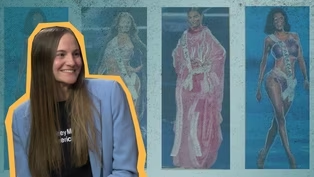
Is AI Changing How We See Ourselves?
Preview: S8 Ep3 | 30s | How does AI blur our view of the world? Explore how AI can change our understanding of this? (30s)
Providing Support for PBS.org
Learn Moreabout PBS online sponsorship












Support for PBS provided by:
Roots, Race & Culture is a local public television program presented by PBS Utah