Roots, Race & Culture
How Closing the Black Wealth Gap Helps Everyone
Season 8 Episode 1 | 26m 28sVideo has Closed Captions
Black and POC communities have faced systemic financial barriers. How do we close this wealth gap?
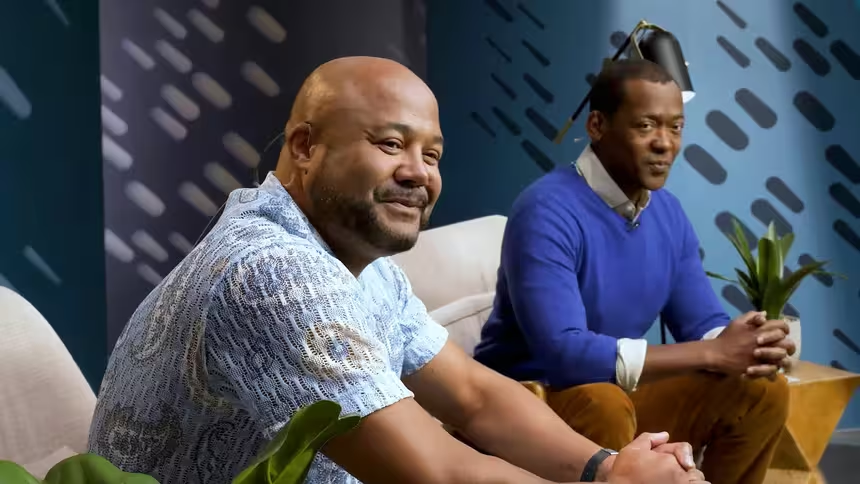
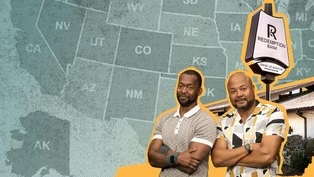
Black wealth means more than money; it’s access to opportunity and ability to build legacy. Historically, Black and POC communities faced systems that created a racial financial gap. Today, change is underway through banking, policy, and community efforts. Ashley D. Bell, chairman of Redemption Bank, joins Sui Lang L. Panoke, founder of Utah Women Run, to discuss the importance of closing the gap.
Problems playing video? | Closed Captioning Feedback
Problems playing video? | Closed Captioning Feedback
Roots, Race & Culture is a local public television program presented by PBS Utah
Roots, Race & Culture
How Closing the Black Wealth Gap Helps Everyone
Season 8 Episode 1 | 26m 28sVideo has Closed Captions
Black wealth means more than money; it’s access to opportunity and ability to build legacy. Historically, Black and POC communities faced systems that created a racial financial gap. Today, change is underway through banking, policy, and community efforts. Ashley D. Bell, chairman of Redemption Bank, joins Sui Lang L. Panoke, founder of Utah Women Run, to discuss the importance of closing the gap.
Problems playing video? | Closed Captioning Feedback
How to Watch Roots, Race & Culture
Roots, Race & Culture is available to stream on pbs.org and the free PBS App, available on iPhone, Apple TV, Android TV, Android smartphones, Amazon Fire TV, Amazon Fire Tablet, Roku, Samsung Smart TV, and Vizio.
Welcome to Season 7
Bold and honest conversations tackled with humor, insight, and empathy.Providing Support for PBS.org
Learn Moreabout PBS online sponsorship- [Announcer] Funding for "Roots, Race, and Culture" is provided in part by the Norman C and Barbara L. Tanner Charitable Support Trust, and by donations to PBS Utah from viewers like you.
Thank you.
(upbeat music) - Hey everyone, and welcome to "Roots, Race, and Culture," where we bring you into candid conversations about shared cultural experiences.
I'm Lonzo Liggins.
- And I'm Danor Gerald, thanks for joining us.
The American Dream is a deep rooted belief that in our country, hard work and ingenuity is the pathway to success.
When families and communities are actively building wealth, it's a prime indicator that the dream is coming true.
But did the dream of Black wealth die with Dr.
Martin Luther King Junior?
When he was assassinated, there were 140 Black-owned banks in America.
Today, there are only 20, and one of those banks, the first one in the Western US, recently opened right here in Utah.
- And when we talk about Black wealth, we're not just referencing dollars in a bank account, we're also talking about access, opportunity, and the ability to build a future.
For generations in the US, Black and brown communities have faced systems that have blocked that opportunity, from redlining and discriminatory lending to barriers in education, employment, and corporate leadership.
The playing field has never been level.
- But this conversation isn't just about the past.
It's about what's happening right now in banking, in the workplace, in policy, and in communities to finally close that gap.
Joining us today in the studio, we have two very special guests.
First, please introduce yourself, Mr.
Bell.
- I'm Ashley Bell.
I'm founder and chairman of Redemption Bank.
You know, originally from Atlanta, Georgia, and have been excited about this journey we've had here in Utah creating such an exceptional historic opportunity, not just for Black entrepreneurs, but really just a beacon of hope and a very unique platform for growth of economic activities around the region.
- That sounds fantastic.
And we also have Sui Lang.
Please introduce yourself.
- Thank you so much for the invitation to join you here today.
Sui Lang Panoke, founder of Rethink International, where we challenge people to rethink how and what they think.
By developing the concept of bridge building, going to the margins and working your way in.
And as we'll talk more about today, I see banks as bridges in closing a lot of those economic gaps that exist across communities across our country.
I'm also strong champion, supporter, and investor in Redemption Bank, and I think it will play a critical role in building bridges across the Beehive State.
- So to kind of help our audience, I'd like to first just kind of establish some groundwork for what we're doing.
What is the biggest misconception about the Black wealth gap, the Black and brown wealth gap that you guys feel?
Because both of you have spent time in Washington DC and around the country.
- You know, I think the first misconception, first of all, Black banking at first is you gotta go straight to the question of what is a Black bank, right?
Some people, if you've never heard of one, if you live somewhere where there aren't any, you may think like, well it's a Black bank, it's only for Black people.
So it's not my thing.
That's absolutely not true.
And that misconception is a big part of the reason that you saw a decline in Black banks over the last 60 years.
You saw a situation where Black banks were only in Black communities, and you saw exodus of Black talent from those communities.
And so every other bank became attractive.
You saw Black families move their money outside of the community, and that left those banks to it with just a very hardcore group of folks that live somewhere off Martin Luther King Junior Drive.
So for us, this is unique because this is the first time a Black-owned bank has not been located in a Black community anywhere in America.
It's never happened.
So it's a unique experiment, but for us, the question was always, could we create a bank that's just Black-owned, but open to everybody, and be a centerpiece of economic activity and a catalytic engine for growth?
- And I think that's probably the misconception is that people think that when you say Black bank, you're thinking, oh, it's just for Black people, it's not for everyone, but a Black bank, it's just a bank, correct?
- That's right.
And that crosses over just businesses in general.
There are a lot of businesses... The consumer is across the board, you know, identifies as multiple nationalities, ethnicities, races.
And many people may not know the ethnic identity of the owner, right?
When then they find out, oh, that's a Black-owned business and it's wildly successful.
So this is just another example of that.
- Being a part of the community is a big part of any financial institution it seems.
And we wanna also kind of help people understand, historically there's been a whole lot of suppression in these communities of color that has really contributed to part of this decline in Black wealth in America.
- Well, I think that you have to look at access to capital, right?
Historically, you know, we're a country that is capitalist, right?
And we've proven that that mantra of capitalism should be a theme for anyone to make it anywhere, right?
That is the theme.
But we still strive every day to be a more perfect union because we haven't really proven that we've allowed capitalism to do what it should be doing.
We've had impediments in capitalism.
You can't really say you're capitalist if at some point people had to work for free.
That's not capitalism, right?
If you have a system where women can't own property, that's not capitalism.
If I can't go eat at any lunch counter that I want, that's not capitalism.
So we've had people get in the way of capitalism.
And so now we're at this, hopefully a new era of capitalism where anybody should be able to start a business, whether it's a bank or barbershop or a bakery anywhere in the country, and that owner should be judged by the ability for them to deliver a product or a service.
And they should be able to make as much money as possible.
They should be able to go to the bank and get whatever their credit says they should.
They should be able to own a home in any neighborhood if their credit and merits say so.
We're getting there.
But to get there, you have to be intentional.
And Redemption is a part of that intentionality.
- So that begs the question when in the intro, it said we went from 140 Black-owned banks, you know, down to, I can't remember the number.
I think it was like 20 or so Black banks.
Why did that number drop so significantly?
- I wanna plug a book.
And Sui knows this book because I gave it to her, and it's a book called "The Color of Money."
"The Color of Money" is the history of Black banks.
The tie is was written by a professor at BYU.
So just throw that out there.
- So that's right here in the Beehive State.
- Exactly.
The preeminent book on Black banks is written by someone right here in Utah, person that's not Black.
So it just goes to show Utah is such an interesting place.
But in that book, it'll chronicle and show you that that decline primarily was because every time America catches economic cold, Black people catch pneumonia.
Anytime people are fired, Black people are first to get fired when there's a downturn and the last to get hired back when the economy comes back.
And so who feels that the most?
The banks that hold those opportunities, the banks that hold the credit and the mortgages of those people who get hit the worst.
So if you look and see when America hits the economic recession, you see Black banks disappearing, and as Black banks disappear, opportunity disappears with them.
- In addition to that, one thing I've learned in banking is risk, right?
Learning how to mitigate risks and who's willing to take risks.
And so generally, minority-owned banks are more willing to take risks on their own members of their own community.
That's a critical part of getting access to that capital that they need to start and grow their businesses.
- Tell me about this vision that you had for this bank and bringing it here to Utah, which is unique.
Tell me a little bit about your vision in the process.
- One of my co-founders obviously is Dr.
Bernice A. King, who's the youngest daughter of Martin Luther King and Coretta Scott King.
And, you know, her and I were on a journey looking for the best place to acquire a bank.
We saw some of the challenges that our nation was facing.
We saw that there needed to be a next generation of Black-owned bank.
The ones that we have are phenomenal and they do their job.
They do the hard work that nobody's willing to do a lot of times, but they are sometimes prisoners of history, meaning that they're locked in communities that have so many things going against them beyond control of the bank, right?
Some of the things we just talked about.
And when you think of what the future of Black banking could be, one, you wanna start a business somewhere where the law's on your side regulatorily.
Utah is to banking with Delaware is to corporations.
You want to be here if you're a bank.
This is why you have Goldman Sachs here.
This is why MX is here.
This is why you could be at a community college in Wisconsin, but your student loan debt is here in Utah.
Utah really doesn't have a concept of usury, which is a concept that makes so extending credit to people, you have to be very careful about the interest rates.
Utah's more of a like, you know, go ahead and do it as long as it's, you know, fair to people, just go for it.
That kind of freedom allows a lot of creativity, which is why you see a lot of unsecured debt banks here.
And that just brings capital.
- And that's a good thing.
- It can be.
- But it can also be a bad thing.
- It can be, right, exactly.
And I think from a business perspective, the market will dictate what you can charge people generally, but you also have predatory practices that you always have to be careful about, right?
So with freedom comes responsibility.
And what I like about Utah is a state where they give businesses the freedom.
And then you have to have that responsibility in how you take that freedom to the marketplace.
And for us, it's a mission-driven institution, you love the freedom because you can get creative, but the exact same time, we're gonna make sure that, you know, our credit card that we have at Redemption Bank is the cheapest credit card in the market, right?
It's the 12% credit card, doesn't move.
If you got an Amex, you don't know how much they charge.
It could be 16 to 28%.
Love my friends at Amex, but that's every credit card.
It fluctuates, depending on what's going on.
A variable rate.
We keep it simple, 12% flat, you know what you're getting.
It's not gonna jump.
It's the cheapest in the business.
So we take that freedom, but also bring responsibility to the marketplace.
- So that begs the question, you chose Utah.
Utah was the place.
You're somewhat from Utah.
Why Holladay?
Holladay is a unique place in Utah.
Utah, Holladay is specifically known to be mostly LDS, mostly white community, why Holladay?
- So my family actually lives in Holladay.
It's kind of my neighborhood where I grew up.
And so it's done me well.
One thing that's also important to note in this conversation about capital wealth building, financial capital is the concept of social capital concept.
And I believe that is truly what made the difference, in Redemption, what makes the difference for Utah and being the strongest economy in our country, the value system that we have here is based on faith, family, community, and trust.
You know, during my time at Zions, which is the oldest and largest financial institution in the Beehive State, celebrated 150 years a couple years ago, these are seasoned, proven, you know, successful bankers, you know, in the industry, not just locally, but nationally and internationally.
And so to take the lessons learned from a historically proven institution like Zions, built upon, again, those same values, faith, family, community, a key part of their business strategy is community investment.
And when you make that the forefront of your financial institution, it's the community that will keep you in business.
It's those relationships that you build with those small businesses and individual clients.
It's that social capital that you build in the communities that you serve.
- Let's talk a little bit about the community.
What sort of community support have you guys found as you were searching for the place to build this institution?
- Yeah, I think the first question you asked me, we came here for the regulations, but we stayed for the people.
You can't have a community bank without the community.
It's just not possible.
So the question was, you know, could there be a Black-owned bank in Utah?
But if you ask any business owner of African-American or African descent in this state, can their business exist with just Black people, they'll tell you no.
So you know that off the gate.
So the question is, can you build a business here with a broad amount of community support from across multiple groups, sectors, incomes.
And I think we found, at least initially, a very open door from the investor class, from the philanthropic world, the people who build foundations and institutions here in this state that are perpetually looking to make this state better, to look out for the least, the last, and the left behind, to pull up people from marginalized communities to the forefront of the capitalist experience.
And that started with the Garff family for us.
You know, Ken Garff Automotive, people know the name.
But Kathy Garff is a dear friend of Dr.
King and the family, and she's become a dear friend of ours.
Our son John and Melissa have been, you know, sort of like the epicenter of what kind of started this journey.
And since then, once they opened the door, and that's how we meet Sui, that's how we meet, you know, Scott Anderson at Zions.
And it's a unique place because when you come here and you're like, okay, well let's figure out who's sort of shepherding these sorts of initiatives.
You end up at Zions, you end up talking to Scott Anderson, you end up talking to Sui.
And then from there, we were able to really find a lot of support from the Eccles family, the Eccles family who has been so generous to us in so many different ways.
Hope and Randy Quarles, the Huntsmans have been phenomenal.
Gail Miller, phenomenal ally and supporter.
You know, Gail has been, she was at our ribbon cutting.
You don't get where we are now without people like Gail who not only put their money where their heart is, but who also aren't afraid to consistently speak up in those moments of community distress.
Like things bubble up, the question is who's gonna step up and say the things that need to be said.
Gail's always been there.
And the Sorensons, you know, I would close it out with, you know, Jim Sorenson and the Sorenson Impact Fund.
This is what they do.
You know, this is at the ethos of why they created that fund.
So when you look at that group of people, and I hope I haven't left anybody, you know, I know I will.
But that core group of families have been critical for us to really get an anchor in Utah.
The fact that we exist alone says so much about this place to where Black people are like, "You know what, I'm going to support."
There's not a day that goes by that we don't see consistent people moving their business accounts, moving their personal accounts to us.
But the reason is they know that this means more than just a bank.
- When we started, you know, having conversations about the even idea of setting up shop in the Beehive State, I had friends from across the country wanting to set up accounts, and they had to wait, what, two years was it before they could actually do so, you know, it was a long road to opening these doors.
But it's also been a long time coming for individuals to finally feel like this is a win.
You know, okay, we're actually making progress, we're moving in the right direction.
Another thing I just wanted to note about the Beehive State is, one thing I learned working closely with Scott Anderson at Zions is that key leaders within our community, in the business sector, in the philanthropy circles, and also on Capitol Hill, have conversations with each other.
Utah's also number one in the country when it comes to social mobility.
And going back to that social capital piece, right?
That social mobility is key.
You know, to feel like you can have access to a decision maker is everything, right?
As someone who is just getting started and is already facing that self-doubt that so many of us who have faced the trauma of doors being slammed over and over again.
You know, it's so frustrating.
So to feel like there's some piece of hope that's keeping you going, and that's the fuel that gets you to the next day.
Redemption is just another beacon of hope.
- And you've been doing this for, what, you said 20 years, right?
You've been looking for people who, you seem to find these patterns in people who are entrepreneurs who seem to be leaders.
What is it that you look for for a person that's like an entrepreneur or a person that you think is gonna succeed in something like this?
- Oh my gosh.
Drive, ambition, hope.
You know, the understanding that something is something bigger than you is what drives you.
And then going back to the impact piece, you know, how can we help?
Identifying, I was always taught by my mentors, and we'll talk about mentorship a little bit more, but here, I'm a proud alumni of the University of Utah, Hinckley Institute, studied political science here.
Dan Jones, Tim Chambless, those are two of my key mentors.
But I was always taught to not necessarily prepare myself to get a job, but I look out into, do an external scan in the community in which I live in, and identify where are the gaps, what are the problems that we need to solve, and carving out some sort of career centered on doing just that.
And I would encourage anyone that, you know, banking, financial services, that is one of those career paths that can do just that.
- That's where Black banks come in though, right?
I mean, Black banks seem to be centerpiece to making a lot of stuff happen within our community because we're not talking about Black hospitals, Black, you know, grocery stores, Black Walmarts.
The important discussion here is Black banks.
Why is it that Black banks seem to play such a critical role in making things improved in our community?
- You know, I think that, you know, being Black in America, historically, if you're successful, you've had to learn how to do more with less.
You've had to be creative.
You've had to overcome, you had to withstand, you had to be resilient.
And so when you do find a way of being successful and being Black in America, you have a unique skillset that not only is helpful to your own people, but can be helpful to other people.
So it's actually a superpower almost, right?
So when you have a Black-owned bank and you have a business owner come in, no matter what background they're in, and they're trying to get to yes.
They're trying to get to how do I make it happen?
We're experts at how to make it happen because we had to do it above all odds at all times, right?
So you gotta take what's been a detriment and make it a positive that you can serve people and think outside the box because we've had to do it more than anybody.
- No other option but to get creative.
- Yeah, and creativity runs in our communities, right?
- What's that?
- Creativity runs in our communities.
- Creativity, innovation.
I mean, that's what every corporate culture claims to embody.
But I mean, we've done it, we naturally do it, because that's how we've always had to do it.
And I would just add that you know, our standards for excellence are extremely high and above and beyond any other basic standard.
So we have to be twice as smart, work twice as hard.
All of the things have twice the capital, you know, to back us, you know, in case something happens.
And so we're continuously reinventing, recreating, restructuring, but somehow we always find a way.
I mean, that gives me hope.
- That's good.
So now one of the sort of foundational ways for building wealth in America has been home ownership, and there's this concept of appraisal bias and also lack of being able to get equal mortgages to someone else and these sort of things.
How does Redemption Bank, which is Black banking 2.0, I heard you say that before.
How does it help solve some of those problems?
Because I know you got a lot of history and understanding of this.
- Yeah, you know, it goes back to what we said.
When you talk about appraisal discrimination, that's human bias.
You know, the numbers on appraisals in Congress and the government has tried to lean in here.
It happens because this is human error.
These are humans unfortunately not being good humans.
It's people, you see the stories every year.
Someone goes into someone's house, it could be an immigrant family, and a guy walks in doesn't look like that family, might not like to smell another cooking, or he might like it and be jealous it's not on his plate, right?
And he's like, "This house is way bigger than mine.
I don't like it."
And that sort of unfairness, the biggest point of discrimination in our system, whether it is banking or our criminal justice system, is this word called discretion.
Discretion is the power that you have so that your discretion deems someone worthy of an opportunity or not, value of something higher or lower, if you have that power, then in that power, you will bring certain prejudices or not.
So what I love about what Redemption's been able to do is that even the people who work for us are the people who want to be a part of our ecosystem.
They've subscribed to a higher level of integrity.
They've subscribed to working for people that might not look like them, they've subscribed to read a book that they might not normally read so they can understand the history and the legacy of discrimination in the past.
So they may be Black, white, or otherwise working for us.
They've signed up to bring to the table a mindset that I have to look at people for more than their credit score, more than just their background or where they went to school, or where they grew up, and see them holistically.
Because I know the system has not, and this is a place where we can get them that redemptive help of bringing those resources back to communities that historically have not had it.
- Can I add something?
- Yes, of course.
- Going back to your regional stat, how we had about 120 Black-owned banks in the country, now we have about 20, the big kind of game-changer that I see in this whole redemption concept is you see a group of Black investors acquiring a white-owned bank and converting it into an MDI, minority depository institution.
That has never been done in this country before.
And what that says to me is there is value in being Black-owned.
- Mm, yeah.
- So I'm gonna let you sit with that for a moment.
That is not a small thing.
And that is huge.
That is how the tides are turning, the game is changing, and there are new players at the table.
- To be received by Governor Cox who gets on a Zoom with you and says, "I heard you want to come to Utah, let me tell you why Utah is the best state for you to be here."
- Wow.
- You don't get that in a lot of other places.
You don't get that anywhere.
So when you talk about why this is the place, I would argue that we couldn't have done this anywhere else but Utah, I would argue that if you're looking to start a Black-owned business of any sort, and you're looking at competing in a marketplace where if you have good ideas and you have the right people behind you that could bring expertise, you get a fair shot here to do it anywhere else.
- What's the biggest idea you want people to leave with from this conversation today?
- I would hope that after hearing our story, that the people who are from here have a greater sense of pride about this place.
That when I get asked a question, why Utah, everywhere I go, when I'm not here, why did you end up in Salt Lake City?
I hope that they watch this program, they understand that this place is different.
There's a lot of opportunity here if you're willing to seize it.
And I fundamentally think that, you know, when it comes to our community, the Black community in particular, that I hope they listen today and see that our best days are ahead of us.
Opportunity is growing.
And if you're willing to take a risk on yourself, then there's people who will meet you halfway.
And there's no greater act of self-determination than to start your own business, chase your own dreams.
And I understand that there's been historic barriers to doing that, but I hope that this conversation today, you understand that you have people here locally that are helping you that can help you break those barriers down.
- It's clear that this is about more than just money in the bank.
This is about opportunity, this is about options, this is about access, and this is about building something that goes on and on for generations to come.
- It is amazing.
- I love that.
- All right, well.
- That's wonderful.
- From all of us at PBS Utah, thank you for joining the conversation.
You're not gonna hear anything like this anywhere else.
And as always, other episodes can be found on our website, pbsutah.org/roots or on the PBS Utah YouTube channel.
- Yes, indeed.
And if you have feedback or ideas for other episodes, be sure to give us a shout out on social media.
Until next time, for "Roots, Race, and Culture," y'all, we are out.
(upbeat music) - [Announcer] Funding for "Roots, Race, and Culture" is provided in part by the Norman C and Barbara L. Tanner Charitable Support Trust, and by donations to PBS Utah from viewers like you.
Thank you.
How Closing the Black Wealth Gap Helps Everyone
Preview: S8 Ep1 | 30s | Black and POC communities have faced systemic financial barriers. How do we close this gap? (30s)
Providing Support for PBS.org
Learn Moreabout PBS online sponsorship












Support for PBS provided by:
Roots, Race & Culture is a local public television program presented by PBS Utah