
Countdown to Election Day
10/30/2026 | 27m 4sVideo has Closed Captions
With Election Day quickly approaching, we break down the key issues driving voter turnout.
With Election Day quickly approaching, our expert panel breaks down the national stakes of the election, what voters can expect, and the key issues shaping voter turnout across the state. Plus, we explore control of Congress and a proposed constitutional amendment that's drawing widespread attention. Journalist Dennis Romboy joins political insiders Kate Bradshaw and Chris Bleak on this episode.
Problems playing video? | Closed Captioning Feedback
Problems playing video? | Closed Captioning Feedback
The Hinckley Report is a local public television program presented by PBS Utah
Funding for The Hinckley Report is made possible in part by Cleone Peterson Eccles Endowment Fund
Countdown to Election Day
10/30/2026 | 27m 4sVideo has Closed Captions
With Election Day quickly approaching, our expert panel breaks down the national stakes of the election, what voters can expect, and the key issues shaping voter turnout across the state. Plus, we explore control of Congress and a proposed constitutional amendment that's drawing widespread attention. Journalist Dennis Romboy joins political insiders Kate Bradshaw and Chris Bleak on this episode.
Problems playing video? | Closed Captioning Feedback
Where to Watch The Hinckley Report
The Hinckley Report is available to stream on pbs.org and the PBS app.
The Hinckley Report
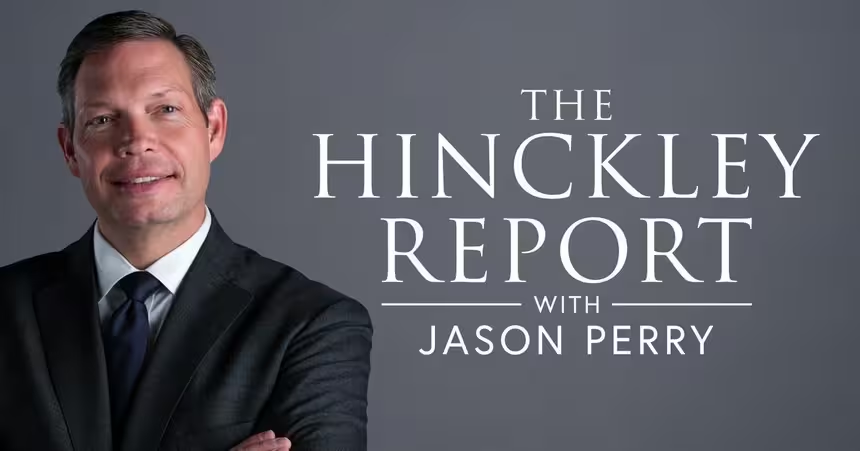
Hosted by Jason Perry, each week’s guests feature Utah’s top journalists, lawmakers and policy experts.Providing Support for PBS.org
Learn Moreabout PBS online sponsorshipJason Perry: On this episode of "The Hinckley Report," election monitors head to the state as in-person voting begins.
Early turnout across the country gives clues as to how this election could impact Utah, and candidates make their final case in the last days before the election season ends.
announcer: Funding for "The Hinckley Report" is made possible in part by the Cleone Peterson Eccles Endowment Fund, and by donations to PBS Utah from viewers like you.
Thank you.
♪♪♪ ♪♪♪ Jason Perry: Hello, and welcome to "The Hinckley Report."
I'm Jason Perry, director of the Hinckley Institute of Politics.
Covering the week, we have Dennis Romboy, an editor and reporter with the "Deseret News;" Kate Bradshaw, mayor of Bountiful City; and Chris Bleak, partner with RRJ Consulting.
Thank you so much for being with us.
Election day on Tuesday.
It's coming.
We're gonna talk about some of these elections, what's happening here in Utah.
Of course, ballots are in the homes of people all across the state.
I hope they all remember it's too late to mail those.
They're gonna have to drop those off at this date.
But I want to get into what is happening.
Dennis, let's start with you.
What is really at stake, I guess in Utah, but let's talk nationally, particularly.
What's at stake nationally in this particular election?
Dennis Romboy: At stake nationally is control of the US House and the US Senate and whether President Trump can carry out his agenda for the next two years that he's in office.
All the projections point to the Democrats taking control of the House.
The Senate may be a little bit closer.
But with the Democratic Congress, it will be interesting to see how President Trump fares in trying to advance whatever agenda he has in the last two years of his term.
Jason Perry: Talk about what might happen politically, Kate, because we have a historically small majority in the House right now, 219 Republicans, 214 Democrats, and in the House, there are 17 toss-up races.
How does that play into what might happen and if it flips to the next two years for the Trump administration?
Kate Bradshaw: You're right, Jason.
There's been incredibly thin margins in both the House and the Senate nationally, and so that has played into a lot of, "Can we get some things done?
Can we not get some things done?"
We've had changeover, particularly in the speaker's seat with these very thin caucuses, and then who can kind of push and pull an agenda because of those thin caucuses.
You know, if we have a change in terms of majority, if we have a, you know, a divided House and Senate, divided government, that could lead us to a certain, you know, mood and experience for the next two years if both of the House and the Senate were to flip.
That also sets us up for some interesting, I think, dynamics between the president and Congress.
So that is going to be an interesting thing for us all to be watching on Tuesday night.
Jason Perry: Yes, so, Chris, with the majority, if the House does flip, the Democrats get it.
There are quite a few things they get to do in terms of investigations and impeachments.
There are multiple things that could happen for those last two years if they do have control of the House.
Chris Bleak: Yes, I think that there's a lot of concern about what's really going to happen next Tuesday from a number of different perspectives.
Certainly there have been polling issues.
You even see, like, down in the Brazilian national elections, the way that the polling was set up did not go the way that the actual vote went.
And so a lot of people have been concerned.
Are pollsters able to accurately reflect the mood of the country, so that dynamic is very much out there, I think has a lot of people nervous.
And then certainly you have January 6th memories, people concerned about what might happen, election monitors coming to Utah.
What impact does that have on the elections, and will people view them as legitimate regardless of the outcome?
So I think there's a number of issues there that are very much in play, but certainly if the Democrats are able to get control of either body or both, it changes the dynamic for the next two years, particularly in the Senate around the confirmation power, and I'll be interested to see how the Trump administration deals with that dynamic.
Talk about that, Dennis, please.
Dennis Romboy: I was thinking it's interesting to note that in 18 of the last 20 midterm elections that the president's party has lost seats in the House, particularly, so the dynamic changes regularly in Congress and in the relationship it has with the president.
Jason Perry: Please.
Kate Bradshaw: I'm just gonna mention, you know, we're treating this like it's a midterm, but really it's kind of the end of a presidential era.
This is really should be maybe thought of a little bit more like the end of an eight-year term, and so it's very much, and the president has made it this way, a referendum on himself and his leadership.
Chris Bleak: And I think that Kate makes a great point there.
I mean, the president has decided this is a referendum on President Trump, and he has inserted himself, "Vote as though I were on the ballot."
And so what impact will that have?
I believe the Democrats will do well, largely from this perspective.
This was not supposed to be a Senate calendar election that was going to be particularly problematic for Republicans, and the fact that they're struggling in states like Texas, maybe Kansas, you're hearing South Carolina, they're spending money in states that they shouldn't necessarily have to spend money, just the fact that they spent as much money as they've had to in Texas has impacted them in states where they might have had a pickup opportunity like in Michigan or other places, and they're just not--they're not able to capitalize on that in this election environment.
Jason Perry: Dennis, I want to get to this point about sort of the Trump factor in these elections in Utah and nationally, but we've done some polling with you and the "Deseret News" recently about where Utah Republicans are, and Utah voters generally on President Trump and how that translates into their participation and into who they're going to vote for.
And of note, President Trump's approvals--this is in the state of Utah, this is a poll we just did this last week--he's sitting at 46% approval in the state, but when you talk about where Utahns are, will they vote for a Democrat or Republican, 50% of Utahns still said they would definitely vote for the Republican candidate.
Explain that.
Is there a disconnect or not?
Dennis Romboy: I don't know if there's a disconnect.
Utah is a solidly red Republican state.
I think what this appears to me that the Republicans are kind of biding their time right now.
I don't think they've been as vocal in their support of President Trump, but I think they're still solidly in favor of his agenda, of Republican principles.
And that's what's driving them to keeping them in the Republican Party, and I don't really see that changing regardless of what happens in the next couple of years.
Jason Perry: Kate, you're an elected official also.
You have to walk this line as you're trying to figure out what you say and not to say, but talk about how you--because Utah seems to be a little different than in the other parts of the country where the Trump concerns are shaping their votes, but in Utah it seems like not really now.
Our Utah Republican candidates are trying to chart their own course.
Kate Bradshaw: I think you're exactly right there, Jason.
Utah has long had different views on President Trump and some of his signature issues.
We talk a lot about the Utah way, and I think this is one of those instances where the Utah way is a little bit different.
Our religious and cultural background, for instance, on immigration means we've long viewed immigration a little bit differently because we send so many thousands and thousands of young people out on religious missions to different parts of the country.
It means we've always just viewed immigrants and things like that and that experience a little bit differently, so we haven't always aligned, and our elected officials at the federal level and at the state level have often not fully embraced Trump.
They've been willing to call balls and strikes on the things they agree and don't agree with him on.
I was at events with two members of our federal delegation during this week, and both of them were able to do that, articulate areas where they saw agreement and areas where they didn't, and they've been doing that through both of the president's terms, and I think that gives us some of that, again, Utah way where we see it just a little bit differently.
I also think sometimes, just like to continue our sports metaphor here, sometimes your team maybe is having a rebuilding year, and I think, to Dennis's point, maybe Utah Republicans see some of our delegation as part of those rebuilding efforts and are willing to continue to support them while acknowledging that maybe we're not going to be having a great Republican experience at the federal level.
Dennis Romboy: The team's going to stay the same.
They're just looking for a new manager.
Jason Perry: Okay, we'll keep that going.
One of the things people are talking about, Chris, is whether or not sort of this dissatisfaction or maybe just lack of enthusiasm for some of these candidates or the administration may cause Republicans to not show up.
Is that something you're hearing?
Is that a likely factor, a potential factor here in Utah?
Chris Bleak: It certainly seems like it, both here and nationwide.
You know, I think there is a number of voters that might generally vote one way or the other, but they probably do feel a little bit less inclined to vote or a little bit more discouraged.
There's a lot of noise out there that is causing them to look at other things.
I think one of the other real dynamics here, though--this is both true on the national stage as well as here in Utah--candidate quality matters.
You look at--you know, some of the El-Sayed, Talafreako--I should say Talarico.
See, I've fallen into Trump's trap there--but are really talented candidates, and they speak very eloquently.
They are talking to regular people and really explaining concerns to them.
And so I think candidate quality really matters, and that's one of the challenges for the Utah Democrats as you think about, you know, they've been in the minority for so long.
Finding candidates that break through--you know, when we've had a Ben McAdams or Jim Matheson, even in purplish seats, they've done well in Utah because they're quality candidates.
And so that's the biggest challenge the Utah Democrats have going forward is where can we identify candidates that can speak to a broader swath of the electorate.
Dennis Romboy: I was just thinking that the Democrats won the redistricting war for now, right, getting the 1st congressional district.
And they're going to win that with Ben McAdams.
It seems like to me that they have not really focused much attention on any of the races and just satisfied with, hey, we're going to get a Democrat back in Congress.
Jason Perry: Tell us how that's playing out there, maybe our 1st congressional district, we'll talk about some of these for a moment, but how this is playing out.
It's the first time we had an election with the new boundaries here for this 1st congressional district.
It looks--it's looking like, you know, at least based on the polling, Ben McAdams is in the lead with a pretty serious amount of money being spent from PACs and from his own campaign.
Kate Bradshaw: Yes, so we do have new districts, and we do have a slightly new numbering system.
I think for the most part, voters are pretty clear on how those district boundaries have shifted, in part because we see a lot of familiar names.
And even though Ben McAdams was--is not an incumbent, he has an incumbent-like status from having represented Utah, having served in Salt Lake County government in the state Senate, and so he has a little bit of that incumbent air about him.
None of our races at the congressional level in any of the districts are all that competitive, highly competitive in the primary cycle, and that's where you saw a lot of excitement, a lot of engagement.
Most of our congressional races are probably not going to be the most exciting things, and I doubt that our national media will spend much time on the Utah map, whether it's, you know, going up red or blue in the count for Congress, because they're largely leaning for the 1st district fairly blue, the other three districts very red.
Dennis Romboy: And in each of those districts, and including McAdams as an incumbent under your definition there, they're outspending their opponents like 10 to 1, and the Democrats just don't have any resources, and they're not using much money to combat all this money that the incumbents have.
Chris Bleak: Well, the way these new lines were drawn, they really are built in a way to protect from these kinds of these waves that might come through for either party, right?
The blue wave this time.
You know, you would have to--in these three Republican seats, you would have to have plus 20, 25, 30 type turn in terms of Republicans voting for Democrats in order to overturn that seat.
Now it makes Ben McAdams's seat much better, but the other seats are almost sort of built to withstand any sort of, you know, change in that regard as well.
Jason Perry: As we get ready to talk about the ballots a little bit, Kate, of interest, we're following closely the turnout already, people who have submitted their ballots or shown up in person.
Partisan breakdown, as of today, GOP 53% voted, Democrats 21%, unaffiliated 22%, other 4%.
Very interesting turnout.
What are you predicting as we look at turnout for this election from the state of Utah?
Kate Bradshaw: So I think the first thing is we can't emphasize enough, it is too late to mail your ballot.
Please drop it off at one of the boxes or take it in on election day if you're watching our show over the weekend.
We don't have as much excitement, I think, as some other parts of the country because our congressional races aren't that competitive.
We don't have a governor's race at the top of the ticket.
We don't have a US Senate race at the top of the ticket, so I think sometimes what we're seeing is a little bit of, you know, maybe fatigue.
We had really decent debates and engagement at the primary.
This is your opportunity though, so I really hope that people will find that ballot that might be sitting on the desk or the kitchen counter and help bring it in.
Utah does have an interesting dynamic.
You just, yeah, alluded to it in the numbers that you shared.
We do have a lot of unaffiliated voters, and I think that speaks to some of the national mood that is also present here in Utah that sometimes we have a tendency to just cast things in red or blue, Democrat, Republican.
There's a lot of people that feel left behind by both parties and are looking more at the content, you know, as Chris, I think, very accurately said that, you know, the quality of the candidates, and so you have some that are going to be looking there, and maybe we'll see for the first time ever some of those third-party candidates see a little bit more turnout than they have before.
Dennis Romboy: I was gonna say there's a lot of Forward Party candidates, other third-party candidates on the ballot.
They're not doing well, but they're on the ballot, and, you know, trying to at least present themselves as a viable candidate.
Chris Bleak: And I think that's a really interesting point Dennis just made.
You know, one of the races that I don't know if it's actually going to be close or not, but I think it's Dan Osborn running as an independent candidate following that model that Evan McMullin used to try to run against Mike Lee here.
No Democrat on the ballot in that state.
What kind of an impact does that have?
Is that a place where Democrats will turn, you know, for more of an independent candidate, and ultimately, if he were to win, how does he operate within Congress, right?
The way Congress is built is on the two-party system.
And so having an independent, you know, that maybe doesn't caucus with one party or the other becomes a real challenge.
So there's some really interesting dynamics that could come out of this election that I think could have an impact in Utah if they're successful.
If they're not, you know, then it's back to the drawing board, so to speak.
Jason Perry: We'll see how this translates into turnout.
It's about 20% right now in Utah, so we'll move it up.
Dennis Romboy: Isn't that typical, about 20%?
Jason Perry: Yeah, but this show is going to get everyone to show up and vote because we're talking about amendments--we're gonna talk about amendments right now.
There's one of the very interesting issues on the ballot this time that is getting a lot of money put into it, maybe more money than we're seeing for many of the races, is Amendment B, let's talk about that for just a moment.
Dennis, talk about what this would do.
Amendment B would require any initiative that would create, expand, or increase taxes to get 60% support from the voters.
A lot of people paying attention to this one.
Dennis Romboy: Yeah, I mean, just historically the legislature has made it more and more difficult for initiatives to get on the ballot, number one, and now adding this is rather than a simple majority pushing it to 60% when it comes to raising taxes, makes it even more difficult to pass.
It seems like to me if the legislature or whoever's behind this wants to impose this on initiatives, it should be imposed on the legislature, and if they want to raise taxes, they should have to pass with a 60% vote.
Jason Perry: I wanna talk about the sort of the arguments on both sides of this because a lot of us are getting things in our mailbox, certainly a lot of text messages from these groups.
Kate, I want to read the first one from--this is from Heather Andrews, who is the Utah director of Americans for Prosperity, which has given one side of the argument to Amendment B, and you can explain it to us.
She says, "It's a little concerning because why would you put that much money opposing something that literally is going to make it harder for outside interests to try to raise taxes on Utah families?"
Break this one down, this argument.
Kate Bradshaw: So she is making the argument that there is a lot of outside money being spent on this issue.
We've talked about that some of our ballots, not that exciting and maybe not that competitive, but Amendments A and Amendments B, they're statewide are probably some of the more exciting parts, and Amendment B probably is the most exciting thing on our ballot.
Her side of the argument is suggesting that there's a lot of out-of-state money on a no vote for Amendment B. It's one of those that I find a little bit interesting because Americans for Prosperity is, of course, a national group.
She's the Utah director, but it's a national group, so that is an argument that I think is just a little bit interesting.
I personally find that the ballot initiative is really hard.
It's been tweaked every few years to make it harder and harder, and the language, I think, is a little bit vague in terms of what constitutes an increase.
Is it a very straightforward, "To do this ballot initiative, we're going to need a 0.5% increase in sales tax," or is it just that it's a new program and it might require an appropriation?
Does that trigger the 60% threshold?
Jason Perry: So, Chris, get into that argument just a little bit more too, because the idea is out-of-state groups are spending some money on one side or the other, and this particularly on the against, but whether or not they're tied to initiatives that are also connected to out-of-state interests.
Chris Bleak: Yeah, absolutely, and I think Kate made a great point there, you know, where are these interests coming from?
They're obviously out-of-state interests that care about what's going on in Utah, there are those in state.
I thought this amendment would pass relatively easily just because of the simple wording of the language.
I thought people would look at it and say, "Oh, yeah, we should have a higher threshold if you want to raise your taxes."
I think, Dennis, the legislature would happily put that on themselves.
I'm not sure I want that just from the perspective of good governance.
The legislature clearly looks at constitutional amendments, the ability to change law as problematic, and I think they have some really valid arguments in that regard.
Ballot initiatives are very crude instruments.
We've all seen and worked in the legislative process and understand how that process works and the give and take and the compromise as things move through.
That is harder to do with a ballot initiative because you put it in law, and you say, "This is what you're--we're going to pass," and so--I think that's where the legislature looks at ballot initiatives as particularly problematic and wants to say, "Look, if you're going to raise taxes or do X, Y, Z, and you've inhibited our ability to make changes to that or adjust to that, then we need to make that bar higher."
So I'm interested that the polling is showing a change in direction on that.
And is that the out-of-state money coming in to talk about it?
Is it people just feeling, you know, eugh about the sort of current ruling class?
I don't know.
It's an interesting dynamic there.
Kate Bradshaw: I would agree with Chris, Jason, that I'm a big fan of process, whether it happens at the municipal level or the state level.
I think issues and policy ideas become better for the way that that process makes people engage.
It makes you think about different perspectives.
It takes the rough edges off of an idea before it becomes something that's law that we all have to live with.
However, we have reserved rights to the people and an outlet.
And as many times as I have been really proud to work on a piece of legislation to help it become something that was a good thing for us to all live and abide by, there have been times where I have been glad that there was another way.
I think that high bar is important.
The question I think that voters have to ask is how high should that bar be on your check?
Jason Perry: Dennis, I wanna read-- Dennis Romboy: Over more is kind of a perception thing, like, by, you know, passing this, we're fiddling with the Utah Constitution.
We're seemingly taking power away from the people.
I think that's been the argument, you know, against this is we're losing some sort of a right that we have as people to generate initiative and put it before the voters and let the voters decide.
Jason Perry: Chris, I just want--I want to read a quote to this great point that Dennis just made as well, just so I give the other side of the argument too with a statement from a group called Utahns Protecting Our Constitution, which kind of gets to what you all just talked about here.
They said, "Amendment B would effectively kill ballot initiatives forever in the state of Utah.
People should be extremely suspicious of those who want to permanently change our constitution.
We have a constitutional right to act when politicians won't, and we are fighting to protect it."
Chris Bleak: Yeah, I'd love to know who the Utahns Protecting Our Constitution are.
I don't--you know, there's no name attributed to that.
And even on the other side, Heather put her name on it, and so we understand who that group is and where they're coming from, and I don't know where the money for this group is coming from.
She makes--it's a great statement.
I understand where she's coming from, but the beauty of this system is the legislature can't pass this without the people voting, and so they'll have the chance to weigh in on this and say, "Yeah, we want to put some constraints on the ability for us as the people or others that want to come in and use the ballot initiative process, make it more challenging, make it more difficult," and I think there's really interesting arguments on both sides and an issue that is not going away anytime soon.
The legislature is still--has real concerns about the ballot initiative process, but the argument I would make is the ballot initiative process has been productive even when initiatives have passed and the legislature has changed it, or we still have things that I didn't think would happen in this state.
We have marijuana, medical marijuana.
We have Medicaid expansion.
Like, those things happened because of the ballot initiative and then the legislature got involved.
So I think that give and take is good, as Kate points out.
Maybe the way where we are on the scale is a little bit different, but-- It's--this is gonna be an ongoing dynamic, and if the people say no on this, I'll be interested to see how the legislature reacts to that.
Jason Perry: It's gonna be interesting indeed, particularly, Dennis, since we're gonna have some new leadership in the Senate, in particular in the Utah State Senate.
Break this down just a little bit and, you know, and why Utahns should be interested in these particular races, particularly when it comes to the new president of the Senate, talk about that.
Dennis Romboy: Senate President Stuart Adams surprisingly lost his primary election, which opens up that spot.
We have a couple of at least longtime senators in Evan Vickers and Kirk Cullimore, not as long in office, but vying for that position.
It's a powerful position in the state.
I think Stuart Adams has made it more visible than it has been in the past.
A lot of people might even not know who the Senate president is, but this is a consequential election in the Senate as to who will lead, and, you know, in the House it's probably--it's going to be Mike Schultz again, and it'll be interesting to see the dynamic between those two as they work together.
Jason Perry: Chris, this is a position you've had in the past, being the chief of staff for a speaker.
Talk about how important these leadership elections are, because it's going to happen immediately after, this November 6th.
We're gonna vote on the 3rd.
On the 6th, they'll convene.
Talk about why it matters for Utahns.
Chris Bleak: Yeah, I mean, these individuals have enormous impact.
They're negotiating important things: budgets, taxes, all of these types of things.
And so it's really incredibly important.
As Dennis pointed out, the races on the Senate side are more interesting because of President Adams's loss.
And so you're going to see new leadership there and a new style, and that will be interesting to see whomever wins there.
I'll give a shout out to my old House area.
I think you're only gonna have really one race at that assistant whip spot.
Cal Roberts, Stephanie Gricius, and Jordan Teuscher, all three very impressive, amazing leaders, all young.
It'll be interesting to see, you know, the House as it starts to change, you know, who's going to start to step up into those positions of leadership, because I think the speaker generally is a little bit more known than the Senate president, because of the dynamics of the body, but, you know, we're going to have a new speaker here at some point in the next couple of years, and it'll be interesting to see how some of these leaders who are stepping up and are very young in their careers start to advance into those positions.
Jason Perry: People might not necessarily know how this works, so I think we know it's consequential for the state, whoever is in these positions, but talk about how it works for just a moment because people might not realize how the voting works, how you figure out what's going to happen, the slates that emerge, and ultimately the committee assignments.
Kate Bradshaw: So this is probably the most interesting election, the one that's gonna happen on the 6th for the state of Utah and primarily in the state Senate.
So the newly elected members of the state Senate on the majority side and the minority side will be meeting in a caucus meeting, and that's where they will elect their leadership for the new year.
It's a closed meeting.
It's a secret ballot, which of course means we're all talking about it.
In the Senate in particular, it looks like from reading the tea leaves that there's a deadlock of 9-9 between Senator Kirk Cullimore and Senator Evan Vickers, which makes the five freshmen--presumably they all win their elections on Tuesday--those five freshmen become incredibly important.
And never have five freshmen held so much power to help determine a Senate president, so that's gonna be what breaks this 9-9 tie.
Jason Perry: Okay, we've heard it here first.
Thank you so much for your great insights, and thank you for watching "The Hinckley Report."
The show is also available as a podcast.
Thank you for being with us.
We'll see you next week.
announcer: Funding for "The Hinckley Report" is made possible in part by the Cleone Peterson Eccles Endowment Fund, and by donations to PBS Utah from viewers like you.
Thank you.
♪♪♪ ♪♪♪
 New Episode
- News and Public Affairs

Top journalists deliver compelling original analysis of the hour's headlines.
 New Episode
- News and Public Affairs

Today's top journalists discuss Washington's current political events and public affairs.

 New Episode
 New Episode
 New Episode
 New Episode

 New Episode



 New Episode
Support for PBS provided by:
The Hinckley Report is a local public television program presented by PBS Utah
Funding for The Hinckley Report is made possible in part by Cleone Peterson Eccles Endowment Fund