
Countdown to 2026 Legislative Session
Season 10 Episode 18 | 26m 58sVideo has Closed Captions
Which key policy issues will get the most attention when Utah lawmakers meet next week?
As Utah lawmakers prepare for the 2026 General Legislative Session to start next week, our expert panel discusses which issues will get the most attention. Plus, new polling offers a closer look at what matters most to Utah voters. Political insider Chris Bleak joins Rep. Karen Peterson and Rep. Grant Miller on this episode of The Hinckley Report with Jason Perry.
Problems playing video? | Closed Captioning Feedback
Problems playing video? | Closed Captioning Feedback
The Hinckley Report is a local public television program presented by PBS Utah
Funding for The Hinckley Report is made possible in part by Cleone Peterson Eccles Endowment Fund, AARP Utah, and Merit Medical.
Countdown to 2026 Legislative Session
Season 10 Episode 18 | 26m 58sVideo has Closed Captions
As Utah lawmakers prepare for the 2026 General Legislative Session to start next week, our expert panel discusses which issues will get the most attention. Plus, new polling offers a closer look at what matters most to Utah voters. Political insider Chris Bleak joins Rep. Karen Peterson and Rep. Grant Miller on this episode of The Hinckley Report with Jason Perry.
Problems playing video? | Closed Captioning Feedback
How to Watch The Hinckley Report
The Hinckley Report is available to stream on pbs.org and the free PBS App, available on iPhone, Apple TV, Android TV, Android smartphones, Amazon Fire TV, Amazon Fire Tablet, Roku, Samsung Smart TV, and Vizio.
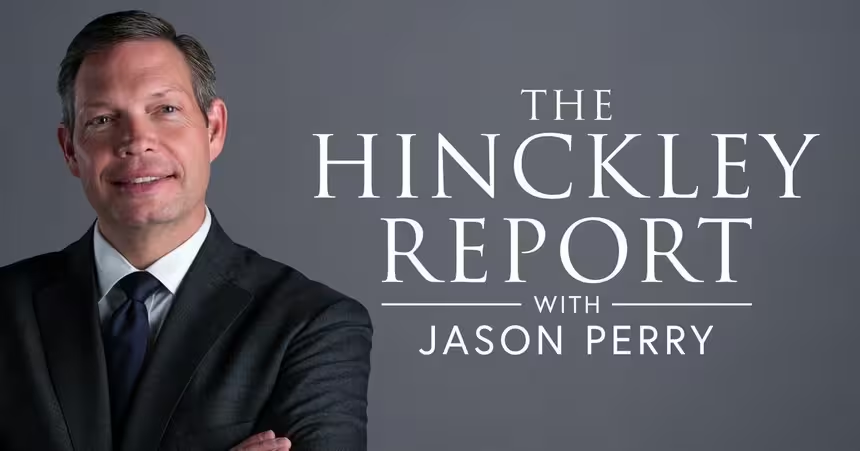
The Hinckley Report
Hosted by Jason Perry, each week’s guests feature Utah’s top journalists, lawmakers and policy experts.Providing Support for PBS.org
Learn Moreabout PBS online sponsorshipJason Perry: On this episode of "The Hinckley Report."
As the clock counts down, Utah lawmakers prepare for the upcoming legislative session.
With high stakes debates over redistricting and other key policy issues, how will Utah lawmakers shape the session?
And new polling offers a closer look at what Utah voters say matters most.
male announcer: Funding for "The Hinckley Report" is made possible in part by the Cleone Peterson Eccles Endowment Fund, and by donations to "PBS Utah" from viewers like you.
Thank you.
♪♪♪ ♪♪♪ Jason Perry: Hello, and welcome to "The Hinckley Report."
I'm Jason Perry, Director of the Hinckley Institute of Politics.
Covering the week, we have Representative Karen Peterson, a Republican from Clinton and Vice Rules Chair in the Utah House of Representatives; Grant Miller, a Democrat from Salt Lake City in the Utah House of Representatives; and Chris Bleak, partner with RRJ Consulting.
So glad to have you on the program, particularly as we get ready for the next legislative session.
It's what we're all waiting for, right?
Karen Peterson: Starts Tuesday.
Jason Perry: We're so excited about this.
It starts on Tuesday, and a lot of bills already out there.
We're having a chance to read them, and I want to get to some of those and talk about sort of what we're going to see this session.
But I want to start with one thing interesting for the public, Representative, a new building is opening on Tuesday.
Is there going to be parking and meeting space?
Karen Peterson: Oh, I hope so.
For a long time, the public has had a hard time when they come up to the Capitol knowing where to park, and they've been on the streets, and they've had to take public transit, which is a good option.
But it's wonderful to have a new building that not only will house meeting space, additional parking.
But also when we have all those fourth graders come up to the Capitol, that they can see some of the artifacts and things that make Utah special.
That will also be housed in that building.
Jason Perry: Chris, this is something even when you worked in the--you still do, but when you were Chief of Staff.
Talk about the origin of this because we've been wanting a place where the people could get, have access and a place to also park.
Chris Bleak: Kudos to Speaker Brad Wilson, who I think was really one of the main drivers on this.
I always wanted to see that building.
They had the old state office building up there, which did not fit the decor and look and feel of the Capitol.
But it's really, I think, a nice addition to it for what Representative Peterson mentioned, in terms of having a Utah museum there and artifacts and a place that we can display more about the history of the Capitol, what happens there, what goes on.
I just think it's so valuable, and I'm excited that maybe there will be some additional parking spots that you and I don't have to feud over, so.
Jason Perry: Oh, boy, it's always the struggle for sure.
And of course, Representative Miller, as Chris just said, the museum is also going in there.
That was something to where we didn't really have access to the public so well.
It was in a space that was not able to display.
Grant Miller: I must have missed the memo because all of my colleagues got a tour of the museum ahead of time.
I must've the missed the invitation because I haven't seen it yet, but I'm excited to jump in.
Jason Perry: Let's get into some of the items that will come up this session.
Representative Peterson, you've been here for a while in these seats, and it seems like there's sort of a theme, sort of a flavor of each session, the items that become the most interesting and the most sometimes controversial or must get passed.
What do you see this session, just at the at the beginning, if you see any of the signs of those?
Karen Peterson: You know, what's really interesting is, you know, I've got my survey out to all my constituents right now, and I'm getting all their feedback.
And across the board, the number one issue is affordability.
"Can I afford to still live in Utah?
Can I raise a family here?
Can I have children, and can we have a house?"
And that is going to be, I think, a big theme this session, is how are we focused on affordability for Utahns?
How do we keep Utah Utah, and how do we make it affordable for families?
Jason Perry: Representative, what's interesting to that comment is it seems like as the priorities have come out for this session, both sides of the aisle seem to have a version of this.
Talk about that and why.
Grant Miller: Affordable housing should never be a partisan issue.
We need to make housing affordable for all Utahns.
It's in our state constitution at the top.
The founding members of our state saw property ownership as so important, they put it in Article 1, Section 1, the right to possess, purchase, and protect property.
And the fact that we've gone this far, that property is so inaccessible, means that we haven't protected one of the most important rights for Utahns under the state constitution.
Jason Perry: Chris, it was interesting.
We had leaders from both sides of the aisle met this last week to talk about what the priorities are going to be.
It was interesting, this was to Representative Peterson's point, Candice Pierucci, the Majority Whip, said, "The number one issue we're hearing right now is the cost of living, and part of that is home ownership."
Talk about that, particularly the arc of that, because it seems like that is getting worse and worse.
Chris Bleak: Yeah, and there are a number of different angles on this, and it's not a simple issue, right?
There are issues and concerns around cities's power for zoning and what additional cost that adds to the price of a home.
There are concerns around property tax, which we're going to touch on, and there are some bills in that regard.
That's a component of the cost of a home.
Land is certainly going--the one challenge we have, and I think this is a good thing, the reason costs have gone up in Utah is it's a place people want to be.
People are attracted and want to live in Utah.
That is a good thing.
That is a good problem, but it does have consequences to that, including home ownership and other things that we're seeing.
And so how the legislature goes about balancing that from a policy perspective as well as a political perspective, because when the public says, Hey, "we're feeling like things are unaffordable," that's a real issue that politicians have to deal with, and grapple with, and make sure that they're recognizing how can we address that, so that the constituency feels more comfortable here, feels like we're headed in the right direction.
Jason Perry: Representative, one of those issues that he just brought up does get to regulation, which a lot of this is left at the local level.
What are you hearing from your colleagues or maybe even some things you're working on that are going to get to that particular issue?
Karen Peterson: So, one of the things that's really interesting about this is oftentimes I see the fingers pointed at cities.
And of course, they do have a role to play in how they zone and their approval process for lots and subdivisions.
But the reality is, we have thousands of lots all across our state that are approved by city councils, that are, you know, they're zoned, they're ready to go, but the issue is the infrastructure.
The infrastructure is not to those lots to make them buildable.
And to me, that's the place where the state and the city should be partnering to figure out how do we get infrastructure to these lots to make them buildable, to expand the inventory in our state, and that's a good place for government to actually get engaged.
There's always this balance of what do we want the market to do, and what do we want the state government to do.
And I think focusing on that essential service of getting water to the end of the road, literally, and opening up those lots to be buildable is a great place for us to be partnering with local government.
Jason Perry: Representative Miller, anything else that you have to say about the affordability priority on the Democratic side of the aisle in particular?
Grant Miller: Well, the difficult thing about affordable housing is you can't attain a solution to such a difficult problem through one pathway.
And so I know that we have several priorities in the Democratic caucus ourselves, and the good news is I think we have a door that's wide open to work with the majority to create some real solutions for Utahns here.
Chris Bleak: One of the things I just want to mention on this, taking the political angle, I don't want to be crass when I talk about that, but I'm always fascinated when we fight upcoming elections based on previous elections, right?
We know that the affordability issue has been front and center, both in the '24 election with President Trump, as well as the '25 election with Mayor Mamdani and others taking this affordability issue.
And I'm not suggesting it's not a real issue and that people aren't feeling pain, but it's always interesting to me how much has the news media and the conversations that have happened up to this point sort of driven the topic of, "Yeah, you know what?
Things are kind of unaffordable, and I'm feeling that."
Will that be the election issue in '26?
You know, you talked about at the beginning, what does this session bring?
Will we be talking about that at the end of the session based on what happens and where people are feeling, you know, their sentiment and the political feelings?
So it'll be--it's always interesting to me that political angle at how people are feeling about issues.
Jason Perry: Almost all these priorities really depend on the budget, and the governor has put out his budget, $30 plus billion dollars budget.
But Representative Peterson, there are some issues this session.
You know, we've heard in the past, "It's going to be a socks and underwear kind of year.
It was a reuse them kind of year."
What kind of year is this?
Put this budget into perspective, because it is less than last year.
Karen Peterson: So, the Utah economy is doing well.
We have great businesses.
We have a really robust economy here in our state, and our economy is growing.
We would have seen maybe about a $300 million increase in the state revenue this year, but with the passage of the One Big Beautiful Bill, federal policies impact Utahns and our budget.
And the impact of that bill is almost equivalent to what we would see in an increase this year, so our revenue will be flat.
So it will be a very interesting conversation this year, because all of these legislators that are coming up to the Hill and lobbyists and different groups that have needs and wants for their area of interest, there's not going to be a lot of money to go around.
And we're going to have to have a conversation about not only where those limited dollars maybe can go, but also, are we using every dollar we've got in the best way possible, and is there maybe an opportunity to reprioritize or reallocate?
Jason Perry: What are you predicting for higher education?
Asking for a friend.
You chair the Higher Education Appropriations Subcommittee.
Just, it's starting with the 5% budget cut.
I think that's what everyone's been talking about.
I'd just like to hear what you all think about that because that's the exercise everyone's going through right now.
Karen Peterson: Yes, every community is going through that exercise, and it is an exercise, right?
It is a way to just force us to think about prioritization.
Now, higher ed is very familiar with a reallocation exercise because we just went through this across the system.
And so I do think that our committee is a little bit unique in that because all of our institutions just went through this exercise where they looked at their budget and their dollars.
And I think because higher ed leaned in and was so successful, I think that's actually why you're seeing it across the system.
Jason Perry: That's excellent.
Talk about what's happening in your committees, and why this direction came out, and it is tied to where our revenues are and the cut that came from the Big Beautiful Bill.
Grant Miller: Well, Jason, I sit on the Criminal Justice Appropriations Committee, and it's hard.
It's really hard.
It's kind of like being on terrible "Shark Tank," where you have all of these really important agencies come through.
You have the Highway Patrol, you have the courts, and they're asking for very modest things.
They're asking for maintenance for patrol cars.
The courts ask for Microsoft Word Suite, things that they just need in order to do their jobs.
And then you look at the budget, and you realize the numbers aren't doing the math to fulfill those requests, and you have to make some people very unhappy when you try to figure out what you can fund and what you can't.
And a lot of times, you look at the budget and say, "It's a socks and underwear kind of year," but sometimes you've got to cut out the underwear, too, and just say, "We're doing socks," so it's really, really hard.
Jason Perry: Yeah, Chris, you've been through this so many times over the years.
I've known you when you were in the positions where you had to actually decide some of these priorities with the body.
Is it harder during a year when you have money?
Is it harder when you don't have money?
What is the approach in your experience that they're going to have to take when there are, as was just stated, a lot of really good priorities out there?
Chris Bleak: Everyone, every member of leadership always says that it's easier to craft the budget in a down year than in an up year.
I don't know if I actually believe them.
I think it's just something they have to say because it's a lot more fun to craft a budget in an up year when you are able to fund and be more creative.
But I think, to Representative Peterson's point, it will force them to look at some things.
That's really what, I believe, the 5% cut exercise is about, is looking at, have you really looked at everything that matters?
Have we prioritized correctly?
Are there places that we can get more efficient?
The governor has been talking about that, you know, ways that we can become more efficient, and so I don't think it's an inappropriate exercise.
President Niederhauser always wanted to do a zero-based budgeting for everyone, start from scratch, and say, "Let's rebuild this thing."
But it does cause some pain, and there are people out there that get really nervous.
You know, they're like, "Oh, my program is going away, or this cut is happening, or this program really matters."
And so it does cause some of that dilemma as well, and leadership and legislators have to deal with that.
They're hearing from, you know, these people that are saying, "Hey, you're getting rid of my program."
It's like, "Well, yes, maybe, no."
You know, and so there are unique challenges that come both from a good year and a bad year.
Jason Perry: Will you just take a couple of seconds on the numbers we have going into the session versus what we have at the end of the session?
Chris Bleak: Yes, so I mean, right now they have budget estimates that they are, they're starting from the projections that they're starting from.
In mid February, we'll get updated revenue estimates, and those revenue estimates, which come from a combination of legislative fiscal analysts, the Governor's Office of Planning, budget, tax, commission, others that are helping devising the best numbers that they can project forward on.
And those are the numbers that they'll ultimately use to make their final budget decisions for starting in July.
I think the one other thing to note on that is if those numbers change, that 5% exercise could look a lot different, right?
If they were revised down, it could be more difficult.
If they're revised up, you know, maybe things are a little bit easier as they move forward.
Jason Perry: I guess that's why we're doing the exercise.
Karen Peterson: That's right, that's right.
Jason Perry: Okay, can we get to some bills?
Some that are on my mind, if there's any you want to talk about ahead of time, that's fine, too.
But I would love to talk about this issue of non-competes for just a moment because we'll see one.
This is Tyler Clancy has one on non-competes, and this is non-exempt workers, students, minors, independent contractors, if you make less than $155,000.
Will you start us on this?
Because this is an issue that has come up a few different times with our legislature.
Karen Peterson: Yeah, I definitely remember these conversations happening before, right, especially around the media and non-competes a number of years ago.
That was a big deal.
So, I think that there's always this balance that we're trying to strike, and any time in the legislature we're talking about balance, right?
How far do we go, and how far do we not?
Utah is a right to work state.
People want to have the opportunity to pursue, you know, all their professional opportunities.
And at the same time, we want to be a good place to do good business.
And we have a couple of industries that are moving really quickly, AI and things that require maybe some proprietary information.
And so I think what we're trying to find that balance, right?
Making sure every Utahn can get out and market their skills and be successful in our economy, but at the same time ensuring that Utah is a good place to do business.
Jason Perry: Representative-- Chris Bleak: Yeah, I was just going to say, when I saw Representative Clancy's bill on non-competes, my immediate reaction was, "We just dealt with this issue, and we came to a good compromise."
And then I had to look up to see what year we actually passed that.
I think it was 2018.
Jason Perry: A while ago.
Chris Bleak: And I realized, you know, Representative Clancy may have been in college still when we dealt with this issue.
So for him to say, "Hey, this is an issue that matters to me," he's often taken the position of looking at workers's rights from a different perspective as a Republican than maybe the traditional Republican caucus.
Speaker Schultz, who's obviously, you know, in charge of the body, he's the one that ran that original bill, and so it will be an interesting discussion because there is a sense in the business community that this issue, we kind of put it to bed.
We agreed on some things.
We made some difficult policy decisions.
Are we really having to go through this again?
Because it was not an easy issue eight years ago.
Jason Perry: Definitely was not.
From your side of the aisle, Representative Miller?
Grant Miller: I got really excited when I saw the bill come through because right now I think we're having some issues with keeping our workforce employed.
AI has really kind of changed the game, and we have a lot of people with very specialized skill sets that could be subject to non-competes that can't find jobs where they need to find jobs.
I think that this bill has some really good ideas.
I understand and appreciate that some organizations have non-competes for a reason, and that's to protect their own industry.
But we also need to protect our workers.
We need to protect our economy, and we need to make sure that when we talk about things like housing affordability, that also includes the ability to work and the ability to make a living wage.
And so I'm enthusiastic about the bill as it's written.
Jason Perry: One of the other things we're gonna talk about a lot is literacy.
You are running a bill, Representative.
Can you talk about how you're approaching this, when we have found that less than half of K-3 students are not reading at level?
Talk about the effort there, and what your bill is going to do, and the larger efforts too, which turns out to be the legislature and the community engaged in this issue.
Karen Peterson: Yeah, so this has been a really exciting conversation to me.
Every session we see hundreds of bills around education, and sometimes I get in a moment of frustration and say, "Why aren't we just talking about we want kids to read?"
That's the thing I want to talk about, so I'm really thrilled that this session that is what we're talking about.
So, I wanna say first, we have incredible teachers in our state, all across the state.
And sometimes I think when we have these conversations, they feel like we're pointing a finger at them.
But really, it's all of us.
It's all of us.
We need our parents reading to kids before they get to school.
You know, we want kids to hear our goal is 3 million words before they come to the kindergarten classroom, right?
And so we want to also support parents in their efforts to help kids before they get to school, and then we want to make sure we have individualized plans for each student that is not meeting benchmarks early, so we can say, "Do you need a high dose tutoring?
Do you need, you know, extra help?
Do you need to be pulled out sometimes?
Do we need to extend the school year for you, so you come in the summer, and we help you not lose your progress over the summer?
What things can we do that will specifically help you as a student?"
Maybe it's also dyslexia testing.
Let's figure out what's going on with the student, so we know that we're really addressing their needs.
The exciting thing is the community has really engaged on this as well.
Private dollars are coming in to help with public service campaigns and things like that that are really exciting, and also to help us fund some of these things because they all come with a cost.
But our community knows reading is important, literacy is important, and making sure a student can read by third grade sets them up for success through all the other grades when you have to read to learn.
Jason Perry: Chris, let's talk about taxes for a second.
Over the years, we've seen, when it comes to income tax in particular, a steady decrease in that rate.
We're right now at 4.5%.
Dan McCay's got a bill to take that down to 4.45%.
Talk about that calculation because it's interesting to be having that at the same time we're talking about a flat year in the state.
Chris Bleak: Well, and one of the interesting--and Represent Peterson mentioned the reason we're having a flat year is the One Big Beautiful Bill reduced taxes.
So already, you know, Utahns, as a result of that bill, will see a reduction in their taxes at roughly $300 million.
And so I do--but I think this goes to two things.
One is maybe the affordability.
But on the income tax specifically, I think the legislature has a strong feeling that, I mean, I think most of them would like to get rid of it.
I don't know if that's truly realistic, but they want to.
They see this as an economic competitive issue, that they want to continue to push that down and really focus on that, and that will continue to be a push.
I mean, that 4.5% to 4.45% is pretty minor in terms of the overall amount, but it signals a desire to continue to tier down.
Maybe more importantly is the potential for changes in the property tax, and this is always a tax that I think is interesting because we pay this once a year.
You know, if you're paying it through your mortgage, maybe you don't think about it necessarily, but you have kind of that one-time payment that comes up, and so there's going to be a lot of focus on property taxes.
Well, how much are residents paying as a result of home valuations going up and some of these other challenges?
You know, what can we do to relieve the burden on the property tax?
Jason Perry: There is a bill on this, in fact.
Chris Bleak: Absolutely, there's a couple.
Jason Perry: Just a couple of seconds, and Representative Miller, if you could-- Chris Bleak: Yeah, I mean, maybe one of the most significant is Representative Koford has a bill that would increase the residential exemption, which is currently at 45% for primary residences, to 60%.
That would be a significant increase for primary homeowners, but it would shift a lot of that property tax burden onto commercial, onto industry, onto second homeowners.
And you know, that might be fine, but the impact of that could be those raising costs to make sure that they are able to meet their rents, and those things that come from an increased property taxes bill.
So it's that balancing act that has to go on there.
Jason Perry: Yeah, talk about that balancing act, Representative Miller.
Grant Miller: Oh, that's a trick.
I mean, here's the thing.
We're still dealing with the fallout of what COVID did to our property values, both in the residential and commercial realms.
Residentially, our housing values have skyrocketed, and commercial values have not stayed consistent with that.
But also, the use of brick and mortar locations has changed dramatically since COVID.
So if we reduce property value tax rates, that's going to help a lot of people, but that creates a deficit where we have to find that money someplace.
If it switches to commercial, we have to take into consideration the economic impact of how people who are still in brick and mortar businesses, whether or not they could foot that bill, whether or not they have to, and whether or not we're going to preserve what's left of brick and mortar commercial industry.
Karen Peterson: Can I also--that's part of this property tax conversation, is both the amount that families are paying and feeling like that crunch, but also the process we go through to raise property taxes.
You've probably heard all across the state this year, people showing up to city council meetings and to school district meetings, in a truth and taxation hearing, and feeling like they left not heard.
They felt like they went, they shared their comments, but the decision had already been made.
So this year also, I've got legislation I'm working on with the Taxpayers Association to make that process more meaningful, to make it a better conversation between elected officials and their public, so that the decision isn't made by the time the public shows up.
And that's another important piece of this conversation.
Jason Perry: Okay, I have two more items I want to get to.
Chris, this next one, for just a moment, because I know you love talking about redistricting.
There's been a lot of that, but just an interesting point, as this ballot initiative is underway to repeal the independent redistricting commission as of this morning.
Roughly 46,000 signatures on this.
But Chris, what I think is interesting here is we've done some polling, the Hinckley Institute with the Deseret News, and we asked Utahns if they would be for or against this.
Would they vote for or against it now?
And what's interesting is it was 26% said they support eliminating the independent redistricting commission, 29% said they oppose.
But the most interesting one here is 44% of Utahns said they don't know, which is not because they don't know about it, because that's what we've been talking about, but give me just some insight on that.
Chris Bleak: Yeah, when this bill, when this initiative was originally proposed, I thought it would pass overwhelmingly.
You know, 60%, 65%.
I thought it would be kind of a no-brainer.
It barely passed.
I mean, I think it was under 51%, if I remember correctly.
But it was really quite close, and there really wasn't an organized no campaign on that, which probably a number of folks regret now.
This very much could be boiled down to what is your partisan lens?
You know, in the world we live in now, do you see an independent redistricting commission as an attempt to get lines to have a Democratic seat?
Do you see it--you know, and so those partisan lenses could be really important.
I suspect that's where we will see, you know, if they're able to get those signatures, where we'll see the the campaigns really break down in terms of what they're trying to advocate for.
But it's all, it's going to be tougher to get the yes vote this go around than it would have been to get the no vote previously.
So it'll be interesting, but I suspect if they get the signatures, there'll be plenty of money flowing in on that on both sides, because it's an issue that strikes at kind of the core of, you know, democracy, and that's kind of what the courts have said as they've looked at this issue as well.
So it's a tricky issue, but does it just boil down to, you know, are you an elephant or a donkey, and you just look at it that way?
I don't know.
I'll be interested to see how that plays out.
Jason Perry: Okay, for our last couple of minutes here, I just want to talk about elections themselves.
We have an amazing number of people running for office, 285 people running for 90 seats.
Well, yours is one of them.
Can you talk about that for just a moment?
Because it's a fairly unique time in Utah.
We have great legislators like you that have done such an amazing job, and let's talk about what's happening right there, because that's a lot of people stepping down that have done so much work.
Karen Peterson: Oh, well, thank you.
It's been a wonderful experience to serve in the legislature, but I always have believed that it's something we do for a time, and then we go back.
That's how public service works, so I'm grateful for the opportunity my community has given me to serve.
What's interesting this year is I think there were a lot of efforts, organized efforts by both parties, to really recruit people into these seats.
And especially across the state, some of our third parties groups have recruited a lot of candidates, Utah Forward and others, who are pushing that number up.
There are very few uncontested races, and that's good for Utah, right?
Voters get to see the differences, and they get to hear the debates, and then they get to decide what they want, and that's good.
Jason Perry: Talk about it from the Democratic side as well, because it is interesting.
There are lots of challengers from a potential first congressional race to others throughout.
This is something we have not seen for a very long time, this kind of interest.
Talk about that.
We've got about 30 seconds left.
Grant Miller: There's a lot of energy behind what's happening behind the democratic apparatus.
A lot of seats and a lot of opportunities, and I think it's a very healthy thing for members on both sides of the aisle to run for office.
When you have seats go uncontested, you fundamentally nullify the purpose of an election.
You don't have a proper democracy when you don't have options to vote for.
Elections need to have meaning.
And when you have multiple candidates, you flex an arm of the community that you need.
It forces elected officials to knock doors, engage the community, and earn votes, and earn the right to be a representative or a senator and to be a good policymaker.
And it's really enlightening and exciting to see so much enthusiasm behind so many candidates throwing their hats in the ring.
Jason Perry: That's got to be the last comment.
Thank you so much.
Good luck in the session.
Chris, I'll see you on the Hill.
Thank you very much, and thank you for watching "The Hinckley Report."
This show is also available as a podcast.
Thank you for being with us.
We'll see you next week.
announcer: Funding for "The Hinckley Report" is made possible in part by the Cleone Peterson Eccles Endowment Fund, and by donations to "PBS Utah" from viewers like you.
Thank you.
♪♪♪ ♪♪♪ ...

- News and Public Affairs

Top journalists deliver compelling original analysis of the hour's headlines.

- News and Public Affairs

FRONTLINE is investigative journalism that questions, explains and changes our world.











Support for PBS provided by:
The Hinckley Report is a local public television program presented by PBS Utah
Funding for The Hinckley Report is made possible in part by Cleone Peterson Eccles Endowment Fund, AARP Utah, and Merit Medical.