
Congressional Races Take Shape
Season 10 Episode 31 | 27m 6sVideo has Closed Captions
Utah's congressional races are beginning to take shape. Plus, leaders weigh in on national headlines
Utah's congressional contests are beginning to take shape. Our expert panel examines how endorsements and accusations of scandal are impacting the races. Plus, Utah leaders weigh in on national headlines. Journalists Heidi Hatch and Daniel Woodruff join political expert Marty Carpenter on this episode of The Hinckley Report with Jason Perry.
Problems playing video? | Closed Captioning Feedback
Problems playing video? | Closed Captioning Feedback
The Hinckley Report is a local public television program presented by PBS Utah
Funding for The Hinckley Report is made possible in part by Cleone Peterson Eccles Endowment Fund, AARP Utah, and Merit Medical.
Congressional Races Take Shape
Season 10 Episode 31 | 27m 6sVideo has Closed Captions
Utah's congressional contests are beginning to take shape. Our expert panel examines how endorsements and accusations of scandal are impacting the races. Plus, Utah leaders weigh in on national headlines. Journalists Heidi Hatch and Daniel Woodruff join political expert Marty Carpenter on this episode of The Hinckley Report with Jason Perry.
Problems playing video? | Closed Captioning Feedback
Where to Watch The Hinckley Report
The Hinckley Report is available to stream on pbs.org and the PBS app.
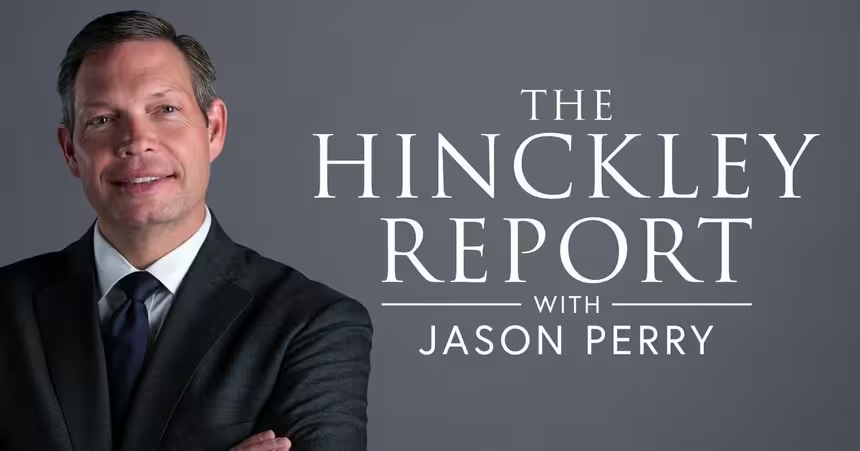
The Hinckley Report
Hosted by Jason Perry, each week’s guests feature Utah’s top journalists, lawmakers and policy experts.Providing Support for PBS.org
Learn Moreabout PBS online sponsorshipJason Perry: On this episode of "The Hinckley Report."
Utah's congressional races take shape as front runners gain traction and endorsements.
As the primary election approaches, candidates, court voters and parties prepare to hold conventions.
And Utah's leaders weigh in on national headlines.
announcer: Funding for "The Hinckley Report" is made possible in part by the Cleone Peterson Eccles Endowment Fund and by donations to PBS Utah from viewers like you.
Thank you.
♪♪♪ ♪♪♪ Jason Perry: Hello, and welcome to "The Hinckley Report."
I'm Jason Perry, Director of the Hinckley Institute of Politics.
Covering the week, we have Heidi Hatch, anchor with KUTV 2 News; Marty Carpenter, partner with Northbound Strategy; and Daniel Woodruff, reporter with KSL.
Thank you so much for being with us.
This has been a very interesting week, particularly when we start seeing what happens when politics and personal life start combining into some pretty big stories.
I want to get to one with you, Daniel, since you broke this story here in the state of Utah with our Utah Supreme Court.
It has connections to the court itself, to relationships, and also the redistricting cases itself.
Give us a synopsis of that, and we'll discuss some of the implications.
Daniel Woodruff: Yeah, so this involves the Utah Supreme Court Justice Diana Hagen, and I reported this story alongside my KSL colleague, KSL.com colleague, Bridger Beal-Cvetko, but essentially, we learned that a complaint had been filed against Justice Hagen with the state's Judicial Conduct Commission, which investigates judges.
In that complaint, an attorney had submitted it and said he had spoken with Hagen's ex-husband, who had alleged that the justice had engaged in an inappropriate relationship with one of the lead attorneys on the redistricting case which led to Utah getting a new congressional map.
The Judicial Conduct Commission investigated the allegations preliminarily, and ultimately decided not to move forward with a full investigation, which would have included subpoenaing alleged inappropriate text messages that the ex-husband says exist or doing further extensive interviews.
We submitted, over about a month, multiple public records requests to KSL to try to get this complaint to the Judicial Conduct Commission and learned what was alleged and how the folks involved responded to it.
And we were able this week to get a copy of that complaint through a public records request.
And now, with that and our reporting, Governor Spencer Cox, House Speaker Mike Schultz, and Senate President Stuart Adams have announced that they are moving forward with an independent investigation.
In a statement to KSL, they told us that they believed that the Judicial Conduct Commission and the court had not done a thorough enough review of the matter and that they felt that there were serious unresolved questions out there.
And so they've announced that they're going to move forward with an investigation.
We don't know who exactly is going to conduct it or when that's going to begin.
I will note as well, Jason, that Justice Hagen has denied any inappropriate behavior or improper behavior, so has the attorney in this case.
And in a statement to me just this morning after our story was already published, the justice defended her steps to recuse herself from cases involving this attorney.
She had said that she renewed a longtime friendship with him, but doesn't speak about anything beyond that.
Jason Perry: Marty, talk about some of the political implications of this story.
Marty Carpenter: Well, thankfully, we got this whole thing all tidied up, and then it just got messed up again, right?
This is just a story that continues to get more and more bizarre.
And every time you think, "All right, well, it's kind of in a--it's in a situation where we're going to move forward, and then we'll figure things out post-election," things get a little bit messier.
I think the bigger point that I would want to make in all of this, whether there was actually improper action here or not or whatever the investigation may play out, may show us when it's all played out, is that the public really needs to be able to trust elected officials and appointed officials, right?
Justices of our Supreme Court being very high on that list.
We need to be able to trust the process and the people we put in place, and we need to be able to trust the process to change that when we get people in there who aren't living up to those standards.
This just feels like one more hit in a never ending string of, "Man, what is going on with all in politics generally?"
And that's more my biggest concern, is that, ultimately, it's eroding our confidence in the way our government works.
Jason Perry: Heidi, talk about this trust in the institutions a little bit, because this has been a reoccurring theme even through this last legislative session.
As the legislature has taken a harder look at the courts, this is yet one more thing that they will certainly draw out for a little while.
Heidi Hatch: Yeah, and I think that's the big thing, is we want to have trust in our institutions.
You want to believe that they all have our best interests at heart, that they're doing things by the letter of the law, and I think that's the frustration.
Whether you're looking at our legislative body, our congressional leaders, our judges, we really want people acting in our best interests, and that's the frustration.
And I'll give a shout out to Daniel, that this is why local journalism matters.
I think these stories matter.
I think we deserve the truth, and I hope there's more that comes out of this, but I think that it's a growing frustration with Utahns as they see some of these problems go because then they can point to that and say, "Yeah, this is why we don't trust them, or why this case was bad, or why the judge shouldn't be picking what our districts are," and so that lack of trust is an issue.
Marty Carpenter: It also feels like we expect a little bit of politics from the executive branch or from the legislative branch.
The judicial has kind of been that sort of holy sanctuary where it's not supposed to be political, and it feels like, just as more of an outside observer than anyone involved in the fight, that there's been enough going on there that it's enough to shake your confidence a little bit.
Again, whether or not anything actually comes out of this particular situation, it's damaging just in the fact that it even has come up as a subject.
Jason Perry: Daniel, one more point on this.
Our legislature was meeting even last night.
Their caucuses were together talking about this.
From what you're hearing as a result of this, are there any new strategies that you're seeing dealing with the court that goes to the heart of Proposition 4 and redistricting itself?
Daniel Woodruff: Not really.
My understanding was that last night the Republican, the House Republican Caucus met either telephonically or virtually just to announce the investigation and to make the members aware that it was going to happen and be carried out.
Jason Perry: We'll watch this one closely.
I'm sure there will be more.
Marty, I want to talk for a moment about a similar sort of thing with our district number 16.
This is the post held by Trevor Lee, and there have been some interesting accusations this week, some former employers talking about him on the eve of the convention that's going to happen tomorrow.
The Davis County Republican Convention is tomorrow.
They'll be selecting the representative from this particular district.
Trevor Lee does have a challenger here.
His name is Bob Stevenson.
Give us a flavor for what just happened here in this story.
Marty Carpenter: Well, we always know that there's, in politics, traditionally an October surprise, right?
That someone's going to try to hit you with something that you may not have time to fully process before you vote.
In this case, we've got not a November election, but we've got some conventions and such coming up that that's sort of what this is at a very fundamental level.
Now, the accusations here that he had some improprieties or improper actions a number of years ago relating to checks, that's one that, it's the type of surprise that really can make people stop and think about how are they gonna vote because again, this goes back to have we hit a fatigue point where we're saying--especially in a convention or primary where a party's trying to pick its candidate, we're picking between two candidates, trying to pick the best one who can win against the other party in November.
So is this something that's going to be a problem for us down the road?
Is this where we want to maybe make a different decision than sticking with this particular candidate?
So it's timed to where it hurts Lee the most.
It may end up hurting him sufficiently that it ends his time in the legislature, but I think it speaks to that bigger point that--I'm interested to see in several of the votes that we have coming up, have we hit that fatigue point where we say, "I'm picking between two pretty good options.
Maybe I'll go with the one that's least problematic?"
Jason Perry: I want to get to some of these allegations for just a moment and then the response from Trevor Lee.
The allegation was on a website, right?
Heidi, I want to talk about this for a moment, where he admitted to committing check fraud in 2013.
His former bosses also accused him of using his elected position in the legislature to influence some government contracts.
Talk about it for a moment and then I'll give his response.
Heidi Hatch: Yeah, I think it's interesting that there was a website built, essentially, to out him for the check fraud that happened when he was essentially what they call a sales bro back in his college days, selling in North Carolina for Moxie Pest Control, and he had essentially changed the totals on some checks and cashed them.
And apparently there was an agreement between his employer and himself that it wouldn't go to court, and they worked something out amongst them.
That was posted online, what he'd signed.
I think the bigger problem he likely has is that there's possibly a pattern of problems that he has, where he has an employer that he was hired with just in the last couple of years where they're alleging that he was given a forward of cash up to $93,000 to $94,000, and that maybe there was some pay for play where it was like, "If you give me this money, I will try to get you a deal in the legislature and maybe a contract that would be good for your company."
Now, nothing ever came of that deal, but it doesn't look good if you're trying to take cash and trying to get someone else-- something in return.
Jason Perry: Daniel, I want to read the response from Representative Lee and get your take on it.
This is what he said in regard to the allegations.
"It is sad when campaigns resort to personal attacks when opponents can't win on the issues... But I have never shied away from the truth, and I never will.
I'm happy to talk to anyone, anytime, because my record of service speaks louder than any former lapse in judgment."
Daniel Woodruff: And that was a portion of a larger statement that he issued, and you know, there's a certain amount of persistence.
"I'm gonna move forward despite this."
But also in the statement, I found it interesting that he very readily admitted the check fraud issue.
He didn't deny that at all, and we don't often see that from candidates when they're accused of something.
But on the other allegations that Heidi brought up about this potential influence peddling or getting government contracts, he flat out denies that and says it's false and accuses the employer, his former employer, of trying to go after him.
And they did have a lawsuit in court that all the parties agreed would be dismissed, so there's a lot of things going on.
I imagine more will come of this.
In fact, House Speaker Mike Schultz says there will be more to come because they're going to look into this.
Jason Perry: Yeah, let's read that response from Mike Schultz, Marty, and then I want to get into the strategy around this.
This is the response from Speaker Mike Schultz.
He said, "We are carefully reviewing the matter and will follow the appropriate process to determine the facts and any next steps.
Allegations of this nature involve a sitting legislator are taken seriously."
Marty Carpenter: And that's something that, as the Speaker of the House, he needs to ensure happens, right?
Partly because, politically, his job is to protect the PAC, not necessarily one individual member of the PAC, and so you want to sort of protect the overall Republican brand within House leadership and in the House majority, so they have to take those steps.
They have to do it.
I think it's interesting from the statement that was issued there by Representative Lee, good to take responsibility for it.
I think that's, you know, "Hey, this did happen."
But to sort of sweep it away quickly--the statement was about as good as I think you could have asked for.
I just wonder if it's enough for the people who are gonna have to make a decision on voting for him, specifically the delegates, to say, "Are we starting to see enough of a pattern here?
And what we want to do is make sure we hold, you know, hold this seat and that we have the right person there."
So it'll be interesting to see how they--how it factors into their decision.
Heidi Hatch: And they don't have a lot of time to think about it, and I think that's the interesting part, maybe why it was dropped, that he doesn't have a lot of time to make his case, that it was just that October/April surprise they got, yeah.
Jason Perry: But Daniel, it's interesting, not much time to make the case, but he did not get signatures, so his fate is in the hands of some people in the very near future.
Daniel Woodruff: The Davis County Convention tomorrow, and then his challenger, Bob Stevenson in the Republican Party, did gather signatures, so he's already on the primary ballot.
So if Trevor Lee wants to try to continue his political career, he needs to get out of the Davis County Convention.
Either way, he'd have to face a primary election.
Marty Carpenter: It also tells you this October surprise, this mid-April surprise is going for the kill, right?
This is the chance to eliminate your opponent.
If you're Stevenson, getting rid of Lee, you can basically end his candidacy if this works.
And if not, it's just one more thing that's in your favor going on in the primary.
Jason Perry: Is your assessment this is largely connected to just politics and timing, then?
Marty Carpenter: Oh yeah, like I don't think there's any reason to suspect that these things are happening organically right now at this time.
I'm not saying that it came from his opponent's camp.
There are a number of people outside of a campaign who will oppose a particular person, so I wouldn't say, "Oh, it's definitely coming from the campaign," but the timing on it certainly aligns with.
Daniel Woodruff: Can I note, too, the allegations are not anonymous.
These businessmen put their names to the allegations.
They're on camera saying what they're saying, so that stood out to me.
And you know, whether or not it came from anyone else, but I did find it interesting that this is an on-the-record, non-anonymous complaint or allegation that is not simply just floating around, but actually has names to it.
Marty Carpenter: I'll just throw this out there from a campaign and communication standpoint.
A written statement is you do that for one purpose, right?
This, "I want to keep it very concise and do this."
I would have probably recommended to pretty much anybody in a situation like this, but probably particularly in this case, do something on camera where you've got two minutes to say, "I'm going to explain what happened.
I'm gonna have that denial right at the top, and then I'm gonna walk you through my position on this," and do it in the second most personable way you can, a second to face-to-face, in person, to doing it on camera.
Jason Perry: Okay, I want to get to a couple more controversial sorts of things happening in races.
Heidi, I want to get to the 1st congressional district.
For this race that's happening right now, some interesting developments this week.
Senator Kathleen Riebe announced that she is withdrawing from that particular race, but endorsing Ben McAdams.
Heidi Hatch: Yeah, so some consolidation in the race.
That happened last week, and we thought maybe that was going to be the biggest thing headed into convention.
But as soon as she backed Ben McAdams, we had this bomb dropped on Nate Blouin, which is even bigger in the race, and so it'll be interesting to see how all this shakes out, if it's just in the news cycle for a couple of days or if it lives a whole lot longer.
Jason Perry: Yeah, so Marty, is this the kind of thing that just a couple of news cycles?
Describe what just happened here because-- Marty Carpenter: This happened right now.
Jason Perry: Because it is, so talk about what just happened right here because there are a lot of text messages, not text messages, posts online from Nate Blouin from his 20s that had a lot to say about Utah and other things.
Marty Carpenter: I would start by saying this: I don't think anybody had a better week in Utah politics than Ben McAdams.
He picks up a key endorsement.
He gets an opponent out of the race, and then on top of that, this bombshell drops on probably his biggest challenger for the seat.
What's interesting to me, and I'm not going to say that I'm an expert on the Democratic side of the politics, like I have much more experience on the Republican side, I would think that to win a race in that district, even though it leans heavily Democrat, that you're gonna find a number of people in there who are Democrats, but are also members of the LDS Church and who are also maybe sympathetic to, "I don't like people talking about my LDS neighbors in this way," and/or, "I'm just opposed to this type of politics and these types of posts," even if it was something that happened a while ago.
Of everything that's happened this week and all the scandals that we're gonna probably cover during this episode, that's the one that I think is the biggest, potentially the most damaging.
And the one thing I think that the Democrats should really be thinking about in that district, considering all that's gone on with Prop 4 and all that's gone on with making that district a more heavily favored for the Democrats, be very careful about the type of Democrat you pick here because we're not done with the redistricting on this, and we may end up with another seat and have a whole another round of this after the next census as well.
So, who do you want there?
Do you want to go out and get a Democrat who's much more palatable to even Republicans in the state or one who's a total firebrand and going to say, "We've got to change something?"
You're going to get more people fired up about changing what Prop 4 changed if you go hard left than if you stay sort of down the fairway with Ben McAdams.
Jason Perry: Yeah, Daniel, talking about this, what kind of Democrat would they pick in this district, it was interesting what Riebe said about this.
She said that "Ben is not my ideal choice.
I am, but instead of making it harder, I'd rather see a clear path for a successful statesman."
That's very interesting, particularly considering her former colleague.
Daniel Woodruff: Current colleague; they're in the Senate right now.
Jason Perry: Not running again, but.
Daniel Woodruff: The whole caucus came out against Senator Blouin on this.
Multiple Democrats have called on him to step aside from the race.
He has not done that.
He said he's going to stay in, but these posts that he was accused of making and admitted to making involved crude, derogatory comments about Latter Day Saints, about victims of sexual battery and other things.
And Nate Blouin did apologize for it, but this is certainly a major impact-making move on the campaign.
Jason Perry: I just want to give a chance to give the response, Heidi.
I'll read the response from Nate Blouin, and then give us a response as we get ready to move into another congressional district.
This is what he wrote.
"There's no excuse for these posts.
They're vulgar, stupid, and reflect a version of me in my early twenties that I'm ashamed of and have thankfully evolved past.
I won't minimize what I wrote, and I believe every candidate forced to look at their old online activity should take full accountability for the person they once were behind their computer screen.
To the people I hurt with my words, I sincerely apologize."
Heidi Hatch: I think we can all appreciate that he gave, I think, a very good apology here, too, where he didn't say "but."
He just apologized for it.
The question is, did he apologize for it and change?
And if you follow him on social media, I don't know that he really has changed.
He does a lot of trolling online.
And when you look at politics, this is really about addition.
Who can you bring in amongst the fold?
And when you talk to his Senate colleagues and you talk to other people who work with him, I have not personally met anyone who backs him who enjoys working with him, and so you at least want your Democratic colleagues on your team.
And better than that, you wanna be able to work across the aisle.
He doesn't work across the aisle, and he doesn't work well with the kids that play in his own group.
And so I think that's gonna be the bigger problem, is if he can't show that he can work well with others, that he's gone beyond this, and that he's not just on there to drop bombs on social media, he's his own problem right now.
Marty Carpenter: The cardinal campaign sin here is that he didn't get out ahead of it.
He's playing defense now.
And if he would have come out ahead of time and said, "I want to say as I'm declaring my candidacy that I've grown up so much in the last number of years.
I've said some things online in the past that I'm sure my opponents will bring out.
And I, you know, I disavow those ahead of time."
That would be on the offense.
Now he's playing defense.
You're in a worse position if you're apologizing for getting caught for something than you are about admitting it beforehand.
So the fact that they weren't-- that he as a candidate wasn't ahead of this is essentially campaign malpractice.
And again, no surprise on the timing and when it pops out.
And I would also say, if now is the time, right?
You've been hit with this, and you better either rip the band-aid and come clean on everything, or you're just gonna get hit with this drip by drip by drip the rest of the way that you're in it.
Jason Perry: Daniel, just interesting kind of through the news hat here.
He has qualified with signatures, so he's gonna be on the ballot, and so just kind of talk about what you see coming from the people you're talking to because this is a story that could linger a little longer than the other one, which is by the weekend.
Daniel Woodruff: And it really depends on who forgives him, who thinks it was a mistake of his early 20s, and who shows up to vote, right?
The primary election electorate is usually a little bit different than the convention, and it really depends, Jason, on who shows up to vote, which campaigns can turn out that day and make a difference, because you're right.
The signature path allows these candidates to go to convention, make their case, but ultimately, they are going to be on the ballot in June.
Heidi Hatch: I was going to say, I think that even a couple of weeks ago he probably had the luck of having maybe a Bernie or AOC fly out here, throw a rally, get more people behind him and excited, because we've seen in presidential elections that sometimes that Bernie Sanders has a lot of pull here and that there's a group that could get behind him.
He's not going to have that anymore, I don't think.
We'll see.
I mean, it'd be surprising if they showed up for him at this point.
Jason Perry: Yeah, Marty, let's talk about the 2nd congressional district.
This is the northern part of the state of Utah now.
Congressman Moore being challenged by several candidates, including Karianne Lisonbee.
Talk about what's happening right there, because it's this interesting back and forth about Proposition 4 itself, the very issue that gave these lines the new districts.
Marty Carpenter: Yeah, and it stems from the Lisonbee camp and others trying to pull more into the, essentially, putting him in a position of blaming him for that, which I don't think is gonna hold up upon much inspection from people, that he, you know, when he said the things that he would have said on it, it was more of a push to say, "Hey, I think we should go through a process and get to a constitutional amendment to figure out the best way to go about this."
But ultimately, being in a position where the legislature still holds the authority they hold in the process to make those determinations.
I don't think it's going to hold up, primarily because I think it's hard to take the highest elected member of House leadership from our state, or from congressional leadership from our state, and say, "Oh, what he really wants is to get more Democrats."
Clearly, that's an argument that, if you take it one step past the initial accusation, just doesn't hold water.
So, I would also mention this, there are stages to these races.
And in convention, this may really help Lisonbee.
But the game for Blake Moore is not the convention.
It's the primary.
Sure, he'd love to end it at the convention if he could, but in a primary, I think you get a broader group of Republican voters, most of whom are not as--either not as fired up about Prop 4 or maybe not even on the side that most of the more ardent Republicans are on Prop 4, and ultimately, I don't think it has a factor in him getting reelected.
Jason Perry: Daniel, I'm curious what the people you're interviewing, what the endorsements mean for people, because it's interesting because Congressman Moore, it's President Trump, Speaker Mike Johnson, congressional leaders, President Stuart Adams, Jerry Stevenson on one side, and for Representative Lisonbee, it's a lot of the House Leadership from Mike Schultz down to the majority leadership.
Talk about what that means in context for those two candidates.
Daniel Woodruff: Most of the House Republicans have endorsed Karianne Lisonbee, and that's unusual, right, for them to go against an incumbent.
And Marty brought up Blake Moore's status in the House leadership in the US House of Representatives.
Karianne Lisonbee has been in House leadership for a couple of years.
And when she became majority whip, things went a little bit south for her.
Her tenure as whip was rocky and short-lived.
She was widely perceived to have a difficult relationship with the Senate.
And ultimately, when she tried to become House Majority Leader in the Utah House, she was rejected, and they elevated somebody else.
And so she went back into kind of the pool of lawmakers, but interestingly, that doesn't seem to have had any effect on her ability to garner support from Speaker Mike Schultz, the other leaders in the House.
And many, most of her Republican colleagues have come out in the House and supported her.
That is not the case in the Senate.
Only a few Republican senators have done that.
So, whether this is, "We're showing support for a colleague and a friend whether or not she wins or not," is one thing, but she has definitely been able to garner a lot of traction that way.
But many argue that probably doesn't matter when primary voters go and punch the ballot.
We'll see.
Marty Carpenter: Yeah, Blake Moore has never won a convention, but he's obviously never lost a primary or a general election, so I wouldn't read too much into whatever happens at the convention.
I would actually, if I'm putting my money on it, I'm saying they get to a primary, and then it's a victory for Moore, probably running away.
Jason Perry: Okay, Heidi, I want to talk for just a moment about the 3rd congressional district and this race, Congresswoman Maloy and Phil Lyman.
But one of the interesting dynamics of this week is, one, the fundraising, Celeste Maloy raising a lot.
Phil Lyman says he's concentrating on other things, but behind that also, neither one of them has submitted any signatures yet.
So this is a very interesting race that, right now, it may be with the delegates, but maybe.
Heidi Hatch: Yeah, it could be a hard-fought battle.
Celeste Maloy definitely has the opportunity of having more money.
She's the incumbent here, but she won in convention in, I think, a pretty hard-fought battle, if you remember back to how it happened.
So the question is, what's going to happen there?
They were both working on signatures.
Phil Lyman was touting that he was doing a grassroots and the clean way.
He wasn't paying for signatures.
Celeste Maloy was gathering.
There's still a slight chance that she could make it past that number mark of 7,000 that she needs because they're still counting, but she was at 4,500 as of today.
So yeah, she may not have any promises here, and then who wins at convention?
And that's the big question, is what's going to happen there, this inner-party fight?
Jason Perry: Okay, one more issue, kind of goes to the fighting and the political speech itself.
Marty, will you take for just a moment this Utah Valley University?
It's just an interesting way to end it, talking about political speech itself.
They had a commencement speaker scheduled.
It was Sharon McMahon, an educator, sometimes referred to as America's government teacher.
Some posts connected to Charlie Kirk that has left UVU with no commencement speaker.
Talk about that for just a moment.
Marty Carpenter: Yeah, I always think these are such interesting controversies to have because it's someone speaking at a convention, and this could be a funny actor, or it could be someone you've never heard of who graduated from the institution.
And so the first surprise to me is that you would invite anybody who would not be 100% squeaky clean, where you know like, "Oh, this--everyone's gonna be in agreement that this is gonna be a good speaker."
So it's unfortunate that it even became anything.
I think we want to get to a point, generally, where we invite people to come in and speak, and they, A, can come in and share their perspective, but, B, we can do it in a way where they're not trying to necessarily indoctrinate everybody one way or the other.
I do understand though, for UVU, obviously, with what happened in the last year on that campus that you'd want to be really careful about this, and I think they've probably taken the right step by saying, "Let's just move on with something a little less controversial right now."
Jason Perry: Dan, you covered all these stories, particularly connected to Charlie Kirk itself, too.
A comment in our last few seconds there about political speech itself and the scrutiny that it's under, wherever you're coming on the spectrum.
Daniel Woodruff: On the one hand, you hear people saying, "Charlie Kirk was all for free speech."
On the other, you hear people saying, "This is still a very emotional time, and there are just a lot of feelings."
Jason Perry: What are you hearing from people you're talking to, Heidi?
Heidi Hatch: I think that's the issue, is that I don't think they're against her speaking on campus.
It's all about time and place.
And if I take off my journalist hat and I put on my mom hat, my son, like many others, thousands of other students were there.
He was standing feet from the stage where Charlie Kirk was shot and killed.
It was emotional.
I think it's been a difficult year on campus.
And I think as a parent looking at this, my son's not graduating this year, but if it were his graduation, I would want the most uplifting, forward-thinking graduation that doesn't get into politics at all and just try to make the kids feel good about moving forward in the world and their place in it.
And so I think that maybe it was just a misstep in thinking about when.
I think maybe two, three, four years down the road, it would have been a different decision.
Jason Perry: So, I'm sorry.
Thank you for that.
It's going to have to be the last comment.
Thank you for your insights this evening, and thank you for watching "The Hinckley Report."
This show is also available as a podcast.
Thank you for being with us.
We'll see you next week.
announcer: Funding for "The Hinckley Report" is made possible in part by the Cleone Peterson Eccles Endowment Fund and by donations to PBS Utah from viewers like you.
Thank you.
♪♪♪
 New Episode
- News and Public Affairs

Top journalists deliver compelling original analysis of the hour's headlines.
 New Episode
- News and Public Affairs

Today's top journalists discuss Washington's current political events and public affairs.

 New Episode
 New Episode
 New Episode
 New Episode
 New Episode

 New Episode
 New Episode
 New Episode
Support for PBS provided by:
The Hinckley Report is a local public television program presented by PBS Utah
Funding for The Hinckley Report is made possible in part by Cleone Peterson Eccles Endowment Fund, AARP Utah, and Merit Medical.