
Analyzing Utah's "Blue Wave"
11/6/2026 | 26m 47sVideo has Closed Captions
In the shadow of a national political shift, we examine what's influencing Utah voters.
The 2026 midterm elections are propelling Democrats toward potentially historic gains in Congress, but what is the story in Utah? Our expert panel digs into the results, examining why voters rejected expectations and how the state's political map is changing. Journalists Heidi Hatch and Max Roth join political insider Glen Mills on this episode of The Hinckley Report with Jason Perry.
Problems playing video? | Closed Captioning Feedback
Problems playing video? | Closed Captioning Feedback
The Hinckley Report is a local public television program presented by PBS Utah
Funding for The Hinckley Report is made possible in part by Cleone Peterson Eccles Endowment Fund
Analyzing Utah's "Blue Wave"
11/6/2026 | 26m 47sVideo has Closed Captions
The 2026 midterm elections are propelling Democrats toward potentially historic gains in Congress, but what is the story in Utah? Our expert panel digs into the results, examining why voters rejected expectations and how the state's political map is changing. Journalists Heidi Hatch and Max Roth join political insider Glen Mills on this episode of The Hinckley Report with Jason Perry.
Problems playing video? | Closed Captioning Feedback
Where to Watch The Hinckley Report
The Hinckley Report is available to stream on pbs.org and the PBS app.
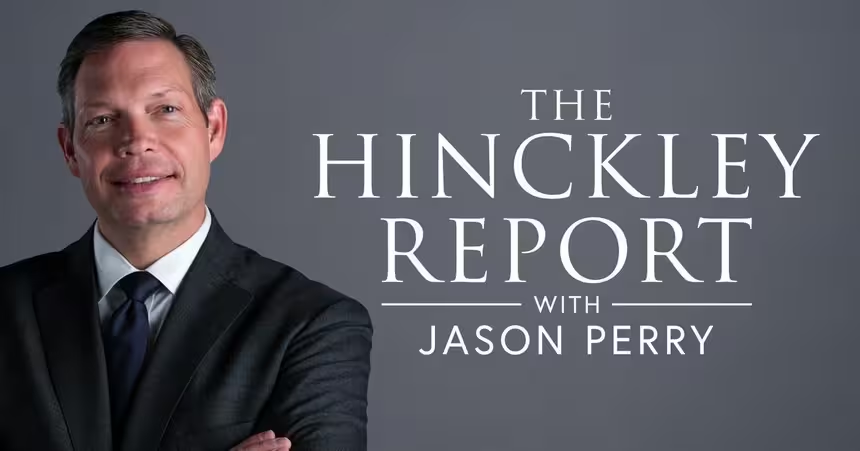
The Hinckley Report
Hosted by Jason Perry, each week’s guests feature Utah’s top journalists, lawmakers and policy experts.Providing Support for PBS.org
Learn Moreabout PBS online sponsorshipJason Perry: On this episode of "The Hinckley Report," our panel reacts to the historic midterm election results.
What were the major issues influencing voters?
What will the changes in Congress mean for Utah?
Were there any surprise results?
And how did voters react to proposed changes to our state constitution?
announcer: Funding for "The Hinckley Report" is made possible in part by the Cleone Peterson Eccles Endowment Fund, and by donations to PBS Utah from viewers like you, thank you.
♪♪♪ ♪♪♪ Jason Perry: Hello and welcome to "The Hinckley Report."
I'm Jason Perry, director of the Hinckley Institute of Politics.
Covering the week, we have Heidi Hatch, anchor with KUTV 2 News; Glen Mills, a political expert and analyst; and Max Roth, anchor with Fox 13 News.
Thank you so much for being with us.
This is the show after the election.
Glen Mills: What a week to be here.
Jason Perry: I can't even believe it.
That's why we've got the three of you.
I know none of you are sleeping.
All of you are putting refresh on your machines, minute after minute, hour after hour.
I know you're all staying up late.
I want to talk about what happened.
Let's get into the election results, not just what the results were, but why.
And Heidi, let's start with you.
What happened?
This is so different than what many expected.
Heidi Hatch: This is crazy from a national level and the blue tsunami to what's happened in Utah, which I think a lot of us didn't expect on the level it did.
It comes, I think, from a lack of humility from Republicans, from the top down, not admitting when they were wrong, saying, "We messed up, we're sorry, we're going to fix that."
I think that would have helped a lot of things, but things kept going in the wrong direction, and President Trump from the very top saying, "It's okay, those gas prices don't hurt that bad.
It's, you know, it's going to be fine," and not realizing what people at home were dealing with.
That was the wrong move.
Jason Perry: Yeah, so Glen, we talked about this blue wave.
It was--maybe that's even an understatement as to what happened, and I want to get to what happened nationally, but it had impacts even here in the state.
Talk about what Heidi just mentioned and the issues that seemed to motivate voters.
Glen Mills: Yeah, so coming into the election, both history and circumstance told us that there would be a shift, but the magnitude of this shift is really what caught us by surprise.
This is such a seismic impact that it really took effect in areas that are Republican strongholds.
When you're looking at a race in Provo, Utah, where a longtime Republican incumbent is likely going to lose that race, that just sets the tone for exactly what happened.
Now, when it comes to what was motivating voters, I really think it was more about a failed message than it was a successful message.
What I mean by that is when we take a look at the polls both across the country and here in the state of Utah, there were a lot of things motivating voters.
We have a perception of corruption and personal gain.
There's an unpopular war that seems to be never ending going on in the Middle East, skyrocketing and out-of-control spending and inflation, and as Heidi already alluded to, gas prices and prices at the grocery store that are really forcing people to make tough decisions.
Voters took a look at that along with--you you mentioned that the president's message was out of touch with that, voters looked at that.
They said, "No, thank you," and they emphatically rejected it.
Max Roth: And Glen, I agree with what both of you said, and the one thing that I might change the nuance of is I don't think it was so much a messaging thing as it was more of a core thing, and that's really what you were getting at in talking about all of those issues as well, but that there's some core anxieties, and if that is the general mood of the whole population, and those are financial, and they're about security, they're about our children and how are they going to do in the future, those sorts of things.
And then just the general direction of the country.
If there's a core anxiety there, then you have to work hard to try and fight against that tide.
Jason Perry: So Heidi, I'm kind of curious, putting all this into perspective right there, was this a change of heart and mind of who showed up or just a change of who showed up?
Heidi Hatch: Well, I think it's interesting of who showed up.
When we look here specifically in Utah, it looks like only half the electorate showed up.
The people who showed up were mad, and I think they were specifically voting against President Trump.
In some races they may have been specifically voting for the candidate on the opposite side, those Democrats, but I think a lot of it was just a protest vote saying, "I don't like what's happening.
I want to go in the opposite direction."
And I think we saw that in the primaries here in Utah, where we're throwing out longtime Senator Stuart Adams, the president.
And so I think a lot of people thought legislatively we were over that, but I think data centers and other issues had a lot of people here in Utah saying, "I'm throwing it all out, baby, bathwater, all of it, you're all gone."
Max Roth: And I think-- I think that also there was probably an underprediction of where Utah's swing districts are because there are places in Utah that can swing to a Democrat in certain situations, and those places appear to have gotten a little bit more that way, so they're more purple than they were light red, you know, pink I guess, and anyway, I think--so what we saw is some of the districts that have historically elected a Democrat every now and then, they all went to Democrat.
Glen Mills: I agree with that, but I don't think we can minimize the fact that both independents and even Republicans chose to vote against Republicans in this cycle.
Jason Perry: Yes, Max, maybe break that down a little bit too, because it is interesting for the kind of victories that we saw here, not just nationally, but even in Utah, it required a whole lot of independents and required Republicans to vote for Democrats.
Max Roth: Yeah, you know, I was thinking about that this week and wondering as I saw the results in all these races, Ben McAdams won by a far bigger margin than any of the Republicans.
The Republican winners had--were much tighter races than McAdams's race.
So the Democrats must have been thinking, looking at that, "There are a whole lot of votes that we could have, you know, that could have gone into these other districts."
So the Democrats were fighting to get that blue district, got it, but if you take precinct by precinct, the results in every single precinct, Democrat and Republican, and put them in the old map, the Democrats would have won two seats.
Jason Perry: Explain it.
You've done some great reporting on that.
How does that break out?
Because it is an interesting point.
Max Roth: It's--so in the old map, you had some districts that were occasionally getting kind of close.
District 2, remember, with every now and then in a Democratic year that would get closer and closer.
Well, this year, if the precincts remain the same, no matter whether there's a--you know, as the districts change, they just shift the different precincts into those, and so the precincts are permanent.
You can look at those numbers and say that down the line, raw numbers, Democrats would have won two, and the other two would have been very close.
Heidi Hatch: Voter turnout probably would have been much higher too.
I think if you would have had two competitive districts, you would have had more people caring, showing up, and had more active debates.
So I think it was a losing situation.
Glen Mills: And another interesting numbers point from the congressional districts.
If you take the four districts and add up all the votes for the Republican and the Democratic candidates, there's only 8,000 votes that separate them as of Friday morning.
And that's about 147,000 more votes for the Democratic candidates than there are active registered Democrats in the state of Utah.
Jason Perry: Back to the potential districts too, Max, explain just a little bit here too, because you're talking about the maps that the legislature wanted.
Max Roth: Yeah, yeah, so if the Republicans got what they wanted with the maps, they might be looking at a disaster for them today, because they could have lost two districts, they could have lost more.
I mean, as Heidi was mentioning, you know, you don't get a lot of funding for--as a Democrat in Utah, if you're not in a Salt Lake City-based district.
Heidi Hatch: Yeah, we saw Blake Moore's race and Mike Kennedy's race just barely called yesterday too, and I think probably a lot closer than they would have liked, where we saw the Democratic candidates performing a lot better than we would normally see too.
So I think it's probably scared Republicans and made them think twice.
The question is, are they going to take this and use it as a time to reflect, to listen to people, see what they want, or will they just keep barreling down the road with what they're doing?
Glen Mills: In District 2, Representative Moore won by about 8 percentage points.
There were three candidates, one unaffiliated and two third-party, that made up that difference there, pretty close to it anyway.
Jason Perry: Very interesting.
Break down these candidates a little too because, you know, Max, when we look at these congressional districts, there weren't any surprises right now in terms of the outcomes necessarily, but I want to talk about the candidates and how the impact of that redistricting really sort of rippled through the rest of the state.
Max Roth: Well, a couple of things, Celeste Maloy.
She was hanging on by a thread with the--in the old districts, you know, it was so close with primary challenges and those sorts of things, and she was the easy winner among the Republicans.
She won by, I think, a 23-point margin, something like that.
And that--this new district is a lot safer, and then you have someone like Blake Moore, he's the guy who's worked his way--similar to what we see in Utah, you know, with Kirk Cullimore in the Senate losing, who was the majority leader.
But on that national level, Blake Moore was the fourth or--is the fourth or fifth, yeah, he's the House caucus leader or whatever that is.
And so for him to be challenged like that, that's an institutional-- anti-institutional vote.
Heidi Hatch: Yeah, I think a lot of that may have to do with Box Elder County, and I think the data centers and the AI fight, which really kind of started to grow in Box Elder with the Stratos data center, it spread across the state, and I think it's become one of the top concerns locally here on the legislative level, and I think it spread to our congressional districts too, people saying, "Hey, you're just not listening to us, you're making moves before you even talk to us about it."
Glen Mills: And the funny thing about that is it wasn't even on the radar not that long ago.
I remember the last cycle, the primary cycle, we were starting to gear up for the debates and at the time weren't even thinking about data centers, and by the time the debates rolled around maybe three, four weeks later, they were the lead question in all of them, so that really came out of nowhere.
Max Roth: And I think they came to represent something, and I think that the data centers in and of themselves are--it's a big issue and a serious issue, and voters are reacting to that.
But also if you have this kind of discontent and this fear that politics is working against you, and then suddenly, an industry appears out of nowhere, I mean, AI--it blew up so big within the last two years that all of a sudden there are these huge things you can see, or you would be able to see if they were there, taking up a footprint in your community, and you're thinking, "What is that and who decided it was going to be there and who said it was okay and who's really making the money?"
Jason Perry: I want to get to these districts, the first congressional district in particular, because Ben McAdams won by a pretty large margin.
The question about how blue that district is, Heidi, is it's very blue.
Heidi Hatch: It is very blue right now.
I think he's winning by right now 72%, 73%, which is even more than I think a lot of people expected.
On election night, Brian King with the Democrats was saying, "Hey, I hope we can turn four seats," and you can see how many people turned out for that race.
And when you look at the entire Salt Lake County map and kind of bleeding north and in south into Utah County, all of these legislative districts, I think largely because of that District 1 turnout turned blue, the entire map there.
I think there's one little red dot maybe in West Jordan that's left.
So that CD1 race, I think, was very influential in what we saw in the election turnout down to our local races.
Jason Perry: Yeah, Glen, break that down just a little bit because it's such a good point because you don't always think about what happens to all those House races and the Senate races in the state when you have a very blue district with a lot of highly motivated people that did show up.
Glen Mills: Yeah, so if Brian King's goal is to flip four seats in the House, he did more than that just in Salt Lake County, it appears.
Yeah, this was a very good night for Utah Democrats.
We haven't seen this type of seismic shift in the legislature for several decades.
We are looking at eliminating the supermajority, and another interesting point about this is it's not only Democrats that are winning the races, there are going to be two unaffiliated representatives taking seats, it appears, in the Utah legislature.
I don't think we've seen that in some 90 years, so that kind of goes back to our point though that it's not necessarily that the Democrats were coming out with this winning message that everyone was getting behind as opposed to the Republicans, it being a bad night to be a Republican because even in the races where there was no Democrat and there were two unaffiliated voters going up against Republican, one was an incumbent, one was an open seat, but they're going to win, it appears as well.
Max Roth: Yeah, you know, the biggest winner in all of this wasn't on the ballot, probably it was Spencer Cox because when you look at how much power the governor wields in Utah, he wields a lot less when there's a supermajority.
His vetoes can now hold where they wouldn't before, and when he goes into a bargaining, you know, place with the House and Senate Republicans, he can hold a whole lot more sway.
Jason Perry: Yeah, so that is such a great point because for a very long time right now the legislatures say, "You can disagree, but we'll just override that veto."
Heidi Hatch: Yeah, and it's been radio silence.
I haven't heard anything from the governor so far.
I'm interested to see what he has to say about it, and I think there has been a good working relationship between Governor Cox and the legislature, and I think some of those working relationships are going to shift.
A lot of these people that we see that have worked across the aisle, maybe more centrist Republicans, Ken Ivory in Salt Lake County.
You're looking at Kirk Cullimore, who we knew was going to be possibly a Senate leader, Steve Eliason, a lot of these people that I think were working with the administration are no longer going to be there.
So there are going to be new dynamics that the governor's going to have to work with if he doesn't have the supermajority.
I think everyone's going to have to figure out how to play nicely and actually work on issues together in a way they haven't had to do before.
Glen Mills: Another interesting point to that is you take a look at the Republicans that are likely to lose their seats, most of those are the ones who were willing to cross party lines, so you're taking a look at replacing them, but these were the ones that were willing to reach across party lines, get reasonable things done for the people of Utah.
Max Roth: We should also remember, though, that these are local races, and so you can swing these districts by effort far more easily than you can with a congressional district.
And so when a House district flips--I actually live in Kirk Cullimore's district, and both my senator and my representative flipped this time around.
It's an unusual thing, but every now and then happens.
But you know, I had door knocks from the candidates themselves, and that's how I met my local candidates, and I think we--that there's still a local factor in these elections, that's not all about, you know, the wave.
Jason Perry: What do you think changed the tide in that particular district, since it's yours and that Senate district for Senator Cullimore has part of Utah County, smaller part of it, and a big part of Salt Lake County?
Max Roth: Yeah, you know, it's a little bit on the east side towards Cottonwood Heights, and so it's always been a population that includes people who, you know, want to live there because they're close to the ski resorts or that sort of thing, and then a very traditional Utah suburban population.
And I think that what we've seen there is that it can swing.
With one of the Obama waves that brought in Democrats, the Speaker Greg Curtis was our representative in that district, the House Speaker, and he lost the race while being the sitting House Speaker in a wave.
And so Utah has these districts where people are willing to consider both sides, not that people aren't in other districts, but there's enough of a coterie of people who can do that.
Glen Mills: Especially on a night where, as I alluded to earlier, long-term Republican incumbent in Provo is going to lose to a Democrat.
Those swing districts are definitely going to come in play.
We've alluded to what the impact of the Cullimore race is, but I think this is really worth diving into a little more.
He was on the verge of becoming the most powerful person in the Senate.
If not this cycle, certainly down the road.
And he, it appears, is going to lose his election and not even have the seat anymore.
In addition to that, Senate President Stuart Adams lost his primary.
I'm not sure we've seen a sitting Senate president lose their primary in the state of Utah.
Heidi Hatch: Yeah, I think it shows how angry people are because when you look at the primaries, they get rid of the sitting Senate president and the person who's most likely to take that, that they're gone.
So the question now is that as these new people fill this void and come in, do they take their opportunity, whether it's new Republicans, mostly new Democrats right now, they have two years to figure out if they can make moves that will keep them there or if they squander that chance, because two years is a long time.
The question is, can they accomplish things that people want to keep them for?
And I think that's the big question is what happens with this.
Another interesting thing is I think we've had centralized power along the Wasatch Front for quite a long time.
I think with some of these new leadership elections we could see that spread out across the state, which I think might be good for some of these other counties to see people in our rural districts that are now taking those positions of power, so that'll be interesting.
Max Roth: And you all know as well or better than I that the reason a state legislature is so interesting is because they have to do stuff.
They have to--there's no--it's in the law that they have to have a budget at the end of their session, they have to fund the schools, they have to do all these things.
There's no such thing as a continuing resolution like we see at the federal level to just, you know, carry on from last year's numbers, and so whoever is in leadership, they're gonna have to work with the new folks and they're gonna have to get things done, and the Republicans still have a big majority, just not a supermajority.
Glen Mills: I just want to hit on one other point on both the local and the national level.
It is definitely a point where you now have to deliver.
If you had a successful election, you need to deliver, and we live in a time where the extremes have a platform where their voices can be amplified.
I, however, still believe that the majority of Americans and the majority of Utahns are more moderate, and they expect reasonable solutions for the problems we face, and we need to start seeing--I think lawmakers will do good for themselves to start taking that approach and realizing we need to get things done for the people.
They felt like they weren't heard.
They felt like things were not going well for them, and now we have to go out and deliver.
Jason Perry: Yeah, Heidi, since you brought up this point that's connected to that, so the Democrats are in a very strong position in Utah, the Republicans still very much in control, but like much more than they've had in the past and nationwide, the United States House, United States Senate.
Since you brought this up, I was kind of curious what you think the Democrats should do for the next two years versus maybe what they're going to do.
Heidi Hatch: I think all promises made during campaigns need to be kept, and when you look at President Trump with no new wars, that was a promise that was not kept.
So I think Democrats have to look at the promises that were made here on a local level, national level, and keep those.
And if you can't keep those, people are listening.
And I think one of the things that Democrats are going to have to be looking at is whether they're going to lean to the DSA side, the Democratic Socialist side, if they're going to be more centrist in getting things done, and people are going to be watching those decisions and whether they're actually getting things done.
The question is, is the country ready to move hard left right now, or are we in that position where we're like, "Okay, let's work together and get things done," because that's gonna be the big question right now is if we're gonna take our hard right and left sides or if we're going to maybe take this opportunity and work together and get back to the old days of when Senator Hatch was in there and with Kennedy and really working out deals.
It's been a long time since we've done that, I think.
Max Roth: And I think that part of that big picture nationally that was also true in Utah is that if the Democrats did something really well in this cycle overall, it was finding candidates who fit the culture of the places that they were running.
And so you have a James Talarico who is someone who speaks the language of a seminarian and can be comfortable talking to a megachurch or talking to the--you know, the local activist group or that sort of thing, and the same thing was true in Iowa and Kansas where we have two winners in Kansas.
The winner is the pastor of the biggest megachurch in the state and a Democrat, and so you know, and in Utah, the Democrats went with Ben McAdams, who's as much not one of the, you know, Democratic Socialist leaning people as you can get.
Jason Perry: A couple of things I wanna get to, on turnout, and Glen, one of the interesting things is sometimes you have candidates that drive people to the ballot box, but sometimes you have issues like amendments, for example, let's talk about this Amendment B for just a moment because there was a lot of energy behind this one, a ton of money from outside the state in particular.
Glen Mills: Absolutely, and there's no doubt it drove people to the polls.
Amendment B sought to change the constitution to where if a measure would raise taxes, it would need a 60% approval rating.
Opponents came out full swing.
They spent a lot of money.
They put a lot of advertisements out, and they drove people to the polls, no doubt about it, and again, it goes back to everything we've been talking about that was on voters's minds.
Voters perceived this as a potential power grab, and that's something that they weren't being listened to potentially, and I think that's why we saw it go down in a blaze of glory.
Heidi Hatch: Yeah, and we saw infighting on that too from Republicans too online.
I saw a lot of fighting in between Republican establishment here in the state, whether they're going to vote for or against it.
So when you have Democrats saying, "Yes, let's vote against it," and Republicans can't figure out what side they're on, it was doomed.
Jason Perry: Glen, break it down just a little bit too because this is about $3.4 million spent on this one.
Set the stage.
Was it seen in your mind as a--at least the voters thought this was a power grab and this--they'll just reclaim?
Max Roth: And they did, they did go with the messaging, but one of the things that makes me think that maybe it wasn't--maybe that ad campaign wasn't as influential as it might have been is because the split was the same on both of the amendments that were considered.
It was a 60/40 split.
It's just that one was for and one was against, and so you kind of get the sense that people looked at their ballot and they read the text and--I mean, it's quite a coincidence that it was the same split.
I think it might have been the same people kind of looking and thinking, "I'm gonna go the moderate way."
Yeah, it makes sense that you don't have to publish something in a newspaper because newspapers don't publish anymore.
But then on Amendment B they're looking at that and thinking, "Huh, do I want to give up, you know, what some citizen authority?"
Jason Perry: Okay, I wanna end our last two minutes talking about a big thing that is going to happen today, tonight, the leadership elections.
You all alluded to this just a little bit, but it's an interesting system.
It's a secret ballot when you get to vote for who your leadership is going to be, in the Senate, in particular, what we're watching.
Heidi, talk about just a little bit because we see some names we know very well, and as you already identified maybe some names that we thought would be on this list that are not even gonna be an option.
Heidi Hatch: I know there was some jockeying between Senator Cullimore and Evan Vickers, and the interesting thing is I think a lot of people really thought that Cullimore was the shoo-in.
He, I think, was probably waiting to see if the numbers would come in and he would win his race, but his name's not even on the list anymore tonight.
And so I think there's probably a lot of talk behind the scenes being like, "Okay, where are we going?
Is this what we want?"
And--I don't know.
I think there's going to be a lot of questions tonight as people go in there saying, "Okay, is there going to be a dark horse?
What's going to happen now?"
Because I think when you have these decisions sort of made beforehand and you've got people that are backing you, they've got to figure out which way they're going next, so, yeah.
Jason Perry: Glen, to this point, I mean, and this is a group that has a lot of influence with the Senate and the policy for the state of Utah.
Glen Mills: Yeah, so some of the names I'm watching will be, Chris Wilson, Senator Chris Wilson.
I could see him becoming the majority leader potentially.
And then the two whip positions, Mike McKell is a name to watch, Senator Johnson and Senator Musselman as well.
Max Roth: And you know, my observation of the Senate for my 25 years reporting in Utah is that they don't like to pick exciting presidents.
They like presidents who are institutional, who have been doing the work for a long time and who get there.
The Senate president has never been a fire breather, and it's always been on the House side that you get the more--I don't wanna use a pejorative term.
I would--the term that comes to mind is bombastic, but what's a better word for that, you know, someone who's, you know, just more blunt, and in the Senate, it's a deliberative body and it's--yeah, I don't think so.
Heidi Hatch: So, Schultz brings the cowboy boots, and somebody's gonna have to bring the loafers on the other end.
Jason Perry: We're gonna have to--it's gonna have to be the last word, we're gonna watch this one very closely because it's gonna set the policy and everything we've talked about will play into this.
So thank you so much for your great insights this evening, and also thank you for watching "The Hinckley Report."
The show is also available as a podcast.
Thank you for being with us.
We'll see you next week.
announcer: Funding for "The Hinckley Report" is made possible in part by the Cleone Peterson Eccles Endowment Fund, and by donations to PBS Utah from viewers like you, thank you.
♪♪♪ ♪♪♪ ♪♪♪
 New Episode
- News and Public Affairs

Top journalists deliver compelling original analysis of the hour's headlines.
 New Episode
- News and Public Affairs

Today's top journalists discuss Washington's current political events and public affairs.

 New Episode
 New Episode
 New Episode
 New Episode

 New Episode



 New Episode
Support for PBS provided by:
The Hinckley Report is a local public television program presented by PBS Utah
Funding for The Hinckley Report is made possible in part by Cleone Peterson Eccles Endowment Fund