
The Address
The story of a tiny school where students memorize, practice and recite the Gettysburg Address.
From
The Address
4/15/2014 | 1h 26m 56sVideo has Audio Description
The story of a tiny school where students memorize, practice and recite the Gettysburg Address.
THE ADDRESS, tells the story of a tiny school in Putney Vermont, the Greenwood School, where each year the students are encouraged to memorize, practice and recite the Gettysburg Address. In its exploration of the Greenwood School, the film also unlocks the history, context and importance of President Lincoln’s most powerful address.
From
Problems playing video? | Closed Captioning Feedback
Problems playing video? | Closed Captioning Feedback
Funding provided by Bank of America; the Anne Ray Charitable Trust; Public Broadcasting Service; and members of The Better Angels Society, including The Pfeil Foundation and Robert & Beverly Grappone....
The Address
4/15/2014 | 1h 26m 56sVideo has Audio Description
THE ADDRESS, tells the story of a tiny school in Putney Vermont, the Greenwood School, where each year the students are encouraged to memorize, practice and recite the Gettysburg Address. In its exploration of the Greenwood School, the film also unlocks the history, context and importance of President Lincoln’s most powerful address.
From
Problems playing video? | Closed Captioning Feedback
Where to Watch The Address
The Address is available to stream on pbs.org and the PBS app.
Buy Now
Related to This Episode
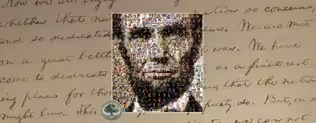
Providing Support for PBS.org
Learn Moreabout PBS online sponsorshipAnnouncer: Funding for "The Address" was provided by the Anne Ray Charitable Trust; by members of the Better Angels Society, a nonprofit organization dedicated to educating Americans about their history through documentary film-- members include the Pfeil Foundation and Robert & Beverly Grappone-- by the Corporation for Public Broadcasting as part of American Graduate: Let's make it happen, a public media education initiative to help communities address the national high-school dropout crisis and help keep more students on a successful path to college and career; and by contributions to this PBS station from... "Four score and seven years ago... " Second Boy: "Our fathers brought forth on this continent a new nation..." Third Boy: "Conceived in liberty "and dedicated to the proposition that all men are created equal."
Announcer: In just 272 words, Abraham Lincoln managed to consecrate a battlefield, heal a nation, reshape a democracy, and inspire a generation of school kids who'd never given a speech before in their lives.
Boy: "For the people shall not perish from the earth."
[train chugging; steam hissing] [child speaking] - Josh, are you up?
- No.
[water running] - You have, like, 2 minutes to crawl out of bed, OK?
[bell tolls] Man: OK, guys, let's please sit up straight in our chairs.
Let's get ready to start morning meeting.
Today, we are introducing the tradition here at Greenwood, studying and memorizing the "Gettysburg Address."
And in a lot of ways, it is a rite of passage here at Greenwood.
All the students have done it in the years since we've been a school.
It's an example of hard work and perseverance.
It's not an easy thing to do to get up and speak in public and certainly recite something from memory.
Some of you might get it the first year.
Some of you, it might take 2 or 3 years, and that's just fine.
This is a Greenwood coin.
And the only way for students to get this Greenwood coin is to recite the "Gettysburg Address."
And I'll be giving these coins out February 15th when you get up on that stage, stand tall, and recite the "Gettysburg" in front of your peers and family.
So, that starts today.
Let's end morning circle on that high note.
Let's sit up straight in our chairs.
Be your best today, guys.
Please stack your chairs.
[kids talking indistinctly] Miller, voice-over: Our kids have complex learning profiles.
There are different diagnoses like dyslexia, like dysgraphia, like ADHD, like executive functioning.
And our students have a combination of many of them.
So much focus has been on what they're not good at.
They don't realize what they're good at.
And that, of course, is not healthy.
[playing "Seasons of Love" from "Rent"] So much of the experience at Greenwood really is an awakening-- an awakening of the talent, the discovery of the passion.
And the success sometimes first happens in the woodshop or the music studio, not the tutorial room, but that is a kernel of success that then you build on.
[boy speaking] Boy: Well, it's kind of a shame, though.
I didn't want people to find out what school I was going to.
You know, I didn't want people to get the wrong image that I'm, you know, disabled or I'm challenged or I'm handicapped.
'Cause even though I know that's not the case for people that go to this school, you know, if you have a learning disability, they're not going to say, "You have a learning disability."
They're gonna say, "You're dumb," you know?
Boy: At my last school, if you were really, like, in the remedial classes, you were considered not worthy.
You were stupid.
You're worthless to the world, and nobody cared about you.
It wasn't fun.
It was never fun.
In my emotional state when I came to Greenwood, when I first arrived, I was just so torn apart and so left out and so nothing to everybody, and Greenwood just kind of is like a place where you can regain that state of I belong somewhere.
Man: It always amazes me, the kind of courage that the boys have.
It's very difficult when you're a kid to be different.
And for our boys, there is a difference that isn't external.
It's not like they have a birthmark or something like that.
There's a difference that is much deeper, and for many of them a difference that they understand very little about, and that takes a long, long time to come to terms with, to understand, and not only for them but for their families.
Many of them go through experiencing incredible hardship because of their differences.
[boy speaking] [second boy speaking] [third boy speaking] [fourth boy speaking] [bell tolls] - So, you know, one of the things that I think is very important is to understand the "Gettysburg" before you learn it, piece by piece, so that you're not just repeating the sentences, that you're really understanding how the sentences are constructed.
OK?
So we're going to look at this first section.
So, here's the first question.
What is the first question?
- "What's the subject..." - "Of this sentence?"
This is one sentence.
- It is?
- "Four score and seven years ago, our fathers "brought forth on this continent a new nation "conceived in liberty and dedicated to the proposition that all men are created equal."
That is one long sentence.
- Is it a run-on?
- No, it's not a run-on, actually.
It really isn't.
That's a good question.
So, you know that sentences have subjects, actions, and expanders, right?
So our expanders usually are-- they tell when, where, how.
Any other expanders you can think of?
- Why?
- Or what.
- Yeah.
- "Four score and seven years ago", that's an expander.
Which one of these expanders does it tell?
- When.
- When.
And when was that that Lincoln's talking about a time?
- 1863.
- He's talking about a time that's 87 years prior to his speech.
- Oh.
- So, do you know about that?
I have a little, so "four score"--score is 20, right?
1, 2, 3, 4 score would be 80, plus 7.
- 87.
- Mm-hmm, so 87 years ago, so that's what that means.
What's the subject of that sentence?
- Our--the fathers?
- Our fathers.
Yeah, that's who the sentence is about.
So, Lincoln starts out with, "Four-score and seven years ago, our fathers..." So, what are the actions or the doing words in this sentence?
What did our fathers do?
- Brought forth.
- Brought forth.
They created.
They brought forth.
And what did our fathers bring forth?
- A new nation.
- Mm-hmm.
[boy speaking] Woman: We've divided the "Gettysburg" into 5 paragraphs for learning.
- I can read it.
"Four score and seven years ago, our fathers brought forth "on this continent, a new nation, conceived "in liberty, and dedicated to the proposition that all men are created equal."
- Well, you did that very well.
Can you tell what was going on in paragraph one, geo, about "four score"?
- How America came together.
And in paragraph 2, it's about what's happening.
- Yeah, well, paragraph 2 is like the present.
- OK, so paragraph 1 is about the history of the country.
And can you show on here where President Lincoln is?
- He was the 16th.
- He's the 16th.
And when he says, "Our fathers" who started the country and broke away from the King of England for freedom for people... - It was George Washington, John Adams, Thomas Jefferson, and was James Madison?
- Yeah, he was.
- All right, and then the other thing that we talked about in the second paragraph.
He said, "We are engaged in a great civil war."
- Which broke up the country in half.
So most of the country wasn't even colonized yet or not colonized yet.
- First came south-- - But-- - Let geo say something, too, all right?
- First came South Carolina, then 10 other states broke away.
- Yeah, so it started with-- - South Carolina.
- So here's the borderline between north and south.
- Right, and the south wanted to-- they said, "We want to be our own country.
"We don't want anything to do with the USA anymore.
We want to be the Confederate states."
And what did Lincoln say?
- Lincoln said no because we were a country.
We broke from Britain and we don't want to break again, so-- 'cause then we would be weak enough for... - Oh, back when the country started?
Yeah, we didn't want to go back to that kind of-- where people can boss other people around.
- But Missouri... - OK.
- Wanted to become a slave state.
- Yeah, and then so we-- - But that was a problem 'cause then there would be 12 and 11, so they send in Massachusetts, which was Maine and Massachusetts so they made Maine a state, too.
- Yeah, OK.
Well, you guys bring a lot to the table.
Woman: What you want to do first is take your t square, line up your horizon line, so I'm going to go up to the top of my first line, the top of the roof, and I'm going to line it up with my vanishing point.
Man: For most children in our culture, school is the second-most important place that they are after home.
It's the center of their social life, it's the center of their intellectual life, it is the place where they grow and meet challenges.
For a lot of these guys who have language-based learning disabilities, that's not a friendly environment.
It's an actively hostile environment.
It's an environment which poses a lot of challenges.
Similarly, they pose a lot of challenges for their teachers, their classmates, sometimes their parents.
These are kids who frequently come to Greenwood quite convinced that they're stupid or that they are inadequate, that they are in some way lacking or at fault.
So, for a kid who has that experience, to undertake the "Gettysburg" and to be able to say, "I believe in myself enough that I can do this," that's asking a lot.
- Ethan, last night your assignment was to memorize the next part of the "Gettysburg Address."
Can we hear how you did?
- Yeah.
- You want to start from the beginning?
- Sure.
- OK.
- "Four score and seven years ago our fathers "brought...on this continent a new nation conceived "in liberty and dedicated to the proposition that all men are created equal."
- Stop.
You missed the word "forth."
OK, so let's go back and try that again from the beginning.
- "Four score and seven years ago our fathers brought forth "on this continent a new nation conceived in liberty "and dedicated to the proposition that "all men are created equal.
"The world will little note nor long remember "what we say here, but it can never forget what they did here."
- "It is for us the living rather."
- Oh, yeah.
"It is for us the living, rather, to be dedicated here for...to be?"
- "To the unfinished work which they who fought here."
- Is it "of which"?
- No.
There's no "of."
- OK.
- Once again.
- "Dedicated here to the unfinished work "which they who fought here have thus far so nobly advanced."
- The only thing that gets me confused is, "Which they."
- Sure, sure, sure.
- What's the words for "which" onward?
- I don't know.
What is it?
- You're in that paragraph right here.
- "They who fought here.
"Dedicated here to the unfinished work, which they who fought here have so nobly--" - "Thus far so nobly--" - "So nobly advanced."
So that's good work.
You did good work last night when you were practicing that.
Awesome.
How you feeling about it?
- Better.
- Better?
Good.
Awesome.
Benj?
- 'Cause I know that, sense of repeating for me is good that I can do that.
- Yeah, yeah.
So, Benj, your job last night was to just memorize the first part.
OK, put your hand down.
There you go.
And when you're ready.
You'll start with the word "four score."
- "Four score seven years ago, our fathers brought forth on this, uh, nation"-- - Continent.
- Oh, "Continent, a new nation conceived in liberty brought on--" - And... - "And brought on this."
- No.
Dedicated.
- Oh, "Dedicated to the proposition that all men are created equal."
- Correct!
Stop.
- Sometimes you get confused on after "liberty" and then you get confused on after "proposition."
So, when you're standing up here, right, you're gonna want to, like, "Four score and seven..." - I kinda zoned out, so I kinda zoned out.
- OK, all right, Ethan, will you sit down?
Will you sit down, Ethan?
OK.
- ...conceived in liberty and dedicated... - But I also kinda zoned.
I'm like, uh... uh... - All right.
So, Benj... Benj, I get that, and you get that don't you?
- That I'm a space cadet?
- That sometimes attention can be an issue, and that's what it is, right?
That's what it is for you?
So we will practice you standing straight and holding attention, keeping your attention for the duration of the time you're saying the "Gettysburg Address," OK?
We'll practice that.
- Uh, wait.
- OK, so you're gonna do the fifth and last part.
- Yeah, depending on if I can memorize that, 'cause I always get confused on... "Dedicated here to the unfinished work which they who..." - It's right here.
"Which fought here..." - "They who fought here have thus so--have thus far so nobly advanced."
Why can't he switch it around?
"So far nobly advanced" it makes... - Yeah.
- That's why they have old English.
- I want to show you something, I want to show you something.
- No.
- I'm not going to do anything.
Look.
Look.
Look, look right there.
- No.
- There's something on your shirt.
I'm dead serious.
There's something on your shirt.
- I don't give a damn.
- Whoo!
Whoo!
Whoo!
- I'll do it.
Just don't make me do it!
- I did it!
- Aah!
Ow!
- I'm going to the last rolling stones concert.
- What?
- 80?
[singing indistinctly] - Yeah.
[bell tolls] Boy: "Four score and seven years ago, our fathers brought forth on this continent "a new nation, conceived with liberty that, and, to the prop..." - And... - "And dedicated to the proposition that all soldiers-- I mean all men are created to--created equal."
- Let's slow down.
Start from the beginning.
Take a deep breath.
Relax.
You're doing this really well.
You're doing a good job.
"Conceived in liberty."
- "Conceived in liberty and dedicated to the proposition that all soldiers are created"-- - "That all men..." - "All men are created equal.
Now we..." Ehrenberg: For a lot of these guys, language-based tasks have always been difficult.
It doesn't fit for them.
So, for those guys to have a complex language-based task that they have to master, the "Gettysburg" is sort of the ultimate, difficult thing.
The language is complex, its conceptually complex, it has all kinds of social meaning, and they have to get up there, and they have to tackle it and they have to do it, and it's scary.
But with enough pushing through and enough support, they can master it, and they do master it, and that's a great thing.
- "Four score and seven years ago."
- "Four score and seven years ago."
- "Our fathers brought forth on this continent a new nation."
- "Our fathers brought forth on this continent a new nation."
- Again.
- "Four score and seven years ago, our fathers brought forth on this con-continent a new nation."
- "Conceived in liberty and dedicated to the proposition that all men are created equal."
- "Conceived to liberty, and..." - "Dedicated"... - "Decor--decorated."
- Dedicated.
- "Deci..." - OK, hold it.
Dedicated.
Can you say "dedicate"?
- Decidate.
- Ded-i-cate.
- Decidate.
- Dedicate.
- I can say it in a sentence.
- OK.
"Conceived in liberty."
- "Conceived in liberty."
- "And dedicated."
- "And decorated."
- "To the proposition that all men are created equal."
- "To the proposition that all men are equal."
- "Are created equal."
- "Created equal."
- "Dedicated to the proposition that all men are created equal."
- "Decorated to the proposition of all men are equal."
- Cooper.
- "Created equal."
- OK, we'll work on that.
- Can you say "dead"?
- Dead.
- And then say "cate."
- Cate.
- Now say "dedicate."
- Dedicate.
- Good.
Excellent.
There it was.
Nice job, nice job.
[playing "When Johnny Comes Marching Home"] - Let's try it again from the top.
[playing "Hit the Road, Jack" intro] Boy, singing: ♪ Hit the road jack ♪ ♪ And don't you come back no more, no more ♪ ♪ No more, no more ♪ ♪ Hit the road jack, and don't you come back no more ♪ ♪ Whoa, woman, oh, woman, don't you treat me so mean ♪ ♪ You're the meanest old woman that I've ever seen ♪ ♪ I guess if you said so ♪ ♪ I'd have to pack my things and go ♪ That's right!
♪ Hit the road jack ♪ ♪ And don't you come back no more, no more ♪ ♪ No more, no more ♪ ♪ Hit the road, jack-- ♪ [music stops] - OK, well, what happened?
You didn't-- you just stopped.
You kept starting and stopping.
Were you unhappy with what you were doing or... - No, it's just--I'm the type of person that it has to sound the way it sounds or it doesn't sound at all.
- Now, see, Alec, you also have a sound in your head that you're trying to match it to, right?
- Yeah, and it's not... - So you're not there yet.
- Like, you see how when I'm singing, "Whoa, woman, oh, woman," how I'm, like, putting my voice to, like, his where he, like, kinda slurs it in some parts?
- You try to make your voice sound like his, right?
- Like Ray Charles, because otherwise it doesn't sound-- - That's the way you hear it.
- Like when I listen to the radio and hear knockoffs of a song, I'm like "pfft" and I just turn it off, I'm like, "Yeah, right."
I like the original and it has to be the way the original is or else it's...not.
- Right, well, there's a saying that I like a lot.
"The perfect is the enemy of the good."
Do you ever hear that saying?
- No.
- "The perfect is the enemy of the good."
You guys get that one?
"The perfect..." Boy: Not at all.
- If you're trying to be perfect-- Boy: Oh, yeah, I get that.
- You won't even be good, 'cause you'll stop.
You'll stop 'cause, "Oh, I did it wrong and oh..." so sometimes, trying to be perfect gets in your way of just being good.
Boy: This is one of the most famous speeches of all time!
And this was like 200, 300 years ago?
So, even if he said it for like two minutes, it still means a lot.
I'm probably going to be, like back home with friends and they're going to be like, "Oh, what did you do?"
And I'm going to be like, "Yeah, I was learning 'Gettysburg'."
And they're gonna be like, "What's that?"
And I can memorize half of it when they don't even know the first sentence, so that's going to be really fun.
Usually it's always how my friends are always faster than me or read higher levels, but at least I can have a little jump start at something they probably will never learn.
Geo learned it in like, a week.
And I'm thinking, it took him one week and it's taking me probably about like two months?
[sighs] Knowing that they can memorize it and probably gonna get that coin, maybe next year I can get the coin, but I'm really positive I'm not gonna present it.
I will present it when I learn the whole thing, so that's probably gonna be next year.
The coin is a coin for your school, it's not just like a regular good luck coin, like a coin, like the basketball hall of fame coin, or a penny, but it's a coin that is a school coin.
It's worth something to you 'cause you worked for it.
I can tell my friends, "Ha-ha, public schools don't give you "this coin that has your school name on it.
"They may give you a sweatshirt or pajama pants, but they don't give you a coin that says 'never give up.'"
["Winter Wonderland" playing] - Epic!
- Are you seriously doing that?
- Yep, I'm seriously doing it!
- Ready?
- Go!
- Fail.
- Hi.
- So, this is [indistinct].
- OK.
Bye-bye.
- Can you move?
[piano playing jazz] Boy: I started playing around with the Rubik's cube since I was like, uh...14.
Then I kinda got addicted to it so I just keep doing it every day in here, yeah.
Then it just kinda became like a habit.
And I don't really have to think while doing it.
So, it's pretty easy.
To, like, solve the Rubik's cube, you have to, like, solve one layer first, then the second layer, then the top layer.
At first, I just think of solving these two layers first.
Then the top layer is like the hardest part to solve, so... and then it gets easier if you do it every time.
In my last school, everyone was treated the same way.
And when I was there, I was actually doing pretty bad in school, because I wasn't really that focused in class, probably because I have ADD or something.
But when I moved here, it felt as if my ADD stopped because I had this motivation that made me want to become a new man.
"Conceived in liberty and dedicated..." throughout my child life, I actually re-really stuttered like a lot.
And I noticed that this speech will actually kind of improve my stuttering, and my pronunciation in words too, my ar-articulation, and the T-H sounds.
"We are met on a great battlefield..." [playing scales on piano] I actually wanted to actually recite the "Gettysburg Address" because there wasn't anything else that I really wanted to recite.
But then, I kinda noticed that the speech, the "address" was actually really inspiring to me.
So, if I cite--recite this--this address in front of people, I think it will make me feel like I ca-can actually do anything I want and will--will eventually make me feel like a new man, I guess.
[child speaking] - Hi.
- So, can you read me this sentence?
- Uh..."President Lincoln set his hurt on fre--" - "Heart..." - "...heart on fwee-ing the slaves."
- Uh-huh.
"Freeing" is another word for you to practice.
Can I hear that again?
Frr... - Fweeing.
- Frr... - Fwee-ing.
- Freeing.
So the "R" is tricky.
- Yeah.
OK.
So, President Lincoln set his heart on freeing the slaves.
So, what does that mean?
- Um... - Send valentines to?
- No, uh, want...to?
- Want.
Uh-huh, what does that say?
- Want very much.
- Wanted very much.
So, we've got your literal meaning for "set your heart on" and the figurative meaning...figuratively it means something you want very much.
- Yes.
- So, what's something that you have set your heart on?
- "Gettysburg."
- On "Gettysburg" in what way?
- Uh, getting first, second, or surd place.
- Ahh!
First, second, or third place.
It's something worth setting your heart on, if that's what you want to do.
- Yeah.
- OK.
So, what are you going to say in a sentence using "set your heart on"?
- I want to set my heart on getting first, second, or surd place in the "Gettysburg" contest.
- OK, so I have set.
You already have that.
- Yeah.
- Yeah, I have set my heart on... OK.
So, first of all, I want very neat writing here on this one.
You have to slow yourself down.
- Wait, uh, where's my binder and backpack?
- Do you have a better pencil?
- Yeah.
- Do you need a grip?
- Yeah, I have one.
- Where is your binder?
How long-- [door closes] OK.
Well... so, he is fearless in terms of doing the "Gettysburg" even if, you know, he's got those "er"... and we're working on it, but it's not really technically at performance level in terms of what he can do, but-- [door opens] So, do you remember your sentence?
Have you been thinking about it?
- Yeah.
- What's the sentence?
- "I have set my heart on getting first, second, or surd place--" - Or... - Surd place.
- OK, so you did really well on first and second.
Do you know what happened on third?
- What?
- I heard--I'm going to say it the way you said it.
"Surd."
- OK!
- Is that correct?
Surd?
- No.
- No, what did I do?
Wait, wait, wait!
I want you to be listening using your ears and watching my mouth.
I said, "Surd."
Is that the word we wanted?
- No, "Third."
- Yes!
Good job.
So, read this again.
"I..." - "I have set my heart on 'Gettys--'" - "Getting..." - "Getting first, second, or surd"-- - "Or, or thhh..." - "Third place in the 'Gettysburg' competition."
- Excellent.
OK.
So, here are a couple of phrases that we need to practice before you get in to saying it.
[yawns] Are you awake?
- Yeah.
- Did you get enough sleep last night?
- No.
- No.
How come?
- My phone kept going off.
I didn't fall asleep till 3 am.
- Ah!
That's not good.
- Yeah.
"Our fathers..." - OK, "Our fathers..." "brought forth on this continent a new nation conceived in liberty..." - OK.
- "And dedicated to the proposition that all men are created equal."
- I'll give you sentences on all of those.
- They're all mastered.
- Those all are mastered, OK.
- 1, 2, 3, 4, 5.
- That's a master.
And how about... - "As a final resting place for those who here gave their lives that that nation might live."
- OK, I'll give you a sentence on that.
You know, the "Gettysburg," if you win a prize, it's wonderful, but I think the best prize for you is the fact that you can master your mouth around these "th" and "ss" sounds, that you can really learn to hear yourself and to correct them, because I can't walk around correcting you all the time, can I?
- Yeah.
- Yeah, that wouldn't be so fun.
That wouldn't be fun for me either.
So, you have to really work on that yourself... - OK.
- You know, practicing those.
That's why I gave you exercises to practice over the vacation and you have to really think about those sounds.
- OK.
- And especially when you're doing the "Gettysburg."
So, would you please turn off your cell phone tonight?
- Yes.
- OK, that's a promise?
- Yeah.
- For all your teachers, because it must be really hard being in school when you're yawning every few minutes.
- Yeah.
- Yeah, I, I believe that it is.
OK, give me... just say the word, "Rather" before you leave.
- "Rather."
- Tell me something that you would rather do.
- Sleep.
I would rather sleep than be in school.
- OK, I understand that.
Some days I feel that way, too.
Bye.
Have a good day!
- Bye.
You too.
- Let's see if it's gonna work.
[projector running] OK.
[projector running] All right, this should work.
[tape flapping] - Come along, you!
- Whoever that is, he's wanted in custody... [light jazz music playing] - Dude, I did the best thing while I was home.
I jumped off of my middle school roof and did a barrel roll down a hill.
It was a 20-foot drop.
It was awesome.
[bell tolls] Woman: So, we're going to do one minute up and down, and then we're going to jog in place for two minutes.
- Guess what the day before "Gettysburg" is?
Valentine's day.
- [indistinct] - No, it's valentine's day, the day before "Gettysburg."
How funny is that?
- He's going to be reciting some of the "Gettysburg Address."
3, 4, 5.
Good job.
Ian, often times, gets a little bit too hyper in the way that he is not able to focus on what we want him to do, and so I prepare him by doing some aerobic exercise and then, you know, segue him into doing some pushups.
And then the next activity, he's going to be working on his core muscles.
And so all of those things, all of those kind of elements help prepare him to do you know, like, prepare him to do something like in class that's more tedious, that has memory with it, that sustains the attention, that keeps him more in a state to be ready to do something that is academic.
So, if you're ready?
- "The world will little note "nor long remember what we say here, "but it can never forget what they did here.
"It is for us, the living, rather to be dedicated here to the unfinished work remaining before us."
- "Which they..." - "Which they who fought here have thus far" - "So nobly advanced."
Mm-hmm.
- "It is for us"-- - "It is rather for us..." - "It is rather for us to be dedic--to be--" - "To be here dedicated..." - "To the great task remaining before us that we take in"-- - "That from these honored dead..." - "We take increased devotion "to that cause for which "they gave their last full measure of devotion that these dead shall not have died"-- - "That we highly..." - "That we highly resolve "that these dead shall not have died in vain.
"That this nation under God "shall have a new birth of freedom "and that government of the bir--people, "for the people, by the peop-- "by the people, for the people, shall not perish from the earth."
- OK, OK.
How do you feel?
- Cookie time!
Boy: We made death cookies, which I came up with yesterday.
- Well, mine--I kind of ran out of toppings, but I just chose my favorites.
I don't know why I shoved sour patch kids in there.
Ha!
I don't know why.
I was bored.
- Ned, Ned.
What's with the hat?
Can you at least tell us what the hat's about?
- I wanted to be an Olympic runner.
Well, I can't really train here, but I just keep my Jamaican hat on me for bolt, and inspiration is always around me with my hats, Ethan knows.
I have like 10 gazillion hats.
Woman: Put those over here.
All right you guys, here we go.
So, we have to work kind of quickly 'cause this is going to cool down and just get thicker and absolutely out of control here.
You go like that and put it down.
Boy: Use a spoon!
- You guys, be a little more generous with the chocolate.
Josh: No, no generousness.
- Josh, that doesn't mean speed it up.
It means be generous.
Josh: More generous?
[metal banging] - This one could use some more.
- Where did he go?
Where is Ned?
Do we know where he is?
[boys speaking indistinctly] - Ned's frustrated 'cause he doesn't know the "Gettysburg Address" and he wanted to recite it for you guys, but he doesn't know it.
So, he's... - Really frustrated.
- Feeling frustrated.
- Keegan, you're gonna be so sugared up.
Keegan: I already am.
- You just have to memorize... you don't have to recite the "Gettysburg," Ned.
It's an option.
[kids all talking indistinctly] [hammering] [drill whirring] - Give me the difference between these two numbers.
How far apart are they?
- OK.
- OK.
- 3.
- Good.
- 5.
- Good.
Last one.
- None.
- Zero.
The difference is zero.
- So, cooper, how far, since last week when I saw you, how far did you get on the "Gettysburg"?
- I know till... - How far do you--the last week we were here-- - Far so far-- - Oh, so you've gotten that all the way down to there?
That's fabulous.
That's great.
OK.
- "Four score and seven years ago, our fathers "brought forth on this continent a new nation, conceived in liberty--" - I'm going to stop you for a minute, OK?
Because one of the words we worked on was in there.
And you know which word I'm gonna-- - Nation.
- Yeah, can you say "new nation"?
- New nation.
- Good.
All right, now start from the beginning again.
- "Four score and seven years ago, our fathers "brought forth on this continent a new nation, "conceived in liberty, "and dedicated to the proposition "that all men are created equal.
"Now we are engaged in a great civil war testing whether that nation..." Woman: "But in a larger sense, we cannot dedicate..." - "But in a larger sense, we cannot dedicate..." - Right.
"We cannot consecrate..." - "We cannot concencrate."
- Consecrate.
- Consecrate.
- Consecrate.
Now, do you know what that word means, "Consecrate"?
- Yeah, that works.
Stephenson: I say, "Four score..." - "Seven years ago..." - "Our fathers... - "Brought forth..." - "On this..." - "Continent..." - "A new nation..." - "Conceived in liberty..." - "Dedicated..." - "To the proposition..." - "That all men are created equal."
Boy: "To that cause for which they gave the last full "measure of devotion-- "that we here highly resolve that these dead "shall not have died in vain, "that this nation, under God, "shall have a new birth of freedom "and that government of the people, by the people, for the people, shall not perish from the earth."
Woman: Terrific.
[bell tolls] Migneault: What we do relative to the "Gettysburg Address" is we have them do a number of activities, and one of them is handwriting.
And so, there are three posters here.
This first one is from last year.
This is 2012, and you'll see their cursive signatures, and then some of the kids have written parts of the "Gettysburg" in print and some wrote the whole "Gettysburg" in cursive.
So it's part of their really assimilating the "Gettysburg" by writing it in cursive or in print and then signing off their signature.
And here he is.
Thomas, good morning.
- Good morning.
How are you?
- I'm good.
How are you doing?
So, when we look at the "Gettysburg Address," and you know, we have divided it up into 1, 2, 3, 4, 5 sections just so that it's a little easier to remember.
So what I'm going to ask you to do is to write this part of the "Gettysburg Address," and I'm going to get you a highlighter strip so that we can... - Highlighter strip?
- Mm-hmm.
And so if we pick this paragraph right here, that's where it's going to stay, OK?
And so then, when you look up, you don't have to decide which one was it, the first one, the second one or the third one.
So you're going to start right here.
- Wow, that's really cool.
- You like that?
Good.
OK.
So, let's have you start here.
We'll skip this space right here.
And just take your time, OK?
So, "What we said here..." - "Said here."
- Mm-hmm.
You're doing a great job.
I know it's a lot of work and it takes a lot of concentration.
That's good, and then this is the last part of it.
"Forget what they did here."
Period.
OK, wow.
That was a task!
OK.
Now, we're going to put this away.
You did a magnificent job.
It was really a lot of work to do that.
[piano playing upbeat tune] [Van Halen's "Jump" playing on piano] - 'Cause I wanted to let you know that it's-- Ian: Lunchtime!
Boy: Come on!
Come here!
[all talking indistinctly] - Whoo!
- Hi, Travis.
Ehrenberg: American culture is identified as very individualistic, and yet there's a tremendous social pressure to conform and to be like everybody else and to marginalize and pathologize with people who function differently in all different kinds of ways.
I will get parents who will say to me, "I just want my kid to be normal."
And sometimes I have to say to them, "It's not his job to be normal.
It's his job to be who he is."
Does that mean that there might be hardships ahead for him?
Yeah, it does.
But the hardship of trying to be someone who you're not is even worse.
- OK, "Now we are engaged and... "a great civil war... testing..." Wait.
"Testing whether..." - You're right.
That was right.
- "Testing whether...um..." - What are they testing?
- "That nation or any nation can long endure..." um...no.
"So conceived and dedicated can long endure"?
- Terrific.
You did it.
- Really?
What?
- You did it.
It's not making complete sense to you yet, but you got the words, all right?
- Oh, wow.
- So this time, the other one took us two days to get that first sentence.
This one's harder, and you got it in-- - Wow.
- 10 minutes.
All right, terrific.
- "It's for us the living rather..." Stephenson: "It is for us the living rather..." - "It's for us the living rather..." - Go again.
"It is for us the living rather..." - "It's for us the living rather to be dedicated to unfinished work"-- - "Dedicated here..." - "Here to unfinished work"-- - Slow down again.
- Can I just have the sheet in front of me?
- No.
- I can't look at the sheet?
- No.
- That's, that's-- - That's hard, isn't it?
- Abraham Lincoln did.
- No, he didn't.
He wrote it on his hand.
Rawley: All right, now we're going to focus on this one.
This is the one we want to spend our day on.
Can you say this one for us?
Boy: "Conceived"?
- Conceived.
You wrote a sentence for that the other day, right?
And what does "con" mean, race?
Race: Together or with.
- Together or with.
OK, so you might want to jot down the word "together" right there.
And is there a suffix on that word, josh?
Josh: "-ceived"?
-ed?
- OK, -ed, so it could be past tense.
So let's see if we can find "-ceive" or there's also a version of it called "-cept."
- Found it.
- Oh, it's on the first page.
Yes.
- "Take, receive, received, reception, accept, conception."
- OK, and conception has to do with birth, maybe having a baby, but also like you could have some kind of concept or idea.
And that's the way it is in the "Gettysburg Address."
The word "detract" is also in the "Gettysburg."
- "-tract" means to pull, to pull or down.
- OK, yeah, "De-" means down away, and "-tract" means to pull.
We've already done "-tract" in here this year, right?
But how does he use it in the "Gettysburg Address"?
- Here, this is one.
- OK, "The brave men living and dead who struggled here have consecrated it far above our poor power to add or detract."
In other words, the dead have made the land holy and there's nothing Lincoln can do to add to what they've done or to take away from.
OK, I'll give you a little--I'll get you started right here.
"The world will little note..." here, let's make it so we can see-- - Can I do paragraph 3?
- Sure, but can we put this together, though?
- Oh, yeah.
- OK, "The world..." I'll put it together and you can read it for me, OK?
- I guess.
- Then if you want to do paragraph 3, you can.
- I guess.
- All right, "The world will little note..." race, can you help us?
Can you double task there?
"The world will little note..." - "Nor long remember what we say here..." - "What we say here..." go on.
- "But it can never forget what they did here."
- OK, "What they did here..." go on.
Boys and woman: "It is for us the living rather "to be dedicated here to the unfinished work "which they who fought here have thus far so nobly advanced.
"It is rather for us to be here dedicated to the great task "remaining before us, that from these honored dead, we take "increased devotion to that cause for which they gave the "last full measure of devotion.
"That we here highly resolve that these dead shall not have "died in vain, that this nation under God..." Woman: He needs to say something, because if he just holds that inside, how is he going to feel if he doesn't say to his... Ian: Like me, which is great.
- How is he going to feel if he... if he holds that... - I answered your question.
- That sense of I didn't get the-- - He's going to feel horrible.
- He's going to feel horrible.
It's going to go more inward.
- Which is how I feel.
- That's how you feel?
- Every day of my friggin' life.
- Because you don't let--you don't talk about how you feel?
- No, because everyone's ripped me apart in the past years.
- Does this help you at all in terms of thinking about-- - No.
- No?
- No, I can't even fight for myself anymore, 'cause I feel like if I do, I'm gonna get beaten or something.
I don't know.
- You think if you stand up for yourself, you're going to get beaten?
- Yeah, by other kids, 'cause they just get really pissed all the time.
- So, it sounds like you need a little bit-- - I don't see that side.
- A little bit of adult help.
- You don't see that side?
Well, now this is the thing-- - I see every side of every aspect.
- So listen to me for one second.
You guys are two different people, right?
Do you think you're going to see things from a different perspective?
- Yeah.
- No!
- He sees the sides of people that are bad-- - Well, but that might be-- hold on just a second.
That might be where Ian is right now.
But what I'd like to really do is sort of stick with this and the reason I think it's really good for you to be in a class where we're talking about passive, aggressive, and assertive is that, you know, if you're holding things inside and you don't feel safe, then sometimes you have to find a safe person to talk to.
That could be a trusted adult.
It could be a trusted friend.
- It could be no one.
- You might not feel safe about saying that in front of... you might not feel safe about being assertive in front of everybody, right?
But it's really important to find someone that you can share those things with.
- ...not gonna be able to make it there... - These guys are really working on their communication style.
They're working on how they stand up for themselves.
As you could see sort of in this group, there are some funny disconnects.
Really, I'm just trying to help them develop their skills so that when there's a conflict, or you know, as you see, Ian is really, really--he's really stressed out and has had a lot of negative experiences.
And so the idea is to try to help him have more tools in his toolbox when there's a conflict.
I want to share something with you guys that's really important, and it really helps with this topic in particular.
It's called an "I statement."
Have you heard of that?
- Oh, I feel, like an "I feel" statement.
- It's like an "I feel" statement.
- It's not worth it.
- You know what, Ian, you just got to take a deep breath and try it and try it again, and try it again, because eventually it really is worth it.
- I've tried over 3,947 times.
- Really?
- It doesn't work.
- OK.
I want to share it with these guys, and I want to practice it with you because it's a formula.
It's a way for you to say how you feel, and an "I statement" includes a feeling, right?
And it includes the word "I" because who do your feelings belong to?
- Me.
- OK, who do your feelings belong to, chase?
Chase: Me.
- Ian?
- The government.
- The government, OK.
- I'm going to take a reset.
Ethan: What if, in his situation-- Ian: Do not mention me while I'm gone, otherwise I will be really upset.
- All right, we'll not mention him while he's gone.
John: Basically what a reset is, is when a student is misbehaving, a teacher will ask them to reset, which means to leave the class, to leave the learning area for a few minutes, sometimes longer, to just get a hold of themselves and get into a place where they can mentally focus and... be a functioning member of the class.
For me, resets don't happen that often.
I usually gauge when I'm losing control.
But some students take more resets than others, and whatever gets them to focus, that's what they need to do, and everybody's different.
Ehrenburg: Here are a lot of kids who have a backlog of a lot of anger and frequently will act out on that anger.
One of the things you want to do is develop the capacity in the kid to recognize when he's getting upset and the reset is an opportunity to do that.
So a kid can ask for a reset or a teacher can say, "You need to take a reset."
Woman: Keegan, would you please leave the classroom?
You may not draw on the desks.
Keegan: You said it would be better to draw with pencils.
- [laughing] - On paper, Keegan, on paper.
[class laughing] Please go out there, pull yourself together and come back.
OK.
So, let's try this again.
[bell dings] Silent resetting, getting ready for class to start.
[multiple, sustained gunfire] [boy narrating] [horse whinnies] [overlapping shouting] ["Battle Cry of Freedom" playing] [distant cannon fires] - Whoa!
- Wake up.
[growling] - Whoo!
[overlapping chatter] Hamm: You know, for many kids, just finishing, just completing it would be a goal.
I don't know if you've seen Ned, but Ned came here sure that he was never going to be able to do it, and as of the last couple of days, he's seeing the end, he's seeing that he can actually do the whole Gettysburg, and he's so happy.
He came here very kind of defeated in a lot of ways, just by his old school and by learning, and things were hard for him.
So, for him, well, getting the coin might be something that he wants, but I don't think he cares whether he wins.
But just the fact that he can actually memorize it and might get up and do it; we don't know yet, but he's very seriously considering it.
Miller: And finally this morning, a great way to close out morning circle.
Where's Ned?
Ned.
Hey.
Woman: Come on up.
Kids: Come on, Ned!
Ned!
- Whoo!
- Go, Ned!
Ned: "Four score and seven years ago, "our fathers brought forth on this continent a new nation "conceived in liberty and dedicated to the proposition "that all men are created equal.
"Now we are engaged in a great civil war, "testing whether that nation or any nation so conceived and so dedicated can long endure."
Hamm: This kid, in spite of all of his emotional stuff, that baggage that he came with, he was able to work through it and even maybe throwing his tantrums and throwing the hat or whatever he needed to do, that's what he needed to do to get to the place where he could feel confident.
- "That this nation, under God "shall have a new birth of freedom "and that government of the people, by the people, for the people shall not perish from the earth."
- All right!
- Whoo!
Miller: Outstanding, Ned.
Great job.
You are qualified.
It is one of the most powerful things in the course of the year, to see you guys study this speech, have the courage to get up and recite it in front of people, have the courage to not get it right and keep going and keep trying.
It's awesome.
Let's think about that.
Continue your hard work.
Congratulations to those who have qualified already.
And if you haven't qualified yet, keep working.
OK, guys, have a great day today, please stack your chairs.
[overlapping chatter] - Remember, join the race.
You might just win.
Ehrenberg: You think you want to do this?
Ben: No.
- I'm not asking if you're scared to do it.
I know that.
I asked a different question.
- I don't want to do it.
Do you feel like it's a growth point for you, that it's important for you, for your growth, to do it, even if-- - No.
- No.
- 'cause I'll back off of it if it's really not a goal of yours.
- It's really not.
- You can do this.
Personally, I don't care whether you do it or not.
What I care about is that you not not do it because it's fearful for you.
- I just don't want to do it.
[bell dings] Man: All right guys, let's take a minute, stand up behind our chairs.
We have a special lunchtime treat today.
Instead of starting our meal with the grace, we are going to start with another Gettysburg qualifier.
Ian is going to share the address with us.
So please take a moment, get yourselves settled, let's be respectful to Ian.
Ian, when you're ready.
Ian: "Fourscore and seven years ago, our fathers brought forth on this continent a new nation..." Ian, voice-over: When you're angry, it's never good.
But when you have grit and perseverance, you can get through stuff a lot more.
Ian: "...now we are engaged in a great civil war, testing..." Ian, voice-over: This year I'm reciting the Gettysburg, and that's huge for me.
It just tells people I'm not stupid, I'm not dumb, I'm not, like, worthless.
"For those who here gave their lives that that nation might live..." Ian, voice-over: Every kid that has been bullied excessively, their life is a battlefield, and every time you're shot down, you just get-- you try to get right back up, but then they just keep shooting you and shooting you.
When you're down for the count, either a devil cries and you're done, or the angels sing, they lift you up, they heal you.
"...rather to be dedicated here to the unfinished work which they who fought here have thus far so nobly advanced."
I want to go up there, I want to nail it, I want to get off, I want to shake Stewart's hand, and I want to get that coin.
It's the turn of a new beginning when that coin hits my hand.
- Good job, Ian.
[horse whinnies] [teen boy narrating] [bell dings] Rebecca: Cooper.
- Yeah?
- Time to roll, my dear.
Boy: Today is Gettysburg day.
I am excited and a little bit nervous, but I'm more excited than nervous.
Man: You need to tie your tie?
Well, I got to wake everyone up first.
You got yours tied.
Ethan, voice-over: I'm not really that nervous about it.
I mean, I'm sort of nervous, but I can't be.
I don't know really what the expression is, but I'm not, like...scared out of my wits about it.
And the speech is only two minutes long and I know it top from bottom, inside-out.
Shouldn't really be a problem for me.
- There.
- Thank you.
Nate: OK, cooper, out of bed.
Let's go.
Stewart: So today is the day.
We've been building up to this for-- really since you guys came back from thanksgiving, right?
And I'm sure there were days, maybe not even that long ago, where you were frustrated with it and didn't think you could do it, but you kept pushing forward, and that's great.
And, guys, for you, while we're all here together, too, when you're up there, if you make a mistake, right, which might happen, Annie's right there.
She can give you a cue.
And because she's really close to you, she can probably give you a cue that nobody else is really going to hear, except you, right?
Annie: It will be subtle, it will be quiet.
You will remember this day, OK?
You will remember how you feel right now-- maybe a little nervous, maybe really confident-- in preparation for tonight.
So, sit up for a second.
Let's sit up straight.
Let's soak it in, let's take a moment and just recognize how we're feeling.
Get centered; get ready to launch into this really special day today.
And feel really proud of what you've accomplished.
- Looking sharp.
[laughter] - Top button's important, believe it or not.
- Ready?
[overlapping chatter] [applause] [Kevin sighs] "Four score and seven years ago..." - "Four score and seven years ago..." - "Four score and seven years ago..." - "Our fathers brought forth on this continent a new nation..." - "A new nation conceived in liberty and dedicated to the proposition that all men..." - "That all men are created equal."
[boy narrating] "I'm sorry; I don't want to be an emperor.
"That is not my business.
"I don't want to rule or conquer anyone.
"I should like to help everyone, if possible: "Jew, gentile, black, white.
"We all want to help one another.
"Human beings are like that.
"We want to live by each other's happiness, not by each other's misery."
- "Fellow citizens, pardon me, "allow me to ask, "why am I called upon to speak here today?
"What have I, or those that represented you "with your national independence?
"Are the great principles of political freedom "and of natural justice embodied in that declaration of independence extended to us?"
- We shall fight in France.
"We shall fight in the seas and oceans.
"We shall fight with growing confidence "and growing strength in the air.
"We shall defend our island, whatever the cost may be.
"We shall fight on the beaches, "we shall fight in the landing grounds.
"We shall fight in the fields and in the streets.
We shall fight in the hills.
We shall never surrender."
[applause] - "Now we are engaged in a great civil war, "testing whether that nation or any nation so conceived and so dedicated, can long endure."
- "We are met on a great battlefield of that war.
"We have come to dedicate a portion of that field "as a final resting place for those who here gave their lives that that nation might live."
- "It is altogether fitting and proper that we should do this."
- "But, in a larger sense, we cannot dedicate-- we cannot consecrate-- we cannot hallow this ground."
- "The brave men, living and dead, who struggled here" - "Have consecrated it, far above our poor power to add or detract."
- "The world will little note, nor long remember what we say here, but it can never forget what they did here."
- "It is for us the living, rather, to be dedicated here "to the unfinished work which they who fought here have thus far so nobly advanced."
- "It is rather for us to be here dedicated to the great task remaining before us" - "That from these honored dead we take increased devotion "to that cause for which they gave the last full measure of devotion" - "That we here highly resolve that these dead shall not have died in vain," - "That this nation, under God, "shall have a new birth of freedom-- "and that government of the people, by the people, for the people, shall not perish from the earth."
[cheers and applause] [overlapping chatter] Geo, voice-over: Every year, we do this thing called the Gettysburg Address, and I'm like-- and each of us--the coin, like, "Wow, I wish I could get that, but I probably won't get even near it."
At first, I said I couldn't do it at all, but, like, once I did it in front of, like, I don't know, 200, 300 people, like, I felt so much more than I was.
I accomplished so much doing that.
It felt like... it felt like I accomplished a million things at once when I recited it and got first place.
Max: When I first heard about Gettysburg, I thought, "This is ridiculous."
Even before then, I just didn't feel like I could get up and talk to people in a big group.
I just...I just can't do it.
Like, if I was the president and I would have to give my inaugural, I would just, like, walk away.
I wouldn't be able to do it.
I could have just walked out, but then I would probably regret that later on, like, "I could have done that, I had it in me."
And when it was finished, I just felt so relieved.
Like I said, I could just feel like I could fly.
I won second place for my efforts, and I felt very proud of myself that I had done it.
- "Four score and seven years ago."
- "Our fathers brought forth on this continent a new nation."
- "Conceived in liberty and dedicated to the proposition that all men are created equal."
- "Now we are engaged in a great civil war, "testing whether that nation or any nation so conceived and so dedicated can long endure."
- "We are met on a great battlefield of that war.
"We have come to dedicate a portion of that field "as a final resting place for those who here gave their lives that that nation might live."
- "It is altogether fitting and proper that we should do this."
- "But in a larger sense, we cannot dedicate-- we cannot consecrate-- we cannot hallow this ground."
- "The brave men, living and dead, who struggled here "have consecrated it far above our poor power to add or detract."
- "The world will little note nor long remember what we say here, but it can never forget what they did here."
- "It is for us the living, rather, "to be dedicated here to the unfinished work which they who fought here have thus far so nobly advanced."
- "It is rather for us to be here dedicated to the great task remaining before us."
- "That from these honored dead, we take increased devotion "to that cause for which they gave the last full measure of devotion."
"That we here highly resolve that these dead shall not have died in vain," - "That this nation under God shall have a new birth of freedom" - "And that government of the people, by the people, for the people shall not perish from the earth."
This is a box.
A box that showed you a world beyond your own.
It was just a box but the world is changed and so have we and now, the box can be almost any size or shape and you decide what you want to explore anytime any place break out of the box with pbs Female Announcer: Learn more about "The Address" and share your own version of the Gettysburg Address online at PBS.org/TheAddress.
"The Address" is available on DVD.
To order, visit ShopPBS.org or call 1-800-play-PBS.
This program is also available for download on iTunes.
Or call 1-800-Play-PBS.
- Go ahead.
- "Four score and seven years ago, "our fathers brought forth on this continent a new nation "conceived in liberty and dedicated to the proposition that all men are created equal."
[bell dings] - "Four score and seven years ago"... - "Our fathers brought forth on this continent a new nation"... - "Conceived in liberty and dedicated to the proposition that all men are created equal."
Announcer: In just 272 words, Abraham Lincoln managed to consecrate a battlefield, heal a nation, reshape a democracy, and inspire a generation of school kids who'd never given a speech before in their lives.
Boy: "...for the people shall not perish from the earth."
Female announcer: Funding for "The Address" was provided by the Anne Ray Charitable Trust; by members of the Better Angels Society, a non-profit organization dedicated to educating Americans about their history through documentary film-- members include the Pfeil Foundation; and Robert & Beverly Grappone-- by the Corporation for Public Broadcasting as part of American Graduate: Let's make it happen, a public media education initiative to help communities address the national high school dropout crisis and help keep more students on a successful path to college and career; and by contributions to this PBS station from... Be more.
PBS.
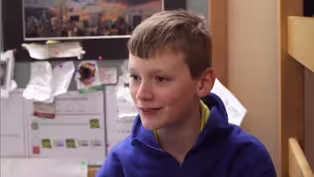
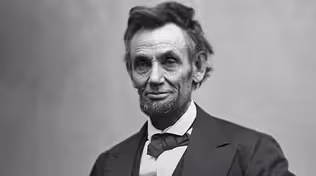
Video has Closed Captions
A short history of the Civil War and the Gettysburg Address. (4m 56s)
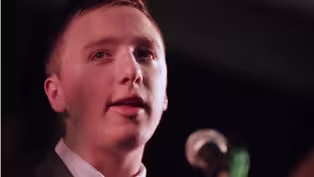
Video has Closed Captions
The boys from Greenwood School recite The Gettysburg Address. (4m 19s)

Video has Closed Captions
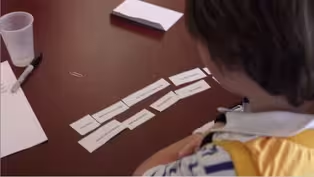
A quick look at the students of Greenwood School. (1m 17s)
Video has Closed Captions
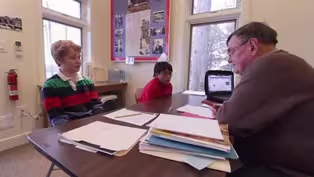
Thomas and Cooper work on memorizing The Gettysburg Address. (2m 37s)
Providing Support for PBS.org
Learn Moreabout PBS online sponsorship









Support for PBS provided by:
Funding provided by Bank of America; the Anne Ray Charitable Trust; Public Broadcasting Service; and members of The Better Angels Society, including The Pfeil Foundation and Robert & Beverly Grappone....