
2026 Legislative Session Week 7
Season 10 Episode 25 | 26m 49sVideo has Closed Captions
As the session wraps, what were the themes? And did lawmakers bring any surprises to the floor?
In the final hours of the 2026 Legislative Session, Utah lawmakers are still working through a record number of bills. Our expert panel examines the major themes this year, whether there were any big surprises, and how all the new legislation will impact the lives of Utahns. Political experts Chris Bleak, Glen Mills, and Kate Bradshaw join host Jason Perry on this episode of The Hinckley Report.
Problems playing video? | Closed Captioning Feedback
Problems playing video? | Closed Captioning Feedback
The Hinckley Report is a local public television program presented by PBS Utah
Funding for The Hinckley Report is made possible in part by Cleone Peterson Eccles Endowment Fund, AARP Utah, and Merit Medical.
2026 Legislative Session Week 7
Season 10 Episode 25 | 26m 49sVideo has Closed Captions
In the final hours of the 2026 Legislative Session, Utah lawmakers are still working through a record number of bills. Our expert panel examines the major themes this year, whether there were any big surprises, and how all the new legislation will impact the lives of Utahns. Political experts Chris Bleak, Glen Mills, and Kate Bradshaw join host Jason Perry on this episode of The Hinckley Report.
Problems playing video? | Closed Captioning Feedback
How to Watch The Hinckley Report
The Hinckley Report is available to stream on pbs.org and the free PBS App, available on iPhone, Apple TV, Android TV, Android smartphones, Amazon Fire TV, Amazon Fire Tablet, Roku, Samsung Smart TV, and Vizio.
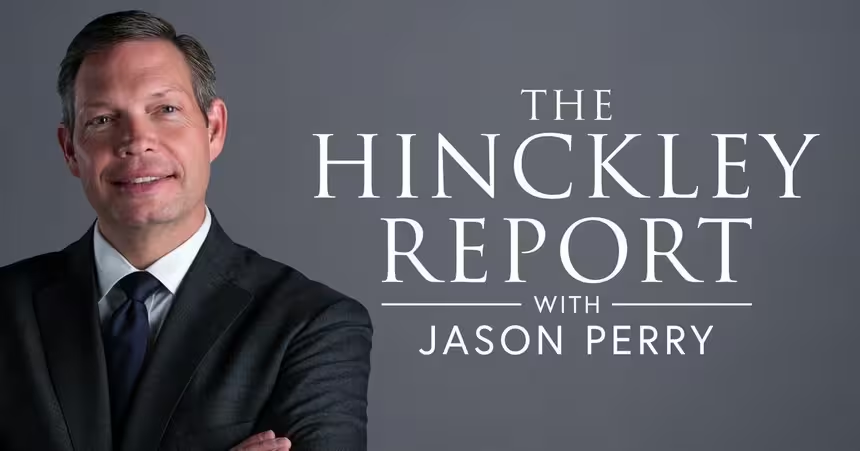
The Hinckley Report
Hosted by Jason Perry, each week’s guests feature Utah’s top journalists, lawmakers and policy experts.Providing Support for PBS.org
Learn Moreabout PBS online sponsorshipJason Perry: On this episode of "The Hinckley Report."
As the 2026 legislative session comes to a close, lawmakers sprint to get through a record number of bills.
What were the major themes?
Were there any big surprises?
And how will the new laws impact Utah's lives?
male announcer: Funding for "The Hinckley Report" is made possible in part by the Cleone Peterson Eccles Endowment Fund, and by donations to "PBS Utah" from viewers like you.
Thank you.
♪♪♪ ♪♪♪ Jason Perry: Hello, and welcome to "The Hinckley Report."
I'm Jason Perry, Director of the Hinckley Institute of Politics.
Covering the week, we have Chris Bleak, partner with RRJ Consulting; Kate Bradshaw, mayor of Bountiful; and Glenn Mills, a political expert and analyst.
Thank you for coming off the Hill for the last day of the legislative session.
I can't believe 45 days is here, and so much has happened.
We're gonna break it down a bit on the show today.
But I want to talk about the numbers, first of all, because it's interesting to see the cadence of bills as they're introduced, as they're drafted.
And Chris, I want to give you a couple of numbers.
You worked with the House for such a long time.
You were chief of staff out there, just kind of get this historical perspective.
We had 1,014 bills introduced this year, a record by a pretty good amount.
But what's interesting is, so far, this is as of the filming today, only 377 have passed so far.
That's like 214 bills by the end of the day to break any records.
Is this going to happen?
Give us some context for us.
Chris Bleak: Yeah, I know, certainly, the governor, the speaker, president have all spoke about the need to reduce the number of bills.
I think it's been something that they've taken very seriously, and we've seen that.
There's a growing, there's a paradox here.
We're a growing state.
There are a lot of issues.
Government has been very involved in a lot of them.
And at the same time, they want to make sure that there are strong policy processes in place to create good policy, right?
"Let's just not do something scattershot just to do it."
So, I suspect they are probably gunning to be a little bit under that record, but it'll probably be pretty darn close from what they've been in the past.
Jason Perry: It's gonna be a very busy day.
Yeah, go ahead, Glen.
Glen Mills: As you point out, we've heard the governor, the speaker, the president, others from the public say, "Why do we keep seeing so many bills?"
And there is some encouragement to try to break that number down, but we're not seeing it happen, a record number.
I was--I'm never shocked about anything when it comes to politics, but it was really quite jaw-dropping to see us go over 1,000 this year, because we're just not heading in that direction.
On a number of metrics, Utah is ranked as one of the greatest states in the country in many different ways, yet we keep seeing, potentially, all these problems that we need to address.
And in many cases, I think we're starting to see more and more that a lot of these bills are a problem in search of a solution.
Kate Bradshaw: You know, last-- Glen Mills: Or I said that wrong, a solution in part of a, in-- Kate Bradshaw: Search of a problem.
Yeah, you know, last session, the governor ended with his closing remarks, saying, "Some of these surely could have been an email or a phone call," to the legislature, and he was saying that about bills dealing with his departments and running the state.
And then he opened his remarks this session with a similar message to the legislature.
And I would say, from a local government perspective, man, I would echo that.
Some of these bills, again, in search of a problem, are based on sometimes an anecdotal story, a one-person story.
And I was reminded this year in conversations with Senator Evan Vickers, he said, "You know, if it's a one-story anecdote, it's a bad bill."
And so that, I would say, also happens in local government, where if you're running a bill just because you had a constituent that had one issue with their local government, it's not a good bill.
That's a great reason, though, for an email, a phone call, an introduction, a connection, so that we can just solve the problems and not gum up the system with so many bills.
Glen Mills: We don't need to be legislating on hypotheticals.
Chris Bleak: But let's be grateful.
They finish in 45 days.
They are a short session, and they have stuck to that.
There have been some bills to maybe look at lengthening that or changing the way that's gone this year, but they get in, they get done and move on, and I think that's beneficial to the process.
Jason Perry: Yeah, Chris, talk about this process just a little bit too, because what was interesting this year is, as of today, almost 400 substitute bills.
So, you had the bills as drafted.
You come up with these ideas, whatever they are, but talk about that for just a second, because that is a pretty big number of a bill that has changed substantially, in some cases, from where it started.
Chris Bleak: And that's probably one of the biggest challenges that they have to think about going forward in terms of having a good process, because the way our structure works, those bills often get dropped right before a committee or right before a vote, and has everyone had the chance to really analyze it, look at it, give feedback on it?
And so when more and more subs are introduced, that probably is something that the legislature needs to spend some time thinking about.
Is this creating a better policy process?
And I would argue, generally, it's not.
Sometimes, it is because a lot of parties have come together to work on that.
But when it's happening so quickly and so frequently, that's potentially problematic.
Glen Mills: And a lot of times, it's just a very complicated issue that it takes time to get right.
I'll give Representative Clancy a ton of credit for bringing people to the table early on some of the issues he's working on this session.
One of the bills just last night went to its seventh substitute, but it's something that work groups have been working on pretty much after last session started, and it's just a complicated issue that people have to come and negotiate and work out.
Kate Bradshaw: Glen's right, I think, Jason, too, that sometimes a substitute is a mark of the fact that the process has been processing.
The rough edges are coming off this bill, and all parties, all stakeholders, legislators, interest groups are part of that solution.
Sometimes, though, it is not, to Chris's point, that the substitutes drop really fast, and parties aren't having time to vet it.
I wanna give a shout-out to Representative Karen Peterson, who moved forward a bill on transportation utility fees this year with no "no" votes against it, but this has been a bill that has been worked on for three years.
It was introduced three years in a row.
It had some concerns that would bog it down at the last minute, and so she took the time, in not just one session, but three sessions, to get that policy right, rather than quickly drop subs that people hadn't had time to and and move through.
So, there are pros to a short session in helping people find compromise that maybe they wouldn't otherwise find.
But one of the negatives to a short session is, particularly in this last week, particularly in this last day of the session, they move so fast, and there are sometimes mistakes.
I can give you an example of one that I was working on this week with the League of Cities and Towns where language, the same language ended up getting put in two bills because of a miscommunication of an intern who was running some messages back and forth as a compromise was worked out.
Luckily, the language is the same, and the policy is the same and is what we agreed to, but things move fast, and so it went in two bills it didn't need to.
It just needed to be in one.
Jason Perry: I want to get to a couple of key bills, and some of them are very much about process also, since we're talking about that.
Chris, I want to talk about this gas tax.
This is House Bill 575, Cal Roberts.
Maybe give us a little context on this and what this does because bill proposed, bill died, is voted against.
It fails in committee, and then it gets brought back.
Talk about this, and then let's get to the process, because a lot of people have been talking about this gas tax.
Chris Bleak: Yeah, and I've worked on this issue representing a client on it, and so I've been involved with it for a long time.
The speaker has been very passionate on the issue, and I give him credit.
You know, to the process point, he brought people together early.
I think there were a lot of dynamics playing out throughout this that, you know, even between states and between different industries that were really interesting in terms of the process.
But ultimately, I think what the speaker accomplished and Representative Roberts, who worked hard on this, is they found a way to lower the gas prices for a period of time.
They also found a way to make sure that we increase supply into the market and, which, you know, just taking laws of economics, you know, that additional supply should help drive down costs, and found a workable solution that could bring all people together.
It wasn't easy.
It was, it had, certainly, had its contention in moments.
We saw a little bit of that play out with the Senate committee hearing where it got voted down, as you were alluding to, and brought back, but I commend a lot of people working hard on it, trying to find a solution that makes sense, and hopefully we'll have a good benefit for Utahns going forward.
Jason Perry: Kate, maybe give us some more context on this, particularly from where it started, which was moving this tax to the refineries from the pump.
Kate Bradshaw: So, Chris is right.
This is a speaker who is interested and focused on making gas prices cheaper for Utahns, which everyone should be excited about and applaud, that his heart and his interest is in bettering an economic situation for Utahns.
The challenge, of course, is we're in interconnected markets in the Mountain West, and then, of course, this week with the war that is taking place in Iran, we've seen that we are also the subject of international politics.
And so we've seen the price of crude go up dramatically in the last week, and so this is a case, I think, of where we were seeing some local actions take place to try and make a product cheaper for Utahns that may now be overshadowed by the fact that things are happening on an international level that is taking those prices up, and may kind of absorb those cuts that we had hoped to see from this legislation.
Glen Mills: The speaker really jumped on this early, and I think, looking back, I've seen him talk about and push this more than any other issue coming into this session.
We all drive by the refineries in North Salt Lake, and that's one of the points he was making.
We have some right in our own backyard.
Why can't we drive that price down?
Jason Perry: Let's get to another one that caused a lot of maneuvering in terms of process, immigration.
We had several bills this session that were dealing with it.
At least one might look like it goes forward, and let's talk about these other ones.
Chris, we've talked about this on the program in the past couple of weeks.
Let's start with what started as House Bill 88.
Trevor Lee had a bill that ended up not having broad support necessarily, at least where it started, It ended up getting circled, which means it was going to stay on the board, and it would be not very easy to move it.
Talk about that for just a moment, because a procedure happened this week where language came from his bill and got put into another bill that had not been locked up.
Chris Bleak: Yeah, and I think this is--I often like to talk about how, you know, now all politics is national, rather than all politics is local, the old saying there, and I think this is an example of that.
Obviously, Representative Lee feels strongly about this issue.
He's parroting a lot of the talking points that you see coming from President Trump and his administration, and their focus on securing the border, and the challenge or problem that they see with immigration.
And so, you know, he feels strongly about that and is looking for any method to advance the policy goals that he has.
I think a lot of folks feel strongly that we need a balanced solution on immigration, and so you've seen that dynamic play out in the counter to, you know, essentially stop that message going forward.
And so it really is going to be about process going forward, a good policy process in order to find a solution, or if Representative Lee or others want to change that.
Jason Perry: Kate, so this ended up being a seventh substitute, so seven changes to the House Bill 88.
And what it got to was it was limiting or prohibiting access to in-state tuition, scholarships, access to some loan programs.
That's kind of where that substitute got.
How does this work when you have a bill that maybe has stalled a little bit in the state of Utah when you want to find another vehicle?
'Cause I want to talk about that, 'cause it did get put into Representative Lisa Shepherd's bill that was about immigration as well.
Kate Bradshaw: So, in our system, you know, a legislator can open up a bill file.
As we've talked about already, you can introduce substitute bills, we call them subs for short, that can evolve and change that process, and you're staying within the same title of state code.
And his bill, as he went through the process, a lot of concerns were identified.
Some of those were concerns identified by local governments about, you know, Meals on Wheels and different types of programs that really provide a safety net.
And so his bill, because of those concerns, HP 88 was what's called circled, meaning there wasn't enough support to advance it, and so it was circled while they had some of those additional discussions.
He found a bill that opened up a similar section of code, and this was a bill that was just repealing a guest worker program that was an idea from several years ago that the federal government had never approved a waiver for.
And so he then made a kind of an aggressive move, this is kind of an aggressive move in just a legislative procedure, to substitute his bill into this other bill to give it a way to keep moving.
And it went through actually two very close votes to do this action.
And then, for once, the language had been amended in for that bill to pass.
And so it very narrowly was amended, and it very narrowly passed the state House.
The challenge he now faces is, in order for the bill to advance, you have to have what's called a floor sponsor, so this is someone in the opposite body, in this case the state Senate, who then carries that bill forward through that other body.
And right now, that bill does not have a Senate floor sponsor, which means it cannot advance.
It cannot be heard on the Senate floor because it appears that no senator is willing to be the champion of this new amended bill.
Glen Mills: Just in addition to the clear divide on the issue between the House and Senate, this was a fiery debate on the House floor, one that I can't think of that I've seen in quite some time.
And I think a lot of that dates back to Utah has a history of being a welcoming community.
You can refer to the Compact that was done some 12-15 years ago.
And you saw Republicans stand up and say, "This goes too far.
Like, we can go ahead and have the debate of where we need to draw the line, but the food issues that you talk about, the medical services."
Representative Cheryl Acton, we saw Representative Ray Ward really stand up, and several Democrats as well, stand up and say, "We're going to draw the line here, and this goes too far."
And that's where we saw a lot of that divide.
Kate Bradshaw: I think some of what you're talking about too, Glenn, it goes to our, kind of our cultural moorings as a state.
We are a state with a predominant faith, where we send, you know, tens of thousands of young people out on missions, and we have done that throughout our history.
And so our interface with people from other countries is really different for a state that sits, you know, in the Intermountain West, not with borders touching any foreign countries.
And so we've always had this kind of interesting relationship because we send so many young people out, because of our faith traditions, to have those experiences in other countries.
And so that always, to me, has been an interesting phenomenon when people seek to understand Utah and how Utahns feel about immigration, that we have this other phenomenon that plays out that gives us, I think, a slightly different leanings and understandings sometimes.
Chris Bleak: Our DNA even goes back further than that if you think about it.
We fled looking for a place of refuge, and so I think it is, you know, for those that are native Utahns, and the state is changing, the demographics are changing, but for those of us that, you know, have that pioneer ancestry, I think that's part of our DNA and why this issue is more complicated than maybe it is on the national level.
And I think that's okay.
Jason Perry: Before we leave this entirely, I just want to lean on your experience dealing with the House in particular.
Is it common in your experience to see the House and the Senate kind of divided on some of these issues, kind of locking horns just a tad?
Chris Bleak: If they're not fighting with the governor, they're fighting with each other, so absolutely.
And that's part of the process.
There are two separate bodies that have different histories and processes, and that's okay.
And often, they fight with each other, but ultimately, they generally come together, and then fight with the governor, as you know well, so.
Jason Perry: That will be next, I suppose.
Yeah, go ahead, Kate.
Kate Bradshaw: One of my favorite ways to describe this to people is the House is often thought of as the gas pedal.
You know, their elections are sooner, every two years, and so they're the gas pedal.
And the Senate is often described as the brakes.
You need both to drive a car.
You need both the gas pedal and the brakes.
And so having that discussion about when we're putting our foot on the gas and when we're putting our foot on the brakes is healthy.
Sometimes it plays out in comical ways during this part of the session, but it's actually something we need.
We need both parts to make this all work.
Glen Mills: And I'll just end on this note on this topic, in the state of Utah, when it all comes down to the end, we typically see bipartisan support for a vast majority of the bills that are passed in our state.
Jason Perry: Yeah, that's absolutely true.
I want to talk about a couple more bills, and then maybe what you're going to see coming today, and maybe even in the interim.
I want to talk about elections for just a moment, Chris.
We have an election cycle about to start, and we'll start seeing that the nominating conventions are about to start within the next couple of weeks.
We had a couple of bills that were aimed at elections that were kind of interesting.
One of them from Jefferson Burton on election code modifications that had to do with mail-in ballots.
And this particular one was whether now, when you drop off a ballot, you had to do it at a polling location.
You had to do it with ID.
Interesting that this one was held in the Senate.
Talk about that, because that one was one of two or three election-related bills.
This one that seems to have stalled.
Chris Bleak: Yeah, and I remember in 2016, that was the last time I voted in a polling booth, and I thought, "I am not going to like mail-in balloting because I like the idea of the civic responsibility, and going down to my school and seeing my neighbors."
And I do think we lose something when we take away those spaces.
But man, it is convenient to vote by mail.
And I, when I voted that first time by mail and had a little bit more time to fill out my ballot and work through it, I thought, "I don't see how we're gonna go back."
I mean, it removes some of the friction, so that you--because sometimes you get to an issue or something, and you say, "I need a little bit more time on this.
I want to look into this."
When you're at the ballot box, that's harder to do, and so I'm not surprised that that has stalled.
Certainly, there's gonna be some debate between the federal government and the states continuing on this front, but I think it's going to be a hard thing to overturn because it makes it more accessible for more people.
And it makes, I think, the process better, in terms of looking through the issues and understanding who the candidates are.
Jason Perry: Glen, oh, go ahead.
Glen Mills: Oh, I was just going to say, his strategy of doing this, because vote-by-mail is widely popular in the state of Utah, was not to necessarily say, "We're taking vote-by-mail away."
You'll still get your ballot in the mail.
You can have your time to look it over, to really dig into the issues, to do your homework, fill it out, but then bring it in.
So, they were trying to do this little hybrid strategy with that bill.
Kate Bradshaw: It has impacts at a number of different levels.
You know, I serve in local government.
We are, I like to remind people, 50% of elections.
Every other year, we're up.
And the change that the bill would have required would have been having more drop-off boxes, but having those boxes monitored by poll workers.
So, elections do have a cost that you fund in government to make sure that you can do that election and conduct it safely.
So this would have driven up the cost for every election, including those that take place at local government, by requiring additional boxes, but two poll workers to sit there and check ID as well.
Like Chris, I really like getting the sticker that showed that I voted and having the discussions in line.
But one of the things I think that has been a really great positive and benefit from mail-in voting is that, again, at the municipal level that I love and serve at, we saw our election turnout go up dramatically.
More people voted.
More people participated in that process.
And I think that's a positive, and one I'm happy to defend that we should continue to make it easy and accessible, rather than kind of just this one day and going there in person and standing in line.
Glen Mills: And some counties have included the "I Voted" sticker in the mail-in ballot, by the way.
Jason Perry: They have.
Glenn, take a second on just one more elections bill.
This is House Bill 529, Secretary of State amendments.
This is Representative Lisa Shepherd that wanted to create the secretary of state position, which we had it before in the state of Utah, but move most of the, I guess, the responsibilities of the lieutenant governor's office into that role.
Talk about that, because the bill was tabled.
Glen Mills: Yeah, so there's a perceived, there's a perception by some that there's this conflict of interest with the lieutenant governor handling certain election details, so that was really the driving force of this bill.
As you mentioned, it was tabled, so really not-- Jason Perry: Not the Nexus motion.
That's kind of done.
Glen Mills: Yeah, not going anywhere at this point, but that's really what was driving that.
And again, it's a perception by some and not everyone.
Chris Bleak: The thing that I find most interesting here, our elections in the United States are so decentralized, going back to local government.
County clerks actually run these elections, also elected offices in these--you know, everything is political now, and so the lieutenant governor, a lot of focus gets put on that position.
Her job there is not significant in terms of the counting of the ballots and doing that.
That's not actually what she's doing.
She's helping coordinate and make sure that there's sort of a framework and consistency across counties.
So, I hate that the focus is always on there.
But you know, elected officials are going to be involved.
It's the way the process works, and I think most try to make the right, the attempt to say, "If I'm involved, I'm going to let the staff, or this be handled by this person to adjudicate, to deal with decisions."
But the lieutenant governor is not running the elections, and that's often overlooked.
The secretary of state was just growing another position that would have also been elected, and would have had a lot of the same problems that people would have had with the LG.
Jason Perry: Well, I'm gonna stay on elections for a moment because we had some big announcements.
And this next week, we're going to start talking about our congressional elections, as well as the other ones.
Kate, let's talk about this for a moment.
We had sort of a big announcement this week from Burgess Owens.
Kate Bradshaw: Yes, Congressman Owens announced that he is going to retire at the end of his term.
He's not going to seek reelection, so that settles kind of some of these questions about--with the new map that we will be using this year, there have been a lot of questions, particularly around three members of Congress, with the way those districts shifted around and where their bases are.
And it probably then settles out which districts that we expect Congresswoman Maloy to run in and the district that we expect Congressman Kennedy to run in, because it's not the three of them vying against each other potentially anymore.
So he, you know, served the state well, but is going to be, you know, moving on to new adventures in retirement.
Jason Perry: Yeah, Glen, talk about the dynamics here, because it's interesting.
We had four Republican incumbents, so it would be under the map that's going to be in place for three Republican, I guess you call it that, three sort of safer Republican areas.
There's a lot of speculation about who is going to maybe decide not to run for that, and how it's going to shape up for what district the rest of them run in.
Glen Mills: Yeah, you have three spots for four people in this situation, right?
I early on heard that that's how it was going to lean, is that Owens would be the one to bow out, and we did see that happen.
There's now a district, District 1, Salt Lake County for the most part.
Jason Perry: The donut hole.
Glen Mills: Mhm, the donut hole, that will, even in Republican circles, they know that's going to go Democratic.
I guess it would potentially maybe be a win to go purple in that area, but I don't really see that happening.
I think it's very safe for a Democratic candidate there.
So, now you have the other three.
They've kind of staked their claims at the districts that they're going to run in.
Blake Moore will be in 2, Celeste Maloy will be in 3, and then Mike Kennedy in 4, but what I'm really watching right now is that race shaping up in the third congressional district because Phil Lyman, former candidate for governor, has announced that he will declare for that race.
And that's not something you can just look at and say, you know, kind of laugh off, because I think he has a really legitimate chance the way that that district is shaping up.
Chris Bleak: Yeah, and I'll say, the Democrats get to enjoy some of the problems that Republicans have had, if you think about that first district.
And I am going to complain, first district should be the northernmost seat.
I don't like the numbering, but-- Jason Perry: Salt Lake is one, and then-- Chris Bleak: Correct, correct, but that first district, the Democrats are going to rip each other apart.
And they could end up having some of the same battles that Republicans have had in terms of, do you have a more progressive candidate versus a more center-type candidate?
And that impact could be interesting in the political dynamics in terms of how Republicans use that seat almost as a foil going forward, and so I think that's something to watch as well.
Jason Perry: Kate, what are you hearing about these districts?
And I guess one of the questions is, what Republican are we going to see run in that new first congressional district?
About 30 seconds.
Kate Bradshaw: Yeah, that is interesting, and I think one of the things that universally unites everybody is that the numbering is wrong.
We should number top to bottom, left to right.
So in that new first district, you know, there are some rumors of Republicans, but it's almost seen as kind of a race where you would be kind of a sacrificial Republican that would step forward in that seat because the numbers show it leans so Democratic.
And so Chris is right.
There's all of these Democratic candidates that are kind of lining up there.
And you know, we've heard some rumors of who may come forward as that Republican candidate.
I think it's maybe just a little too early to say because it is really seen as just being so blue.
Jason Perry: Okay, that's gonna be the last comment.
Thank you so much for your insights on this last day of the session, and thank you for watching "The Hinckley Report."
This show is also available as a podcast.
Thank you for being with us.
We'll see you next week.
announcer: Funding for "The Hinckley Report" is made possible in part by the Cleone Peterson Eccles Endowment Fund, and by donations to "PBS Utah" from viewers like you.
Thank you.
♪♪♪ ♪♪♪ ♪♪♪

- News and Public Affairs

Top journalists deliver compelling original analysis of the hour's headlines.

- News and Public Affairs

FRONTLINE is investigative journalism that questions, explains and changes our world.











Support for PBS provided by:
The Hinckley Report is a local public television program presented by PBS Utah
Funding for The Hinckley Report is made possible in part by Cleone Peterson Eccles Endowment Fund, AARP Utah, and Merit Medical.