
2026 Legislative Session Week 6
Season 10 Episode 24 | 26m 56sVideo has Closed Captions
Lawmakers enter the final week, big court rulings on redistricting, and federal help for the GSL.
With the legislative session about to enter its final week, our panel discusses which bills and policies willl get prioritized. Plus, we analyze the latest court rulings affecting Utah's congressional map and how state leaders are asking for federal help with the Great Salt Lake. Republican Senator Chris Wilson, Democratic Senator Stephanie Pitcher, and journalist Brigham Tomco join this episode.
Problems playing video? | Closed Captioning Feedback
Problems playing video? | Closed Captioning Feedback
The Hinckley Report is a local public television program presented by PBS Utah
Funding for The Hinckley Report is made possible in part by Cleone Peterson Eccles Endowment Fund, AARP Utah, and Merit Medical.
2026 Legislative Session Week 6
Season 10 Episode 24 | 26m 56sVideo has Closed Captions
With the legislative session about to enter its final week, our panel discusses which bills and policies willl get prioritized. Plus, we analyze the latest court rulings affecting Utah's congressional map and how state leaders are asking for federal help with the Great Salt Lake. Republican Senator Chris Wilson, Democratic Senator Stephanie Pitcher, and journalist Brigham Tomco join this episode.
Problems playing video? | Closed Captioning Feedback
How to Watch The Hinckley Report
The Hinckley Report is available to stream on pbs.org and the free PBS App, available on iPhone, Apple TV, Android TV, Android smartphones, Amazon Fire TV, Amazon Fire Tablet, Roku, Samsung Smart TV, and Vizio.
The Hinckley Report
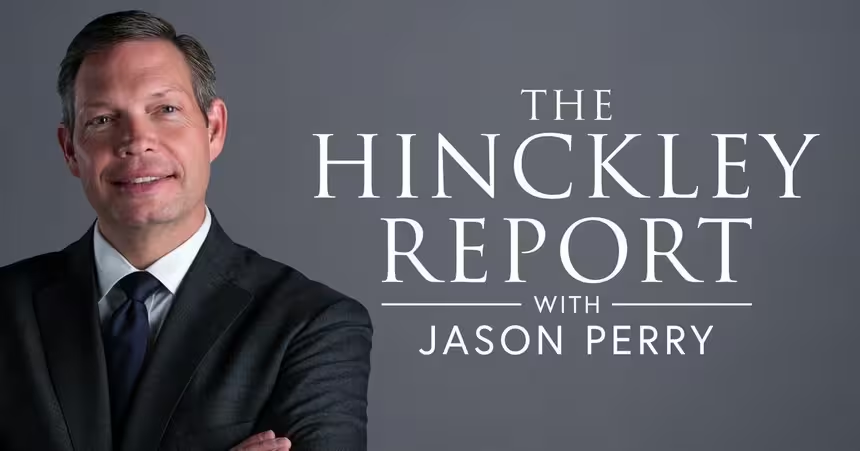
Hosted by Jason Perry, each week’s guests feature Utah’s top journalists, lawmakers and policy experts.Providing Support for PBS.org
Learn Moreabout PBS online sponsorshipJason Perry: On this episode of "The Hinckley Report."
With just one week left in the legislative session, legislators strategize on which bills to pass and which programs to fund.
State and federal courts make big decisions on redistricting.
And state leaders ask for big dollars to save the Great Salt Lake.
announcer: Funding for "The Hinckley Report" is made possible in part by the Cleone Peterson Eccles Endowment Fund, and by donations to "PBS Utah" from viewers like you.
Thank you.
♪♪♪ ♪♪♪ Jason Perry: Hello, and welcome to "The Hinckley Report."
I'm Jason Perry, Director of the Hinckley Institute of Politics.
Covering the week, we have State Senator Stephanie Pitcher, a Democrat from Mill creek; State Senator Chris Wilson, a Republican from Logan and Majority Whip in the State Senate; and Brigham Tomco, reporter with the "Deseret News."
Thank you so much for being with us, coming off the Hill at this very important time as we get ready for the last week of the legislative session.
Thank you for being with us, because we have a few bills to talk about, money to talk about, so many things today.
Let's get into the bills themselves.
Before we talk about some specific bills, let's talk about the numbers because there is a record number of bills that have been introduced as of this week.
But what's interesting is the number of bills versus how quickly we're getting to them.
So Senator Pitcher, let's talk about that for just a second.
We have just over a thousand bills have been introduced.
I know you're a person that reads them all, so that's something.
Over 1,000 bills, but so far only 169 of them have passed all the way through the House and Senate.
Talk about that in terms of the numbers, but also the strategy a little bit, since there are a lot of bills still to be heard.
Stephanie Pitcher: Yeah, there are a lot of bills, and I'm not sure what accounts for the process, why we're going a little bit slower than in years past.
I think at this point in the game, with just a week left, one strategy may be to see if you can take in an issue that's important to you and see if it can be subbed in another bill.
Near the end of the session, we'll have prioritization options where we can send over our top options and get those on the other chambers's boards.
But yeah, we're coming down to the wire, and we'll have to make some big decisions.
Jason Perry: Talk about that strategy a little bit because, particularly in leadership, you have to think about this; when the bills come up, when they get moved forward.
There's a lot of strategy behind this besides just what the content of the bills are.
Chris Wilson: Yes, and first of all, thank you very much for having me.
One thing to clarify, there are a record number of bills in the House.
The Senate, actually, we have less bills this year than last year by four.
So, I think we're doing our job to have less bills in the Senate.
But still, the most important thing right now is prioritizing because there's no way the process will allow for these bills to go through.
And we have been able to eliminate some bills through our committee process, which is why we have committee hearings, and so it'll be interesting.
Last week, you're gonna have a lot of craziness.
A lot of senators and legislators are going to be wanting to get their bills through, knowing that we're limited on how many.
And I would guess we're going to pass less bills this year than last year.
Well, to that point, Brigham, a statement from Speaker Schultz, the Speaker of the House.
In fact, he said this just yesterday.
He said, "I think you'll see us pass less bills this year.
We're behind, trying to do a really good job of vetting those bills."
Talk about that a little bit, because you've been watching this as close as anyone.
Brigham Tomco: What Speaker Schultz has told reporters is that they're leaning heavily on this committee process to vet, particularly the Rules Committee, which is the place where bills go to die or to get a committee hearing.
And so, maybe more than in the past, we're seeing bills stay there and not move through the process.
And for the past few years, Utah Governor Cox has asked lawmakers, "Stop sending me so many bills to sign," right?
And studies have shown that the more bills that are discussed during the session, the less time is spent per bill, and maybe there's less debate, less conversation there.
But lawmakers, so far the legislative leadership in particular, has pushed away proposals that would limit the number of bills to be introduced.
They don't want to limit the freedom of their members, I think, to introduce policies they're interested in.
Jason Perry: In fact, that was a potential resolution by Clint Okerlund, which is interesting.
That one didn't quite get through.
But maybe for a second, since you brought this up, Senator Pitcher, talk about this, sort of this Rules Committee, because there is a little bit of a process here, because these bills do get filtered by a lot of people as they decide what comes up on the board when.
How does that work?
Stephanie Pitcher: Yes, I don't sit on the Rules Committee, but there is a process.
And in fact, one of my own bills was sat in Rules for a bit, and then someone on the Rules Committee asked or approached me about policy and said they had an issue.
And we worked on a sub, and that sub was presented in the Rules Committee.
It was the first time that I had that happen, but there certainly is a vetting process.
And I understand the logic behind starting at the very beginning.
Jason Perry: I'm always trying to get--go ahead.
Chris Wilson: There's a number of bills that need to have committee hearings.
In fact, we've just added some committees to Wednesday morning, so we're gonna have a few more committees both in the Senate and the House to try and help make sure that the bills have a committee hearing.
And that's really where the vetting--you have public comment, which is so important up on the Hill, to have a public comment.
So the committee work is very, very important, and so we've added some committee hearings to Wednesday morning.
Jason Perry: Okay, I want to talk about these committees for a moment, but Senator Wilson, if you'll continue on this.
Right now, the committee that many people are looking at is the Executive Appropriations Committee.
This is a committee that you are on.
And a good thing happened this week.
Since our last show, the revenue numbers came in, $88 million new ongoing dollars and $125 million one-time.
Something we were hoping would be the case, but we didn't know.
Will you please just break out what's going to happen?
Because you have a big meeting today to talk about where all this money's going to go.
Chris Wilson: It has been a crazy week.
We've been there late every night.
Our committee chairs have done a tremendous job, and our Legislative Budget Director, Jonathan Ball, has been really, really busy.
And they've all--we've had meetings every day.
We've been staying late.
The one thing you make sure of, it will be a balanced budget.
We will have a balanced budget in the state of Utah.
And I think today we will come out with the executive appropriations.
We'll finalize that budget, and but it's been a crazy process, very impressive what's done to try and balance that budget.
And I mean, you've got thousands of different accounts that have to be vetted and looked at.
And we've had some cuts this year.
We knew it's a little bit of tighter budget year.
You gotta remember, though, the state of Utah, our economy is doing very, very well.
We had almost $700 million of growth.
Of course, a lot of that was taken out with the Beautiful Budget or Beautiful Bill that eliminated with--gave some tax cuts to some people and federal tax cuts.
So, we've had about $220 million we've added for education, 4.2% for the WPU, huge increase for public education.
And also, a benefits package for our state employees is also something that we are able to fund.
And so we did have some cuts, and so those have been reappropriated.
And I think we're being very, very efficient and effective on spending our taxpayers's money.
Brigham Tomco: Well, something to highlight here is this is a sign of how strong Utah's economy is.
We had come into the legislative session with a $300 million revenue surplus, and that was erased by the Big, Beautiful Bill, right?
It decreased the amount of income taxes that the state could take in, unless it wanted to decouple from federal policy, which we haven't done.
But it turns out that the economy is churning and producing, you know, an additional $180 or $120 million in revenue.
And so this changes the conversation up on the Hill because we had come into the session asking all the state agencies to present 5% cuts to make sure there was the efficiencies there, and that we could, you know, fit in this tight budget year.
And so there may be more wiggle room for those pet projects, or just for the agencies to expand instead of contract, so.
Jason Perry: Senator Pitcher, works on both sides of the aisle.
Everyone's competing for some of these dollars.
Talk about that process from your vantage point.
Stephanie Pitcher: Sure, I mean, there's two ways that you can get a bill funded or project funded.
One is to go through the appropriations process.
And the other, of course, is near the end of session with fiscal note bills.
And like my colleagues have said, there is a prioritization process, and there's only so much money to go around, and we've got to make those decisions.
Jason Perry: Yeah, it's so interesting how many requests are out there.
It's nice to have a little extra money, but wow, a lot of--.
Chris Wilson: Requests well over a billion dollars that we obviously don't have, so it's an interesting process.
We try and prioritize, and our committees do a great job, and everybody sits on the Appropriations Committee and is part of that process.
Jason Perry: I want to get into a couple of bills if we may.
And Senator Pitcher, you've had some very interesting bills dealing with artificial intelligence, with AI.
Maybe walk us through a couple of those, because it seems like this is something that is not just interesting statewide.
The federal government has taken a view of this.
The White House is, so this is about something that we'll have to grapple with over the next couple of years.
Stephanie Pitcher: Yeah, it is, and AI technology is developing incredibly fast.
It's very hard for us to keep up with it, but I do have a couple of bills.
One deals with law enforcement and the way that they use AI technology and integrate it into their reporting.
And there's some really fascinating technology that is-- works with the body cameras that officers wear and will convert that into the narrative reports.
And so one of my bills just requires some transparency around that process so individuals understand the way the AI integrates into that system.
And then there's another bill that I ran that didn't make it out of committee this year, but it deals with pricing discrimination.
And pricing discrimination is a process whereby large companies work with data brokers to buy data that's online on you individually, and then based on what they know about you, they can tinker with the price.
And we know that it's happening.
The FTC has opened an investigation on this process.
My bill would have required companies to provide like a transparency notice to consumers if they do engage in that process.
And the will of the committee was to study this a little further over interim, which I think is a reasonable outcome, but I do hope it's something we keep talking about because it's a fascinating concept.
Jason Perry: Does it get to this dynamic pricing idea?
Stephanie Pitcher: Dynamic pricing is different, so dynamic pricing is based on supply and demand, regardless of what they know about you.
But if you are, let's say you're online, and you do a search for like fever medicine for your kid, and then later you're looking for a thermometer or something like that, the price could go up.
That's just an example.
So, it's based on data that they know about you specifically and less about supply and demand generally.
Jason Perry: Okay, Senator Wilson, let's get a couple of bills that you have been working on.
One in particular that we've talked about on this show is about the courts, and you were the sponsor of this particular bill.
Talk about the origin of this.
This was Senate Bill 134.
It was the first bill signed by the governor, so you got this through pretty quick.
Talk about the rationale behind this, where you did increase the number of Supreme Court justices, the Court of Appeals, and the district court judges.
Chris Wilson: Yeah, it was a high priority of both Senate and House leadership.
And if you read the judicial review, they've had a record number of filings both in the Supreme, the appellate court, and district courts.
So I think this is a record amount of funding for our courts when you add additional two justices to the Supreme Court, the appellate court, and three district court judges along with clerks.
And clerks, of course, are attorneys that will help with, you know, research and also precedent cases.
So, I mean, it's, I think, somewhere around $6 million total.
And from what I can understand, what I've been told, that's the record amount of funding for the courts.
And we know the record number of filings with our increase in population, I think it was well justified.
We were at five Supreme Court justices.
The ten local, the ten closest states to our population all had either sevem or nine Supreme Court justices, and the appellate court, again, was seven.
We think going to nine was something they really needed with a number of case filings.
Jason Perry: Brigham, give us some context on this.
You've done some great reporting on it.
Brigham Tomco: Well, thank you.
So, lawmakers have certainly put a spotlight on the judicial branch of government over the past few sessions.
And we see this as legislative priorities have been held up in the courts for several years, whether that's on abortion or on redistricting, and so lawmakers have framed this as an attempt to increase transparency and accountability in the courts.
And maybe that's not the reasoning behind Senator Wilson's court expansion bill.
But certainly, there's priorities coming from the House on judicial transparency that would require them, the court system, to produce a website and have all their hearings online, with the audio there would also require financial disclosures of judges in a way that is required already of lawmakers, but hasn't been required of judges, making Utah, I think, one of two states in the country that doesn't make that requirement.
And then finally, a bill that would require those challenges to state laws on constitutional grounds to be heard before a random three-panel district court as opposed to the district courts that have been hearing these lawsuits previously.
And so this is part of a tug of war, I think, between the branches of government.
Some see it as a healthy exercise of checks and balances.
And then others, maybe the state bar and former Supreme Court justices, have framed this as an attempt to maybe shape the outcomes of these lawsuits.
Jason Perry: And Senator Pitcher, we're all friends, but you voted against this bill.
Stephanie Pitcher: I did, I voted against it.
I was probably the senator's biggest opponent on his Supreme Court expansion bill.
Look, I've been public about this, but I just--I don't see the need.
And I trust the judiciary to tell us what they need, and this isn't it.
I'm not very persuaded about what other states do.
We've always done things the Utah way.
And if you look at the data from the judiciary, we know that the bottleneck happens at the lower courts, at the district courts.
That's where they need resources.
That's where they need more clerks, and that's where we should be directing our resources.
Chris Wilson: And we did add, later on, we did add the three district court judges.
I think we did listen to the courts.
We did listen, and so we added a lot of resources to the district.
I think that's the first time we've ever added three district court judges-- Stephanie Pitcher: We added three--I apologize.
Not to interrupt, but we did add three.
That's true, but I think they needed many more, many more than that.
I think there's a much greater need than what we were able to meet this session.
Jason Perry: Another issue we'll be talking about, and Brigham, you can give us an update on this a little bit too, talking about the Great Salt Lake.
But this is a very interesting week, when our own governor, Governor Cox, was in the Oval Office with the President of the United States talking about the Great Salt Lake, and it prompted a post from the president.
And I want to read that and get some context from all of you, because it does get to an issue that's the heart of all Utahns, regardless of party here.
Let me read this to you, Brigham, and then you give us some commentary on this.
This is from President Trump.
"Very important to save The Great Salt Lake in Utah.
This is an Environmental hazard that must be worked on, IMMEDIATELY--It is of tremendous interest to me.
The people of Utah are spectacular, and they deserve to be helped.
I am dealing with your very caring Governor, Spencer Cox, and we're going to make it all happen!
MAKE 'THE LAKE' GREAT AGAIN!
PRESIDENT DONALD J.
TRUMP."
Brigham Tomco: So, I see this as a really interesting culmination of a year and a half of relationship building between Governor Cox and President Trump.
The governor endorsed the president before the 2024 election and has focused over the past year or so in collaborating with him on different issues, and it seems to be paying off.
Over the past weekend, the governor was in Washington DC for a National Governors Association meeting, and legislative leadership told us he spent an hour one on one with the president talking about Utah priorities, and that included the Great Salt Lake.
And the governor told reporters that he requested $1 billion in federal funding because, to solve this problem, they need regional buy-in, federal government assistance.
And so this, I think, might be the clearest example yet that the president is aware of Utah and Utah's governor.
Jason Perry: What do you make of that, Senator Wilson?
Chris Wilson: It's interesting, and we were able to meet with the governor yesterday on some budget items, and he did mention that the meeting was scheduled for 15 minutes.
And so then he was able to spend I think an hour, over an hour, with the president.
And so the president does care about Utah, and he does care about the Great Salt Lake.
I think it's great.
And you look at our state funding, where we just purchased US Magnesium assets to try and--and we were able to purchase a number of water shares.
And we've spent hundreds of millions of dollars, and it's gonna be great to have some federal help.
And I just appreciate President Trump, and knowing this is on his radar and he's committed to it.
It's a big deal for the people of the state of Utah.
Jason Perry: Of course, Senator Pitcher, on your side of the aisle, this is something that has been discussed greatly as well, the Great Salt Lake, not just implications here, but statewide and even regionally.
Stephanie Pitcher: Yeah, yeah, that's right.
Look, I'm grateful for the bipartisan approach to the lake.
I'm glad that it's on the president's radar.
Talking about it is one thing, action is another, and so I'm very hopeful that we see federal dollars coming in to help us.
Jason Perry: Okay, let's get into three big things that happened on redistricting this week.
We teed this up a little bit last time, but we have decisions.
And Brigham, let's start with first what happened here.
The district court was reviewing the case brought by Congressman Burgess Owens and Congresswoman Maloy to try to eliminate the map, the new map that was chosen.
A decision just came out this week.
Talk about that.
Brigham Tomco: So, on Monday, a three-judge panel of federal judges ruled that these two members of Congress from Utah are not able to move forward with this argument to return to the 2021 congressional map because it's too close to our primary election season.
And that relies on a Supreme Court principle called the Purcell doctrine, which just states that federal courts should try not to intervene with state elections this close to--in Utah, we have the caucus convention system starting in just a couple of weeks.
Now, one thing to highlight is that one of the judges, a President Bush appointee, said that he didn't buy that argument.
The primary process hasn't started yet in Utah.
He thought that there were some issues, you know, with the argument that the judge, Diana Gibson, had violated the elections clause, but said it's because of her decision to, you know, take the map selection process into her own hands that led us to be here in the first place.
And so I think that the judges thought this was a messy situation that Utah is in.
It wasn't a clear decision, so.
Jason Perry: Some comment on that, Senator Wilson, because these events are coming very quickly, and the court did not want to weigh in on it.
It seemed like they were not thrilled that they were even asked to do it.
Chris Wilson: Yeah, it's kind of an interesting process, and we appreciate the Congress, Congresswoman Maloy and Congressman Owens, in looking at this.
I'm sure they still have a decision to make whether they want to appeal it to the Supreme Court.
I think it's still a possibility.
And there's still a possibility if maybe we can look at maybe moving the dates even further back a couple of weeks is probably still an option that we can look at, but I'm not quite sure.
We'll see what happens, what Congresswoman Maloy and Congressman Owens would like to do.
Jason Perry: Senator Pitcher, put on your legal hat, attorney as well, because the Utah Supreme Court also ruled on Friday that they upheld the map that had been put in place.
Stephanie Pitcher: Sure, yeah, the Utah Supreme Court's most recent ruling was on procedural grounds based on appellate timelines, deadlines, and things like that, but I support the decision.
I think they made the right call.
Jason Perry: Yeah, we'll see.
At least right now, the map, as the new map is in play, which leads to Proposition 4, Brigham.
Can we talk about that a little bit?
Because also a big one on that, you had to get a lot of signatures to get this initiative on the ballot to repeal Prop 4.
That's what the initiative is, and it looks like a couple of major hurdles just got--were just met.
Brigham Tomco: So yeah, so real quick, it's helpful to think about this in two different categories of opposition to Prop 4, which we know is the redistricting law passed in 2018 by voters.
One is this legal challenge side from the legislative defendants, and then also these members of Congress, Representative Owen and Maloy.
And then the other vehicle for opposing Prop 4 is a repeal effort by the Utah Republican Party.
So, this is an effort to put Prop 4 on the ballot a second time.
And so, to do that, you have to gather 8% of signatures statewide, so that's about 8% of voter signatures, and so that's about 141,000.
As of this morning, they have 158,000 signatures that have been verified statewide, and they've met the threshold in Senate districts.
You have to get 26 out of the 29 Senate districts hitting that 8% threshold.
They've done that in 25 districts and have eight signatures left.
But one catch in all of this is that there's been a coordinated campaign by Better Boundaries, the group behind the original Proposition 4 ballot initiative, to remove signatures, and so we'll have to wait a couple more weeks to see whether this removal--signature removal campaign brings the effort back down below the threshold, so.
Jason Perry: Senator Wilson, they need 26 of 29 Senate districts.
They're within a few votes of actually doing that, so what happens next?
Because there's this big effort, including a video from Congressman Moore saying, "Just let this thing get on the ballot.
We don't need to try to remove signatures," because that's something that could happen.
People could take their names off if they wanted to.
Chris Wilson: Yeah, and the good Congressman was the co-chair of the original Better Boundaries, so he kind of understands what the original intent was.
So he is coming out, and it's allowing the public to decide.
Originally, the original Prop 4, and now, I don't think there's any issue why we shouldn't allow the public to decide.
It obviously passed with only 7,000 votes.
So we have to go through re-elections, at least Senate, we do every four years, House of Representatives, every two years, and so we go to the voters to decide.
So I think it's very reasonable to go to the voters this time, and it sounds like it's going to be able to be put on the ballot.
Stephanie Pitcher: Well, and if I may, the voters did decide in 2018.
It's been eight years since the voters decided on Prop 4, and the legislature still hasn't delivered on that ballot initiative.
And I think it's time that we make good on what the voters wanted.
I understand there's a process now on a potential repeal, but the voters did decide, and we need to deliver.
Chris Wilson: Well, just like voters get to decide, again, just like with me, every four years, they decide whether they want me to represent them or not.
So I think after seven years, eight years, it's time to probably let them try to decide again if they still continue to support Prop 4.
Stephanie Pitcher: But we don't put your election on pause for four years after they've decided the first time, and that's the point I'm making, is they decided in 2018.
We need to deliver on that while this process also plays out.
Jason Perry: I want to keep on elections for just a moment, too.
Brigham, very interesting lawsuit, the state of Utah is being sued by the Department of Justice.
Some of our viewers may know that the Civil Rights Division sued Lieutenant Governor Deidre Henderson this week because they had requested voter registration information, specifically names, dates of birth, addresses, driver's license numbers, and the final digits of Social Security numbers.
Our lieutenant governor refused to give that information.
The lawsuit came along with the lawsuit in 29 other states.
Talk about that for just a moment.
Brigham Tomco: Yeah, so I think this fits into the vision of the Trump administration, which is to increase federal oversight over elections in the name of election security.
This has led to President Donald Trump saying things over the past couple of months like, "Elections in some cases need to be nationalized or taken over," quote-unquote, "by the Republican Party."
And so, in Utah, they've always kind of led out in innovative election policy, and so there has been a tension there this session between the federal government's desire to oversee that process and Utah wanting to manage its own voter rolls and election system.
Jason Perry: I want to give the statement from Lieutenant Governor Deidre Henderson.
And Senator Wilson, if you give a comment after I read it, because she seems fairly resolute in her decision not to give up this information.
She said, "Neither state nor federal law entitles the Department of Justice to collect private information on law-abiding American citizens.
Utahns can be assured that my office will always follow the Constitution and the law, protect voters' rights and administer free and fair elections."
Chris Wilson: Yeah, and we did also have a conversation with the Lieutenant Governor yesterday, was also in our budget meeting.
And she did talk about this, and there's been other red states that have been sued.
And I don't know how much they're going to pursue this, the Department of Justice, and we do have to be careful.
I mean, the Trump administration, and I know we'd all be very, very concerned during the Biden administration or another administration maybe in the future, what they could do with that information.
So, we do have to be careful.
And like I said, there's other red states, along with Utah, who have denied, and they have been sued.
And I don't see the Department of Justice, I'm not quite sure, but I don't know if they're going to really pursue it.
They did file it, but I don't think it's going to interfere with the state of Utah and what President Trump is willing to help us with going forward.
Jason Perry: Senator Pitcher, a comment on that because, of course, the administration is saying that this is to make sure the states are adequately maintaining their voter information records.
That was the stated purpose, in any event.
Stephanie Pitcher: Yeah, I think that data privacy is so important.
It's probably largely a bipartisan issue.
Voters want to know that if they're giving their data that it's going to be used for the sole purpose of the elections process, and we wanna maintain voters's trust in that process as well.
Both Senator Wilson and I will be candidates again, and we want to be able to obtain that data to engage our potential voters.
And if voters become more reticent to make their records public or to provide their data in the first place, it makes it harder for us to reach voters, and I think it just weakens the process overall.
Jason Perry: Maybe just a couple of seconds, Brigham, talk about that and the people you're talking to about their information being out there, and then we'll wrap up.
Brigham Tomco: Sure, well, I think this fits into several policies being considered this session that are re-examining Utah's election laws.
In the past, the default in Utah has been to allow voters to make their information private, and they're thinking about reconsidering that just after the last few election cycles and the complaints that have come from candidates.
Jason Perry: Okay, we'll watch this one closely.
Thank you so much for your insights.
Good luck the last week of the session.
Brigham, we look forward to reading the stories.
And thank you for watching "The Hinckley Report."
This show is also available as a podcast.
Thank you for being with us.
We'll see you next week.
announcer: Funding for "The Hinckley Report" is made possible in part by the Cleone Peterson Eccles Endowment Fund, and by donations to PBS Utah from viewers like you.
Thank you.
♪♪♪ ♪♪♪

- News and Public Affairs

Top journalists deliver compelling original analysis of the hour's headlines.

- News and Public Affairs

FRONTLINE is investigative journalism that questions, explains and changes our world.











Support for PBS provided by:
The Hinckley Report is a local public television program presented by PBS Utah
Funding for The Hinckley Report is made possible in part by Cleone Peterson Eccles Endowment Fund, AARP Utah, and Merit Medical.