
2026 Legislative Session Week 3
Season 10 Episode 21 | 26m 36sVideo has Closed Captions
We discuss the changes coming to Utah's courts, plus will Utahns see another tax cut?
With week 3 of the session in the books, lawmakers make major moves to reshape Utah's courts. Our panel discusses this will impact the state's judiciary. Plus, as legislative leaders consider additional tax cuts, state agencies defend their budgets. Republican Senator Mike McKell, Democratic Senator Jen Plumb, and journalist Daniel Woodruff join this episode of The Hinckley Report.
Problems playing video? | Closed Captioning Feedback
Problems playing video? | Closed Captioning Feedback
The Hinckley Report is a local public television program presented by PBS Utah
Funding for The Hinckley Report is made possible in part by Cleone Peterson Eccles Endowment Fund, AARP Utah, and Merit Medical.
2026 Legislative Session Week 3
Season 10 Episode 21 | 26m 36sVideo has Closed Captions
With week 3 of the session in the books, lawmakers make major moves to reshape Utah's courts. Our panel discusses this will impact the state's judiciary. Plus, as legislative leaders consider additional tax cuts, state agencies defend their budgets. Republican Senator Mike McKell, Democratic Senator Jen Plumb, and journalist Daniel Woodruff join this episode of The Hinckley Report.
Problems playing video? | Closed Captioning Feedback
How to Watch The Hinckley Report
The Hinckley Report is available to stream on pbs.org and the free PBS App, available on iPhone, Apple TV, Android TV, Android smartphones, Amazon Fire TV, Amazon Fire Tablet, Roku, Samsung Smart TV, and Vizio.
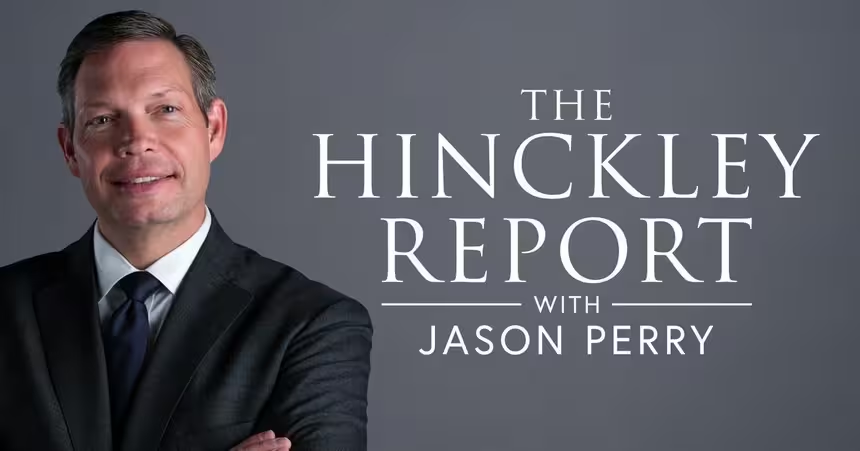
The Hinckley Report
Hosted by Jason Perry, each week’s guests feature Utah’s top journalists, lawmakers and policy experts.Providing Support for PBS.org
Learn Moreabout PBS online sponsorshipJason Perry: On this episode of "The Hinckley Report."
With week three of the session in the books, legislators make moves to reshape Utah's courts.
Lawmakers debate tax cuts, while state agencies defend their budgets.
And a new lawsuit makes waves in the battle over Utah's congressional districts.
male announcer: Funding for "The Hinckley Report" is made possible in part by the Cleone Peterson Eccles Endowment Fund, and by donations to "PBS Utah" from viewers like you.
Thank you.
♪♪♪ ♪♪♪ Jason Perry: Hello, and welcome to "The Hinckley Report."
I'm Jason Perry, Director of the Hinckley Institute of Politics.
Covering the week, we have Senator Jen Plumb, a Democrat from Salt Lake City and Minority Assistant Whip in the Utah Senate; Senator Mike McKell, a Republican from Spanish Fork and Majority Assistant Whip in the Utah Senate; and Daniel Woodruff, politics reporter with "KSL."
Thank you so much for being with us.
Week three of the session, does it feel like week three?
Daniel Woodruff: No.
Sen.
Mike McKell: Yes.
Sen.
Jen Plumb: I was gonna say yes and no, yes and no.
The heat's up, and also the fatigue's real, so there you go.
Jason Perry: Yeah, it's starting, and so many bills, record number of bills coming out.
I want to talk about that for just a moment.
But Senator McKell, let's start with you on--it's interesting that one of the very first bills passed, definitely one of the very first bills signed by the governor already, has to do with the courts.
We suspected there would be some conversation about the courts.
Talk about this, when it comes to the expanding the Utah Supreme Court.
Sen.
Mike McKell: Yeah, and let's just look at it from a broader perspective.
We did expand the Utah Supreme Court.
I think there's been some need there, but we also expanded two judges on the Court of Appeals.
We also expanded three district court judges.
Senator Plumb and I both will have a judge in the areas we represent.
The Third District Court up in Salt Lake will have another district court judge, the Fourth District Court down in Utah County.
And the big need was down in Washington County, so the Fifth District Court.
There are a lot of needs.
Our state has grown.
When you look at states that are similar to our size, most of those states have seven members of the Supreme Court.
We did expand, but that comes with additional resources as well.
That includes four additional law clerks on the Supreme Court.
A lot of need for a lot of years.
Obviously, there are some folks that didn't want to see the Supreme Court expand.
I think there's a pretty broad consensus that expanding the Court of Appeals was needed, as well as those district court judges.
I feel really good about where we landed at.
I'm glad we got that through early in the session.
Jason Perry: Daniel, what are you hearing about this one?
Because there are definitely two sides to this, including from the side of the court.
Daniel Woodruff: The Utah State Bar was pretty opposed to the expansion of the Utah Supreme Court, and they held a press conference this week, a pretty lengthy one, talking about that.
Although, curiously, they held it after the bill was already law.
Governor Cox signed it very quickly last weekend, and then they held their press conference on Tuesday.
But they had a lot of concerns about that generally, and about the overall broader issue, which we've heard now for a couple of years in a row, that they perceive the legislature is coming after the courts, that they've been unhappy, the Republican-controlled supermajority over some decisions from the Supreme Court and district judges, and that they are coming after the courts with an effort to remake the judiciary.
That's the complaint from people like the Utah State Bar.
Certainly, a debate to be had about whether that's the case, but they had a lot of people stand up and talk about various bills and proposals that they feel like gets into the independence of the courts, which is a separate branch of government.
Sen.
Jen Plumb: Well, and that's a challenge, I think, a little bit of that "What are we doing?
Why are we doing it?"
that I observed from constituents and from folks who are worried about this, that the timing made people have some suspicions that this was about more than just what kind of court load, or excuse me, case load was there, what kind of backup was there, given that there had been these controversial decisions to some recently, whether it was about boundaries or abortion, but that there, some felt the optics were off.
I ultimately felt better knowing that we were expanding these lower courts because you don't increase a judiciary's power to do more by just increasing the top.
You have to get the whole way up, so I do think that we did good work, and I do also see why folks had concerns.
Jason Perry: Senator McKell, related to this, we talked about this constitutional court on the show last week on "The Hinckley Report."
Some changes have happened since then.
I think you've been connected to those changes.
Talk about how this constitutional court has changed and why.
Sen.
Mike McKell: Yeah, so we are considering a constitutional court.
That bill is coming through the Senate right now.
And the big change is that'll be a panel of judges, and it'll do a standard rotation.
I'm an attorney.
When I file a lawsuit in the Fourth District Court, for example, where I'm at, that just gets assigned randomly to a judge, and that's what we're--that's what we envision with this constitutional court.
You'll have a panel of three judges, and those cases will be assigned on a rotation.
The idea that you could forum shop, it wouldn't happen in that scenario.
But just going back to the expansion of the Supreme Court, just briefly, I'm an attorney.
I hear from a lot of attorneys across the state that they're very appreciative of the expansion of the Supreme Court and those courts resources.
I've heard privately from a number of judges, more judges than I would have expected that have reached out to me privately, thanking the legislature for doing that.
Sometimes, I think the bar up here in Salt Lake is a little bit isolated.
There are a lot of attorneys that see it differently than the Utah State Bar, and that's kind of been a theme.
I've been in legislature for 14 years, and I, unfortunately, I think the Bar is fairly isolated from the rest of the attorneys throughout the state, and it's just an unfortunate trend.
Jason Perry: Senator Plumb, talk about that one too, because it does seem like there are several of these bills we might, I think we've seen all we're going to, but just a really quick recap from your side of the aisle on this issue.
Sen.
Jen Plumb: Well, I think that, and my colleague Senator Pitcher, has been pretty vocal on this as someone who exists within the judicial system.
And it has felt like there is an attack on the judiciary, and that there has been kind of, to somewhat feels like an undermining.
And for me, one of the frustrations about that was we weren't having as many conversations about that within our communities and within our spaces because there were a lot of distracting bills that were coming, especially out of the House, that had people's kind of wow factor.
And I wish we would have been able to have more conversations about them, because when we do sit and talk about them, we can find the sense pieces where we may find more kind of consensus.
But we didn't, I feel like, have enough conversations around those for a lot of folks within my spheres to feel like they were heard.
Daniel Woodruff: And I would add too, Jason, on the judiciary, it's interesting to have heard from the governor on this issue.
When the session was beginning, we sat down with him to talk, and he was very supportive and obviously signed the bill into law that expanded the Supreme Court, the Court of Appeals, and the district courts a little bit.
But he also noted that he feels like a lot of the bills from previous years that have become law are still being implemented regarding the courts, and he wanted to sort of see those play out a little bit.
And he noted, I think fairly strongly in our interview, that he has less of an appetite this year for further bills on the judiciary than he's had in quite some time.
Jason Perry: Senator McKell, all of this at least has some connection to redistricting.
That's certainly why we started to talk about the courts so much.
And talk about this very interesting federal lawsuit.
This week, Representative Burgess Owens and Congresswoman Celeste Maloy, interesting, they have filed a lawsuit saying that the maps in play in the state of Utah would suffer and Utahns would suffer irreparable harm if that new congressional district map was put in place.
Sen.
Mike McKell: Boy, I'll tell you, Jason, that's a difficult issue.
There's a lot of chaos surrounding the elections.
I know I get asked, I get asked in town hall meetings about that and what's going to happen next.
And to be honest with you, I don't know.
It's not clear in my mind.
I certainly feel like Congresswoman Maloy, Congressman Burgess Owens, they have standing to bring that suit.
I think their rights have been impacted, but it's a difficult case.
I think there's a lot of chaos that's been created by some of these decisions we've seen in the state.
It's interesting that that has come up through the federal system.
I think the federal court is an appropriate jurisdiction for those federal offices, but now we've got a dual track with a federal lawsuit and a state lawsuit, and I'd just say buckle up.
There's a lot of chaos, and we're going to have to see how it plays out.
Sen.
Jen Plumb: Irreparable harm is an interesting choice of words, right, because there are a whole lot of Utahns who feel like they've been irreparably harmed by not being represented.
And there were a whole lot of Utahns who voted for the ballot initiative that put this whole process into play.
So I suppose I have a little less sympathy/empathy for people who have something to lose when there's a whole lot of Utahns who feel like they have not been represented and have lost a lot.
Jason Perry: Well, one of the options underway, Daniel, is a potential initiative to get rid of Proposition 4, and it's by signature gatherers that are happening right now.
I just want to talk about what's happening right there because there are two weeks to get the signatures in.
As of this airing of the show, they've verified 72,000 signatures to eliminate that Prop 4.
They're going to need about 75,000 signatures in the next little while.
Talk about that because there's a lot of controversy around the signatures themselves.
Are they going to make it?
Are they going to get it in all the districts they're supposed to be in?
Daniel Woodruff: Yeah, and it's been a big activity.
I was at Costco yesterday and got approached by a signature gatherer.
I politely declined to sign because I don't sign petitions as a reporter.
It's not my role, so I report on them.
But the issue here, I think, is we have heard, kind of from both sides of the signature-gathering effort, will they get enough?
Will they not?
I think that's one thing, but we have reported on people who have felt misled by signature gatherers and characterizing what they're actually signing.
You're overturning Proposition 4 through your signature, you're supporting it, but there are some signature gatherers, as we've reported, that are saying other things, that are trying to get people to put their name on that.
On the other hand, we've heard of signature gatherers being assaulted and being accosted, and physically taking their papers and ripping them and things like that.
Police departments have confirmed this, and so it's been a very contentious issue.
I think over these next two weeks you'll see an all-out push to get those signatures because, as you mentioned, tens and tens of thousands remain in order to get that.
Not only do they have to get a number of signatures, they have to meet a certain quota in, I think it's 15 of the 29 Senate counties.
And so there's a fairly high bar for them to reach.
We'll see if they can.
Jason Perry: I think on this one, I think it's an 8% threshold, 26 to 29, I think, is the requirement, which is quite a few of those districts.
And Senator Plumb, talk about this, because Daniel is so right about this.
People are being accosted because of this, a lot of discussion, and even the Utah County clerk is saying there may be some fraud associated with some of the signatures.
Sen.
Jen Plumb: It sure feels a lot different than any of the other signature-gathering spaces I've witnessed or been a part of.
I think that when there was a signature-gathering effort that went towards the repeal of 267, which was the union bill, we saw a huge push out across the state, and it went very professionally.
It was thoughtful, it seemed to me.
I didn't hear a whole lot of people saying that there was this kind of scuffle situation going on.
And the number of texts I get from people who say, "Can you tell me what these signature gatherers are really gathering for?
Because they're telling me it's this" has been a bit remarkable to me.
So, I think that there is likely further conversation for us to continue to have about signatures, whether that's in these ballot initiatives or our individual elections.
This doesn't feel right.
That being said, it is the process.
Daniel Woodruff: Jason, you alluded to the investigation in Utah County into fraudulent signatures.
The county clerk there has said they've identified a number of signatures that don't smell right, don't look right.
And I think it's interesting that the Republican Party chair, Rob Axson, on both sides has been, I think, fairly consistent.
He's condemned those who are attacking the signature gatherers, but he's also condemned anyone who would dare to submit a fraudulent signature.
He says that this effort has no place for that, and anyone who's caught doing that has no place gathering.
Jason Perry: Senator McKell, talk about where this initiative goes to repeal because they--do you think they're going to get the signatures?
What do you think is happening overall?
Sen.
Mike McKell: Yeah, and Jason, I do think they're going to get the signatures.
The last two weeks in my own law office in Spanish Fork, we've opened up the doors.
We've allowed them to come in and gather signatures.
Last Saturday we had about 250 people came in and signed.
We've had peaceful protesters both weeks, and it's actually flowed just fine.
But some of these concerns with the fraud, I share those concerns.
Some of these signature thresholds are so difficult and so high that this fraud, there's almost an incentive to see that.
You know, not to change the subject entirely, but I've got a bill, an election bill, where we look at signature thresholds, and we try to bring some of those thresholds down because right now the incentive is to get as many signatures as you can.
And I think that's why we're seeing some of this fraud, and I think it's a real concern.
Jason Perry: Final word on this one, Senator?
Sen.
Jen Plumb: No, I agree.
It's a conversation that needs to continue, but I also always encourage us to do better.
And I think that's what we need to do; figure out a way to do better.
Jason Perry: Okay, Daniel, can we talk about taxes for a moment?
Daniel Woodruff: Sure.
Jason Perry: Okay, I just want to hear what you're getting from people on the Hill.
And then let the legislators talk about this, but there is a potential income tax cut on the table.
We talked about it on the show.
It's out of committee, but we're hearing this is maybe connected to some other tax cuts.
Talk about the intent of the legislature as you're hearing it, and then we'll get the word from them on these tax cuts.
Daniel Woodruff: I'll start with the income tax cut, and let these two add from their perspective, but sixth year in a row, potentially, cutting the state income tax.
This has been a major priority of legislative leaders, particularly Senate President Stuart Adams.
They have talked a lot about this since 2021 when they began cutting this income tax.
Every year it's a little bit here and a little bit there.
This year proposes to drop it by 0.05%, which the Taxpayers Association tells me is about $45 a year for a typical family.
That's a pretty big criticism point I found in my reporting from people, because they point to that and say, "Why would you cut taxes to that small amount when you could put it toward social programs, or things that might make a broader community difference?"
But the Taxpayers Association in particular has told me that this tax cut year after year has added up to the tune of hundreds of dollars for Utah families, and this is just a continuation of that effort.
And so, we'll see if it happens.
I think it is heavily dependent on the projections in the budget that will be out later this month, whether or not there is that money.
Sen.
Jen Plumb: And you mentioned social services.
I sit on the Social Services Appropriation Committee, and they are some of the most heart-wrenching testimonies to sit through, because these are people who truly need help from the state and need supports from the state.
And we did, as Utahns, get a huge tax break that came out of that, what I won't call it, bill out of the feds.
It has another name.
Sen.
Mike McKell: The Big Beautiful Bill.
Sen.
Jen Plumb: No, it says there's another name.
I can't quite think of it.
No, exactly, but there was a very large tax cut that came out of that, and that actually then impacted the taxes that the state of Utah can collect, so the amount of money that Utah can then spend has shifted significantly.
And I understand why tax cuts are important.
I really do, but I also think we possibly have hit that threshold where we need to be a little bit more thoughtful because the things that we're risking losing are very important to some of our most vulnerable community members.
So I would much rather have us spend on those in need than cut a little bit more this year, more than the federal system already has cut.
Jason Perry: Senator McKell, last thought.
Sen.
Mike McKell: So, Big Beautiful Bill did cut about $300 million in taxes.
Daniel is exactly right.
The Senate president, it's been a big priority for him, but I think it's a priority for the legislature.
I hope to see an income tax cut, but let me tell you one thing that's been remarkable.
We've been able to cut taxes at the same time we've been able to raise teacher salary, and we're gonna do that this session.
We've already allocated some increases for teachers, but I think we can do both.
I'd like to see six years in a row cutting income tax.
Jason Perry: I wanna get to a couple of other issues.
We're gonna get through this quickly because we've got a few bills I wanna get to as well.
But Daniel, can we talk about the SAVE America Act for just a moment?
This is very interesting because it's happening from Senator Mike Lee in Washington DC, talking about voter eligibility.
Essentially, the idea is you need to have proof of citizenship to register to vote, and then your ID, real ID, to actually vote.
Talk about those two things, because there's some discussion about why those two things should be required.
Daniel Woodruff: Well, there's been a big push, especially on the Republican side, to get that for a vote in the US Senate.
And if you just go on social media, it seems like almost anything that Senator Curtis or Senator Lee or anyone in the federal delegation posts, every comment is from the supporters of the SAVE Act; "Push the SAVE Act forward."
Obviously, there is a lot of criticism about requiring people to have that, and worries about disenfranchising voters who may not have that form of identification, or who may just not be as prepared to do that.
And so the debate is what it is.
It's been around for a long time.
But at this point, we haven't seen the SAVE Act move forward, just a lot of pressure to do so.
And we've also seen bills at the state level here in Utah that mirror some of the provisions of the SAVE Act, that would require proof of citizenship or things like that, with the same goal that Senator Lee has--I forgot the word--has expressed.
Jason Perry: Yeah, he has expressed that.
Talk about that for a minute, Senator McKell, from your perspective on that, because some of these components have been put into place in law, as Daniel said already, in Utah.
Sen.
Mike McKell: Yeah, and I think the SAVE Act's got a lot of great components.
But I think to Daniel's point, to what you pointed out, most of what's in the SAVE Act is already implemented in the state of Utah.
We're very, very careful.
We did an audit, and the audit is ongoing.
We looked at the number of folks who may be illegal that are voting.
So far we found one person that didn't vote that was registered that may be illegal.
That's still ongoing, but we're doing a really good job in the state of Utah making sure that the appropriate people that should be voting are voting.
I think there's a lot of great components in the SAVE Act.
Jason Perry: Senator Plumb, one comment too, if you will, to this point that Daniel made also.
Some of the arguments are about there are a lot of people that don't have all these documents.
I think it was 146 million Americans don't have a passport.
Sometimes when you get married, you might not have documents that have the name that you're using.
Sen.
Jen Plumb: The name changes, something you get divorced similarly.
And I appreciate Senator McKell bringing up actually how well things are going in Utah because what needs saving in America right now is apparently not the same.
Senator Lee and I are not seeing the same things because I don't see that we need voter suppression to save America.
I don't see that we are having these enormous voter fraud and stolen elections.
I really don't see that.
And I actually watch how well our state works in this space with, really, diligence and thought to making sure that our elections are trustworthy, and so I find it to be harmful rhetoric.
And the saving that I think America needs is the saving of our Constitution, looking at what's happening in our cities right now with people feeling threatened that they're not safe, people losing their rights right and left.
And so saving America being about fixing our elections to me doesn't jive.
Sen.
Mike McKell: Can I say one thing, too?
Our lieutenant governor, Deidre Henderson, does a remarkably good job.
For the past couple of years, she's been unnecessarily attacked, and there's been a lot of criticism of her by a faction of the Republican Party.
It's interesting, as these audits, these studies, have come out, it's validated.
I mean, they've lost all their lawsuits.
But as we look at it, it's validated, what we already know.
Those elections have been running very well.
And I think we've got to give some credit to our Lieutenant Governor.
I think Deidre Henderson has done a very good job, and I think those criticisms are very, very unfair based on what we see.
Sen.
Jen Plumb: Agreed.
Daniel Woodruff: And one thing we've seen in the news this week is President Trump calling to nationalize elections in certain states, as he continues to push this idea that there is voter fraud in Democratic-led states.
And Lieutenant Governor Henderson came out very strongly against that, as well as others.
Senate Majority Leader John Thune, others that are of the president's party, came out and basically said, "Nationalizing elections is probably not the way to go.
We have a pretty strong tradition of states running those elections."
Jason Perry: Let me get--thank you for that.
Let's get to a couple more bills, and Senator McKell, to one that you are particularly connected to that people might not realize so much.
Look, we're gonna have to talk about what it is: kratom.
All right, talk about what it is, because this is some regulation.
I think this is something people should know about.
Sen.
Mike McKell: And I'm actually glad I'm here with Senator Plumb.
She's a doctor in the real world.
She's done more work to deal with opioid addiction and the use of naloxone than anybody in the legislature.
Kratom is an opioid.
It impacts your opioid receptors.
A lot of folks call it "gas station heroin."
There is an industry that started as a multi-million-dollar industry.
It's now a billion-dollar industry.
This is a very dangerous product.
It should not be sold in gas stations.
It should not be sold in smoke shops.
You got a pretty big lobby out there with a lot of money trying to push this on states across the nation.
It's inappropriate, and we need to get it off the shelves.
There's no doubt: this is an opioid.
It's killing folks.
In 2019, we passed the Kratom Protection Act in the state of Utah.
And the moment we passed that bill, our deaths skyrocketed.
It's not working, and people are dying, and I'm glad you brought it up.
It's a form--it's gas station heroin.
That's what it is.
Let's call it what it is, and we need to get it off the shelves.
Jason Perry: Senator, can I show a video?
And then, particularly as a physician, it's so important to get your perspective on this.
There was a hearing just this past week on this very thing.
And I wanna show some responses from some of the public, and then I'd just love to have your lens on this.
Sen.
Jen Plumb: Absolutely.
Jason Perry: Okay, let's show the video.
male: I'm a widower because I lost my wife to this product.
female: Over time, the substance changed how he thought and functioned.
He lost his job, dropped out of school, and moved out of state.
female: When I go and take it, within 15 minutes, my body can walk.
I can function in life.
female: To straight out ban plain leaf powder would be a death sentence in my life.
Jason Perry: A couple of sides on that from the testimony.
Sen.
Jen Plumb: It's really hard to watch because there are people who really do feel that their life has been bettered by access to this substance.
And then the reality is that the way that it has been pushed out across our state and the frank greed, I would say, from the folks who are making, distributing, and selling it is going to result in those folks not being able to have access to the product.
We talk about the pure leaf tea.
I do think, you know, and I think a lot of us have had these conversations, there's something in there that's worth exploring.
But the greed and the recklessness has made it to the point where we can't trust it to be out there and safe for our citizens.
And for the last six years, sadly, I've watched, much like Senator McKell has, as it's gotten out of control.
And the numbers of deaths that had Kratom involved in them were, you know, one or two.
Still too many, but now it's over 100 every year.
So this has to, unfortunately, be hit with a hard hammer because I don't think there's a way to regulate it when there's been so much recklessness around getting it out there to people.
Jason Perry: Daniel, just tell us what you're hearing.
Daniel Woodruff: From--I just want to say first, from a journalist's perspective, it's very interesting to see.
You rarely hear a lawmaker say, "I voted wrong," and Senator McKell has said that he voted wrong on legalizing kratom and bringing it into the mainstream, and now is trying to reverse that.
So just from that perspective, this is fascinating to me.
But what am I hearing?
We get voicemails from people who call in with pretty horrific stories about losing loved ones, either to kratom or to suicide, and debt that they've racked up and things like that.
And so I won't weigh in one way or the other on the issue, and I'm certainly not a physician, but there is a strong case being made out there that Utah maybe got it wrong a couple of years ago and needs to fix it.
We'll see what happens as the session plays out.
Jason Perry: Okay, last word on this.
I Sen.
Mike McKell: mean, just last word.
This is an industry that I don't trust or respect at this point.
This last week, they've been heavily lobbying Capitol Hill.
They've brought some research from a group called Pinney and Associates.
And they're probably going to watch your show, and they're gonna be concerned about my comments.
But I've got their 990s.
I've got the tax returns for those folks associated with kratom.
And I can tell you that Pinney Associates, this medical science that they're using to promote this product, was paid for by the kratom industry.
They're a big lobby.
There's a lot of money on the line, and I get that.
But I appreciate Daniel's comments.
I voted for this in 2019.
I wish I never had.
I didn't run the bill, but I did, I did vote for the Kratom Protection Act.
That was a mistake.
And I hope I get a chance to make it right and eliminate that protection.
Jason Perry: Senator, go ahead.
Sen.
Jen Plumb: No, I'm just--there's a lot of thought that's gone into this, and there's a lot of sadness behind why the thought has had to go into it.
So, onward we go.
Jason Perry: Okay, any big issue we're going to see this next week?
Just give us one preview in our last 30 seconds.
Sen.
Mike McKell: Social media tax.
Jason Perry: Okay, I always love to get the preview on that.
Sen.
Jen Plumb: Of what to expect?
Well, and I'm deeply concerned about some of the bills that are coming over from the House.
I think that our first three weeks in the Senate, we've had good debates.
We've had quality agreements and disagreements on things, but we have been looking at good policy, I would say.
And the things that are coming over from the House really concern me.
There's some really big threats to folks.
Jason Perry: Okay, Daniel?
Daniel Woodruff: Whatever comes over, I'll be watching.
Jason Perry: You'll be reporting on it, whatever it is.
Well, thank you for this.
And we do have a record number, so we're gonna see a lot of interesting bills.
I encourage everyone to check out the website and see what's coming.
And we thank you for watching "The Hinckley Report."
This show is also available as a podcast.
Thank you for being with us.
We'll see you next week.
announcer: Funding for "The Hinckley Report" is made possible in part by the Cleone Peterson Eccles Endowment Fund, and by donations to "PBS Utah" from viewers like you.
Thank you.
♪♪♪ ♪♪♪ ♪♪♪

- News and Public Affairs

Top journalists deliver compelling original analysis of the hour's headlines.

- News and Public Affairs

FRONTLINE is investigative journalism that questions, explains and changes our world.











Support for PBS provided by:
The Hinckley Report is a local public television program presented by PBS Utah
Funding for The Hinckley Report is made possible in part by Cleone Peterson Eccles Endowment Fund, AARP Utah, and Merit Medical.