
2026 Legislative Session Week 2
Season 10 Episode 20 | 26m 54sVideo has Closed Captions
Utah lawmakers prioritize funding requests and debate a record number of bills.
With the 2026 Legislative Session in full swing, Utah lawmakers are beginning to prioritize funding requests. Our expert panel discusses which state agencies could get more money, and which budgets may be trimmed. Plus, a record number of bills are filed and debated. Democratic Representative Sahara Hayes, Republican Representative Paul Cutler, and journalist Doug Wilks join this episode.
Problems playing video? | Closed Captioning Feedback
Problems playing video? | Closed Captioning Feedback
The Hinckley Report is a local public television program presented by PBS Utah
Funding for The Hinckley Report is made possible in part by Cleone Peterson Eccles Endowment Fund, AARP Utah, and Merit Medical.
2026 Legislative Session Week 2
Season 10 Episode 20 | 26m 54sVideo has Closed Captions
With the 2026 Legislative Session in full swing, Utah lawmakers are beginning to prioritize funding requests. Our expert panel discusses which state agencies could get more money, and which budgets may be trimmed. Plus, a record number of bills are filed and debated. Democratic Representative Sahara Hayes, Republican Representative Paul Cutler, and journalist Doug Wilks join this episode.
Problems playing video? | Closed Captioning Feedback
How to Watch The Hinckley Report
The Hinckley Report is available to stream on pbs.org and the free PBS App, available on iPhone, Apple TV, Android TV, Android smartphones, Amazon Fire TV, Amazon Fire Tablet, Roku, Samsung Smart TV, and Vizio.
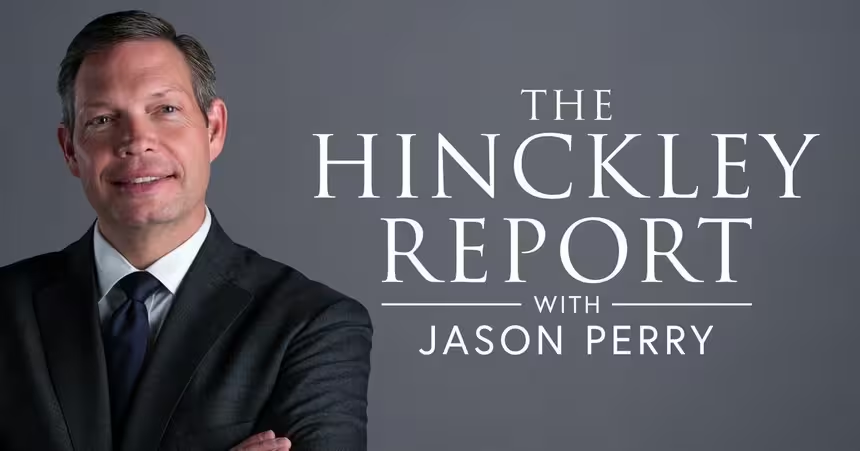
The Hinckley Report
Hosted by Jason Perry, each week’s guests feature Utah’s top journalists, lawmakers and policy experts.Providing Support for PBS.org
Learn Moreabout PBS online sponsorshipJason Perry: On this episode of "The Hinckley Report."
Week two of the legislative session is in the books, and funding priorities come into view.
A near record number of bills are filed and are debated.
And national headlines ripple across Utah.
announcer: Funding for "The Hinckley Report" is made possible in part by the Cleone Peterson Eccles Endowment Fund, and by donations to "PBS Utah" from viewers like you.
Thank you.
♪♪♪ ♪♪♪ Jason Perry: Hello, and welcome to "The Hinckley Report."
I'm Jason Perry, Director of the Hinckley Institute of Politics.
Covering the week, we have Representative Paul Cutler, a Republican from Centerville; Representative Sahara Hayes, a Democrat from Salt Lake City and House Minority Assistant Whip; and Doug Wilks, executive editor of the "Deseret News."
Thank you for being with us as we end the second week of the legislative session.
A lot to get to--the funding, we're going to talk about the priorities, but I want to start with something that's happening nationwide and certainly here because it's so timely today.
But I'll start with you, Doug, if that's all right, for some context on this.
So, incidents happening with ICE.
There's, across the country today, some walkouts, some protests, some boycotts, including here in the state of Utah, which I think maybe we will be seeing throughout the weekend.
Doug Wilks: Yeah, obviously this has been the story of the week or two weeks about the reaction to ICE being in Minnesota, which started with allegations of fraud and some misuse of funds in Minnesota by immigrant community members.
So, what we had happened, though, that everything escalated, there was violence, there was death, and now it's kind of--they've tried to turn down the temperature a little bit, Donald Trump with a call to the governor of Minnesota.
And also, the backdrop to all that is funding for ICE.
So what we're seeing now is maybe a pause to see what needs to happen, and there may yet be a drawdown of officers from, of Homeland Security officers from Minnesota.
We'll see.
Jason Perry: Representative Cutler, talk about this from your perspective as well.
This immigration issue was one that President Trump was touting.
This was a campaign issue.
Talk about what's happened from then to now.
Rep.
Paul Cutler: It is.
People want the border to be secure and closed, and we have a secure, closed border now, which is important.
People have high expectations for law enforcement officers.
In our local communities, we give them incredible power, and we trust, and we hold them to a high standard.
And federal officers should also be held to a high standard if they're doing law enforcement.
And so I think people are concerned about what they're seeing and the behavior that they're seeing.
And we need to have a conversation about what is the standard that all law enforcement, national or local, should be held to?
Should they--what should we expect from that?
What are the rights that everyone deserves?
What if the tables were turned, and they were going after, you know, your people, a different crowd, a different political view, would we feel differently about this?
Jason Perry: Representative Hayes, talk about this, because we had elected officials from all sides of the aisle, from across the state, from Moab to Logan, weighing in on this particular issue as well.
Talk about how it's being perceived and if there are some, maybe some changed perceptions or not on this issue.
Maybe just speak to Utah in particular.
Rep.
Sahara Hayes: Sure, I think the thing that I keep seeing and that I keep hearing is that people are scared, and so there's so much debate, especially with the shootings that happened, about whether it was justified or not.
And that's all very well and good, but it's still impacting people's lives today.
People are scared to go to school.
People are scared to go out in public for fear of what will happen to them or their family members.
And that is--I don't think anybody wants that.
We want people to be safe.
We want people to feel valued in society, and we want to value them in turn.
So what I'm hearing is fear, and I think we need to take that really seriously.
Jason Perry: Doug, we did some polling with you and the "Deseret News," and this was in January.
I want to put this in context.
It was before the shootings in Minnesota.
I just want to get your sense of what you're hearing and seeing.
The question was, "Do you approve or disapprove of the deportation methods by ICE and Border Patrol?"
In Utah, 41% said they somewhat or strongly approved, 53% said somewhat disapprove or strongly disapprove.
Put that in context from then and now and what you're hearing.
Doug Wilks: I think there needed to be a reset.
I think people were saying, "Yes, we needed the border to be closed," and the border's closed, so what do you do now?
Then the administration said, "We need to deport those who are criminals."
And even Governor Cox talked about the 200 plus that were in Utah's prisons.
Should they be deported?
And then you started seeing, well, the actuality was others were being approached, this fear.
You didn't know if you're driving a car and you're going to be approached.
And then there's some instances of those who in Minnesota were taken.
They were evaluated in Texas, and then said, "Okay, you're good."
But you've gone through this process when you don't even know if you're going to be kicked out of the country.
So all those things now have come to a head, and there seems to be a reset with where we go forward.
Homan has now gone to, with Homeland Security, has gone to Minnesota.
And even Governor Cox, who was at Harvard University this week speaking about this, said, "Look, there's been a change with the administration."
And he spoke about that at Harvard.
Something different happened because everyone says, "Look, whoever's to blame, this did not go well, and an American citizen is dead and others."
So, this reset is a really important, crucial time, and it can be bipartisan, right?
Something different has to happen.
Jason Perry: Representative Cutler, as you think about your constituency and the people who are talking to you, is the position changed a bit on immigration, or is it mostly the implementation or what's happened and how it's going, the administration is going about it?
Rep.
Paul Cutler: I think everyone agrees we need to follow the law.
Immigrants need to follow the law.
Protesters need to follow the law, but what we're seeing is fear and concern.
And everyone needs to take a step back and think carefully about how they're acting.
If we follow the law, we have a right to protest the government.
We also have an expectation that people will follow the laws that are on the books.
Both need to happen.
Jason Perry: Well, this issue is getting into government, federal government, and Representative Hayes, let's talk about this for just a moment, because this very issue seems to be at the heart of the reason why there's a potential government shutdown.
I guess, we have to have until tonight to find some kind of compromise on this issue, but there may be some efforts to forego the shutdown that may have happened by tomorrow.
Talk about that for just a minute, how this plays into it.
Rep.
Sahara Hayes: Yeah, I think that nobody wants to go through another government shutdown.
We just got done with that.
I followed a girl on social media who had to start an account to try to be an influencer because she wasn't getting paid, and she needed to make rent.
So we want to avoid this outcome as much as possible.
And that being said, I'm glad that there are negotiations that are happening because this is a serious issue, and the fact that discussion is happening means that there's the potential for change.
And we do need the status quo on this to change, so I hope that they come to a good compromise.
Jason Perry: Doug, before--oh, go ahead.
Rep.
Paul Cutler: Congress has been--the great news is, Congress has been doing their job in passing these appropriation bills.
The House passed theirs.
The Senate was so close before we had this blow up.
So, I'm hopeful we'll get back to regular order and pass appropriations bills, like it's their job to do.
Jason Perry: Doug, a lot may change over the next several hours here for this weekend, but it sounds like there might be some efforts to keep much of government open while they work through this last remaining issue.
Doug Wilks: Yeah, there is a willingness-- I don't know at this moment where it is--but to kind of carve out homeland security, keep the government open, and then let's spend a few weeks, I think till mid February, trying to determine what should be the budget for that.
And I think that hinges a lot on what happens next, in terms of how, the approach for homeland security.
You know, one thing is you try and do a one-size-fits-all, and it doesn't really work.
If you cross the border illegally, you know, that's a certain crime.
If you overstay your visa, that's a different statute.
If you have something in court, but you miss your court date, that's something different.
So to kind of wrap everybody in the same bucket, and someone who's been here for 25 minutes and someone who's been here for 30 years, it's very difficult to get every movement correct.
So, trying to fix immigration for decades, both parties, and it's been unsuccessful.
So at the end of the day, if they can make movement on this and get something going that both parties and Americans can live with, then that would be a good thing.
Jason Perry: I want to keep talking about money because-- so what you all are doing this week with the legislature in particular.
So, as I'm taping this Friday, and this is the deadline for all the requests for appropriation.
They all have to be in today.
Representative Cutler, will you give us a start on this?
Explain for our viewers what this process is, and the list is long.
Rep.
Paul Cutler: It is.
Everybody has something they want from the government.
But, so everyone puts in their request for appropriations.
There's a lot more requests than there is money to spend.
And then we go through and talk about those and prioritize those.
There's one very important point that we do different in Utah than they do in Washington.
At the beginning of the legislative session, we pass a base budget, a minimum budget to keep the government operating no matter what.
So we are never in this situation where we're arguing at the very end where time is running out, and that's the Utah way, to be responsible and keep things moving forward.
Jason Perry: Representative Hayes, talk to us about this sort of by subject and by committee, how the prioritization process goes after this Friday, because this is where you see all sorts of very interesting asks.
Some probably going to rise, a few maybe not.
Rep.
Sahara Hayes: Sure, to be clear, I love the RFA process.
I think that it represents all of the best pieces of the state, because you have all these wonderful organizations that are doing so much work for our communities, and so you want to support them all and you want to help them all because they're helping your constituents.
And then you can't, and that kind of sucks.
But what happens is everybody will submit their requests, and they'll go to their appropriate committees.
So I serve on the Higher Education Appropriations Committee, so we hear requests that have to do with higher education or with organizations that touch higher education, but it goes that way by committee.
The committees will then have a prioritized list of the recommendations that they heard that they'll send to Executive Appropriations Committee.
And then Executive Appropriations is gonna, they might leave it as is, or they might, you know, do a lot of shuffling.
Jason Perry: Yeah, we'll watch that closely.
That committee certainly has a lot of influence.
All right, everyone has a priority.
Rep.
Paul Cutler: And you can count on some shuffling going on.
Rep.
Sahara Hayes: There's gonna be some shuffling.
Jason Perry: Some of us are counting on that.
A lot of this relates to, Doug, what's happening with our tax base here in the state of Utah.
And it's interesting, Senator Dan McCay, Senate Bill 60, which passed out of committee this week, is going to lower income tax.
This is down to 4.45% from 4.5%.
As we're talking about a flat budget this year, it's interesting that we still have this conversation.
Doug Wilks: Well, you know, over the past few years, the legislature has been successful in lowering the income tax, which I think people are very happy about.
This year, with President Trump's so-called Big Beautiful Bill, those savings, was it $400 million about that would have maybe come to Utah is not coming to Utah, so you do start with less.
So whether the federal government passes along or Utah, it makes it a little harder to make the priority decisions they're talking about.
So not everyone is actually wanting a lower income tax this year because, again, you're trying to say, "Well, what are the priorities?"
Education certainly is a big one, and some of the others: safety, public safety.
But that lack of, or that change from federal to state really had an impact this year.
Rep.
Paul Cutler: It's going to be a real challenge because the Big Beautiful Bill lowered the AGI that everyone, that Utah levies taxes against, so everybody is getting a tax cut based on the Big Beautiful Bill.
Less money coming to the state means less money that we have to do a tax cut with, so this will be particularly challenging this year.
Everybody wants a tax cut, but the budget isn't there that we had because of the federal action.
Rep.
Sahara Hayes: You said everybody wants a tax cut.
I don't agree with that, actually.
Rep.
Paul Cutler: Okay, we're happy to raise your taxes.
Rep.
Sahara Hayes: I think that we really need to weigh the balance of a cut versus needed services.
And for me, the scales of, "Do I want $50 back in my pocket?"
Versus, "Do I want to provide support and a safety net for people?"
It balances out towards helping others, and I think it's important to note that, since 2018, we've cut $800 million in taxes here, and so we would probably not be in the position that we are today of having to really rank, to ask institutions to make cuts if we hadn't done those choices in the past.
So I would be very hesitant to look at another tax cut this year.
Doug Wilks: Well, part of that process, though, is going through and asking every department, whether it's education or otherwise, "Hey, what would happen if we had to cut your budget by 5%?"
And so rather than just have the legislature go through and say, "Okay, we're going to cut it," it's not a horrible process to have the institution come back and say, "Okay, we could do this, this, and this, but you're just going to have a steep cost."
I mean, private enterprise certainly does this every year.
You have to justify your own budget.
We certainly do.
So what the outcome of that is, I think, is where you, I mean, that's why you're in the legislature, right?
You have to weigh it.
Rep.
Paul Cutler: This is a healthy exercise to go through and say, "If you had to cut, what would you cut?
What are the most important programs?
What are we having success with, and what is not performing as well as we would like?"
Doug Wilks: There is one difference, though.
I think last year--philosophy gets into it, right?
I mean, University of Utah had to justify, "Why is this program here?
Why is this program here?"
So now you go through that progress, and I thought the University of Utah--just to give you a compliment, I think Taylor Randall and your group is just phenomenal in how you handled that.
So this year, well, what is it?
Is it about money or is it about programs?
And so, and you have to keep the trust so that it doesn't turn totally political.
Rep.
Paul Cutler: It's going to be a challenge.
Jason Perry: Let's talk about some money in the pocket or not that is also political.
Representative Cutler, let's talk about this gas tax.
All right, so we don't have a bill yet, but we had a lot of conversation about a bill that we haven't seen yet.
Talk about this.
The gas tax in Utah is $0.385 cents, about maybe the fourth highest in the Western states.
But this potential bill, and you're going to fill us in on what this is, it's a tax with an exemption for fuel that is exported out of the state of Utah.
And it's that particular part we're talking about.
The gas tax goes down.
You can explain it maybe better than me, but the tax would move to the refineries, the producers.
Rep.
Paul Cutler: We hear the concerns about the cost of living, and energy, gas, is a big part of that.
Currently, Utahns bear the cost of refining gas for most of the Intermountain West.
We have most of the refineries.
We bear the environmental costs.
We bear the infrastructure costs, et cetera.
But that gas is taxed at the retail location, not at the point of refinery.
So we think it's a conversation worth having: should those costs be shared among our neighboring states?
It's also amazing political theater.
We're saying, "Hey, we want to share these costs with you."
Idaho has gotten very upset about that.
We've got some Speaker on Speaker political theater going on.
They're threatening to put an export tax on their potatoes or hold water from the Great Salt Lake.
You know, are we going to be paying more for tater tots because of this?
I don't know.
Jason Perry: Go ahead, Representative.
Talk about this one from your side of the aisle, because we're expecting we may see something soon.
Rep.
Sahara Hayes: Sure, and I--listen, there's a lot of issues facing Utahns today.
I don't think this is the highest one, but I do think it is facing the West, and so I think this needs to be a conversation that takes place beyond just our state's borders.
Representative Cutler was just talking about it.
I mean, this is impacting other states that are neighbors to us, and so I think we need to approach this from a regional perspective, not necessarily a state perspective.
Rep.
Paul Cutler: Things have regional impact.
California is shutting down refineries.
That means there's more demand for the products coming out of Utah, raising the prices for those.
And should Utahns pay the price for our neighbors' decisions, political decisions?
Jason Perry: Doug, it's interesting, as was just mentioned, is it has created a pretty quick response from legislators in Idaho, some even in Wyoming, resolutions being talked about, floor debates being talked about, the action here in Utah and its implications.
Doug Wilks: Well, we have had such a conversation in the past year about tariffs, right?
A tariff for Canada, a tariff for our allies, partners, and others, and they go up, and they come down, and it's a negotiating tactic.
I don't know that this is a negotiating tactic.
I don't think it's the same.
But if you look at here's what we're doing in Utah, and we really would like Idaho, Wyoming, others to pay a steeper price, there's no question they will then come back and say, "Well, if you're going to take millions out of our state, we have to have--our people need to buy groceries, too," so where can they go and do that?
And if it's potatoes, then that might come back.
The bottom line to all of this is, fundamentally, the way we shop, tax, you live, our housing prices went way up, sales tax totally changed because everyone started buying online and not the brick and mortar, so the law had to be reassessed.
So the whole financial model shifts, and I think we're still looking at that, whether it's gas tax, sales tax, property tax, income tax.
So it's a battle every year, just because of the speed by which the economy changes, and Utah is still number one, which is pretty outstanding.
Rep.
Paul Cutler: It is.
Jason Perry: Since you mentioned, Doug, mentioned this property tax, let's take just a moment on Representative Jill Koford's bill that will be lowering property, residential property tax.
And let's talk about what that will do and the potential impacts on other sides of the ledger.
Rep.
Paul Cutler: I commend Representative Koford for bringing up this really tough issue.
Over the last 10-15 years, the property tax revenue has shifted from more commercial properties, which used to be high value, to residential properties.
Utah builds the biggest homes in the nation on average.
Our homes are bigger.
They're more valuable, so the burden has shifted from commercial to residential.
Representative Koford has brought up, "Should we shift this back?"
We're not gathering more tax, but should commercial owners pay more so residential owners can pay less?
Should we be incentivizing home ownership, allowing people to stay in their homes?
And it's an important thing to weigh.
We want to support our businesses, but the home is so important.
That's--your home is your castle.
We need to keep people in their homes, and I think it's a conversation worth having.
Where should that balance be between commercial and residential?
And the other important point is, should non-owner occupied homes pay a different rate?
We have concerns about corporations that own homes.
Why should they get a residential exemption if they are a commercial business that is renting out that home again and again?
It's a conversation worth having.
Jason Perry: Representative Hayes, maybe give us some comments on that on this conversation, because there are corresponding impacts.
You lower it in one place.
Does it pop up in another place?
That's kind of what this discussion is right now, I suppose, among many other things.
Rep.
Sahara Hayes: Sure, and I'm so glad that the conversation is being had, and this is an issue that I don't actually know where I'm going to fall on it.
But I'm so glad that we're in a place where we can discuss it, because this does matter to people and affordability matters to people.
I hear about cost of living all the time from my constituents.
And especially from people on fixed incomes, I think this could be incredibly beneficial.
So, I'm very glad that we're moving in a direction, even if I'm not quite sure where it's going to end up yet.
Jason Perry: We'll watch this one closely.
A lot of people are.
Doug, I want to get to some bills on the judiciary.
Your paper's written great articles about this, and I want to get to just a couple really quickly with your comment on it, because we knew there would be legislation with the courts.
But one of them is creating this new three-judge constitutional court, a court that has exclusive jurisdiction over these constitutional issues.
Doug Wilks: Well, clearly, the legislature, both the House and the Senate, have determined that the judiciary, structuring the judiciary, adding judges or not, is a priority for this session.
This, adding this constitutional court is--it's quite an issue to explore because you're saying that "Okay, we're going to have these three judges.
Everyone will know who these three judges are, but someone has to make a determination to take a case into that judge."
And you can say, "Well, those that deal with the Constitution, we'll put there."
But if you have judges who you perceive to be favorable to your position, you're going to try to find a reason to take a court case to those three judges, and so that's a worry for some people because, well, who's going to make that decision, and is this gaming the system?
And time will tell whether that's the case.
But when you have a new judiciary like this, it's something to watch.
Rep.
Paul Cutler: Jason, we're early in this discussion.
It's a new bill.
It's a new idea, but I think it's worth considering.
Today, a case goes to one district judge, supposedly at random, and you get that judge's perspective and opinion, one person.
We would never do that on the legislative side to say, "Okay, one person gets to make the decision."
We have a panel or we have a council.
We have a group.
So the question is, if we had a three-judge panel, would we get more consistent decisions on these issues that are most important to the future of our state?
And I think it's worth considering.
It's important to understand how we choose these judges.
It needs to be done in a fair manner.
And my understanding is there are active discussions going on between the governor and the judiciary and the sponsor of the bill to see if we can find an agreement on how to move forward on this.
So, I'm not dismissing it yet.
I think it's worth pursuing and worth talking about to see if we can find something that works for everyone, but we need to get the judiciary on board that this is a good idea.
It's been used in other states.
We've heard positive things.
It needs more discussion and more investigation.
Jason Perry: Representative Hayes, just give us a view from your side of the aisle.
And right along with Senator Chris Wilson's bill, this is House Bill 134, it did pass out of the Senate's and the House now, that increases the number of judges: three justice courts, three justices in the district courts, two to the Supreme Court, two to the appellate courts.
Give us your perspective on this.
Rep.
Sahara Hayes: Oh gosh, so I have very different takes on this than my good colleague here.
First of all, I think the idea of handpicking judges that will hear cases on bills that--on cases that talk about bills that we ran, I think that's very problematic and a big red flag for me on the first bill we were discussing.
The second, I think, is a little bit more of a mixed bag.
The Supreme Court has indicated that they need more district-level judges, and so I'm glad that this bill is giving that to them.
However, it's also increasing seats on the Supreme Court.
And I think if you zoom out and look at--you don't even have to zoom out far.
Like there has been a lot of tension between the judicial and the legislative branches recently having to do with the legislature disagreeing on how they decided cases pertaining to our bills.
And so I think it is really difficult to take the environment that this is happening in out of the context.
I can't see this as being anything other than political based on the discussion that's been happening.
Rep.
Paul Cutler: Jason, we've been talking about expanding the courts for some time.
Every year there's a request to expand more.
This year, the courts have asked for eight new lower-level judges.
The Senate, which has advice and consent power, they want two new Supreme Court judges.
Each new judge comes with clerks and staff, costs between half a million and $800,000, roughly, for a new judge and all the staff and operations.
So part of this is a budget constraint.
How many can we afford?
Everyone agrees we need more.
I think we'll end up somewhere in the middle.
We'll have more lower-level judges, plus the Senate really wants those two Supreme Court judges.
There's room for negotiation here.
Jason Perry: Doug, I want to get to one really interesting bill this week dealing with the Great Salt Lake and water, a very interesting development.
The state planning to buy US Magnesium, $30 million, and it is going to generate over 144,000 acre feet of water.
Doug Wilks: Well, I think so much attention has been given and discussed about the Great Salt Lake.
We're having a bad water year so far, and so it's--you can't stop the momentum.
And when this opportunity came up, you know, they're saying, "Look, we can't--this is a lot of money, but we can't forego this opportunity to get those water rights and to help with the Great Salt Lake."
So I think it can be bipartisan to fill the lake, and how do you do that?
This is one way to do something tangible.
So, a lot of people are looking at this as a very positive thing.
Rep.
Paul Cutler: This is a great move.
This is fantastic.
It's a way--we've got the equivalent of the Deer Creek Reservoir of earth of water rights.
And US Magnesium in the past has proven not to be a great community partner in terms of cleaning up the environment, so this is a win-win for everybody.
We're going to have more water for the lake and get a more environmentally-sound environment there.
Jason Perry: Go ahead, Representative.
Rep.
Sahara Hayes: I'm just so excited.
You guys, I hear so much about how people are worried about the lake, and it's like we keep nibbling around the edges of the cookie and trying to get there, and this is actually a big bite.
This is actually going to do something tangible.
It is going to help.
It's going to help keep us from breathing arsenic in a few years, which all of us want, and I'm so excited.
Doug Wilks: I think we all agree.
Jason Perry: Everyone agrees on this one.
We'll be watching this one very closely.
A lot to come on water bills and others during this legislative session.
Thank you so much for your insights this evening.
We'll continue to monitor closely.
And thank you for watching "The Hinckley Report."
This show is also available as a podcast.
Thank you for being with us.
We'll see you next week.
announcer: Funding for "The Hinckley Report" is made possible in part by the Cleone Peterson Eccles Endowment Fund, and by donations to "PBS Utah" from viewers like you.
Thank you.
♪♪♪

- News and Public Affairs

Top journalists deliver compelling original analysis of the hour's headlines.

- News and Public Affairs

FRONTLINE is investigative journalism that questions, explains and changes our world.











Support for PBS provided by:
The Hinckley Report is a local public television program presented by PBS Utah
Funding for The Hinckley Report is made possible in part by Cleone Peterson Eccles Endowment Fund, AARP Utah, and Merit Medical.