
2026 Legislative Session Begins
Season 10 Episode 19 | 26m 48sVideo has Closed Captions
Lawmakers begin crafting policy as Gov. Cox outlines his goals for the state.
With the 2026 Utah Legislative Session officially under way, our expert panel examines how lawmakers are pushing for their priorities. It's expected to be a tight budget year, so how will that affect things on Capitol Hill? Plus, Gov. Cox delivers his annual State of the State address. Political insider Kate Bradshaw joins journalists Ben Winslow and Dennis Romboy on this episode.
Problems playing video? | Closed Captioning Feedback
Problems playing video? | Closed Captioning Feedback
The Hinckley Report is a local public television program presented by PBS Utah
Funding for The Hinckley Report is made possible in part by Cleone Peterson Eccles Endowment Fund, AARP Utah, and Merit Medical.
2026 Legislative Session Begins
Season 10 Episode 19 | 26m 48sVideo has Closed Captions
With the 2026 Utah Legislative Session officially under way, our expert panel examines how lawmakers are pushing for their priorities. It's expected to be a tight budget year, so how will that affect things on Capitol Hill? Plus, Gov. Cox delivers his annual State of the State address. Political insider Kate Bradshaw joins journalists Ben Winslow and Dennis Romboy on this episode.
Problems playing video? | Closed Captioning Feedback
How to Watch The Hinckley Report
The Hinckley Report is available to stream on pbs.org and the free PBS App, available on iPhone, Apple TV, Android TV, Android smartphones, Amazon Fire TV, Amazon Fire Tablet, Roku, Samsung Smart TV, and Vizio.
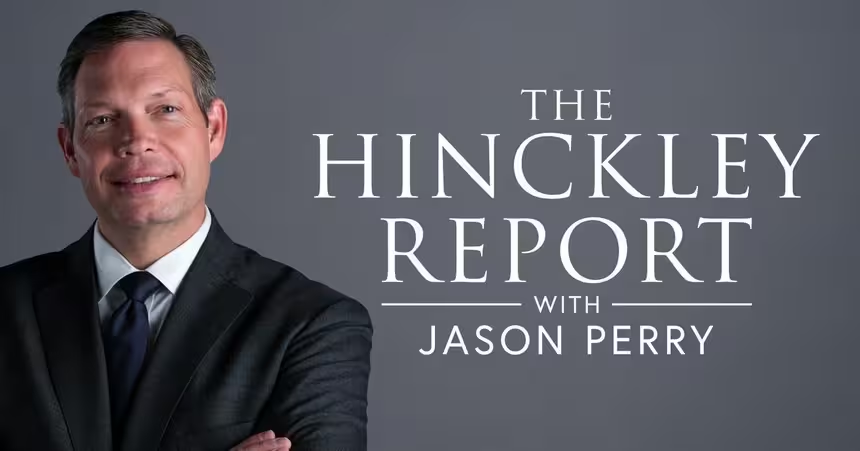
The Hinckley Report
Hosted by Jason Perry, each week’s guests feature Utah’s top journalists, lawmakers and policy experts.Providing Support for PBS.org
Learn Moreabout PBS online sponsorshipJason Perry: On this episode of "The Hinckley Report."
The 2026 legislative session kicks off as bills are drafted and legislators push their priorities.
Funding requests are heard as lawmakers look to tighten budgets.
And Governor Cox addresses major issues in his annual State of the State address.
male announcer: Funding for "The Hinckley Report" is made possible in part by the Cleone Peterson Eccles Endowment Fund, and by donations to PBS Utah from viewers like you.
Thank you.
♪♪♪ ♪♪♪ Jason Perry: Hello, and welcome to "The Hinckley Report."
I'm Jason Perry, Director of the Hinckley Institute of Politics.
Covering the week, we have Kate Bradshaw, Mayor of Bountiful City; Dennis Romboy, editor and reporter with the "Deseret News;" and Ben Winslow, reporter with "Fox 13 News."
Thank you so much for being with us.
We just finished the first week of the legislative session.
Does it feel like four days?
Ben Winslow: No, it feels like four weeks.
Jason Perry: Well, it's just about to get going, isn't it?
It's so interesting, as we look at the beginning of the session.
It starts with a lot of ceremony, and it starts with some speeches.
And this week we got to hear from, well, all three branches of government as we start the legislative session.
And Kate, let's start with you for just a moment.
Congratulations on your election, Mayor, glad to have you with us.
Let's start first with the Senate, because President Adams opens his session with the Senate with a little bit of vision.
Talk about that, and then I want to go down, talk about the House, and then we'll get to the State of the State speech that happened last night.
Kate Bradshaw: Sure, so Senate President Stuart Adams opened, and he was doing a little bit of forecasting of what he thinks the big issues are for our state and how we need to stay competitive.
So, he was talking about AI, he was talking about critical minerals, and he was forecasting that he thinks these are the issues about how Utah stays on top from an economic perspective.
He's very proud.
To listen to Stuart Adams speak is to make sure that you know that Utah is number one in a variety of categories.
And he wants us to stay that way, and he sees that path through some of these critical infrastructure: energy, AI, critical minerals aspects.
And so he was very much forecasting in his speech that those are the issues he wants his colleagues to be focused on and working on so we maintain that number one standing.
Jason Perry: Dennis, we had this a little bit even in the House.
The Speaker, when he gave his speech, he talked about someone, you know, some of us started googling, "Good Roads" Roberts was who we talked about.
Someone who was really responsible for the early days of the road system here in the state of Utah.
This idea that the legislature should be, that this was sort of the imagery, you know, planting the trees now that someone else will enjoy later.
Talk about that really future-looking aspect of this session that we got from, it sounds like, from President Adams and from Speaker Schultz.
Dennis Romboy: Yeah, I think a lot of this is looking ahead.
Transportation is obviously a perennial issue.
I didn't hear a lot of talk about water, but that's an issue.
And we'll get into the affordable housing looking ahead, try to solve that issue.
Homelessness, I think a lot of these speeches kind of do forecast what the state should be looking at here coming in the future.
How they can address all those immediately remains to be seen.
Jason Perry: Please, give us your take on these two speeches, Ben.
You followed these for a very long time, and sometimes the House and the Senate are in sync.
Sometimes they start that way.
Some of the issues divide them a little bit.
Talk about right now how you see the overlap of some of these priorities that we heard.
Ben Winslow: Well, clearly they're trying to set this agenda that they are looking beyond this next legislative session, that they are looking, you know, 10 years, 20 years, 30 years, 50 years, 100 years out.
They want to say that they are setting these policies for future generations to benefit from.
That was very much what we saw in both of these speeches, you know, just focusing on things like energy and critical minerals, as Kate mentioned.
You know, just this idea of we need these things for future generations.
Nuclear power was another thing I heard invoked, and you know, obviously the state is going very big on that as an energy source, you know, while dealing with this unprecedented growth that we still continue to experience.
Jason Perry: Please, Kate.
Kate Bradshaw: It's interesting, you know, the Speaker in his speech in particular, in talking about "Good Roads" Roberts--who we all, you know, learned about thanks to it--but he was telling his story about how his colleagues and some of the residents kind of ridiculed him at the time for not having that vision.
And I think the Speaker was very much trying to tell his body and his colleagues some of these things are going to be really hard for us to do.
Some of them are going to feel, perhaps, challenging to fund, or they're going to feel like, "Why now?"
And you know, forecasting, you know, these are going to pay off later, but they're going to be a little bit hard for us to accomplish right now, and asking his colleagues to be ready to stretch, and so that was very much part of the Speaker's theme.
Jason Perry: Yeah, so Ben, I want to pick this up for you as well because the long-term policies are not something you often get people diving into with short-term election cycles.
Ben Winslow: Exactly, and you know, there's going to be a lot of interesting bills this session.
And this is maybe a little bit of a forecasting of where things go because, obviously, you have leadership here with the Speaker and the Senate President talking about these long term things, and you have bills being introduced that are very much for, you know, reacting to what is happening now.
And that's just going to be the tension that we see play out over the remainder of the legislative session.
Dennis Romboy: I think AI is a good example of that.
The state has already passed laws regarding AI.
It looks like there might be more on the horizon.
And to see how those jive with what the federal government's trying to do, what the Trump administration has said about AI and the directive there, whether those things are going to mesh or not.
President Adams seem to think that the state can work with the federal government, might be ahead on some of these issues regarding AI, and maybe Utah can kind of be a model for some of those types of laws.
Jason Perry: Of course, the policies that we heard about in these speeches translate into bills.
And Kate, it's interesting, give us a little update, because we're about to have a record number of bills.
Kate Bradshaw: You know, we are.
We are tracking just 38 bills as of today off of the record pace for bill file requests, and it's probably a good bet that they will exceed that.
And that's been a major theme of the last few years, is they're introducing and passing more bills than they historically ever have in a 45-day session.
It's something the Governor raised with them at the close of last session, that perhaps some of these things could be an email or a phone call or a discussion with various agencies over the course of the interim.
And it was something that he raised, of course, in his State of the State, again, letting them know that this pace, you know, perhaps is a bit much.
Jason Perry: Yeah, it's so interesting--.
Ben Winslow: And there is a bill to deal with bills.
Jason Perry: Talk about that for a second because it is interesting.
This gets right into the State of the State.
It's interesting that Governor Cox did say, "Maybe too many bills."
Ben Winslow: Right, and he also said, "Maybe this bill could have been an email."
You know, it--Representative Clint Okerlund has a bill to limit the number of bills.
The governor did give him a little bit of a shout out.
I talked to Representative Okerlund, who wasn't sure if he was getting roasted by the Governor or if that was an actual endorsement, but he certainly was hoping that his bill to limit the number of bills gets legs this session.
Dennis Romboy: What's interesting is we have a 45-day session.
And I don't know, maybe Kate knows, how many bills are actually passed in the last few days or few hours of that session?
There's always a mad rush at the end, and I don't think the bills get the treatment, the public hearings, the discussion, the debate that they need sometimes because there are so many of them, they're rushing to get them all passed, and it happens up until midnight on the last day of the session.
Kate Bradshaw: You're right, the graph shows as you go across the session weeks of the session that the vast majority of bills pass at the end of the session.
And there's also some interesting stats that that are that come out at the end of each session about how many minutes each bill gets on the floor.
And so it used to be that in our 45-day session, which is actually only 33 working days, that the carrying capacity was kind of 500-ish bills, but we've been ticking above that, closer to 600 actually passed.
And so the amount of time the bill spends being actively debated, in that back and forth, having those rough edges worked off through the process, the process that we've designed, has gone down.
And so these things that the Governor and Representative Okerlund have pointed out with his bill are real factors.
Jason Perry: Let's get to the State of the State for just a moment from Governor Cox.
We have some themes over his years as governor.
This is a chance to be in the chambers talking to his former colleagues, when he was a member of the legislature.
And Ben, I just wanted to break down some of the themes because there's a lot about virtue, a lot about self-government, and sort of this great American experiment part of this speech.
Ben Winslow: Yeah, it was a little bit of a civics lesson here.
You know, the Speaker and the Senate President had a very forward-looking speech.
His did a little bit, but it was also very looking back, and Founding Fathers, invoking a lot of that, talking about virtue, character, and really an appeal to people's better angels.
He kind of called out divisiveness in America, both political parties, you know, and this idea of like outrage and perpetual outrage online, things like that.
He also did get into policies, pushing his child literacy initiative, you know, going after one of his favorite targets, which is social media companies, you know, just pushing some of his other, the housing and homelessness initiatives that he's got out there.
So he definitely still laid out what he wants to see the legislature accomplish, while also just kind of saying, "Everybody needs to take a breath."
Jason Perry: Mm-hmm, Dennis?
Dennis Romboy: We've also learned he really likes Calvin Coolidge.
Jason Perry: Wow, yes, one of his favorite presidents.
Dennis Romboy: Who knew, right?
Yeah, I mean, Calvin Coolidge as a legislator, was a governor, became president.
Spencer Cox was a legislator, a governor, name's come up a time or two to run for president.
So yeah, I don't know.
Jason Perry: Okay, there you go, Dennis.
For just a minute, Kate, let's talk about some of these priorities, and Ben mentioned a few of those: literacy, housing, homelessness.
These were key parts of it, but it's interesting sort of the framing.
He called literacy, you know, "It's a moral infrastructure."
That was what I thought was interesting.
He talked about Utah cannot be a state of renters.
Talk about that for just a moment, because these are big policy objectives.
Kate Bradshaw: Yeah, so there's been some interesting studies that have come out and data that our youth are not reading where they should be by the third grade level, and so there's a number of different policies the legislature is going to consider, and the governor has obviously made this a prime focus that we need to get back on track.
You know, this was a focus about 15 years ago with a different governor, and we made progress, and then perhaps--it'd be interesting to study this out more--if the pandemic impacts have had us falling back.
And so the emphasis is going to be, how do we get kids reading, and is it going to be additional funding, additional training?
There are discussions about, you know, whether there's an effort to hold kids back if they're not, because it's such an important, foundational, critical thing that builds on everything else if you're not reading at grade level.
So that was clearly an opening focus for the governor, and he really led strongly with that.
He definitely cares deeply about affordability and housing and wanting our kids to be able to stay in the communities they grow up in.
He spoke to local government officials both at the county level and the city level this week as well, and definitely, you know, charged local governments to continue to do more in that space.
And this is an interesting and challenging space, one I spent a lot of time in as a locally-elected official.
And one of the things we've asked for help from the legislature and the governor is there are 190,000 entitled units statewide that are ready to be built on, but they lack infrastructure.
Almost 88% of those entitled units are struggling for infrastructure, and so we've really asked the governor and the legislature to help us with that gap so that we can continue to make progress there collectively.
But the governor is very focused on it.
He raised it with local officials this week.
Jason Perry: Did he, now?
Kate Bradshaw: He did.
Jason Perry: Because Dennis, this gets to one of these big primary questions.
Maybe you can follow up on this, Kate, after too, but the legislature is talking about maybe getting into the zoning ordinance business just a little bit to try to stop this logjam that Kate was just talking about.
Dennis Romboy: Yeah, guess the state wants to come in and kind of tell cities and counties how they should zone, rezone, make it more easier--more easier--make it easier for builders to come in and build the homes.
You know, I don't know how that would work.
We're more about local control and letting local officials deal with these kind of on-the-ground issues like that.
I don't know if city officials appreciate the state coming in and saying, "Hey, we're gonna take over your zoning laws."
Kate Bradshaw: I can tell you that they don't.
I happen to also serve as President of the League of Cities and Towns this year, and so it's an issue I've spent a lot of time on.
And my city also just went through a general plan update process, and I can tell you those are interesting, important, vital conversations that you have with your community neighborhood by neighborhood about this place that we call home.
And the ability to shape the place that someone says "I am from" is a really important and powerful duty that local government has, and we have been working on this.
We have clearly heard the call.
Cities can always continue to do better, but we've heard that call, and we have moved through--there was a great bill on subdivision ordinances a few years ago to help streamline that process.
And so we've moved through these entitled units that are ready to be built on, but we have a pinch point.
I don't believe it's local zoning.
I believe it's this infrastructure gap, where often you need sewer, you need water, you need roads, yeah, power.
All of those are very expensive components that aren't necessarily going to be funded by the developers.
You're putting them on the backs of cities.
These are very import--expensive infrastructure components, and so we need help, and that's where we're asking for help.
And that's, I think, where the best of government comes from is when we collaborate and pool together and say, "Here's what we have done.
Here's where we are struggling.
Please come help us with this component."
Dennis Romboy: So, what's the solution to bringing water, power, infrastructure to these developments?
Kate Bradshaw: So there's a couple of different bills that are coming.
I think we'll see some legislation from Representative Cal Roberts, some additional funding tools and mechanisms and legislation coming from Senator Harper on allowing us to use tax increment in different ways to help fund these projects, and creating new revolving loan funds and things like that.
It's just been amazing, the growth of cost in some of these infrastructure projects.
To put in new sewer stations or new lift stations is millions of dollars, and that's what unlocks thousands and thousands of housing units, and that's where we really need help.
Jason Perry: Ben, I just want to get some context to this before we leave this issue.
You're so much in the community.
And we did a poll with Dennis Romboy and the "Deseret News" and The Hinckley Institute, and we asked what the top priorities were for this legislative session, what Utahans think they should be, and affordable housing is 32%, by far number one.
What I thought was interesting is the category of the Gen Z, the younger part of the state of Utah, that was a--37% of them said this is their number one concern.
Give us some context on that, because that's a big number from a young group that hopefully will be politically engaged for a long time.
Ben Winslow: The rent is really high, y'all.
I mean, that's basically what it is, is people--I talked to a housing advocate recently who said that to afford a modest two-bedroom home, or a two bedroom apartment rather, in the state of Utah, statewide average, you have to make about $29.29 an hour.
In some counties, it's as high as $30 or $40 an hour.
This is for a modest two-bedroom apartment.
So you can see where people are seeing this.
And then this is why we've also seen, with legislative leadership, this real push for affordability to address things.
They're, you know, talking about bringing the cost of housing down, groceries, obviously.
And this is Republican, Democrat, it doesn't really matter.
Everybody seems to be talking about affordability.
That's why you're also seeing some of these bills, like gas tax, and wherever they can attack this.
You know, just trying to drive costs down for people is, I think that's what you're seeing, is, you know, just to quote a famous saying, "The rent is too damn high."
Dennis Romboy: I wonder if we already are a state of renters.
When I drive around, I see a lot more apartment buildings going up than I do houses.
And maybe Kate could speak to that more specifically, but yeah, it seemed like a lot of multi-unit, big developments, apartment complexes are being built as opposed to single family homes.
Kate Bradshaw: Yeah, I would say that for the last decade or so, a lot of the legislative emphasis on zoning policies, pushing back on municipals, was to create density, and that led to a lot of rental properties.
And I think there's an argument to be made now that we've kind of landed where we need to be on that, and I do appreciate the Governor and a lot of legislative leadership that is pushing on small lot, single family-owned product, owned product being that really important keyword there.
And you know, that's where I think we need some of this help on unlocking, again, the infrastructure that will help us build those, but it's critically important.
The Governor definitely charged local government officials to, you know, look at our Gen Zers and say, "How are you going to help them stay in the community they grew up in?"
Bountiful is my hometown.
That's where I grew up.
I've never doubted that I could return and continue to live in Bountiful, and we need to make sure that that's a possibility.
And the small lot single family concept is, I think, where we need help, and I think we're seeing great collaboration between state leaders and local leaders on moving forward.
Jason Perry: Okay, I want to get to the other speech, the judiciary.
Ben--.
Ben Winslow: That was a "grab your popcorn" moment.
Jason Perry: It was.
Why don't you talk about that?
Because--talk about the context, where it's given, so Chief Justice Durant.
Please give us what happened.
Ben Winslow: Yeah, I think this is the closest we'll get to "Real Housewives of State Legislature," because this has been brewing for a while.
This--the legislative leadership\ and some in the legislature have obviously not been fans of some of the rulings that the courts have made: redistricting, abortion, other issues out there.
And you know, there's been these bills that have been discussed about this idea of, you know, reworking the courts.
In fact, there is one to expand the Supreme Court and the Court of Appeals, add some more judges, you know.
And you know, there's other bills as far as, you know, snap recall elections, things like that for unpopular decisions that, you know, some don't like.
And the Chief Justice decided to respond, very collegial, but you know, said, basically, "We don't go out there and put you guys on blast, you know?
Why are you putting us on blast?"
And he got a polite standing ovation.
I did notice some in the chamber did not stand.
But yeah, this has been a brewing battle for some time, and now we're seeing it finally kind of play out in public a little bit.
Jason Perry: Dennis, I'm gonna give that quote to you, and maybe give your comment, because this is in front of the legislature where he gave this.
This is Justice Durant.
He said, "I'm afraid judicial activism has become to mean 'a decision I disagree with.'
You will never read an opinion where we challenge your integrity or good faith.
I ask that you pass the same courtesy in challenging our decisions."
Dennis Romboy: Yeah, I think any judicial decision now, whether it's on the state level or federal level, if it's questioned, if it goes against you, then the judge is an activist judge.
That's nationwide that that's going on, I think, and I didn't expect that that would raise its head here in Utah, but obviously it has with these decisions that have been unpopular mostly with Republicans on redistricting, on the ballot initiative process, that kind of thing.
I think the judge, Justice Durant, is making a fair point about this, that they don't go after legislators and go in the public and say these kinds of things like have been said about them.
Kate Bradshaw: He had a great line as well in his speech that I really enjoyed about disagreement versus disparagement, and that disagreement is healthy.
The tension between the branches holds our entire system in check, so disagreement is healthy.
Disparagement starts to erode some of that trust in institutions and faith in the process.
And I'm someone who has a lot of great faith in the process.
I've watched a lot of local and state decisions become so much better thanks to a process, where we take those disagreements and use it as the sandpaper in the system to get to better things, and so I really appreciated Justice, Chief Justice Durant's comments.
And honestly, he had the demeanor for the moment.
He came in in a very calm and humble way to give this very important message, and I think he demonstrated what he was trying to say: "I disagree with you.
I have emphasis and things I need for the court system, and so I'm gonna ask you for them, but I'm not going to do it through a way where I disparage you."
Dennis Romboy: Maybe that was a model for disagreeing better.
Kate Bradshaw: Perhaps.
Ben Winslow: And they are giving it to them, maybe not in the way the judiciary would like.
I mean, there have been issues, to Republican leadership's point, there have been rulings that take forever.
You are waiting a very long time.
You are, you know, the process moves slow, whether it's by design or whether it is, you know, not.
You know, and so they're saying, "We're trying to give you these resources that you say you want, but it does come with some strings attached."
They are looking at expanding the Supreme Court.
The governor is supportive of that, you know, saying, "Look, you know, you guys need to get more rulings out there."
You know, and the Chief Justice did push back saying, you know, "Some of that was pandemic related, and we are trying to improve these things."
It looks like they are looking to give the judiciary, though, a little of what they'd want, but maybe not quite how they want it.
Jason Perry: Are these bills likely to pass?
It's everything from expanding the number of district court judges to expanding the Supreme Court from 5 to 7, which has been at 5 for 100 years in the state of Utah.
Kate Bradshaw: I think they are likely to pass.
I think there is probably some room for some discussion to play out for the remaining six weeks of the legislative session.
The courts have very much said, "Look, where we need help is the Court of Appeals.
We need help there, and we need some additional help with staff."
That's where they've identified their bottleneck.
Ben Winslow: And district court.
Kate Bradshaw: And district court.
And as Ben had pointed out, they think the bottlenecks may be at the State Supreme Court level and giving more justices there.
So, I imagine that they're going to have some really great conversations.
And whether it will shake out exactly as the bills are introduced, I don't know.
I did note and found this interesting, the Chief Justice was responding to a legislative concern about the lack of transparency into that branch of government, into the judicial branch.
And the justice announced several of the things they're doing to increase transparency, to increase the ability for people to understand the system, those that are, you know, attorneys and working in the system, their ability to engage and give feedback.
And I noted just, you know, last week there was an open house at the Matheson Courthouse where they're taking some of that criticism and acting on it.
So, hopefully that also leads to some positive discussions they're having on these various bills.
Jason Perry: Okay, let me take just a moment and maybe get a sense of the bills that you're following that you think will catch some headlines or some interest.
Dennis, can we start with you?
Dennis Romboy: Yeah, I have a lot of interest in sports and sports business, and looking at a bill that would require universities to get approval from the legislature to enter into a private equity deal to fund athletics, like the University of Utah is looking at doing here shortly, so that is of great interest to me, to see if there is an appetite for the legislature to get involved and have oversight over a private equity deal for the athletics department.
Jason Perry: Bill's been filed.
We'll follow that one closely.
How about you, Ben?
Ben Winslow: There certainly are some bills that do get headlines.
I'm always interested in the omnibus alcohol bill, seeing what happens with that; Great Salt Lake legislation, seeing what happens with that, chasing some of those bills.
Jason Perry: Talk about what that is for just a moment, because it's very important.
Ben Winslow: We've got a series of bills that are being introduced.
Obviously, the pause on water that the speaker had is off.
We've got a bill that just made it through a committee with a unanimous vote that would require data centers to report how much water they use.
That's been amended.
The bill will now require a public disclosure.
I'm not sure exactly what that looks like when it all shakes out, but that's still in the works.
You know, there's some bills about making sure the water that is conserved actually gets to the Great Salt Lake, just trying to find ways to make sure that the math is mathing, as it were.
I'm also interested in an issue that is happening in the middle of the session that has a little bit to do with the legislature, but not really, but it's the Colorado River negotiations.
There's a deadline, mid February, by the Trump administration.
"Get a deal, or we might start making decisions, and none of you may like that."
So, I'm keeping an eye on that because that could impact our legislative session as well.
The governor's going to DC next week to hopefully broker a deal with the other governors.
Maybe they'll get some consensus.
Maybe they get some agreements.
Maybe they don't.
But those are kind of the things I'm keeping an eye on.
Jason Perry: Okay, Kate?
Kate Bradshaw: Of course, I'm always interested in anything to do with municipal authorities, so local land use.
There may be some changes coming on the transportation and transit side and how we administer and fund those areas, so I'm very interested in tracking those.
And then I always, always, always get a great kick out of the bill that changes our list of state things, like trees and rocks, and there is a bill dealing with which operating system, whether you like green text bubbles or blue text bubbles.
Jason Perry: You're gonna have to explain what that means, you know, for those people who are divided on their phones.
Kate Bradshaw: Yes, so Senator Cullimore has introduced a bill that would make the state operating system the Android operating system.
He is wrong on this bill and on this point.
I've communicated that to him through several of the Mac versus PC commercials that we all enjoyed a decade or so ago.
But he is introducing that.
That's the same section of state code where we have a state tree and a state animal and a state rock, and so I don't know that this is serious legislation on his part.
It is one I intend to vigorously follow through the process.
Ben Winslow: He has said it will probably not get a committee hearing.
Jason Perry: It's true, it's true.
That's gonna have to be the last comment.
Thank you for your great insights, and thank you for watching "The Hinckley Report."
This show is also available as a podcast.
Thank you for being with us.
We'll see you next week.
announcer: Funding for "The Hinckley Report" is made possible in part by the Cleone Peterson Eccles Endowment Fund, and by donations to PBS Utah from viewers like you.
Thank you.
♪♪♪ ♪♪♪ ...

- News and Public Affairs

Top journalists deliver compelling original analysis of the hour's headlines.

- News and Public Affairs

FRONTLINE is investigative journalism that questions, explains and changes our world.











Support for PBS provided by:
The Hinckley Report is a local public television program presented by PBS Utah
Funding for The Hinckley Report is made possible in part by Cleone Peterson Eccles Endowment Fund, AARP Utah, and Merit Medical.